that substances and their mixtures are present in nature; how to create heterogeneous and homogeneous mixtures by combining different components; how to separate selected mixtures into components.
You will learn
to prepare solutions;
to indicate factors that may affect the dissolution process;
to explain which properties of water make it essential for human life and health.
When creating a mixture sometimes the particles of one substance are dispersed in another. Such process is called dissolution. If one substance completely dissolves in the other substance, a homogeneous mixture called a solutionsolutionsolution is created. Each solution is composed of a solventsolventsolvent and a solutesolutesolute (one or more). A solvent is an ingredient of a solution that is greater in volume and has solute particles evenly dispersed between its own particles.
Examples of solutions include:
sugar water – water is a solvent in this solution, whereas sugar is the solute;
sea water – water is a solvent in this solution, mineral salts and other components are solutes;
sparkling mineral water – it’s an example of a multi‑component solution in which mineral salts (solids) and carbon dioxide (gas) are dissolved in water;
Vinegar – water is a solvent in this solution, whereas acetic acid is a solute.
R1PTswS7rcuch
Ilustracja przedstawia cztery fotografie. Do każdej dodano opisy. Fotografia w lewym górnym rogu przedstawia dwie szklane butelki różnej wielkości. Butelki napełnione są cieczą. Opisy:
1. vinegar ,
2. water is a solvent in this solution, whereas acetic acid is a solute.,
Fotografia w prawym górnym rogu przedstawia szklankę napełnioną wodą. W wodzie widoczna jest duża ilość pęcherzyków powietrza. Opisy:
3. sparkling mineral water ,
4. water is a solvent in this solution, mineral salts (solids) and carbon dioxide (gas) are solutes;
Fotografia w lewym dolnym rogu przedstawia plastikowy kubek, do połowy napełniony wodą. Opisy:
5. sugar water ,
6. water is a solvent in this solution, whereas sugar is the solute,;
Fotografia w prawym dolnym rogu przedstawia szklaną filiżankę na okrągłej podstawce. Filiżanka napełniona jest wodą, w której parzy się herbata w woreczku. Opisy:
7. tea ,
8. water is a solvent in this solution, whereas chemical compounds are solutes.
Ilustracja przedstawia cztery fotografie. Do każdej dodano opisy. Fotografia w lewym górnym rogu przedstawia dwie szklane butelki różnej wielkości. Butelki napełnione są cieczą. Opisy:
1. vinegar ,
2. water is a solvent in this solution, whereas acetic acid is a solute.,
Fotografia w prawym górnym rogu przedstawia szklankę napełnioną wodą. W wodzie widoczna jest duża ilość pęcherzyków powietrza. Opisy:
3. sparkling mineral water ,
4. water is a solvent in this solution, mineral salts (solids) and carbon dioxide (gas) are solutes;
Fotografia w lewym dolnym rogu przedstawia plastikowy kubek, do połowy napełniony wodą. Opisy:
5. sugar water ,
6. water is a solvent in this solution, whereas sugar is the solute,;
Fotografia w prawym dolnym rogu przedstawia szklaną filiżankę na okrągłej podstawce. Filiżanka napełniona jest wodą, w której parzy się herbata w woreczku. Opisy:
7. tea ,
8. water is a solvent in this solution, whereas chemical compounds are solutes.
Solutions in everyday life
Source: Tomorrow Sp. z o.o., GroMar Sp. z o.o., licencja: CC BY-SA 3.0.
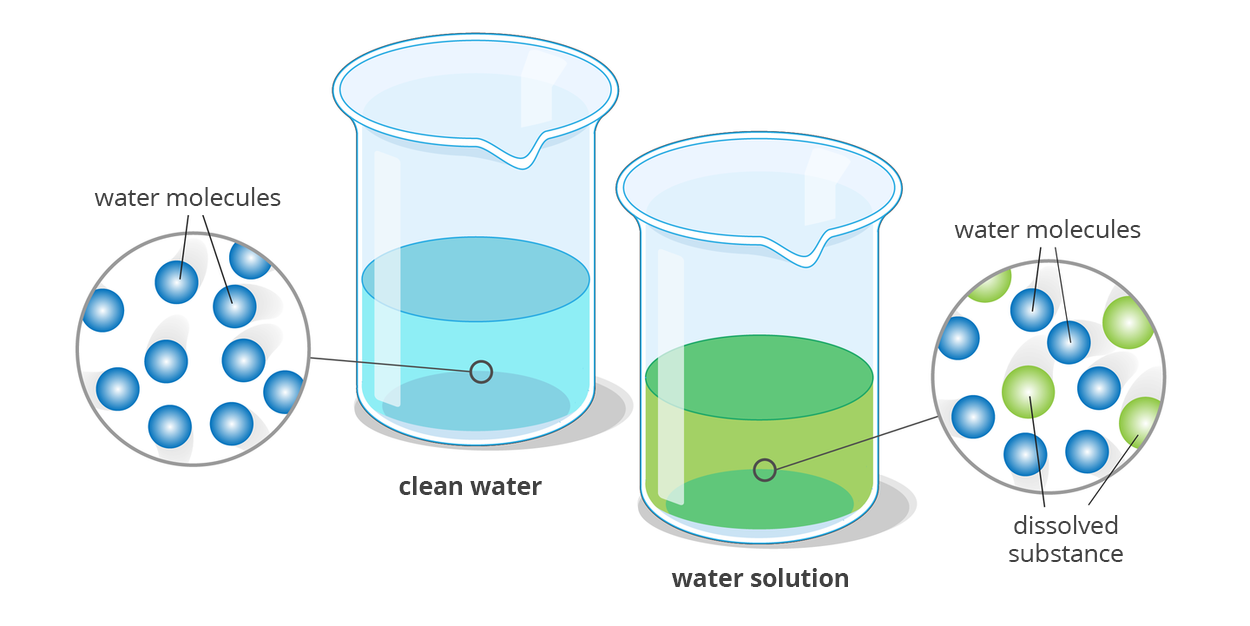
On a day‑to‑day basis, we most often deal with solutions in which the solvent is water, i.e. aqueous solutions. More substances can be dissolved in water than in any other known solvent. Aqueous solutions that occur in nature contain dissolved solids, liquids or gases. Plants draw water along with mineral salts they need to survive dissolved in that water from the soil. The same applies to humans and animals – necessary substances are delivered to our organisms along with an aqueous solution.
R1BiAWOOIGXz2
Na ilustracji zaprezentowano dwie szklane zlewki. Jedna jest wypełniona wodą (clean water), a druga roztworem wodnym w kolorze zielonym (water solution). W kółkach obok zlewek zaprezentowano modele drobinowe cząsteczek każdej z tych substancji - przy wodzie w kółku niebieskie kuleczki (water molecules), przy zielonym roztworze - niebieskie i zielone drobiny (water molecules, dissolved substance).
Particle model of an aqueous solution
Source: Andrzej Bogusz, licencja: CC BY 3.0.
Solubility of substances
Can we dissolve any volume of sugar or salt in water? In order to check that, it’s best to perform an experiment. We’ll examine the solubilitysolubilitysolubility of substances and the factors that affect it.
It’s necessary to remember that some substances are not soluble in water, but may be perfectly soluble in other substances. As solvents we’ll use gasoline or alcohol, among others.
Rozpuszczalność substancji
Observation 1
Investigation of factors affecting the rate of dissolution of a substance in water.
You will need
warm water,
cold water,
granulated sugar,
powdered sugar,
a teaspoon,
6 glasses.
Instruction
Stage 1: cold water
Pour cold water into a glass so that it’s 1/4 full.
Add one teaspoon of sugar to the water and stir until the sugar dissolves.
Add additional teaspoons of sugar, but each time stir the water carefully and observe whether sugar dissolves after each additional teaspoon added.
Stop the experiment when you notice that the sugar no longer dissolves despite the water being stirred. Note how much sugar dissolved in a 1/4 full glass of cold water.
Add water so that the glass is half full and once again try to stir the sugar to check whether it dissolves.
Stage 2: warm water
Pour warm water into a glass so that it’s 1/4 full.
Proceed as instructed in regard to cold water. Note how many teaspoons of sugar dissolved in a 1/4 full glass of warm water.
Stage 3: rate of dissolution
Pour warm water into two glasses so that they’re at least half full.
Add a teaspoon of sugar to each glass. Stir the contents of one of the glasses. Note in which glass sugar dissolves at a faster rate.
Stage 4: solute particle size
Pour the same amount of cold water into two glasses.
Add a teaspoon of powdered sugar to one glass and a teaspoon of regular sugar to the other. Stir the contents of both glasses. Assess which type of sugar dissolved at a faster rate.
Summary
The solubility of solid substances in liquids can be accelerated by:
raising the solvent’s temperature;
stirring the solution during the dissolution process;
grinding a solute.
R1Vul0SAvGxOK
Exercise 1
Indicate which sentences are true and which are false. Not all substances dissolve in water. Możliwe odpowiedzi: True, False. Any volume of a substance can be dissolved in water. Możliwe odpowiedzi: True, False. Particle travel speed doesn’t affect the substance mixing rate in the solution. Możliwe odpowiedzi: True, False. Each solution is composed of a solvent and a solute. Możliwe odpowiedzi: True, False. The rate of dissolution depends on temperature. Możliwe odpowiedzi: True, False
Indicate which sentences are true and which are false. Not all substances dissolve in water. Możliwe odpowiedzi: True, False. Any volume of a substance can be dissolved in water. Możliwe odpowiedzi: True, False. Particle travel speed doesn’t affect the substance mixing rate in the solution. Możliwe odpowiedzi: True, False. Each solution is composed of a solvent and a solute. Możliwe odpowiedzi: True, False. The rate of dissolution depends on temperature. Możliwe odpowiedzi: True, False
Indicate which sentences are true and which are false.
True
False
Not all substances dissolve in water.
□
□
Any volume of a substance can be dissolved in water.
□
□
Particle travel speed doesn’t affect the substance mixing rate in the solution.
□
□
Each solution is composed of a solvent and a solute.
□
□
The rate of dissolution depends on temperature.
□
□
RBEGmbZ4VurGr
Exercise 2
Fill in the terms. Solution:
1. solvent, 2. solute – e.g. water, oil
1. solvent, 2. solute – e.g. sugar, salt
Fill in the terms. Solution:
1. solvent, 2. solute – e.g. water, oil
1. solvent, 2. solute – e.g. sugar, salt
Fill in the terms.
solute, solvent
Solution:
.............. – e.g. water, oil
.............. – e.g. sugar, salt
R5Lh58DSkwhNY
Exercise 3
Match the pairs: English words with Polish definition. solution Możliwe odpowiedzi: 1. mieszanina jednorodna rozpuszczalnika i substancji rozpuszczonej; najczęściej spotykamy roztwory wodne, np. ocet jest roztworem kwasu octowego w wodzie, 2. substancja, w której rozpuszczają się drobiny innych substancji; najbardziej rozpowszechnionym rozpuszczalnikiem jest woda, 3. zdolność substancji do rozpuszczenia się w innej substancji, 4. substancja, która rozpuszcza się w rozpuszczalniku solvent Możliwe odpowiedzi: 1. mieszanina jednorodna rozpuszczalnika i substancji rozpuszczonej; najczęściej spotykamy roztwory wodne, np. ocet jest roztworem kwasu octowego w wodzie, 2. substancja, w której rozpuszczają się drobiny innych substancji; najbardziej rozpowszechnionym rozpuszczalnikiem jest woda, 3. zdolność substancji do rozpuszczenia się w innej substancji, 4. substancja, która rozpuszcza się w rozpuszczalniku solubility Możliwe odpowiedzi: 1. mieszanina jednorodna rozpuszczalnika i substancji rozpuszczonej; najczęściej spotykamy roztwory wodne, np. ocet jest roztworem kwasu octowego w wodzie, 2. substancja, w której rozpuszczają się drobiny innych substancji; najbardziej rozpowszechnionym rozpuszczalnikiem jest woda, 3. zdolność substancji do rozpuszczenia się w innej substancji, 4. substancja, która rozpuszcza się w rozpuszczalniku solute Możliwe odpowiedzi: 1. mieszanina jednorodna rozpuszczalnika i substancji rozpuszczonej; najczęściej spotykamy roztwory wodne, np. ocet jest roztworem kwasu octowego w wodzie, 2. substancja, w której rozpuszczają się drobiny innych substancji; najbardziej rozpowszechnionym rozpuszczalnikiem jest woda, 3. zdolność substancji do rozpuszczenia się w innej substancji, 4. substancja, która rozpuszcza się w rozpuszczalniku
Match the pairs: English words with Polish definition. solution Możliwe odpowiedzi: 1. mieszanina jednorodna rozpuszczalnika i substancji rozpuszczonej; najczęściej spotykamy roztwory wodne, np. ocet jest roztworem kwasu octowego w wodzie, 2. substancja, w której rozpuszczają się drobiny innych substancji; najbardziej rozpowszechnionym rozpuszczalnikiem jest woda, 3. zdolność substancji do rozpuszczenia się w innej substancji, 4. substancja, która rozpuszcza się w rozpuszczalniku solvent Możliwe odpowiedzi: 1. mieszanina jednorodna rozpuszczalnika i substancji rozpuszczonej; najczęściej spotykamy roztwory wodne, np. ocet jest roztworem kwasu octowego w wodzie, 2. substancja, w której rozpuszczają się drobiny innych substancji; najbardziej rozpowszechnionym rozpuszczalnikiem jest woda, 3. zdolność substancji do rozpuszczenia się w innej substancji, 4. substancja, która rozpuszcza się w rozpuszczalniku solubility Możliwe odpowiedzi: 1. mieszanina jednorodna rozpuszczalnika i substancji rozpuszczonej; najczęściej spotykamy roztwory wodne, np. ocet jest roztworem kwasu octowego w wodzie, 2. substancja, w której rozpuszczają się drobiny innych substancji; najbardziej rozpowszechnionym rozpuszczalnikiem jest woda, 3. zdolność substancji do rozpuszczenia się w innej substancji, 4. substancja, która rozpuszcza się w rozpuszczalniku solute Możliwe odpowiedzi: 1. mieszanina jednorodna rozpuszczalnika i substancji rozpuszczonej; najczęściej spotykamy roztwory wodne, np. ocet jest roztworem kwasu octowego w wodzie, 2. substancja, w której rozpuszczają się drobiny innych substancji; najbardziej rozpowszechnionym rozpuszczalnikiem jest woda, 3. zdolność substancji do rozpuszczenia się w innej substancji, 4. substancja, która rozpuszcza się w rozpuszczalniku
Match the pairs: English words with Polish definition.
substancja, która rozpuszcza się w rozpuszczalniku, substancja, w której rozpuszczają się drobiny innych substancji; najbardziej rozpowszechnionym rozpuszczalnikiem jest woda, zdolność substancji do rozpuszczenia się w innej substancji, mieszanina jednorodna rozpuszczalnika i substancji rozpuszczonej; najczęściej spotykamy roztwory wodne, np. ocet jest roztworem kwasu octowego w wodzie
solution
solvent
solubility
solute
Summary
Solutions are homogeneous mixtures composed of two or more substances. They contain a solvent and a solute dissolved in that solvent. Aqueous solutions of substances are the most common.
The dissolution process is affected by: temperature of the solvent, the stirring of components and decreasing the size of solute particles.
roztwór – mieszanina jednorodna rozpuszczalnika i substancji rozpuszczonej; najczęściej spotykamy roztwory wodne, np. ocet jest roztworem kwasu octowego w wodzie