The Universe was created nearly 14 billion years ago as a result of the Big Bang. Throughout that entire time, it kept constantly expanding and changing to reach its current size and structure. It has to be mentioned that we still know very little about the Universe and the knowledge we have is not definitive.
The Sun is one of millions of stars comprising a large system of stars. Such system of stars is called a galaxygalaxygalaxy. The galaxy in which our Sun is located is called the Milky Way. We can observe a part of this galaxy from Earth in the form of a brigther streak across the sky. Galaxies are unimaginably large in size – light would need 100,000 years to travel across the entire galaxy it at its widest point. For comparison – light needs only 8 minutes to travel the way from the Sun to Earth (i.e. 150 mn kilometres).
RAUKigScKQc12
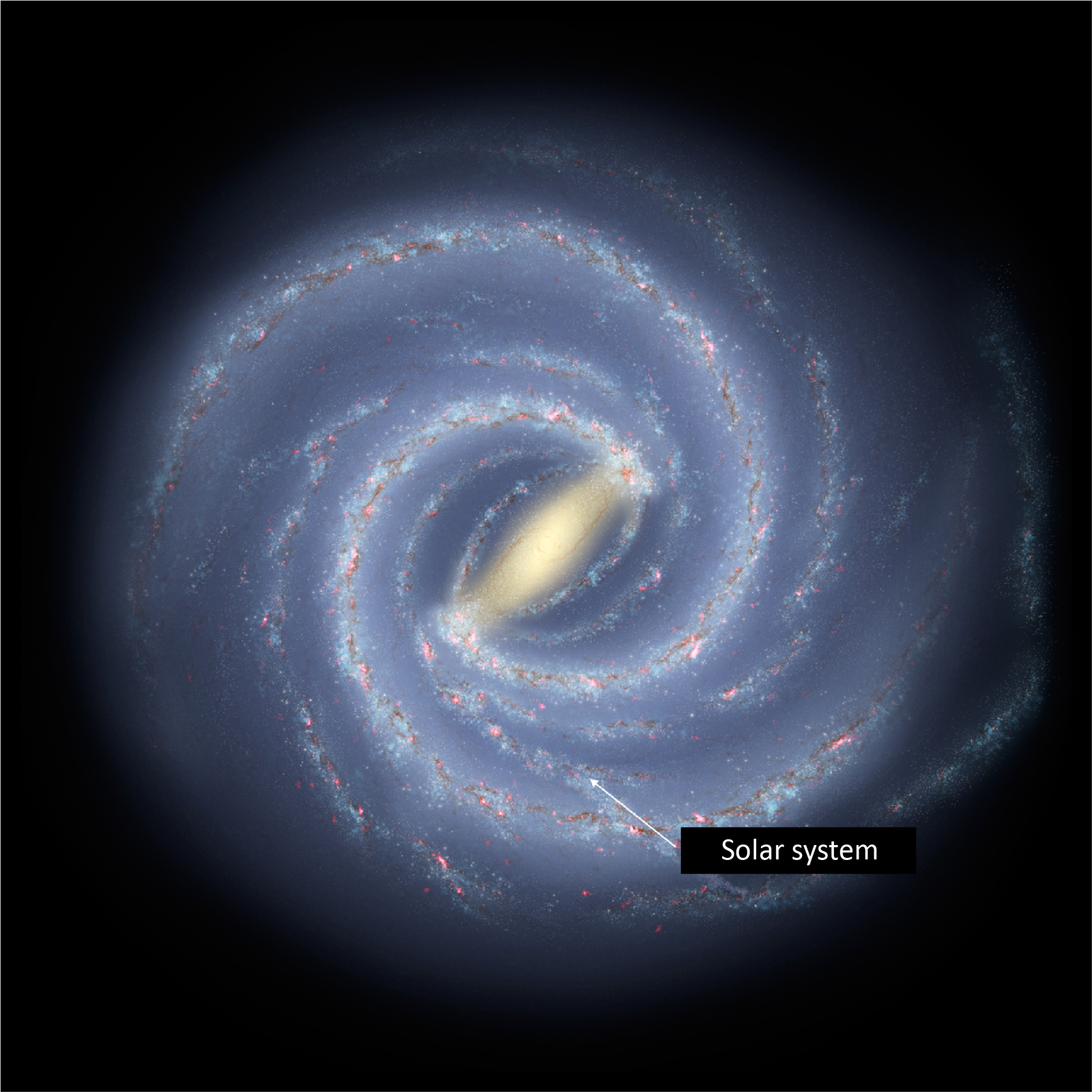
Grafika prezentuje wygląd galaktyki Drogi Mlecznej. Galaktyka prezentowana od góry ma kształt spiralny, w jej centrum znajduje się jądro. W połowie jej promienia zaznaczono Układ Słoneczny.
The Milky Way. The supposed appearance of the Milky Way and the location of our Solar System. Her view of the night sky reminded our ancestors of drops of spilled milk, hence its name.
Galaxies are large systems of stars in which we can distinguish hundreds of millions of glowing objects using telescopes and other devices! Next to individual stars, planets, rocks and other objects, they form part of the UniverseUniverseUniverse, i.e. everything that physically exists. The study of these remote objects falls under the purview of a branch of science called astronomyastronomyastronomy. In their work, astronomers use such devices as telescope that allow them to observe even the most remote stars and galaxies.
Rn6Vf5MCiAxw5
Ilustracja interaktywna przedstawia sposoby obserwacji astronomicznej gwiazd i galaktyk. Na zdjęciu nocne niebo z wyraźną Drogą Mleczną.
1. Telescope. In 1610, Galileo was the first to use the telescope to observe the Milky Way,
2. Thanks to the use of various types of telescopes, it became possible to conduct more detailed observations of the sky,
3. The 20th century observation technique has discovered: fotografia Galaktyki Andromedy; what galaxies are and how far away they are from Earth; what is the distance between stars within the Milky Way,
4.Telescopes in orbit around Earth: Hubble telescope, Kepler telescope,
5. Sky observation can also be done using binoculars or a telescope.
Ilustracja interaktywna przedstawia sposoby obserwacji astronomicznej gwiazd i galaktyk. Na zdjęciu nocne niebo z wyraźną Drogą Mleczną.
1. Telescope. In 1610, Galileo was the first to use the telescope to observe the Milky Way,
2. Thanks to the use of various types of telescopes, it became possible to conduct more detailed observations of the sky,
3. The 20th century observation technique has discovered: fotografia Galaktyki Andromedy; what galaxies are and how far away they are from Earth; what is the distance between stars within the Milky Way,
4.Telescopes in orbit around Earth: Hubble telescope, Kepler telescope,
5. Sky observation can also be done using binoculars or a telescope.
Astronomical observations of stars and galaxies
Source: Ruffnax (Crew of STS-125), Sailko, Unknown, GroMar Sp. z o.o., licencja: CC BY-SA 3.0.
R1FGFTZKMj1ww
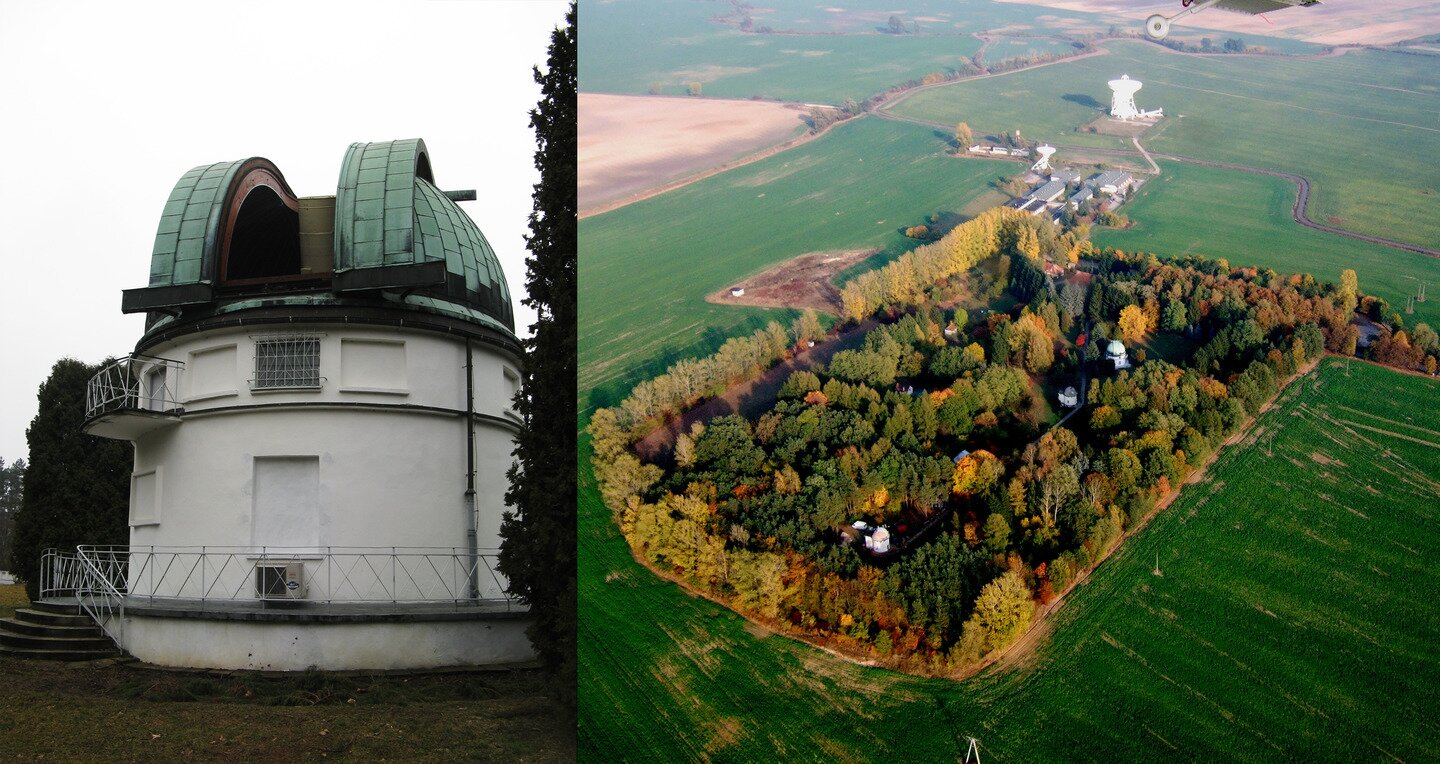
Fotografia po lewej stronie prezentuje owalny budynek obserwatorium zwieńczony rozsuwaną kopułą, przez którą wystaje teleskop. Obok zdjęcie wykonane z lotu ptaka - ukazuje prostokątny zadrzewiony teren otoczony polami. W środku terenu budynki dwóch obserwatoriów. W pobliżu nie ma żadnych innych zabudowań. Brak sztucznego oświetlenia umożliwia obserwowanie nieba.
Telescope. Astronomical observatories are located in secluded areas, where the view of the night sky is not disturbed by artificial light from cars, houses or street lamps
Source: EAJoe, Margoz, http://commons.wikimedia.org, licencja: CC BY-SA 4.0.
RMUWbOdeTewLI
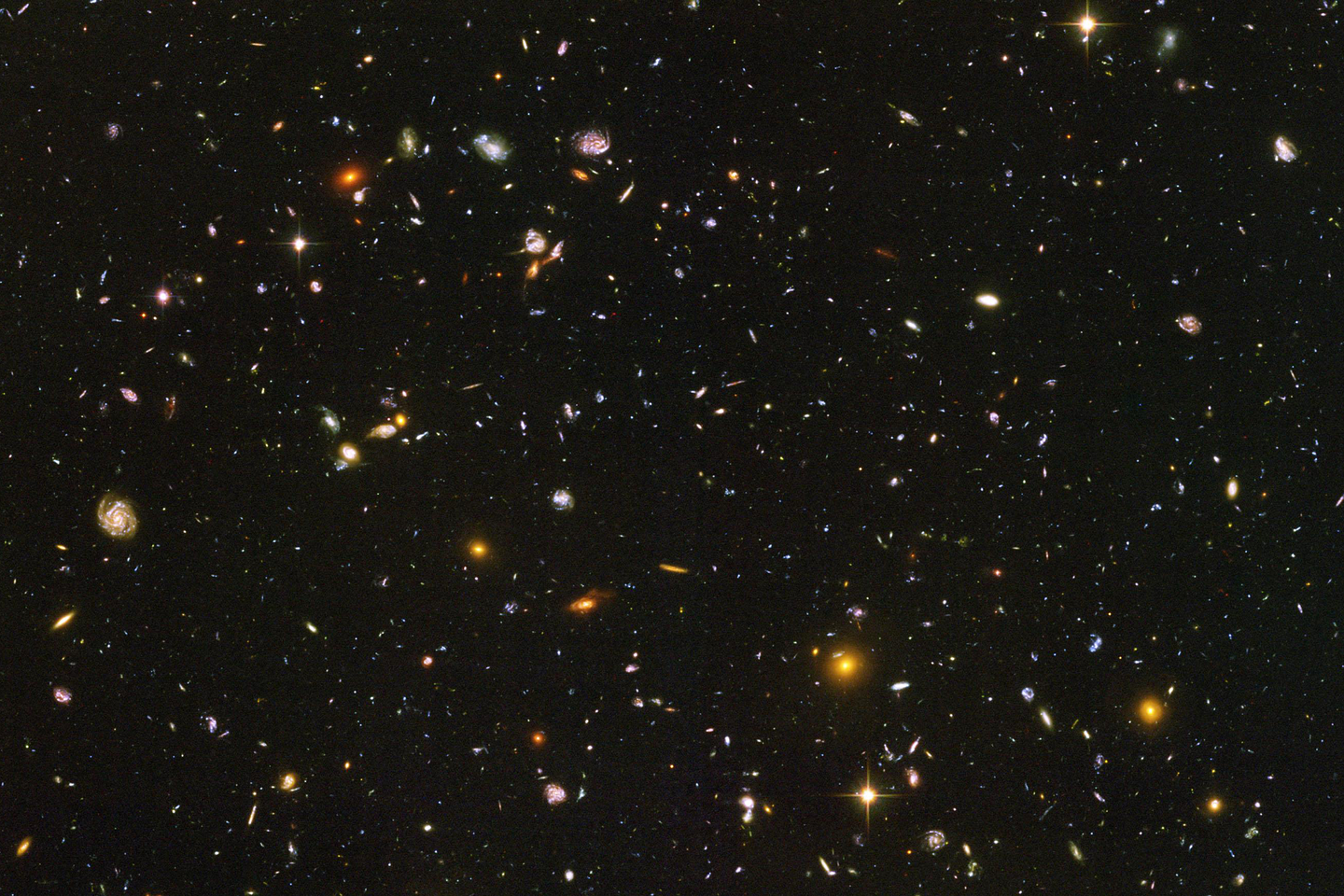
Fotografia wykonana z teleskopu umieszczonego w kosmosie. Na tle czarnego nieba widoczne liczne mniejsze lub większe punkty obrazujące galaktyki.
Distant galaxies. A photograph from a telescope placed in space represents hundreds of very distant galaxies. Each of them consists of millions of stars. This picture gives you an idea of how big the universe is
Source: Marc Van Norden, www.flickr.com, licencja: CC BY 2.0.
RBs1Pwvfaa4RD
Exercise 1
Choose an instrument which it would not be possible to observe the night sky. Możliwe odpowiedzi: 1. lornetka, 2. luneta, 3. lupa, 4. teleskop.
Choose an instrument which it would not be possible to observe the night sky. Możliwe odpowiedzi: 1. lornetka, 2. luneta, 3. lupa, 4. teleskop.
Source: domena publiczna.
R1BvwPwLDB2KV
Exercise 2
Select all statements that correctly describe the structure of the Universe. Możliwe odpowiedzi: 1. The Milky Way is one of many galaxies in the Universe, 2. Observed galaxies are astronomical objects located within the Solar System, 3. There are many galaxies in the Universe, 4. The Milky Way is many times bigger than the Solar System, 5. Each galaxy is composed of many stars, 6. Light needs only 8 minutes to travel across the Milky Way at its widest point
Select all statements that correctly describe the structure of the Universe. Możliwe odpowiedzi: 1. The Milky Way is one of many galaxies in the Universe, 2. Observed galaxies are astronomical objects located within the Solar System, 3. There are many galaxies in the Universe, 4. The Milky Way is many times bigger than the Solar System, 5. Each galaxy is composed of many stars, 6. Light needs only 8 minutes to travel across the Milky Way at its widest point
Select all statements that correctly describe the structure of the Universe.
The Milky Way is one of many galaxies in the Universe
Observed galaxies are astronomical objects located within the Solar System
There are many galaxies in the Universe
The Milky Way is many times bigger than the Solar System
Each galaxy is composed of many stars
Light needs only 8 minutes to travel across the Milky Way at its widest point
Summary
The Sun is one of millions of stars comprising a large system.
Stars group together into large systems called galaxies.
The system of stars in which our Sun is located is called the Milky Way.
Homework
Task 1.1
Think about and provide an answer why astronomical observatories are located far away from human settlements.