Stylisation and its types
you will define stylisationstylisation
you will distinguish various types of stylisation
you will indicate the stylistic features of various literary texts


The word style and stylisation belong to one family of words. Fill in the gaps taking into consideration the word formation definition.
stylish, stylisation, stylist, stylistic, stylistics
...................... — adjective: referring to style, connected with the style of a work or speech, e.g. ... device; ... error
...................... — noun: shaping something, e.g. an artistic work in accordance with the requirements of a given style
...................... — noun: a person who created somebody’s style - advises on suitable make-up, outfits, hairstyles, etc.
...................... — adjective: having the characteristics of a representative style, e.g. the style of a former era, but also being in good style
...................... — noun: the scientific field dealing with description, comparative analysis and interpretation of linguistic styles
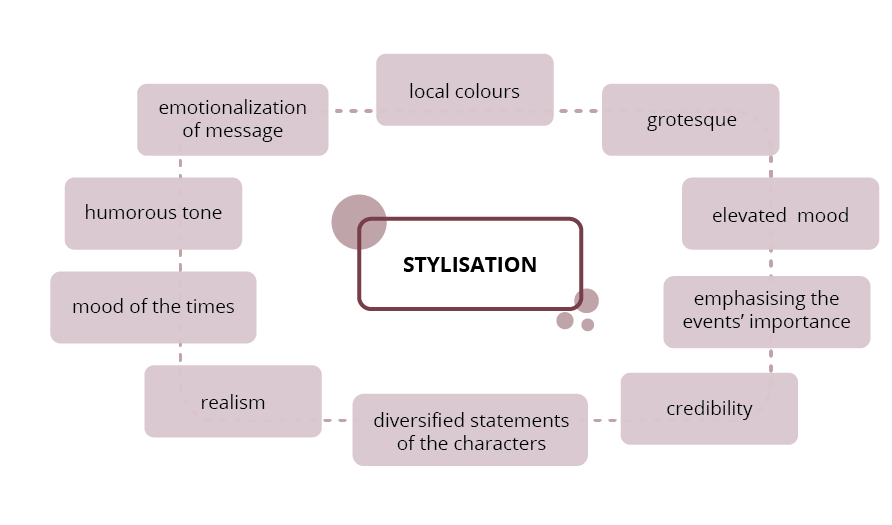
In philological science, the word stylisation refers to a conscious and deliberate application of the features characteristic to one stylestyle into a written or oral utterances that represent another style.
Texts can adopt various styles, e.g. regional or professional, as well as functional or genre‑related. The language of such texts can also be adapted to former eras.
Dialogues are styled in order to make them more realistic and to reproduce their regional tone. Stylisation also helps to characterise protagonists and their background. Other stylisation aims include ridiculing, parodying certain types of language or their ennoblement (e.g. creating a sublime mood).
Types of stylisation.
Professional stylisation
The introduction of elements characteristic to professional groups, e.g. student, actor or military dialect, the language of internet users, criminal or hip-hop jargon. The application of lexical features characteristic to individual professional groups is a sign of stylisation application.
Regional stylisation
The application of grammatical or lexical features characteristic to regional varieties, i.e. dialects. This type of stylisation is often applied in order to highlight characteristic features of protagonists and indicate their rural background. They are often attributed with various features, especially phonetic, rather than those characteristic to a specific region of Poland, which are associated (by Polish language users) with the way village inhabitants speak.
Archaisation
The introduction of linguistic elements characteristic to the language of the past, i.e. archaisms. This stylistic move is to introduce a viewer with the atmosphere of the past, just like writers such as Henryk Sienkiewicz or Ignacy Kraszewski did. It can also be applied to create a sublime mood, to make an utterance sound turgid or solemn, or - on the contrary, to make it sound playful or preposterous. S.Mrożek and W. Gombrowicz applied the mocking features of archaisation.
Biblical stylisation
Attributing/equipping texts with features characteristic to biblical style, hence the application of biblical genres (psalm, parables), metaphor, phraseology originating from the Bible and characteristic syntax (a predominance of coordinating sentences, inverted order).
Match the features of the texts with the appropriate stylisation.
labialisation (pronouncing „ł” before a word or vowel „o”, e.g. “łokno” instead of “okno”), Phraseological expressions originating from the Bible, e.g. the massacre of innocents., preiotation (pronouncing „j” before a vowel, e.g. “janioł” instead of “anioł”), The use of words that belong to criminal jargon., The use of words from past eras, e.g. apothecary, damsel, handmaid, asunder., Inverted order, e.g. And their room clean was., The use of pluperfect tenses (e.g. He did do great things)., The use of words typical for student jargon., masuration (pronouncing „z”, „s”, „dz”, „c” instead of „ż”, „sz”, „dż”, „cz”)
| Professional stylisation | |
|---|---|
| Regional stylisation | |
| Archaisation | |
| Biblical stylisation |
Match the types of stylisation with their descriptions.
poeticising, intellectualisation, colloquialisation
| making expressions similar to an artistic style | |
| attributing texts with features of scientific style | |
| making a speech colloquial |
Match the book titles with the appropriate type of stylisation.
H. Sienkiewicz, <em>Ogniem i mieczem</em>, J. Tuwim, <em>Polskie kwiaty</em>, J.I Kraszewski, <em>Stara Baśń</em>, W. Bogusławski, <em>Cud mniemany, czyli krakowiacy i górale</em>, W. Gombrowicz, <em>Trans-Atlantyk</em>, K. Tetmajer, <em>Na skalnym Podhalu</em>, B. Prus, <em>Lalka</em>, S. Wyspiański, <em>Wesele</em>, E. Niziurski, <em>Sposób na Alcybiadesa</em>, S.I. Witkiewicz, <em>Szewcy</em>
| Archaisation | |
|---|---|
| Regional stylisation | |
| Professional stylisation |
Indicate the correct sentences.
- In descriptive and narrative parts of Chłopi archaisation prevails.
- Regional dialects in Chłopi represent the Łowicz dialect only.
- Dialogues in Chłopi are saturated with dialects.
- The protagonists’ dialogues in Chłopi are loaded with various features of different dialects.
- The fundamental language variety in Chłopi is the general language of the end of the nineteenth and the beginning of the twentieth century.
Gloria victisWodzem ich był człowiek świętego imienia, które brzmiało: Romuald Traugutt. Pytasz, dlaczego świętym jest to imię? Albowiem według przykazania Pana opuścił on żonę i dzieci, dostatki i spokój, wszystko, co pieści, wszystko, co raduje i jest życia ponętą, czarem, skarbem, szczęściem, a wziąwszy na ramiona krzyż narodu swego, poszedł za idącym ziemią tą słupem ognistym i w nim zgorzał. Nie tutaj zgorzał. Nie w tej mogile śpi. Kędyś daleko. Ale wówczas na czele hufca tego na tę polanę przyszedł i patrzyłyśmy na niego my, drzewa.
Source: Eliza Orzeszkowa, Gloria victis, Warszawa 1947, s. 10.
Wysoka obdukcjoŚwiadkiem dowodowym była ich długoletnia przyjaciółka, pani Wiktoria Komoda, która z rozdartym, jak mówiła, sercem złożyła następujące zeznanie: – Trzy lata patrzałam, proszę sądu wysokiego, na to, co się tam działo. Same najpierwsze złodzieje w całem Grochowie, tak zwana więzienna elita tam się schodziła i różny towar przytaszczała. Czego tam nie było: radia, gramofony, bielizna męska i damska, a Kolczyk chodził i wszystko sprzedawał. Jednego razu przychodzę, patrzę, a pan Kolczyk na łóżku leży na obcej bieliźnie, kradziony sok malinowy do wody sobie dolewa, kradzionemy serdelkami zakąsza i mówi: – Patrz pani, pani Komoda, jak sobie żyję, wszystko mam, o czem mnie dusza zamarzy – i nogą mnie wskazał na salceson włoski, któren leżał na łóżku.
Source: Stefan Wiechecki, Wysoka obdukcjo [online], dostępny w internecie: https://pl.wikiquote.org/wiki/Stefan_Wiechecki [dostęp 26.10.2015 r.].
Srebrne orły– Romulad rzekł – ciągnął dalej papież – że Bolesław Patrycjusz nie zasłużył na koronę królewską, jako że nie jest mężem sprawiedliwym, wyzuł bowiem braci z dziedzictwa ojcowskiego. (...)
– A do mnie dochodziły wieści, że ci, którycheś wykupił, stokroć ciężej na ziemiach biskupów i klasztorów, grzbietem i ramieniem, nie myślą, pracują, niż tu jako niewolnicy pracowali.Source: Teodor Parnicki, Srebrne orły, s. 268–345.
Głosy z przeszłościAle nic to dzióbku, że się starzyjymy, bez to bardzij życi docyniać umiymy. Biermy se go pokonszczyczku, bez nerwów i butlu, bo niy wiymy, co nom skludzi tajymnicze jutro. Nasze bajtle taki gryfne, choć wyflurgnom z gniozda, co wartało nasze życi, po nich bydzie poznać.
Source: Maria Wojtak, Głosy z przeszłości, s. 66.
Arrange a multiple-choice question for a friend or colleague. Check if he can remember the lesson information.
Question: ...
- ...
- ...
- ...
- ...
- ...
Keywords
style, stylisation, archaization, dialectization
Glossary
styl
stylizacja
archaizacja
dialektyzacja
kolokwializacja
intelektualizacja
stylizacja biblijna
stylizacja środowiskowa
poetyzacja
biblizmy
gwaryzmy
dialektyzmy
kolokwializmy