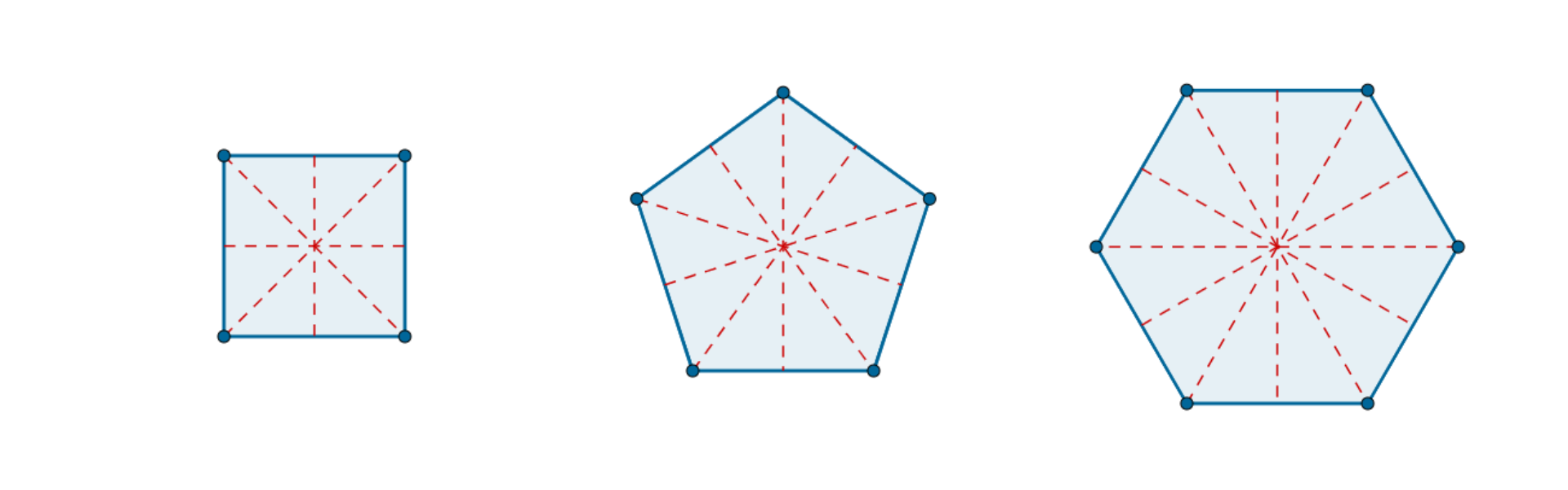
Rysunki przedstawiają wielokąty foremne czworokąt, pięciokąt i sześciokąt. W wielokątach wyrysowano osie symetrii. Wielokąt foremny ma tyle osi symetrii, ile ma boków.
Source: GroMar, licencja: CC BY 3.0.
RzPsgbAr99bwl1
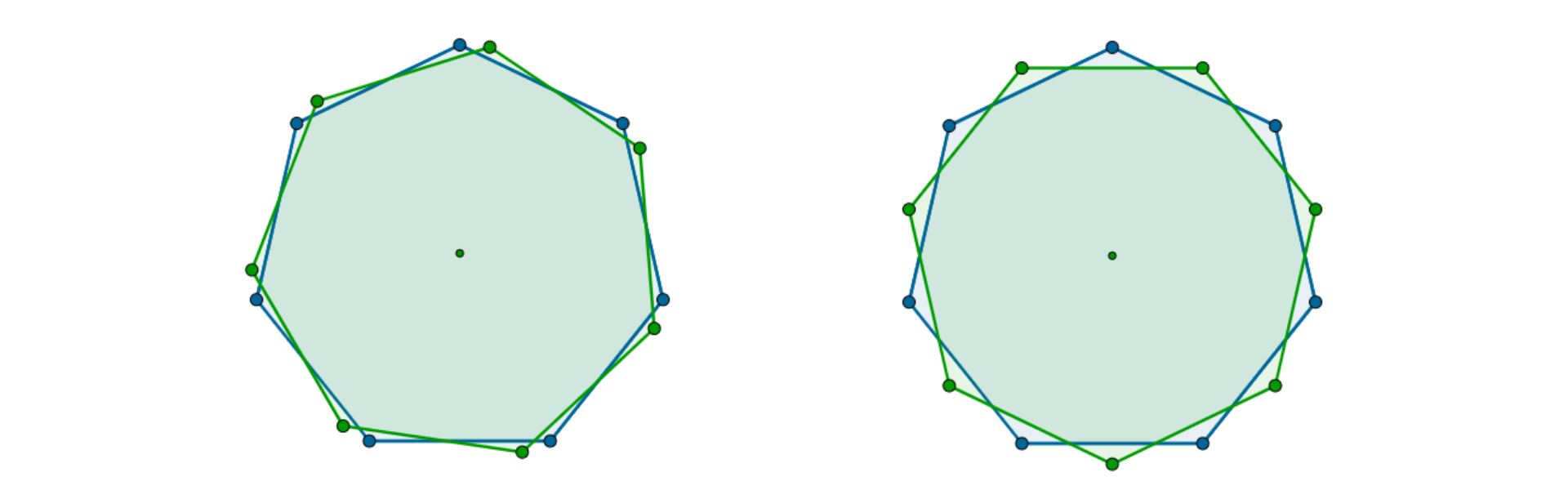
Rysunki przedstawiają siedmiokąt foremny, na nim taki sam siedmiokąt foremny obrócony o 146 stopni oraz siedmiokąt foremny, na nim taki sam siedmiokąt foremny obrócony o 180 stopni. Siedmiokąt foremny nie jest figurą śrokowosymetryczną.
Source: GroMar, licencja: CC BY 3.0.
RBSrZi8KJYwd81
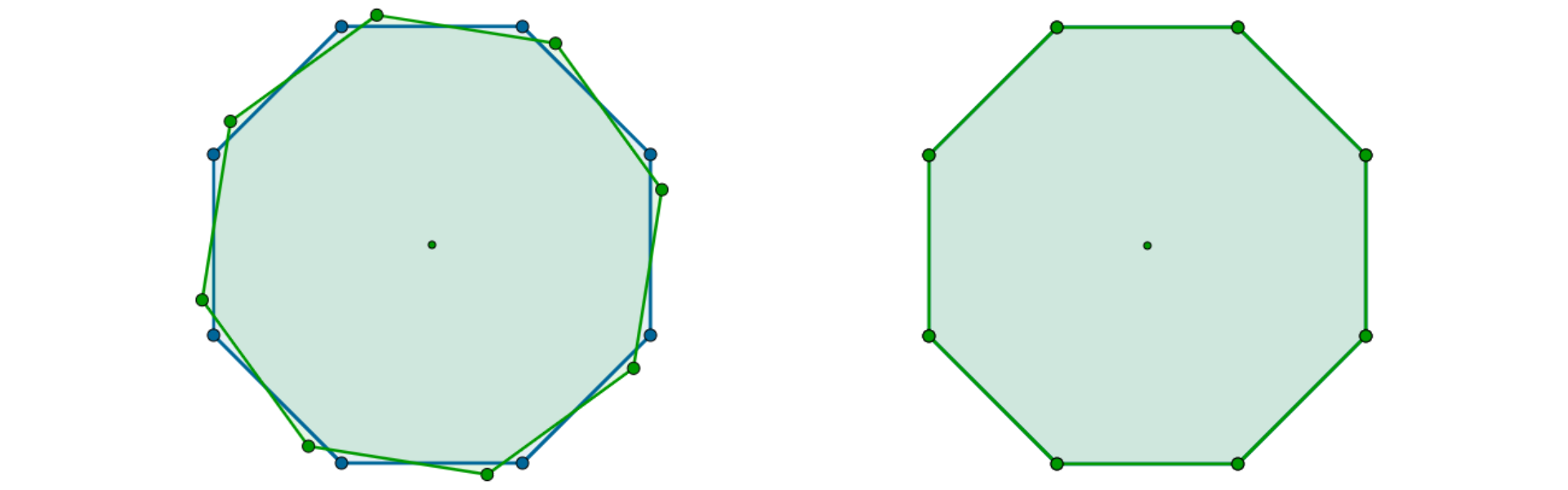
Rysunki przedstawiają ośmiokąt foremny, na nim taki sam ośmiokąt foremny obrócony o 36 stopni oraz ośmiokąt foremny, na nim taki sam ośmiokąt foremny obrócony o 360 stopni. Siedmiokąt foremny nie jest figurą śrokowosymetryczną.
1. Does a regular polygonregular polygonregular polygon have at least one axis of symmetrysymmetry line, axis of symmetryaxis of symmetry? If so, what is the maximum number of the axes of symmetry? 2. Are the axes of symmetry the perpendicular bisectors in each case? Are they angle bisectors? 3. Is every regular polygonregular polygonregular polygon a centrosymmetric figure?
Consider the cases for the even and odd number of polygon sides.
1. A regular polygon has as many axes of symmetry as sides. 2. The axes of symmetry in a regular polygon with an odd number of sides include themselves in the bisectors of its angles and are the perpendicular bisectors of its sides at the same time. 3. The axes of symmetry in a regular polygon with an even number of sides are the perpendicular bisectors of its sides or include themselves in the bisectors of its angles.
1. Consider if every regular polygonregular polygonregular polygon is a centrosymmetric figure. Set the applet slider on α = 180° and check your assumption. 2. Changing rotation angle of n‑angle on the slider, check what is the smallest rotation angle which you need to make the polygon cover the n‑angle before the rotation.
Write down your observations depending on n and try to generalize them.
1. Polygons with the even number of sides are centrosymmetric. 2. n = 3, the smallest rotation angle α = 120Indeks górny oo n = 4, α = 90° n = 5, α = 72° etc. for any n,
1. The centre of symmetry in a regular polygon is located on the intersection of its angle bisectors (the perpendicular bisectors of its sides). 2. Yes. It is also worth noticing that the following statement is true: A regular polygon has the centre of symmetry when there are two such axes of symmetry that intersect producing a right angle.
Remember:
All regular polygons are centrosymmetric. A regular polygonregular polygonregular polygon has as many axes of symmetry as sides.
Regular polygons with an even number of sides have the centre of symmetry. The centre of symmetry is the intersection point of its angle bisectors (the perpendicular bisectors of its sides).
Exercises
R5CbLAgOkDchV
Exercise 4
Wersja alternatywna ćwiczenia: ... has twelve axes of symmetry. Możliwe odpowiedzi: 1. A regular hexagon, 2. A regular dodecagon (12-gon), 3. A regular decagon (10-gon), 4. A regular octagon (8-gon)
Wersja alternatywna ćwiczenia: ... has twelve axes of symmetry. Możliwe odpowiedzi: 1. A regular hexagon, 2. A regular dodecagon (12-gon), 3. A regular decagon (10-gon), 4. A regular octagon (8-gon)
... has twelve axes of symmetry.
A regular hexagon
A regular dodecagon (12-gon)
A regular decagon (10-gon)
A regular octagon (8-gon)
Rzadanie
Source: GroMar, licencja: CC BY 3.0.
R1Opev2MhctXo
Exercise 5
Wersja alternatywna ćwiczenia: ... has the centre of symmetry. Możliwe odpowiedzi: 1. An equilateral triangle, 2. A dodecagon (12-gon), 3. A pentagon, 4. A heptagon (7-gon)
Wersja alternatywna ćwiczenia: ... has the centre of symmetry. Możliwe odpowiedzi: 1. An equilateral triangle, 2. A dodecagon (12-gon), 3. A pentagon, 4. A heptagon (7-gon)
... has the centre of symmetry.
An equilateral triangle
A dodecagon (12-gon)
A pentagon
A heptagon (7-gon)
Exercise 6
How to find the centre of symmetry in a regular icosagon (20‑gon)?
Answer the question in English.
R1CnH64iJMR4I
Exercise 7
Wersja alternatywna ćwiczenia: Indicate which pairs of expressions or words are translated correctly. Możliwe odpowiedzi: 1. wielokąt foremny - regular polygon, 2. osiowosymetryczny - axisymmetric, 3. środek symetrii - point of symmetry, 4. oś symetrii - symmetry line, 5. n-kąt - angle bisector, 6. symetralna boku - central symmetry
Wersja alternatywna ćwiczenia: Indicate which pairs of expressions or words are translated correctly. Możliwe odpowiedzi: 1. wielokąt foremny - regular polygon, 2. osiowosymetryczny - axisymmetric, 3. środek symetrii - point of symmetry, 4. oś symetrii - symmetry line, 5. n-kąt - angle bisector, 6. symetralna boku - central symmetry
Indicate which pairs of expressions or words are translated correctly.
wielokąt foremny - regular polygon
osiowosymetryczny - axisymmetric
środek symetrii - point of symmetry
oś symetrii - symmetry line
n-kąt - angle bisector
symetralna boku - central symmetry
zadanie
Source: GroMar, licencja: CC BY 3.0.
R16NyFjvY1Rhj1
Interaktywna gra, polegająca na łączeniu wyrazów w pary w ciągu jednej minuty. Czas zaczyna upływać wraz z rozpoczęciem gry. Jeden ruch to odkrywanie najpierw jednej potem drugiej karty z wyrazem. Każdy wyraz jest odczytywany. Kolejny ruch to odkrywanie trzeciej i czwartej karty. W ten sposób odsłuchasz wszystkie wyrazy. Nawigacja z poziomu klawiatury za pomocą strzałek, odsłuchiwanie wyrazów enterem lub spacją. Znajdź wszystkie pary wyrazów.
Interaktywna gra, polegająca na łączeniu wyrazów w pary w ciągu jednej minuty. Czas zaczyna upływać wraz z rozpoczęciem gry. Jeden ruch to odkrywanie najpierw jednej potem drugiej karty z wyrazem. Każdy wyraz jest odczytywany. Kolejny ruch to odkrywanie trzeciej i czwartej karty. W ten sposób odsłuchasz wszystkie wyrazy. Nawigacja z poziomu klawiatury za pomocą strzałek, odsłuchiwanie wyrazów enterem lub spacją. Znajdź wszystkie pary wyrazów.
Match Polish terms with their English equivalents.
axisymmetric
wielokąt foremny
n-gon
point of symmetry
symmetry line
środek symetrii
n-kąt
osiowosymetryczny
oś symetrii
regular polygon
Source: Zespół autorski Politechniki Łódzkiej, licencja: CC BY 3.0.