The importance of soil
the distribution of climate zones and types of climate on Earth;
the influence of climate on the diversity of vegetation and soil on Earth;
the difference between weathering and erosion;
the geomorphic role of flowing waters and wind;
how to justify the need for rational management in an environment with major shortages of fresh water.
to name the stages of soil formation;
to explain the role of soil in the natural environment;
to explain the term „soil degradation”;
to name the factors causing soil degradation;
to propose solutions on how to improve the degraded soil or protect it against degradation.
The importance of soil
Soil is composed of rocks, minerals, water, air, and organic matter. The presence of the latter humushumus is crucial as it allows most plants to grow and, as a result, entire ecosystems connected with them, such as forests, arable land, or meadows.
The soil formation process is time- consuming. It starts with the weathering of rocks. Thanks to the presence of water, conditions are ensured in the rock mantle for the least demanding organisms, such as bacteria, algae and lichens, to grow. Their remains subject to decomposition enable the growth of more complicated organisms. This way the rock mantle is enriched with organic matter, transforming into soil.
In natural conditions, the matter circulates and the substances obtained from the soil by plants sooner or later return to it (food chain!), thus the situation is stable. Everything changes when we start to engage in wasteful exploitation of soil for farming purposes – we use the soil’s resources but when harvesting crops, we fail to give back the minerals taken by plants. If this lasts for too long (depending on soil fertility, sometimes a few years is enough), the soil loses its productivity. This is referred to as soil degradationsoil degradation
Main causes of soil degradation
Analyse the extent of soil degradation on one continent. Find the reasons for the situation. You can use population density maps and agricultural land maps (wall maps, atlases, or electronic).
There are many causes of soil degradation and they often overlap.
The most common one is overgrazing – the animals eat plants so quickly that they fail to grow again. As a result, soil is uncovered, mainly its humus level. Wind and rainwater easily remove it, which makes the soil lose its properties quickly. It is particularly characteristic for dry land and semi‑dry land, especially in the Sahel, Africa. Similar effects are caused by wasteful deforestation, but the consequences are visible much faster.
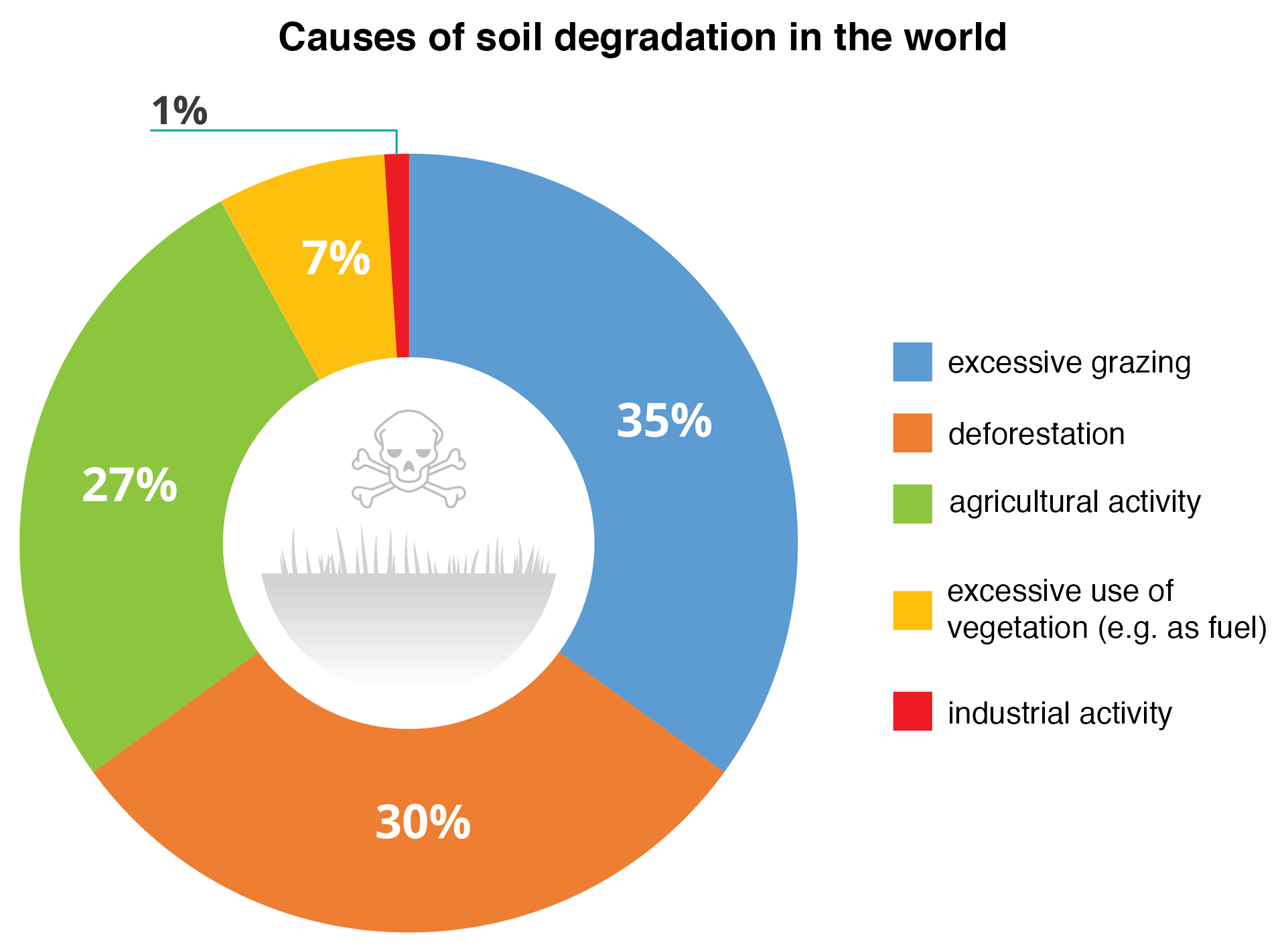
Farming, if improperly conducted, also contributes to soil degradation. Long‑term, irrational exploitation leads to the reduction of humus content. This results in reduced amount of nutrients in the soil, but also deterioration of soil structure, limited ability to retain water, reduced activity of soil organisms, and impaired chemical stability.
The most obvious solution is to use fertilisers. The best ones are the natural ones, but usually there is too little of them. If fertilisers are improperly used, they may be counterproductive. For example, with too high doses, the soil may become contaminated – the soil microorganisms die, heavy metals are activated, and pH changes (acidity rises), which impacts the ability of plants to intake nutrients. Overfertilisation is typical for highly developed countries with intensive farming.
Consequences of soil degradation
The extent of soil degradation varies. For every continent, though, it means reducing the ability to deliver agricultural produce. The problem, however, is not of the same importance everywhere.
In Europe, population growth is very slow and a lot of agricultural produce is imported. In addition, in highly developed countries of Europe, North America or Asia, productivity is rising and agricultural production on non‑degraded soil is growing. In Africa, on the other hand, especially in its Sub‑Saharan part, the situation is completely different – population rises very fast and poor economic growth limits the ability, or even makes it impossible, to import food.
What does "soil degradation" mean? Choose the correct answer.
- loss of soil productivity as a result of wasteful exploitation
- the development of simple and not very demanding organisms within rock mantle
- purposeful farming by man to obtain agricultural produce
- persistent, long-term enrichment of rock mantle with organic matter
Keywords
soil degradation, overfertilisation, soil fertility, humus, soil formation process
Glossary
degradacja gleby - ogół procesów i zjawisk, które wpływają na stratę produktywności gleby
próchnica