The European Union is a supranationalsupranationalsupranational organization integrating 28 states on the basis of the principles of subsidiarity and solidarity.
It took decades to achieve the level of integration EU member states enjoy nowadays - from ECSC, through EEC, to the European Union.
You will learn
You will be able to name the main institutions of the European Union and explain their competences.
You will be able to explain which of the institutions are involved in the creation of the EU budget.
You will be able to describe, where the revenuesrevenuerevenues of the EU budget come from, and how the money is spent.
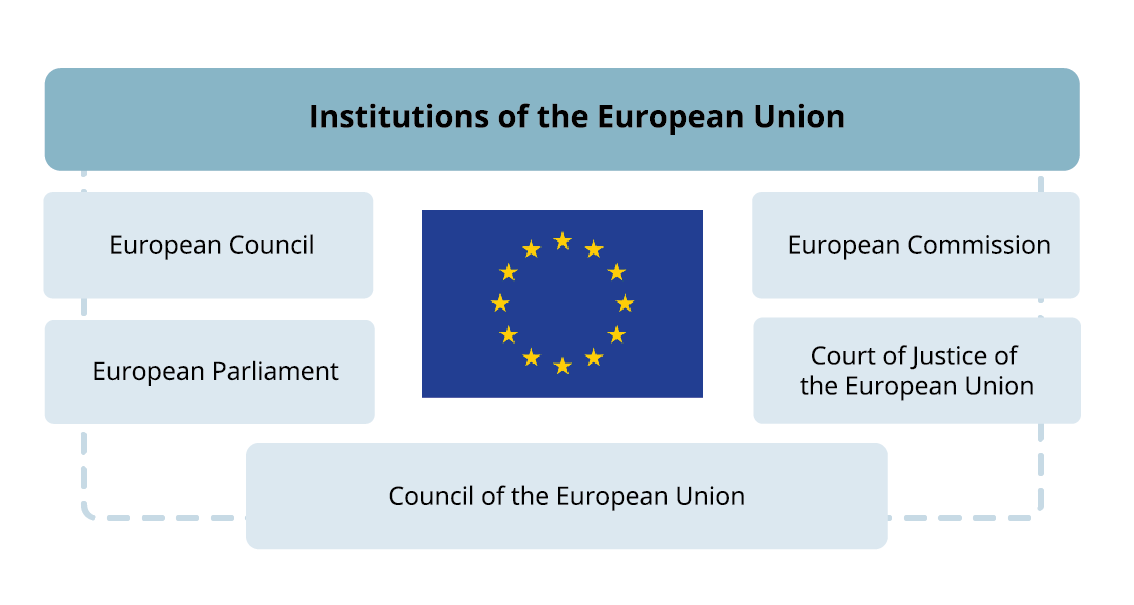
Na grafice w centralnym miejscu widnieje flaga Unii Europejskiej. Dookoła niej, w dymkach, znajdują się następujące napisy: na samej górze "Institutions of the European Union, dalej natomiast, w kierunku ruchu wskazówek zegara, "European Commission", "Court of Justice of the European Union", "Council of the European Union", "European Parliament", "European Council".
The European Council
The European Council consists of the heads of state and governmentheads of state and governmentheads of state and government of the member states of the European Union. The main competence of the Council is to set priorities and the general direction of the European Union's policy. The European Council has no official seat, but its meetings are held in Brussels.
It is headedto headheaded by the President of the European Council. Since 2014 the position is held by Donald Tusk. The President represents the European Union externally in matters concerning the common foreign and security policy.
The Council of the European Union
The Council of the European Union, also known simply as the Council, is the main body making political decisions of the European Union. The Council of the European Union includes ministers from all EU member states. The Council's task is to coordinate EU policy and participateto participateparticipate in lawmaking. The Council plays an important role in adopting the European Union budgetto adopt (the budget)adopting the European Union budget.
The Council meets in various configurations. Depending on the topic discussed, the member state is represented by the minister responsible for the given field (e.g. foreign policy, agricultural policy, finances, etc.). The Council meets in Brussels and in Luxembourg.
The European Commission
The European Commission is a supranational body. This means that its members are independent of national governments. The Commission's headquarters is located in Brussels. It consists of commissioners, one from each of the member states of the European Union.
R131UVgfgubyz
Grafika przedstawia flagę Unii Europejskiej, pod którą widnieje napis "European Commission". Z lewej i prawej strony flagi znajdują się jasnoszare paski, które są elementem dekoracyjnym. Na nich umieszczono następujące informacje: 1. development and submission of proposals for European legislation,
2. overseeing the application of European law,
3. development of the project and implementation of the European Union budget,
4. representing the European Union in the international arena.
Grafika przedstawia flagę Unii Europejskiej, pod którą widnieje napis "European Commission". Z lewej i prawej strony flagi znajdują się jasnoszare paski, które są elementem dekoracyjnym. Na nich umieszczono następujące informacje: 1. development and submission of proposals for European legislation,
2. overseeing the application of European law,
3. development of the project and implementation of the European Union budget,
4. representing the European Union in the international arena.
The Commission's competencies
Source: domena publiczna.
The European Parliament
The European Parliament represents the interests of EU citizens. Every citizen of an EU member state, irrespectiveirrespectiveirrespective of his place of residenceplace of residenceplace of residence, has the right to elect representatives or be a candidate to the European Parliament. Elections take place every 5 years. For this reason, the Parliament is considered to be an expressionexpressionexpression of the democratic willwillwill of over 500 million citizens of the Union. The number of seats per member state depends on the number of inhabitants and political arrangements between countries. Currently, with 28 member states, there are 751 deputies in the Parliament.
The headquarters of the European Parliament is located in Strasbourg. The deputies also work in Brussels and Luxembourg.
R1WDhpohnbxp5
Grafika przedstawia schematyczny rysunek okrągłej sali ze schodkowymi trybunami, w prawym dolnym rogu grafiki znajduje się flaga Unii Europejskiej. Na grafice znajdują się następujące informacje: 1. legislative function – the Parliament adopts legal acts together with the Council of the European Union, 2. budget functions – together with the Council of the European Union, the Parliament adopts the EU budget and exercises control over its implementation.
Grafika przedstawia schematyczny rysunek okrągłej sali ze schodkowymi trybunami, w prawym dolnym rogu grafiki znajduje się flaga Unii Europejskiej. Na grafice znajdują się następujące informacje: 1. legislative function – the Parliament adopts legal acts together with the Council of the European Union, 2. budget functions – together with the Council of the European Union, the Parliament adopts the EU budget and exercises control over its implementation.
The most important functions of the European Parliament
Source: domena publiczna.
The Court of Justice of the European Union
The Court of Justice is the judicial body of the EU. It consists of three bodies: the Court of Justice, the General Court and the Civil Service Tribunal. The seat of the Court is in Luxembourg.
Its basic task is to ensure that EU law is interpreted and applied uniformlyuniformlyuniformly in all member states. The Court of Justice and the General Court settle disputesto settle disputessettle disputes between member states, EU institutions, businesses and individuals. The Civil Service Tribunal settles disputes between the European Union and its officialsofficialofficials.
The budget of the European Union
The Council of the European Union, the European Parliament and the European Commission create the law and decide on the budget of the European Union. The EU budget is a revenue and expenditureexpenditureexpenditure plan drawn up for the financial year that coincidesto coincidecoincides with the calendar year.
Where does the EU take the money from and what does it spend them on? The funds available to the EU come from various sources, including contributionscontributioncontributions paid by member states, customs dutiescustoms dutiescustoms duties, and part of the revenues from value added tax (VAT).
From its budget, the European Union finances common policies, supports less‑developed regions, implements research projects and responds to current problems, such as humanitarian crises. As much as 94% of funds from the EU budget under various funds return to domestic entrepreneursentrepreneurentrepreneurs and citizens. The institution responsible for the implementation of the EU budget is the European Commission. The control over its implementation is exercised by the European Parliament. The European Commission annuallyannuallyannually reports to the European Parliament on how the EU funds were spent.
Rw4ve8qssrSdp
Exercise 1
Where does the EU take money from and what does it spend them on? From the statements below, select the true ones. Możliwe odpowiedzi: 1. The EU budget only consists of contributions from the member states., 2. The budget year coincides with the calendar year., 3. The EU budget is augmented by funds from customs duties and part of the value added tax (VAT)., 4. Only 20% of funds from the EU budget return to domestic entrepreneurs and citizens., 5. The EU budget finances common policies and supports less developed regions.
Where does the EU take money from and what does it spend them on? From the statements below, select the true ones. Możliwe odpowiedzi: 1. The EU budget only consists of contributions from the member states., 2. The budget year coincides with the calendar year., 3. The EU budget is augmented by funds from customs duties and part of the value added tax (VAT)., 4. Only 20% of funds from the EU budget return to domestic entrepreneurs and citizens., 5. The EU budget finances common policies and supports less developed regions.
Where does the EU take money from and what does it spend them on? From the statements below, select the true ones.
The EU budget only consists of contributions from the member states.
The budget year coincides with the calendar year.
The EU budget is augmented by funds from customs duties and part of the value added tax (VAT).
Only 20% of funds from the EU budget return to domestic entrepreneurs and citizens.
The EU budget finances common policies and supports less developed regions.
The European Union is an international organization with special featuresfeaturefeatures. Through its institutions, the EU creates law that is binding for and in the member states and establishes a common budget. The system of the EU institutions was built in such a way as to fulfill the interests of the member states, the European Union as an organization, and EU citizens. Each institution has important functions and is associated with other bodies.
RnPNYPa3lXIcK
Exercise 2
Ćwiczenie alternatywne: Listen to the abstract recording to review the material and new vocabulary. Explain the meaning of following words: to participate; place of residence; will; official; revenue; contribution; annually; feature. If it's too difficult, use lesson's glossary.
Ćwiczenie alternatywne: Listen to the abstract recording to review the material and new vocabulary. Explain the meaning of following words: to participate; place of residence; will; official; revenue; contribution; annually; feature. If it's too difficult, use lesson's glossary.
Listen to the abstract recording to review the material and new vocabulary. Then do the vocabulary exercise. Match the pairs: English and Polish words.
składka, cecha, wola, brać udział, wpływy, rocznie, co roku, urzędnik, miejsce zamieszkania
to participate
place of residence
will
official
revenue
contribution
annually
feature
Keywords
European Council, Council of the European Union, European Parliament, European Commission, Court of Justice of the European Union, General Court, Civil Service Tribunal, revenues, expenditure