The Polish cause at the Versailles Peace Conference
to characterize the positions of the powers on the Polish demands;
to describe the Polish territorial proposals;
to list the decisions on the Polish cause at the Versailles Peace Conference.
The representatives of the Polish cause at the Paris Peace Conference were Roman Dmowski and the Prime Minister of the Polish government Ignacy Paderewski. Ultimately, the Treaty of Versailles awarded the Greater Poland to Poland. The Polish state also got the Danzig Pomerania, “cutting” the German state in half, which will be a cause of conflict in the future. Danzig was proclaimed the Free City of Danzig under the control of a High Commissioner of the League of Nations. Poland was granted certain privileges in the city. The fate of the Upper Silesia, Warmia, Masuria and Powiśle was to be decided in plebiscitesplebiscites. Poland and the other newly established countries not only had to sign the Versailles Treaty but also a treaty that guaranteed minority rights, also known as the Little Treaty of VersaillesLittle Treaty of Versailles.
Find out what the top leaders of Europe and the President of the United States of America thought about Poland.
Find information about the speech of Roman Dmowski at the Versailles Peace Conference on the Internet. Analyse the map and learn the territorial demands, stated by him. And then do the exercise.
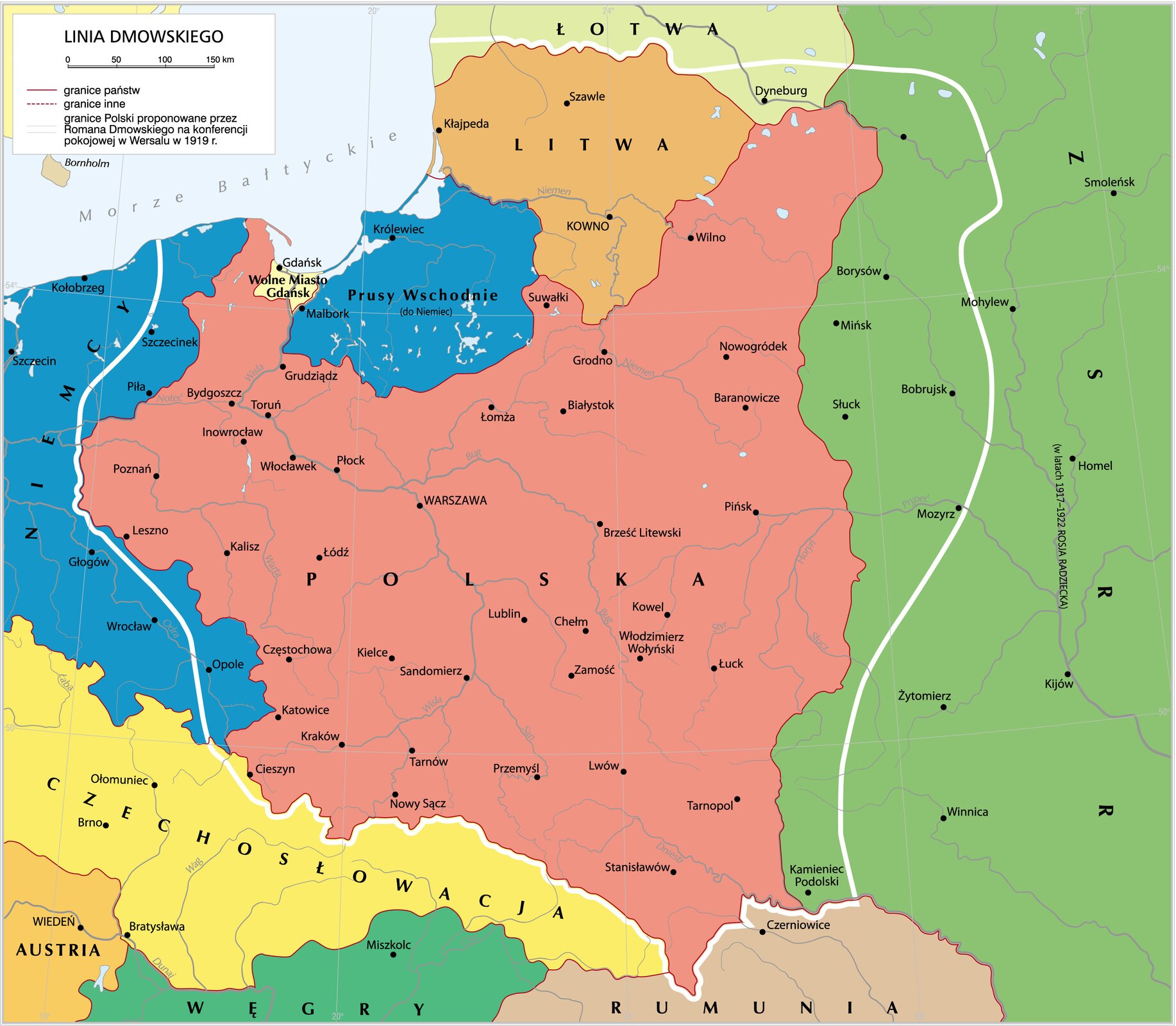
Select the correct sentences.
- During his speech, Dmowski showed a great diplomatic talent and extraordinary competence. He delivered the speech, which lasted several hours, in French, without any notes, and he also repeated his arguments in English.
- Roman Dmowski argued that the German presence in Danzig is dangerous and must be suppressed.
- Roman Dmowski argued that the Bolshevik presence in Danzig is dangerous and must be suppressed.
- Dmowski called for the eastern border of Poland running along the following line: to the north of Dyneburg – to the west of Mohylew – Mozyrz – to the west of Kamieniec Podolski to the border with Romania.
- Dmowski called for the eastern border of Poland running along the following line: Dźwina – Ostróg – Zbrucz.
- Dmowski treated Kashubia as a Polish territory.
- Dmowski claimed that “non-historical” nations, which was the name he gave to nations which had never had their own states, such as Ukrainians or Belarussians, should not have them.
- The so-called Dmowski line encompassed the Greater Poland, the Danzig Pomerania, Warmia, the Opole region and the Upper Silesia, as well as Lithuania (a "real union”). It reached Bobrujsk in the east.
- The so-called Dmowski line encompassed the Greater Poland, Warmia, the Opole region, the Upper Silesia and the Lower Silesia. It reached Bobrujsk in the east.
- The Polish Committee, headed by the French diplomat Jules Cambon, received Dmowski’s demands favourably, albeit with two exceptions. It proposed plebiscites in the southern part of East Prussia. Apart from that, it rejected the Polish claims to small parts of the Western Pomerania and the Lower Silesia.
- The Polish Committee headed by the French diplomat Jules Cambon, received Dmowski’s demands with disapproval. It only agreed to a plebiscite being held in the southern part of Each Prussia.
- The demands of Dmowski and the Cambon Committee were torpedoed by the British Prime Minister David Lloyd George who had a negative attitude towards Poland. He challenged the decision to incorporate Danzig and the Upper Silesia into Poland. The reason for that was his reluctance to weaken Germany excessively.
- In accordance with the decisions made at the Versailles Peace Conference, the fate of the Upper Silesia, Warmia, Masuria and Powiśle was to be decided in plebiscites.
Keywords
The Treaty of Versailles, plebiscite, the Curzon Line, the Dmowski Line, the Little Treaty of Versailles
Glossary
plebiscyt - głosowanie mieszkańców określonego terytorium w celu wypowiedzenia się w sprawie jego przynależności państwowej.
linia Curzona - termin powstał od nazwiska ministra spraw zagranicznych Wielkiej Brytanii, który w 1919 roku zaproponował jej kształt, pokrywający się z granicą zachodnią Rosji po III rozbiorze Polski na linii Bugu, natomiast na południu przecinająca ziemie Rzeczypospolitej, znajdujące się od 1772 roku pod zaborem austriackim; zaproponowana granica miała mieć charakter linii rozejmowej.
linia Dmowskiego – propozycja ustaleń terytorialnych, przedstawiona przez Romana Dmowskiego na konferencji wersalskiej. obejmowała Wielkopolskę, Warmię, Opolszczyznę, Górny i Dolny Śląsk. Na wschodzie sięgała po Bobrujsk.
Mały traktat wersalski} – nazwa umowy w sprawie ochrony mniejszości narodowych, podpisanej razem z traktatem wersalskim i stanowiącej warunek jego zawarcia; Na mocy traktatu mniejszościowego rząd polski (a także rządy innych nowopowstałych państw, poza Republiką Weimarską) miał obowiązek zapewnić pełne uprawnienia wszystkim obywatelom bez względu na wyznanie i narodowość, zagwarantować im możliwość używania rodzimego języka, zakładania i prowadzenia własnych szkół oraz instytucji kulturalnych.