information about the genetic features of the organism is written in the DNA which is found in every cell;
genetic material of the parents is transferred to the offspring via gametes
You will learn
to foresee the features of the offspring based on the features of the parents, by writing down the genetic diagrams for one feature;
to interpret the schematic diagram of inheriting features (genetic diagram), using the words like phenotype, genotype, gene, allele, homozygote, heterozygote, dominant, recessive;
to tell the difference between the genotype and the phenotype.
RSla9TRJjVMG7
Nagranie dźwiękowe dotyczące badań Grzegorza Mendla, genotypów i fenotypów
Nagranie dźwiękowe dotyczące badań Grzegorza Mendla, genotypów i fenotypów
Nagranie dźwiękowe dotyczące badań Grzegorza Mendla, genotypów i fenotypów
The research of Gregor Mendel
R1Ff0KJThKlbb
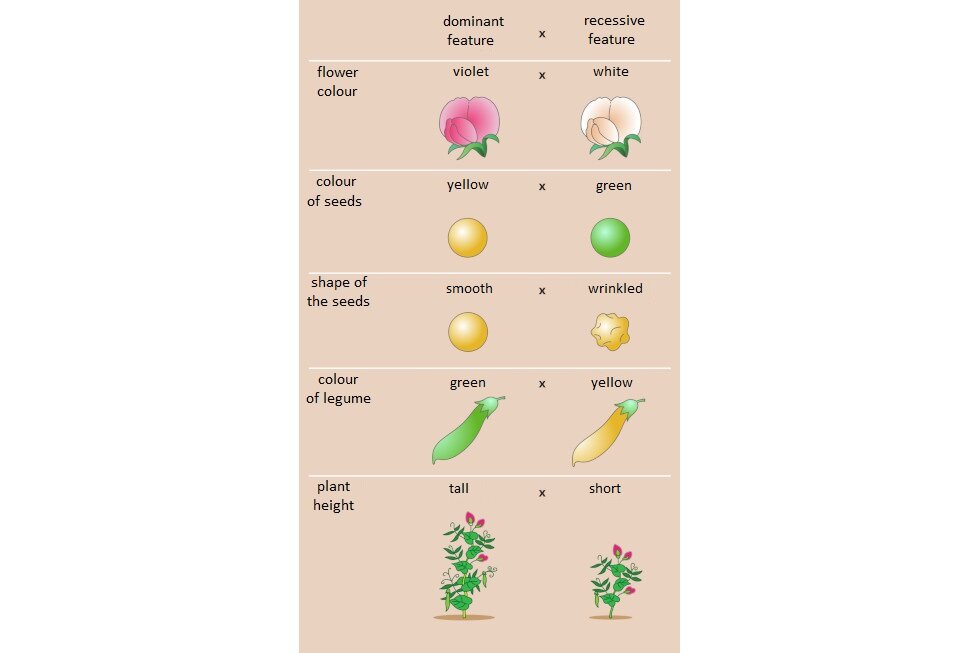
Ilustracja przestawia cechy grochu badane przez Grzegorza Mendla. Rysunki są w dwóch kolumnach i czterech rzędach. Lewa kolumna przedstawia cechy dominujące, prawa krzyżowane z nimi cechy recesywne. Od góry kwiat czerwony krzyżowany z białym. Niżej nasiona żółte krzyżowane z zielonymi. W trzecim rzędzie nasiona okrągłe krzyżowane z pomarszczonymi. Niżej strąk zielony krzyżowany z żółtym. Na dole roślina wysoka krzyżowana z niską. Podpisano: dominant feature; recessive feature; flower colour; colour of seeds; shape of the seeds; colour of legume; plant height; violet; white; yellow; green; smooth; wrinkled; tall; short
The features of pea investigated by Gregor Mendel
Source: Andrzej Bogusz, licencja: CC BY 3.0.
Genotype and phenotype
Genes of pea are responsible for the features like the height of the plant, the colour of the flowers, the colour and shape of the seeds or pods. Just like in other organisms, their features are conditioned by the genes. The collection of all the genes which forms a complete genetic information about a given organism is called the genotypegenotypegenotype. Each organism has a specific genotype. The collection of all the features of an organism, conditioned by the genotype and, to some extent, by the environment, is called the phenotypephenotypephenotype. The colour of the flowers, the shape of the seeds, the height of the stem are features of the phenotype.
As we know, in diploid cells, such as somatic cells, each chromosome exists in two copies. Genes are fragments of chromosomes, meaning that in each diploid cell there are two copies of a given gene. Those copies are called the allelesallelealleles.
R12e1WsXUDEfF
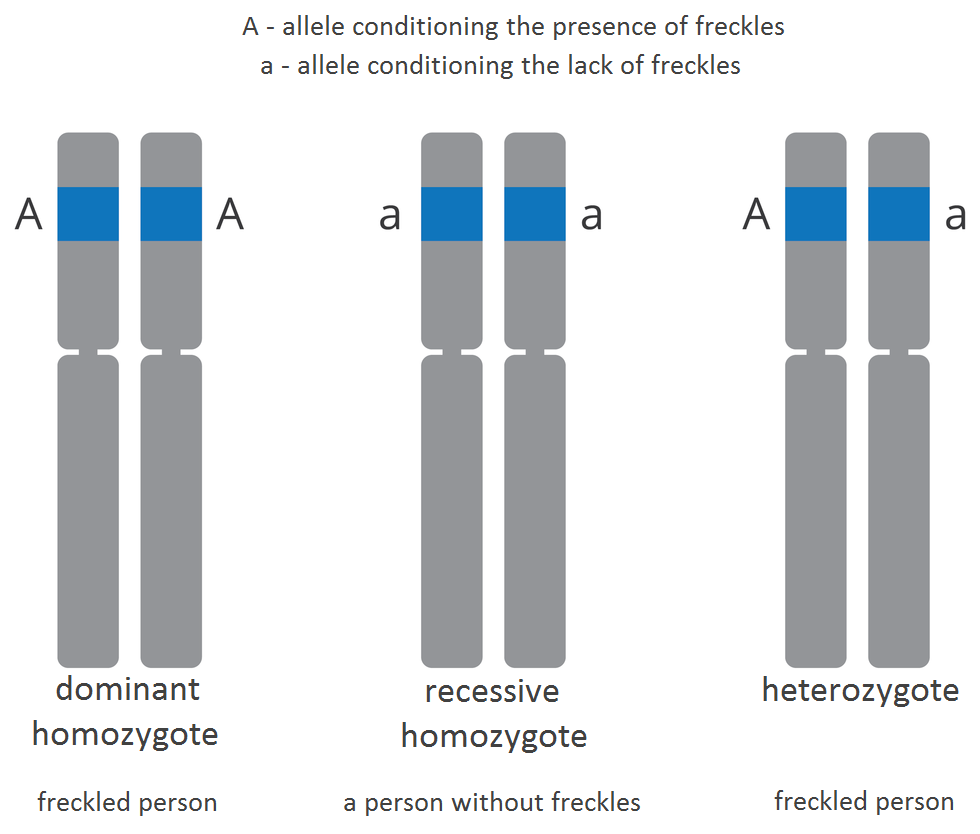
Ilustracja przedstawia trzy pary alleli. AA, Aa, aaSą to popielate pałeczki z niebieskimi poziomymi paskami w górnej części. Na ilustracji podpisano: A- allel conditioning the presence of freckles; a- allele conditioning the lack of freckles; dominant homozygote; freckled person; recessive homosygote; a preson without freckles; heterozygote; freckles person
Alleles
Source: Dariusz Adryan, licencja: CC BY 3.0.
The alleles of a given gene can be dominant or recessive. Dominant allele is an allele which one copy in a cell is enough to generate a specific feature of an organism, called dominant feature. Recessive allele causes a given feature to appear only when in a cell there is no other allele of a given gene. Recessive alleles generate recessive features. If alleles that create pairs of genes are identical, we call such organism a homozygotehomozygotehomozygote from the perspective of that gene. Once an organism has two different alleles of a given gene, we call it heterozygoteheterozygoteheterozygote when it comes to that gene. Dominant alleles are marked with capital letters, whereas recessive alleles – with lowercase letters. Homozygote that has two dominant alleles of a given gene is called a dominant homozygote, whereas one that has two recessive alleles – recessive homozygote.
R1c7pJgQiDHb3
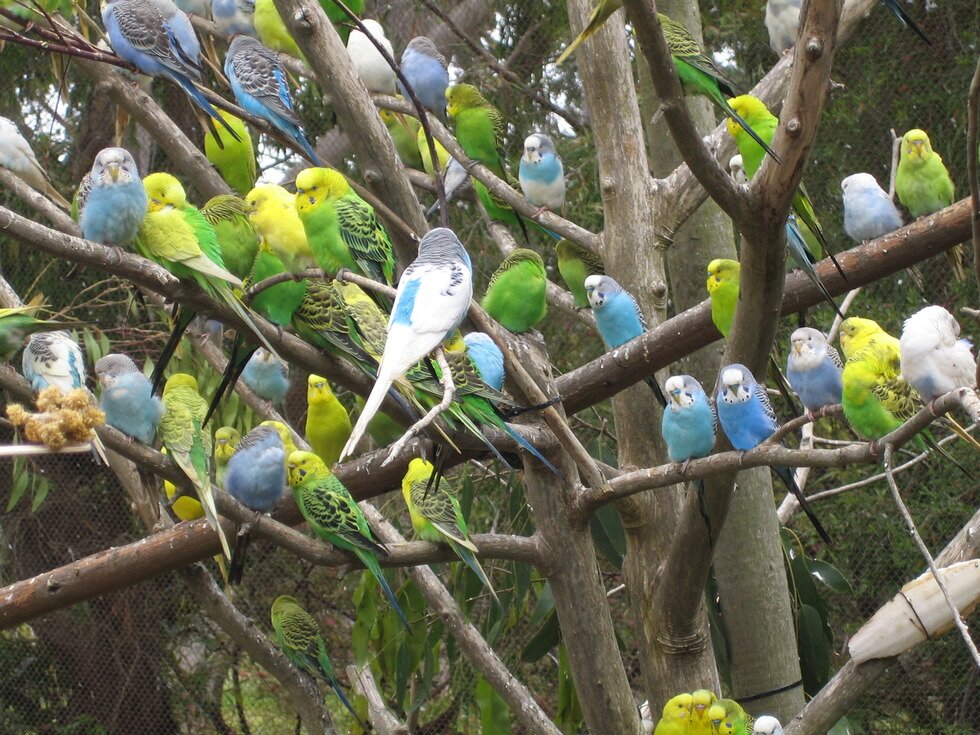
Fotografia przedstawia zielone, żółte i niebieskie papużki faliste,siedzące na drzewie. Ptaki mają różne genotypy i różne fenotypy (wygląd).
Budgerigars: different genotypes, different phenotypes
Source: Kurt Shaped Box, http://commons.wikimedia.org, licencja: CC BY-SA 2.0.
Task 1
Dominant allele of the gene responsible for the height of the pea plant will be marked with a capital D, whereas the recessive allele – with a lowercase d. Low pea plant has two recessive alleles, which is written down as genotype dd.
Decide, whether low pea plant is a homozygote or heterozygote.
Using letters, write down the genotype of tall pea plant. Explain, whether it is a homozygote or heterozygote.
R2pYvJr2U4n5s
Exercise 1
Ćwiczenie połącz w pary. Match the following notions with their definitions. genotype Możliwe odpowiedzi: 1. an organism that has in its homologous chromosomes two identical alleles of a given gene, 2. an organism that has in its homologous chromosomes two different alleles of a given gene, 3. group of all the genes of an individual that conditions his features, 4. group of all features of build and physiology of an organism that are specified by the genotype and the environment. phenotype Możliwe odpowiedzi: 1. an organism that has in its homologous chromosomes two identical alleles of a given gene, 2. an organism that has in its homologous chromosomes two different alleles of a given gene, 3. group of all the genes of an individual that conditions his features, 4. group of all features of build and physiology of an organism that are specified by the genotype and the environment. homozygote Możliwe odpowiedzi: 1. an organism that has in its homologous chromosomes two identical alleles of a given gene, 2. an organism that has in its homologous chromosomes two different alleles of a given gene, 3. group of all the genes of an individual that conditions his features, 4. group of all features of build and physiology of an organism that are specified by the genotype and the environment. heterozygote Możliwe odpowiedzi: 1. an organism that has in its homologous chromosomes two identical alleles of a given gene, 2. an organism that has in its homologous chromosomes two different alleles of a given gene, 3. group of all the genes of an individual that conditions his features, 4. group of all features of build and physiology of an organism that are specified by the genotype and the environment
Ćwiczenie połącz w pary. Match the following notions with their definitions. genotype Możliwe odpowiedzi: 1. an organism that has in its homologous chromosomes two identical alleles of a given gene, 2. an organism that has in its homologous chromosomes two different alleles of a given gene, 3. group of all the genes of an individual that conditions his features, 4. group of all features of build and physiology of an organism that are specified by the genotype and the environment. phenotype Możliwe odpowiedzi: 1. an organism that has in its homologous chromosomes two identical alleles of a given gene, 2. an organism that has in its homologous chromosomes two different alleles of a given gene, 3. group of all the genes of an individual that conditions his features, 4. group of all features of build and physiology of an organism that are specified by the genotype and the environment. homozygote Możliwe odpowiedzi: 1. an organism that has in its homologous chromosomes two identical alleles of a given gene, 2. an organism that has in its homologous chromosomes two different alleles of a given gene, 3. group of all the genes of an individual that conditions his features, 4. group of all features of build and physiology of an organism that are specified by the genotype and the environment. heterozygote Możliwe odpowiedzi: 1. an organism that has in its homologous chromosomes two identical alleles of a given gene, 2. an organism that has in its homologous chromosomes two different alleles of a given gene, 3. group of all the genes of an individual that conditions his features, 4. group of all features of build and physiology of an organism that are specified by the genotype and the environment
Match the following notions with their definitions.
an organism that has in its homologous chromosomes two identical alleles of a given gene, an organism that has in its homologous chromosomes two different alleles of a given gene, group of all features of build and physiology of an organism that are specified by the genotype and the environment, group of all the genes of an individual that conditions his features
genotype
phenotype
homozygote
heterozygote
R5rl3k11QP5IN
Exercise 2
Ćwiczenie wybierz prawidłowe odpowiedzi. Why did 3/4 of the pea plants that were created as a result of crossbreeding of the crossbreeds F1 (which is heterozygous) with violet flowers had also violet flowers? Mark all the correct answers. Możliwe odpowiedzi: 1. Because they included at least one dominating allele that conditioned the violet colour of the flowers., 2. Because in the case of pea plant, both the dominating homozygote and the heterozygote have a dominating allele that conditions the violet colour of the flowers, even though they have identical phenotypes., 3. Because in the case of a pea plant, the presence of a recessive allele that conditions the white colour of flowers is masked by the dominating allele., 4. Because they had at least one recessive allele conditioning the white colour of the flowers.
Ćwiczenie wybierz prawidłowe odpowiedzi. Why did 3/4 of the pea plants that were created as a result of crossbreeding of the crossbreeds F1 (which is heterozygous) with violet flowers had also violet flowers? Mark all the correct answers. Możliwe odpowiedzi: 1. Because they included at least one dominating allele that conditioned the violet colour of the flowers., 2. Because in the case of pea plant, both the dominating homozygote and the heterozygote have a dominating allele that conditions the violet colour of the flowers, even though they have identical phenotypes., 3. Because in the case of a pea plant, the presence of a recessive allele that conditions the white colour of flowers is masked by the dominating allele., 4. Because they had at least one recessive allele conditioning the white colour of the flowers.
Why did 3/4 of the pea plants that were created as a result of crossbreeding of the crossbreeds F1 (which is heterozygous) with violet flowers had also violet flowers? Mark all the correct answers.
Because they included at least one dominating allele that conditioned the violet colour of the flowers.
Because in the case of pea plant, both the dominating homozygote and the heterozygote have a dominating allele that conditions the violet colour of the flowers, even though they have identical phenotypes.
Because in the case of a pea plant, the presence of a recessive allele that conditions the white colour of flowers is masked by the dominating allele.
Because they had at least one recessive allele conditioning the white colour of the flowers.
Summary
Genotype is the collection of genes of a given organism, whereas a phenotype is the set of its features.
Phenotype is influenced by the genes and the environment.
Gregor Mendel created the basics of genetics in 19th century.
RsnQxak50awx8
Dokończ zdania. How was this lesson? Did you like it? Finish selected sentences. Propozycje It was easy for me (uzupełnij), It was difficult for me (uzupełnij), Today I learned (uzupełnij), I understood that (uzupełnij), It surprised me (uzupełnij).
Dokończ zdania. How was this lesson? Did you like it? Finish selected sentences. Propozycje It was easy for me (uzupełnij), It was difficult for me (uzupełnij), Today I learned (uzupełnij), I understood that (uzupełnij), It surprised me (uzupełnij).
How was this lesson? Did you like it? Finish selected sentences.
How was this lesson? Did you like it? Finish selected sentences.
allel – jedna z dwóch lub więcej odmian danego genu, odpowiedzialnego za wytworzenie konkretnej cechy organizmu; allele danego genu są położone w określonym miejscu na chromosomie
genotyp – zespół wszystkich genów danego osobnika warunkujący jego cechy; pojęcie czasem (w krzyżówkach genetycznych) używane w odniesieniu do jednej lub kilku par alleli