The birth of the Polish United Workers’ Party in 1948 is considered the beginning of StalinismStalinismStalinism in Poland. All authority was concentrated in the hands of one party, with its representatives controlling every aspect of the Poles’ lives. The state’s functioning was watched over by the all‑powerful Ministry of Public Security, which, using its elaborate terror apparatus and omnipresent indoctrinationIndoctrinationindoctrination, caused widespread fear in the Polish society. All manifestation of oppositional thinking and resistance, even within the party (the arrest of Władysław Gomułka in 1951) were brutally dealt with. As a result of the repression and purgesPurgepurges, thousands of people, including many activists and soldiers that did great services to Poland, such as General Fieldorf or Rittmeister Pilecki, lost their lives. In the economic sphere, Soviet‑model production plans were introduced (such as the Six Year Plan of 1950‑1955), and the production was geared towards catering to the expanding army. Agriculture was subjected to further collectivization, and the peasants that protested (kulaksKulakkulaks) were persecuted and universally condemned. In workplaces, competition between the workers (the Stakhanovite movementstakhanovist movementStakhanovite movement) and raising the production norms became common place. It did not, however, raise the wages, which was met with resentment from the regular workers. PropagandaPropagandaPropaganda gained a very important role in the state, imposing the “one‑and‑only” vision of the world on its receivers. Art was employed as its tool, with socialist realismsocialist realismsocialist realism becoming its leading philosophy. It portrayed the Soviet Union as the ideal country, with its leader, Joseph Stalin, portrayed as the ideal human being. To a lesser degree, the cult of personalityCult of personalitycult of personality of the President of the State Council, Bolesław Bierut, played a role in his portrayals. One of the Polish renditions of Stalinism’s characteristics was the fight against the Catholic Church, since 1948 led by Primate Stefan Wyszyński. The concordateConcordateconcordate was severed, decrees against the Church’s officials and followers were announced, and priests were being accused of spying for the USA. At the culmination of the fight, Primate Wyszyński was interned (1953‑1956) for his disagreement against the authorities’ influence on the appointment of Church officials (the famous “Non possumus” letter). The adoption of the 22 July 1952 Constitution, which changed the state’s name to “Polish People’s Republic” (PRL) and handed the authority over to the “working people of the cities and countryside”, summed up the Stalinist period in Poland. The greatest testament of the USSR’s influence on Poland was the fact that the project of the Constitution was translated into Russian, and Stalin himself wrote his comments in the text. The end of Stalinism did not come about even on the day of the cruel dictator’s death on 5 March 1953. It only arrived 3 years later, at the 20th Congress of the CPSU, when the new Soviet leader, Nikita Khrushchev, denounced his predecessor and accused him of distorting the system and committing crimes.
Task 1
R1M7sgoqi1FZA
Take a look at the timeline and learn about the most important events of the Stalinist period in Poland. 1947 The beginning of the Stakhanovite movement in Poland A house in the Warsaw neighborhood of Mariensztat is build in a mere 19 days, 4.1950 The agreement between the government and the Episcopate of Poland The primate, Stefan Wyszyński, the initiator of the agreement between the Church and the Communist authorities, which, however, did not prevent another conflicts between the authorities and the church., 10.1950 Money exchange The money exchange in the National Bank in Warsaw was diligently taken care of by Stakhanovite Danuta Stokwisz, 6.1951 The arrest of Władysław Gomułka, 22.7.1952 The adoption of the 1952 Constitution The project of the Constitution of the Polish People’s Republic with corrections by Bolesław Bierut., 1950 - 1955 Six Years Plan A banner promoting the plan, placed on the facade of the Central Trade House (still in construction at the time) during a 1 May Procession in Warsaw in 1950
Take a look at the timeline and learn about the most important events of the Stalinist period in Poland. 1947 The beginning of the Stakhanovite movement in Poland A house in the Warsaw neighborhood of Mariensztat is build in a mere 19 days, 4.1950 The agreement between the government and the Episcopate of Poland The primate, Stefan Wyszyński, the initiator of the agreement between the Church and the Communist authorities, which, however, did not prevent another conflicts between the authorities and the church., 10.1950 Money exchange The money exchange in the National Bank in Warsaw was diligently taken care of by Stakhanovite Danuta Stokwisz, 6.1951 The arrest of Władysław Gomułka, 22.7.1952 The adoption of the 1952 Constitution The project of the Constitution of the Polish People’s Republic with corrections by Bolesław Bierut., 1950 - 1955 Six Years Plan A banner promoting the plan, placed on the facade of the Central Trade House (still in construction at the time) during a 1 May Procession in Warsaw in 1950
Source: ADM/CAF, Janusz Trocha, Kazimierz Sayse-Tobiczyk, PAP/CAF-ARCHIWUM, Władysław Piotrowski, domena publiczna.
Task 2
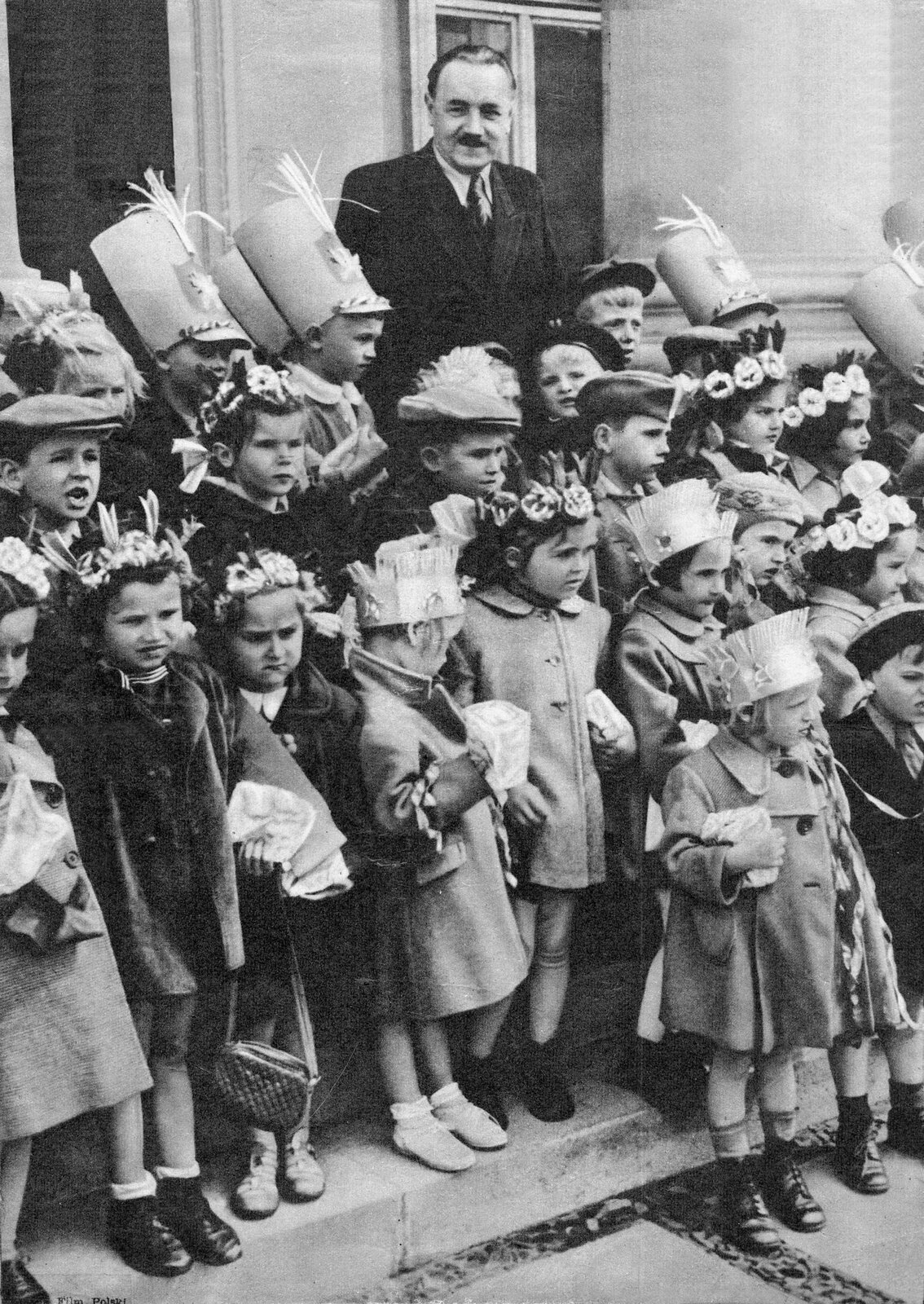
Why does Bierut was often presented around children? Does this way of creating the image of prominent politicians refer to the patterns of Soviet propaganda? Justify the answer.
R5iQVKgr59kXX
Fotografia czarno-biała przedstawiająca Bolesława Bieruta w otoczeniu dzieci.
Bolesław Bierut surrounded by children
Source: a. nn., domena publiczna.
Task 3
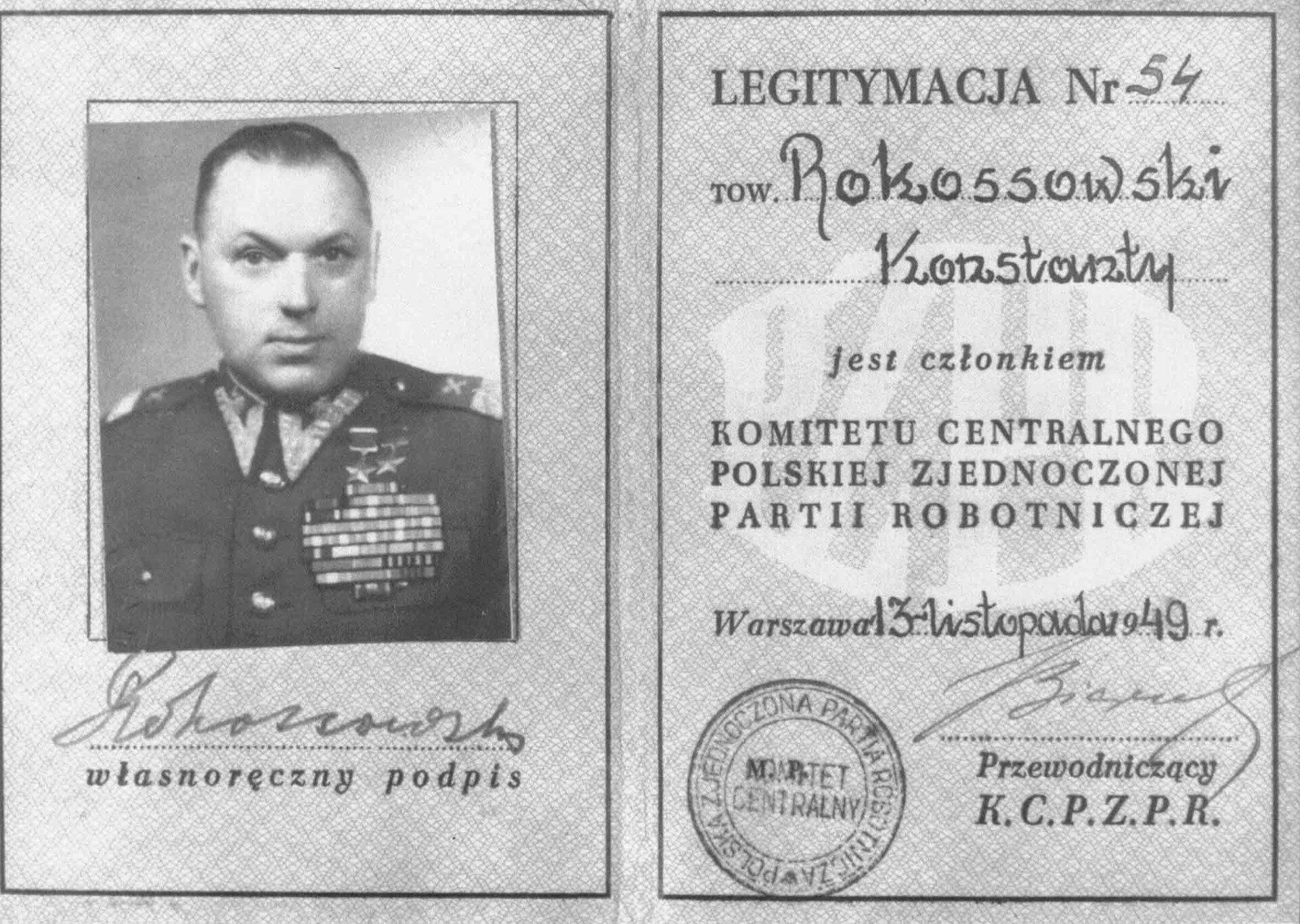
Find out (talk to grandparents, parents, look on the internet) if it was possible to occupy high positions without belonging to the ruling party.
RC4gE5ta4vL6x
Fotografia czarno-biała przedstawiająca Kartę partyjną członka PZPR Konstantego Rokossowskiego.
The party card of the PZPR member Konstanty Rokossowski
Source: Ariadna Rokossowska, Wikimedia Commons, licencja: CC BY-SA 2.5.
RnReY7xTmt2Ye1
Exercise 1
Match the terms with their definitions. Stalinism Możliwe odpowiedzi: 1. the elimination – most commonly, physical – of undesired people, usually those who lead the institutions exercising power (military, police, government). Most commonly, it is characterized by ruthlessness and mass application., 2. work competition and raising the daily production norms. In Poland, it began as early as 1947, and, as a consequence, the daily production norms were raised for every worker, with the wages frozen in place., 3. the propaganda term for peasants who did not support the Communist authorities and did not wish to undergo collectivization. It was also used to refer to peasants that owned land and hired temporary workers., 4. imposing the Soviet system and its political and economic solutions on other states using military force and propaganda., 5. an agreement between the Pope and the head of a given state that stipulates the rules of the Church’s position and functioning in the state., 6. the systematic process of imbuing the society with certain meanings and political, religious, or social ideologies. For this end, propaganda was implemented in mass media and in the education system., 7. purposeful activities meant to lead to adoption of the desired behaviors and views. It serves to spread information useful for its originator. In common speech, it is used as a synonym for lies and manipulation., 8. a totalitarian ideological system based on Stalin’s model of ruling the country and steering its economy. After World War II, it was imposed on the so-caled “people’s democracies”. In Poland, it was present until 1956. Indoctrination Możliwe odpowiedzi: 1. the elimination – most commonly, physical – of undesired people, usually those who lead the institutions exercising power (military, police, government). Most commonly, it is characterized by ruthlessness and mass application., 2. work competition and raising the daily production norms. In Poland, it began as early as 1947, and, as a consequence, the daily production norms were raised for every worker, with the wages frozen in place., 3. the propaganda term for peasants who did not support the Communist authorities and did not wish to undergo collectivization. It was also used to refer to peasants that owned land and hired temporary workers., 4. imposing the Soviet system and its political and economic solutions on other states using military force and propaganda., 5. an agreement between the Pope and the head of a given state that stipulates the rules of the Church’s position and functioning in the state., 6. the systematic process of imbuing the society with certain meanings and political, religious, or social ideologies. For this end, propaganda was implemented in mass media and in the education system., 7. purposeful activities meant to lead to adoption of the desired behaviors and views. It serves to spread information useful for its originator. In common speech, it is used as a synonym for lies and manipulation., 8. a totalitarian ideological system based on Stalin’s model of ruling the country and steering its economy. After World War II, it was imposed on the so-caled “people’s democracies”. In Poland, it was present until 1956. Sovietization Możliwe odpowiedzi: 1. the elimination – most commonly, physical – of undesired people, usually those who lead the institutions exercising power (military, police, government). Most commonly, it is characterized by ruthlessness and mass application., 2. work competition and raising the daily production norms. In Poland, it began as early as 1947, and, as a consequence, the daily production norms were raised for every worker, with the wages frozen in place., 3. the propaganda term for peasants who did not support the Communist authorities and did not wish to undergo collectivization. It was also used to refer to peasants that owned land and hired temporary workers., 4. imposing the Soviet system and its political and economic solutions on other states using military force and propaganda., 5. an agreement between the Pope and the head of a given state that stipulates the rules of the Church’s position and functioning in the state., 6. the systematic process of imbuing the society with certain meanings and political, religious, or social ideologies. For this end, propaganda was implemented in mass media and in the education system., 7. purposeful activities meant to lead to adoption of the desired behaviors and views. It serves to spread information useful for its originator. In common speech, it is used as a synonym for lies and manipulation., 8. a totalitarian ideological system based on Stalin’s model of ruling the country and steering its economy. After World War II, it was imposed on the so-caled “people’s democracies”. In Poland, it was present until 1956. Purge Możliwe odpowiedzi: 1. the elimination – most commonly, physical – of undesired people, usually those who lead the institutions exercising power (military, police, government). Most commonly, it is characterized by ruthlessness and mass application., 2. work competition and raising the daily production norms. In Poland, it began as early as 1947, and, as a consequence, the daily production norms were raised for every worker, with the wages frozen in place., 3. the propaganda term for peasants who did not support the Communist authorities and did not wish to undergo collectivization. It was also used to refer to peasants that owned land and hired temporary workers., 4. imposing the Soviet system and its political and economic solutions on other states using military force and propaganda., 5. an agreement between the Pope and the head of a given state that stipulates the rules of the Church’s position and functioning in the state., 6. the systematic process of imbuing the society with certain meanings and political, religious, or social ideologies. For this end, propaganda was implemented in mass media and in the education system., 7. purposeful activities meant to lead to adoption of the desired behaviors and views. It serves to spread information useful for its originator. In common speech, it is used as a synonym for lies and manipulation., 8. a totalitarian ideological system based on Stalin’s model of ruling the country and steering its economy. After World War II, it was imposed on the so-caled “people’s democracies”. In Poland, it was present until 1956. Kulak Możliwe odpowiedzi: 1. the elimination – most commonly, physical – of undesired people, usually those who lead the institutions exercising power (military, police, government). Most commonly, it is characterized by ruthlessness and mass application., 2. work competition and raising the daily production norms. In Poland, it began as early as 1947, and, as a consequence, the daily production norms were raised for every worker, with the wages frozen in place., 3. the propaganda term for peasants who did not support the Communist authorities and did not wish to undergo collectivization. It was also used to refer to peasants that owned land and hired temporary workers., 4. imposing the Soviet system and its political and economic solutions on other states using military force and propaganda., 5. an agreement between the Pope and the head of a given state that stipulates the rules of the Church’s position and functioning in the state., 6. the systematic process of imbuing the society with certain meanings and political, religious, or social ideologies. For this end, propaganda was implemented in mass media and in the education system., 7. purposeful activities meant to lead to adoption of the desired behaviors and views. It serves to spread information useful for its originator. In common speech, it is used as a synonym for lies and manipulation., 8. a totalitarian ideological system based on Stalin’s model of ruling the country and steering its economy. After World War II, it was imposed on the so-caled “people’s democracies”. In Poland, it was present until 1956. Stakhanovist movement Możliwe odpowiedzi: 1. the elimination – most commonly, physical – of undesired people, usually those who lead the institutions exercising power (military, police, government). Most commonly, it is characterized by ruthlessness and mass application., 2. work competition and raising the daily production norms. In Poland, it began as early as 1947, and, as a consequence, the daily production norms were raised for every worker, with the wages frozen in place., 3. the propaganda term for peasants who did not support the Communist authorities and did not wish to undergo collectivization. It was also used to refer to peasants that owned land and hired temporary workers., 4. imposing the Soviet system and its political and economic solutions on other states using military force and propaganda., 5. an agreement between the Pope and the head of a given state that stipulates the rules of the Church’s position and functioning in the state., 6. the systematic process of imbuing the society with certain meanings and political, religious, or social ideologies. For this end, propaganda was implemented in mass media and in the education system., 7. purposeful activities meant to lead to adoption of the desired behaviors and views. It serves to spread information useful for its originator. In common speech, it is used as a synonym for lies and manipulation., 8. a totalitarian ideological system based on Stalin’s model of ruling the country and steering its economy. After World War II, it was imposed on the so-caled “people’s democracies”. In Poland, it was present until 1956. Propaganda Możliwe odpowiedzi: 1. the elimination – most commonly, physical – of undesired people, usually those who lead the institutions exercising power (military, police, government). Most commonly, it is characterized by ruthlessness and mass application., 2. work competition and raising the daily production norms. In Poland, it began as early as 1947, and, as a consequence, the daily production norms were raised for every worker, with the wages frozen in place., 3. the propaganda term for peasants who did not support the Communist authorities and did not wish to undergo collectivization. It was also used to refer to peasants that owned land and hired temporary workers., 4. imposing the Soviet system and its political and economic solutions on other states using military force and propaganda., 5. an agreement between the Pope and the head of a given state that stipulates the rules of the Church’s position and functioning in the state., 6. the systematic process of imbuing the society with certain meanings and political, religious, or social ideologies. For this end, propaganda was implemented in mass media and in the education system., 7. purposeful activities meant to lead to adoption of the desired behaviors and views. It serves to spread information useful for its originator. In common speech, it is used as a synonym for lies and manipulation., 8. a totalitarian ideological system based on Stalin’s model of ruling the country and steering its economy. After World War II, it was imposed on the so-caled “people’s democracies”. In Poland, it was present until 1956. Concordate Możliwe odpowiedzi: 1. the elimination – most commonly, physical – of undesired people, usually those who lead the institutions exercising power (military, police, government). Most commonly, it is characterized by ruthlessness and mass application., 2. work competition and raising the daily production norms. In Poland, it began as early as 1947, and, as a consequence, the daily production norms were raised for every worker, with the wages frozen in place., 3. the propaganda term for peasants who did not support the Communist authorities and did not wish to undergo collectivization. It was also used to refer to peasants that owned land and hired temporary workers., 4. imposing the Soviet system and its political and economic solutions on other states using military force and propaganda., 5. an agreement between the Pope and the head of a given state that stipulates the rules of the Church’s position and functioning in the state., 6. the systematic process of imbuing the society with certain meanings and political, religious, or social ideologies. For this end, propaganda was implemented in mass media and in the education system., 7. purposeful activities meant to lead to adoption of the desired behaviors and views. It serves to spread information useful for its originator. In common speech, it is used as a synonym for lies and manipulation., 8. a totalitarian ideological system based on Stalin’s model of ruling the country and steering its economy. After World War II, it was imposed on the so-caled “people’s democracies”. In Poland, it was present until 1956.
Match the terms with their definitions. Stalinism Możliwe odpowiedzi: 1. the elimination – most commonly, physical – of undesired people, usually those who lead the institutions exercising power (military, police, government). Most commonly, it is characterized by ruthlessness and mass application., 2. work competition and raising the daily production norms. In Poland, it began as early as 1947, and, as a consequence, the daily production norms were raised for every worker, with the wages frozen in place., 3. the propaganda term for peasants who did not support the Communist authorities and did not wish to undergo collectivization. It was also used to refer to peasants that owned land and hired temporary workers., 4. imposing the Soviet system and its political and economic solutions on other states using military force and propaganda., 5. an agreement between the Pope and the head of a given state that stipulates the rules of the Church’s position and functioning in the state., 6. the systematic process of imbuing the society with certain meanings and political, religious, or social ideologies. For this end, propaganda was implemented in mass media and in the education system., 7. purposeful activities meant to lead to adoption of the desired behaviors and views. It serves to spread information useful for its originator. In common speech, it is used as a synonym for lies and manipulation., 8. a totalitarian ideological system based on Stalin’s model of ruling the country and steering its economy. After World War II, it was imposed on the so-caled “people’s democracies”. In Poland, it was present until 1956. Indoctrination Możliwe odpowiedzi: 1. the elimination – most commonly, physical – of undesired people, usually those who lead the institutions exercising power (military, police, government). Most commonly, it is characterized by ruthlessness and mass application., 2. work competition and raising the daily production norms. In Poland, it began as early as 1947, and, as a consequence, the daily production norms were raised for every worker, with the wages frozen in place., 3. the propaganda term for peasants who did not support the Communist authorities and did not wish to undergo collectivization. It was also used to refer to peasants that owned land and hired temporary workers., 4. imposing the Soviet system and its political and economic solutions on other states using military force and propaganda., 5. an agreement between the Pope and the head of a given state that stipulates the rules of the Church’s position and functioning in the state., 6. the systematic process of imbuing the society with certain meanings and political, religious, or social ideologies. For this end, propaganda was implemented in mass media and in the education system., 7. purposeful activities meant to lead to adoption of the desired behaviors and views. It serves to spread information useful for its originator. In common speech, it is used as a synonym for lies and manipulation., 8. a totalitarian ideological system based on Stalin’s model of ruling the country and steering its economy. After World War II, it was imposed on the so-caled “people’s democracies”. In Poland, it was present until 1956. Sovietization Możliwe odpowiedzi: 1. the elimination – most commonly, physical – of undesired people, usually those who lead the institutions exercising power (military, police, government). Most commonly, it is characterized by ruthlessness and mass application., 2. work competition and raising the daily production norms. In Poland, it began as early as 1947, and, as a consequence, the daily production norms were raised for every worker, with the wages frozen in place., 3. the propaganda term for peasants who did not support the Communist authorities and did not wish to undergo collectivization. It was also used to refer to peasants that owned land and hired temporary workers., 4. imposing the Soviet system and its political and economic solutions on other states using military force and propaganda., 5. an agreement between the Pope and the head of a given state that stipulates the rules of the Church’s position and functioning in the state., 6. the systematic process of imbuing the society with certain meanings and political, religious, or social ideologies. For this end, propaganda was implemented in mass media and in the education system., 7. purposeful activities meant to lead to adoption of the desired behaviors and views. It serves to spread information useful for its originator. In common speech, it is used as a synonym for lies and manipulation., 8. a totalitarian ideological system based on Stalin’s model of ruling the country and steering its economy. After World War II, it was imposed on the so-caled “people’s democracies”. In Poland, it was present until 1956. Purge Możliwe odpowiedzi: 1. the elimination – most commonly, physical – of undesired people, usually those who lead the institutions exercising power (military, police, government). Most commonly, it is characterized by ruthlessness and mass application., 2. work competition and raising the daily production norms. In Poland, it began as early as 1947, and, as a consequence, the daily production norms were raised for every worker, with the wages frozen in place., 3. the propaganda term for peasants who did not support the Communist authorities and did not wish to undergo collectivization. It was also used to refer to peasants that owned land and hired temporary workers., 4. imposing the Soviet system and its political and economic solutions on other states using military force and propaganda., 5. an agreement between the Pope and the head of a given state that stipulates the rules of the Church’s position and functioning in the state., 6. the systematic process of imbuing the society with certain meanings and political, religious, or social ideologies. For this end, propaganda was implemented in mass media and in the education system., 7. purposeful activities meant to lead to adoption of the desired behaviors and views. It serves to spread information useful for its originator. In common speech, it is used as a synonym for lies and manipulation., 8. a totalitarian ideological system based on Stalin’s model of ruling the country and steering its economy. After World War II, it was imposed on the so-caled “people’s democracies”. In Poland, it was present until 1956. Kulak Możliwe odpowiedzi: 1. the elimination – most commonly, physical – of undesired people, usually those who lead the institutions exercising power (military, police, government). Most commonly, it is characterized by ruthlessness and mass application., 2. work competition and raising the daily production norms. In Poland, it began as early as 1947, and, as a consequence, the daily production norms were raised for every worker, with the wages frozen in place., 3. the propaganda term for peasants who did not support the Communist authorities and did not wish to undergo collectivization. It was also used to refer to peasants that owned land and hired temporary workers., 4. imposing the Soviet system and its political and economic solutions on other states using military force and propaganda., 5. an agreement between the Pope and the head of a given state that stipulates the rules of the Church’s position and functioning in the state., 6. the systematic process of imbuing the society with certain meanings and political, religious, or social ideologies. For this end, propaganda was implemented in mass media and in the education system., 7. purposeful activities meant to lead to adoption of the desired behaviors and views. It serves to spread information useful for its originator. In common speech, it is used as a synonym for lies and manipulation., 8. a totalitarian ideological system based on Stalin’s model of ruling the country and steering its economy. After World War II, it was imposed on the so-caled “people’s democracies”. In Poland, it was present until 1956. Stakhanovist movement Możliwe odpowiedzi: 1. the elimination – most commonly, physical – of undesired people, usually those who lead the institutions exercising power (military, police, government). Most commonly, it is characterized by ruthlessness and mass application., 2. work competition and raising the daily production norms. In Poland, it began as early as 1947, and, as a consequence, the daily production norms were raised for every worker, with the wages frozen in place., 3. the propaganda term for peasants who did not support the Communist authorities and did not wish to undergo collectivization. It was also used to refer to peasants that owned land and hired temporary workers., 4. imposing the Soviet system and its political and economic solutions on other states using military force and propaganda., 5. an agreement between the Pope and the head of a given state that stipulates the rules of the Church’s position and functioning in the state., 6. the systematic process of imbuing the society with certain meanings and political, religious, or social ideologies. For this end, propaganda was implemented in mass media and in the education system., 7. purposeful activities meant to lead to adoption of the desired behaviors and views. It serves to spread information useful for its originator. In common speech, it is used as a synonym for lies and manipulation., 8. a totalitarian ideological system based on Stalin’s model of ruling the country and steering its economy. After World War II, it was imposed on the so-caled “people’s democracies”. In Poland, it was present until 1956. Propaganda Możliwe odpowiedzi: 1. the elimination – most commonly, physical – of undesired people, usually those who lead the institutions exercising power (military, police, government). Most commonly, it is characterized by ruthlessness and mass application., 2. work competition and raising the daily production norms. In Poland, it began as early as 1947, and, as a consequence, the daily production norms were raised for every worker, with the wages frozen in place., 3. the propaganda term for peasants who did not support the Communist authorities and did not wish to undergo collectivization. It was also used to refer to peasants that owned land and hired temporary workers., 4. imposing the Soviet system and its political and economic solutions on other states using military force and propaganda., 5. an agreement between the Pope and the head of a given state that stipulates the rules of the Church’s position and functioning in the state., 6. the systematic process of imbuing the society with certain meanings and political, religious, or social ideologies. For this end, propaganda was implemented in mass media and in the education system., 7. purposeful activities meant to lead to adoption of the desired behaviors and views. It serves to spread information useful for its originator. In common speech, it is used as a synonym for lies and manipulation., 8. a totalitarian ideological system based on Stalin’s model of ruling the country and steering its economy. After World War II, it was imposed on the so-caled “people’s democracies”. In Poland, it was present until 1956. Concordate Możliwe odpowiedzi: 1. the elimination – most commonly, physical – of undesired people, usually those who lead the institutions exercising power (military, police, government). Most commonly, it is characterized by ruthlessness and mass application., 2. work competition and raising the daily production norms. In Poland, it began as early as 1947, and, as a consequence, the daily production norms were raised for every worker, with the wages frozen in place., 3. the propaganda term for peasants who did not support the Communist authorities and did not wish to undergo collectivization. It was also used to refer to peasants that owned land and hired temporary workers., 4. imposing the Soviet system and its political and economic solutions on other states using military force and propaganda., 5. an agreement between the Pope and the head of a given state that stipulates the rules of the Church’s position and functioning in the state., 6. the systematic process of imbuing the society with certain meanings and political, religious, or social ideologies. For this end, propaganda was implemented in mass media and in the education system., 7. purposeful activities meant to lead to adoption of the desired behaviors and views. It serves to spread information useful for its originator. In common speech, it is used as a synonym for lies and manipulation., 8. a totalitarian ideological system based on Stalin’s model of ruling the country and steering its economy. After World War II, it was imposed on the so-caled “people’s democracies”. In Poland, it was present until 1956.
Match the terms with their definitions.
the systematic process of imbuing the society with certain meanings and political, religious, or social ideologies. For this end, propaganda was implemented in mass media and in the education system., purposeful activities meant to lead to adoption of the desired behaviors and views. It serves to spread information useful for its originator. In common speech, it is used as a synonym for lies and manipulation., an agreement between the Pope and the head of a given state that stipulates the rules of the Church’s position and functioning in the state., imposing the Soviet system and its political and economic solutions on other states using military force and propaganda., work competition and raising the daily production norms. In Poland, it began as early as 1947, and, as a consequence, the daily production norms were raised for every worker, with the wages frozen in place., the propaganda term for peasants who did not support the Communist authorities and did not wish to undergo collectivization. It was also used to refer to peasants that owned land and hired temporary workers., a totalitarian ideological system based on Stalin’s model of ruling the country and steering its economy. After World War II, it was imposed on the so-caled “people’s democracies”. In Poland, it was present until 1956., the elimination – most commonly, physical – of undesired people, usually those who lead the institutions exercising power (military, police, government). Most commonly, it is characterized by ruthlessness and mass application.
Stalinism
Indoctrination
Sovietization
Purge
Kulak
Stakhanovist movement
Propaganda
Concordate
Keywords
Stalinism, indoctrination, cult of personality, propaganda, concordate, socialist realism
Stalinizm – totalitarny system ideologiczny ukształtowany na podstawie modelu rządzenia państwem i kierowania jego gospodarką przez Stalina. Po II wojnie światowej został narzucony państwom tzw. demokracji ludowej. W Polsce istniał do 1956 r.
Indoktrynacja – systematyczny proces wpajania społeczeństwu określonych treści i ideologii politycznych, religijnych lub społecznych. Wykorzystywano w tym celu propagandę w środkach masowego przekazu i systemie nauki szkolnej.
Czystka – eliminacja, najczęściej fizyczna, niepożądanych osób zwykle stojących na czele instytucji sprawujących władzę (wojsko, policja, rząd). Najczęściej charakteryzuje się bezwzględnością i masowością.
Kułak – propagandowe określenie chłopów, którzy byli niechętni władzy komunistycznej i nie chcieli poddać się kolektywizacji. Określano tak również chłopów posiadających ziemię i zatrudniających robotników najemnych.
Ruch stachanowski (przodownictwo pracy) – współzawodnictwo pracy i wyrabianie coraz wyższych norm. W Polsce rozpoczął się już w 1947 r., a jego konsekwencją stało się podnoszenie norm pracy dla wszystkich robotników bez wzrostu wynagrodzeń.
Kult jednostki – propagandowe przedstawianie jednostki (najczęściej przywódcy) jako osobę nieprzeciętną i nieomylną, obdarzoną niemal boskimi cechami. Objawiał się idealistycznymi przedstawieniami w kulturze, sztuce i literaturze. Jest charakterystyczny dla ustrojów totalitarnych.
Propaganda – celowe działania, które mają doprowadzić do określonych zachować i poglądów. Służy ona do upowszechnienia dogodnych informacji dla nadawcy. W języku potocznym synonim kłamstwa i manipulacji.
Socrealizm – kierunek w sztuce powstały w 1934 r. w Związku Radzieckim, a po II wojnie światowej rozpropagowany w pozostałych krajach bloku wschodniego. Miał status jedynej metody twórczości artystycznej. Cechował się realizmem i był narzędziem propagandy komunistycznej.