A market is an actual or nominal place where forces of demand and supply operations, and where buyers and sellers interact to trade goods and services.
Working is a natural way of participating in social life.
You will learn
You will be able to explain the need for “decentdecentdecent work”, and discuss why all forms of forced labour or slavery should be eliminated.
You will be able to analyze the role of work in human life and discuss the phenomenon of unemployment.
The functioning of the labour market is an important condition and a factor in the development of an economy. The labour market should also achieve social goals, i.e. the right to work.
In accordance with the Universal Declaration of Human Rights, adopted by the United Nations in 1948 and Convention No. 122 on the Employment Policy of the International Labour Organization of 1964, a man has the right to freely choose the type and place of work, carried out in safe conditions, productive and rewarded in a way that ensures existence in dignitydignitydignity.
At the same time, the Declaration on Fundamental Principles and Rights at Work adopted by the International Labour Organization in 1998, defines the four most important areas of workers' rights:
freedom of association and the effective recognition of the right to collective bargaining,
the elimination of all forced or compulsory labour,
the abolition of child labour,
the elimination of discrimination in respect of employment and occupation.
What is work for a modern man?
Work is a human activity aiming at the production of goods and services, so it is a purposefulpurposefulpurposeful activity that is supposed to provide a man with the conditions for existence and development. Thanks to work, products and services are supplied that serve human needs. UndoubtedlyundoubtedlyUndoubtedly, the change in the nature of the economy (from industrial to service economy) means that work, which is one of the factors of production in the economy, is also changed.
Work is also a way of creating new bonds between people - the bonds of cooperation. New relations and a new community are created – a workplace (enterprise). Therefore, jobs cannot be considered only in economic terms. Work is one of the most important elements in people’s lives, a value, because thanks to work people can function in a specific society, make new contacts, and plan the implementation of future goals.
Work plays an important role in the life of a man, but also in societies as a whole. According to public opinion polls, work is an undeniableundeniableundeniable value.
RBjybaI4LZ35c
Infografika zatytułowana: Three basic functions of the work. Poniżej tytułu znajdują się trzy podpunkty.: 1. economic function. Work is a factor in creating GDP (gross domestic product). Work enables the increase of production of goods and services, contributes to the increase of social well-being. It is the most active factor in the economic process, because it is people who start machines, drive means of transport, etc. Efficiency of work depends on many factors:
a. knowledge, skills, talents of people (the so-called human capital),
b. motivation to work and innovation,
c. working conditions and technical level of machines, devices, means of transport and communication.
2. income function. Work is a way of earning income. People work mainly to obtain the necessary funds for living. Income from work is the most important and the most desirable form of income.
3. social function. Work is a means of satisfying professional and social aspirations. People spend a significant part of their lives in the work environment. Employees expect employers to treat them as partners in the process of work and business.
Infografika zatytułowana: Three basic functions of the work. Poniżej tytułu znajdują się trzy podpunkty.: 1. economic function. Work is a factor in creating GDP (gross domestic product). Work enables the increase of production of goods and services, contributes to the increase of social well-being. It is the most active factor in the economic process, because it is people who start machines, drive means of transport, etc. Efficiency of work depends on many factors:
a. knowledge, skills, talents of people (the so-called human capital),
b. motivation to work and innovation,
c. working conditions and technical level of machines, devices, means of transport and communication.
2. income function. Work is a way of earning income. People work mainly to obtain the necessary funds for living. Income from work is the most important and the most desirable form of income.
3. social function. Work is a means of satisfying professional and social aspirations. People spend a significant part of their lives in the work environment. Employees expect employers to treat them as partners in the process of work and business.
The functions of the work
It is very difficult to judge what it means to “have a good job”. The same type of work may be perceivedto perceiveperceived as good by one person, and as bad by another – bring joy, fulfillment, and a fair pay or be a highly unpleasant, unprofitable waste of time. Also in science when describing the nature of work, this duality of assessment criteria is emphasized. However, it is important that in cases where the work conditions are assessed negatively, actions are undertaken to improve them.
Standards for such an improvement have been set by the international law. In 1999, the International Labour Organization coinedto coincoined a term “decent work” – as the kind of work which brings satisfaction and leads to self‑development and the development of the enterprise. The term has also been included into the European law. The introduction of term is based on the assumption that work is a source of personal dignity, stability of the family and peace in society. Decent work strengthens democracy, because it contributesto contributecontributes to economic growth, which extends the possibilities of creating jobs and developing entrepreneurship.
However, work is not always considered decent. Forced or slavery work are two examples of work that is not “decent”. International Labour Organization Forced Labour Convention (No. 29, 1930) provides a definition of forced labour - forced or compulsory labour is “all work or service which is exactedto exactexacted from any person under the menacemenacemenace of any penalty and for which the said person has not offered himself voluntarily”. An International Labour Organization report published in 2014 describes how forced labour thrivesto thrivethrives in favourablefavourablefavourable conditions of poverty and vulnerabilityvulnerabilityvulnerability, low levels of education and literacyliteracyliteracy or migration. The number of victims of forced labour in the world is stimatedto estimatestimated at 20,9 million, of which 14,2 million are victims of labour exploitationexploitationexploitation, 4,5 million sexual exploitation, and 2,2 million work forced by the state. The largest share of forced labour cases occurs in the Asia‑Pacific region (11,7 million). In developed countries and the EU, the number of victims is estimated at 1,5 million. The basic premisepremisepremise that makes people become victims of forced labour is their economic situation.
On the other hand, slave labour and slavery should be understood as “the status or condition of a person over whom any or all of the powers attaching to the right of ownership are exercised” (League of Nations Slavery Convention of 1926). This legal expression means that a person or group of people is an object that can be freely acquired or sold. Formally, slavery is now bannedbannedbanned in all countries of the world, but in fact it still exists, although it usually takes the form of forced labour (e.g. Chinese or Burmese labour camps, children as cheap labour). FigurativelyfigurativelyFiguratively, the term „slave labour” is used to refer to heavy or poorly paid work, often the only one available.
Unemployment
Unemployment is a state opposite of work as an economic activity. It is a social phenomenon, a situation in which some people who are able and willing to work are not employed. The phenomenon of unemployment in Poland is measured in two ways:
as the total number of persons registered in institutions appointed to serve the unemployed (the so‑called registered unemployment),
as a number estimated on the basis of surveyssurveysurveys – the total number of people who were not employed in the week precedingprecedingpreceding the survey, although they were actively looking for a job and were ready to take it. In this case, in Poland, for example, we are talking about BAEL unemployment.
RhfxjaKJpnpEZ
BAEL (Badania Aktywności Ekonomicznej Ludności, Economic Activity Survey) The BAEL survey has been carried out by the Central Statistical Office (GUS) in Poland since 1992 as a permanent, representative study addressed to households and people aged 15 and more, who are members of these households. It is conducted using the direct interview method with the use of two questionnaires - one common for all members of the household and individual questionnaires addressed to individual household members who have reached the age of 15.
The study is based on definitions of the economically active population, the employed and the unemployed recommended for use by the International Labour Organization and the EU regulations.
The BAEL survey is a source of information on the size of the labour force, its structure (according to basic demographic and social characteristics), spatial distribution of labour force and its status on the labour market. It is the source of basic data for calculating labour market indicators, as well as for international comparisons.
When analyzing the labour market, three groups of people should be considered according to the age criterion:
1. group in the pre-working age (17 years and less),
2. working age group, divided into subgroups:
up to 44 years – mobile working age,
over 44 years until retirement – so-called immobile working age,
3. post-working age group – i.e. after reaching the retirement age – after the age of 65 for men, and 60 for women.
Analyzing the population according to this criterion makes it possible to project economic growth, unemployment level, etc.
We can apply additional criteria to find out if we have an improvement or a worsening situation in the labour market. Some questions to be taken into consideration:
How many people are professionally/economically active?
How many people do not work, but also do not look for employment? What are the reasons for such a situation?
How many people are unemployed? How many are working?
The resources of the labour market are the working people and the unemployed. These resources are called economically active people or simply – the labour force., Economically active population (labour force) People of working age who work or want to work. This group includes both people who work professionally (employers, employees, self-employed, members of family helping at work free of charge), as well as unemployed people actively seeking employment and those interested in taking up employment. The economically active people, however, do not include neither apprentices, housewives, people living solely from capital, officers and soldiers of professional state units conducting activities in the field of national defense and public safety, nor soldiers currently in compulsory military service.
People of working age, who do not have a job for various reasons, are included in the group of economically inactive people., Economically inactive population Persons aged 15 and more who have not been classified as working or unemployed according to the following criteria, i.e. persons who during the period of the surveyed week:
were not working, did not have a job and were not looking for it,
were not working, yet were looking for a job, but were not ready to take it in the next two weeks,
were not working and were not looking for a job because they had a job arranged and were waiting for it to start in the period:
– longer than 3 months,
– up to 3 months, but they were not ready to take this job.
An economically inactive person is a person who is of working age, but does not take up work, for example due to:
learning and increasing her qualifications,
illness or disability,
household duties (e.g. taking care of a family member),
pensions.
The reason for professional inactivity may also be discouragement because of a long-term job search. Of course, being unemployed does not mean that we will not find a job. The same applies to a professionally inactive person - even someone who has been looking for work for a long time without any effects and has given up further search may come across an offer of work right for him.
BAEL (Badania Aktywności Ekonomicznej Ludności, Economic Activity Survey) The BAEL survey has been carried out by the Central Statistical Office (GUS) in Poland since 1992 as a permanent, representative study addressed to households and people aged 15 and more, who are members of these households. It is conducted using the direct interview method with the use of two questionnaires - one common for all members of the household and individual questionnaires addressed to individual household members who have reached the age of 15.
The study is based on definitions of the economically active population, the employed and the unemployed recommended for use by the International Labour Organization and the EU regulations.
The BAEL survey is a source of information on the size of the labour force, its structure (according to basic demographic and social characteristics), spatial distribution of labour force and its status on the labour market. It is the source of basic data for calculating labour market indicators, as well as for international comparisons.
When analyzing the labour market, three groups of people should be considered according to the age criterion:
1. group in the pre-working age (17 years and less),
2. working age group, divided into subgroups:
up to 44 years – mobile working age,
over 44 years until retirement – so-called immobile working age,
3. post-working age group – i.e. after reaching the retirement age – after the age of 65 for men, and 60 for women.
Analyzing the population according to this criterion makes it possible to project economic growth, unemployment level, etc.
We can apply additional criteria to find out if we have an improvement or a worsening situation in the labour market. Some questions to be taken into consideration:
How many people are professionally/economically active?
How many people do not work, but also do not look for employment? What are the reasons for such a situation?
How many people are unemployed? How many are working?
The resources of the labour market are the working people and the unemployed. These resources are called economically active people or simply – the labour force., Economically active population (labour force) People of working age who work or want to work. This group includes both people who work professionally (employers, employees, self-employed, members of family helping at work free of charge), as well as unemployed people actively seeking employment and those interested in taking up employment. The economically active people, however, do not include neither apprentices, housewives, people living solely from capital, officers and soldiers of professional state units conducting activities in the field of national defense and public safety, nor soldiers currently in compulsory military service.
People of working age, who do not have a job for various reasons, are included in the group of economically inactive people., Economically inactive population Persons aged 15 and more who have not been classified as working or unemployed according to the following criteria, i.e. persons who during the period of the surveyed week:
were not working, did not have a job and were not looking for it,
were not working, yet were looking for a job, but were not ready to take it in the next two weeks,
were not working and were not looking for a job because they had a job arranged and were waiting for it to start in the period:
– longer than 3 months,
– up to 3 months, but they were not ready to take this job.
An economically inactive person is a person who is of working age, but does not take up work, for example due to:
learning and increasing her qualifications,
illness or disability,
household duties (e.g. taking care of a family member),
pensions.
The reason for professional inactivity may also be discouragement because of a long-term job search. Of course, being unemployed does not mean that we will not find a job. The same applies to a professionally inactive person - even someone who has been looking for work for a long time without any effects and has given up further search may come across an offer of work right for him.
Definitions
BAEL (Badania Aktywności Ekonomicznej Ludności, Economic Activity Survey) The BAEL survey has been carried out by the Central Statistical Office (GUS) in Poland since 1992 as a permanent, representative study addressed to households and people aged 15 and more, who are members of these households. It is conducted using the direct interview method with the use of two questionnaires - one common for all members of the household and individual questionnaires addressed to individual household members who have reached the age of 15.
The study is based on definitions of the economically active population, the employed and the unemployed recommended for use by the International Labour Organization and the EU regulations.
The BAEL survey is a source of information on the size of the labour force, its structure (according to basic demographic and social characteristics), spatial distribution of labour force and its status on the labour market. It is the source of basic data for calculating labour market indicators, as well as for international comparisons.
When analyzing the labour market, three groups of people should be considered according to the age criterion:
1. group in the pre-working age (17 years and less),
2. working age group, divided into subgroups:
up to 44 years – mobile working age,
over 44 years until retirement – so-called immobile working age,
3. post-working age group – i.e. after reaching the retirement age – after the age of 65 for men, and 60 for women.
Analyzing the population according to this criterion makes it possible to project economic growth, unemployment level, etc.
We can apply additional criteria to find out if we have an improvement or a worsening situation in the labour market. Some questions to be taken into consideration:
How many people are professionally/economically active?
How many people do not work, but also do not look for employment? What are the reasons for such a situation?
How many people are unemployed? How many are working?
The resources of the labour market are the working people and the unemployed. These resources are called economically active people or simply – the labour force.
Economically active population (labour force) People of working age who work or want to work. This group includes both people who work professionally (employers, employees, self-employed, members of family helping at work free of charge), as well as unemployed people actively seeking employment and those interested in taking up employment. The economically active people, however, do not include neither apprentices, housewives, people living solely from capital, officers and soldiers of professional state units conducting activities in the field of national defense and public safety, nor soldiers currently in compulsory military service.
People of working age, who do not have a job for various reasons, are included in the group of economically inactive people.
Economically inactive population Persons aged 15 and more who have not been classified as working or unemployed according to the following criteria, i.e. persons who during the period of the surveyed week:
were not working, did not have a job and were not looking for it,
were not working, yet were looking for a job, but were not ready to take it in the next two weeks,
were not working and were not looking for a job because they had a job arranged and were waiting for it to start in the period:
– longer than 3 months,
– up to 3 months, but they were not ready to take this job.
An economically inactive person is a person who is of working age, but does not take up work, for example due to:
learning and increasing her qualifications,
illness or disability,
household duties (e.g. taking care of a family member),
pensions.
The reason for professional inactivity may also be discouragement because of a long-term job search. Of course, being unemployed does not mean that we will not find a job. The same applies to a professionally inactive person - even someone who has been looking for work for a long time without any effects and has given up further search may come across an offer of work right for him.
The labour market consists of all issues related to shaping the supply and demand for labour. This includes conditions in which contacts between employees and employers are made.
From the point of view of the labour market, it is important what the number of people who are currently working or can work is. It should also be taken into account how the market will change in the future - how many people will enter the market or retire. Similarly as in the whole economy, current data is analyzed, but it is also forecastedforecastedforecasted what the situation will look like in the coming months and years.
R1GK4uQLHYAXN
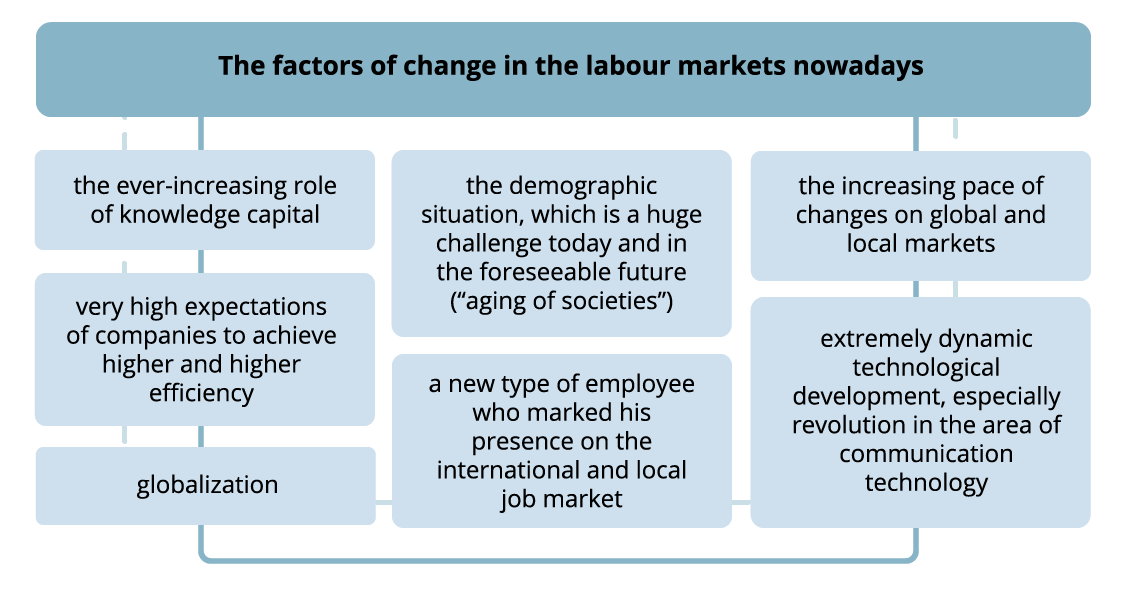
Infografika zatytułowana: The factors of change in the labour markets nowadays. Poniżej głównego elementu znajdują się następujące podpunkty: Pierwsza grupa: 1. the ever-increasing role of knowledge capital. 2. very high expectations of companies to achieve higher and higher efficiency. 3. globalization. Druga grupa: 1.the increasing pace of changes on global and local markets. 2. extremely dynamic technological development, especially revolution in the area of communication technology. Pomiędzy grupami znajdują się dwa elementy: 1. the demographic situation, which is a huge challenge today and in the foreseeable future ("aging of societies"). 2. a new type of employee who marked his presence on the international and local job market. Wszystkie elementy połączone są ze sobą linią poza - the demographic situation, which is a huge challenge today and in the foreseeable future ("aging of societies").
R1aml9qR2sQxH
Exercise 1
Ćwiczenie alternatywne: Listen to the abstract recording to review the material and new vocabulary. Then do the vocabulary exercise. Explain the meaning of following words: to contribute; spatial distribution; exploitation; to estimate; disability; dignity; purposeful; to thrive. If it's too difficult, use lesson's glossary.
Ćwiczenie alternatywne: Listen to the abstract recording to review the material and new vocabulary. Then do the vocabulary exercise. Explain the meaning of following words: to contribute; spatial distribution; exploitation; to estimate; disability; dignity; purposeful; to thrive. If it's too difficult, use lesson's glossary.
Listen to the abstract recording to review the material and new vocabulary. Then do the vocabulary exercise. Match the pairs: English and Polish words.