Analyse the slideshow concerning the natural, even and triangular numbers.
R1WDrYvHWTZa31
Pokaz multimedialny - liczby parzyste i trójkątne. Instrukcja obsługi z poziomu klawiatury: 1. Uruchomienie aplikacji - ENTER, 2. Na każdym ze slajdów czytany jest automatycznie tekst alternatywny po polsku, 3. Przy pierwszym uruchomieniu na pierwszym slajdzie, czytanie tekstu po angielsku - TAB, 4. Przejście między slajdami: do następnego slajdu - TAB, do poprzedniego slajdu - TAB + SHIFT, 5. Przejście do czytania napisu po angielsku - strzałka w górę + strzałka w dół (czyta tekst po angielsku widoczny na slajdzie).
Pokaz multimedialny - liczby parzyste i trójkątne. Instrukcja obsługi z poziomu klawiatury: 1. Uruchomienie aplikacji - ENTER, 2. Na każdym ze slajdów czytany jest automatycznie tekst alternatywny po polsku, 3. Przy pierwszym uruchomieniu na pierwszym slajdzie, czytanie tekstu po angielsku - TAB, 4. Przejście między slajdami: do następnego slajdu - TAB, do poprzedniego slajdu - TAB + SHIFT, 5. Przejście do czytania napisu po angielsku - strzałka w górę + strzałka w dół (czyta tekst po angielsku widoczny na slajdzie).
Write the algebraic expression describing the following:
a. the natural number divided by 3, b. the sum of two subsequent natural numbers divided by 3, c. the odd number, d. the sum of four subsequent odd natural numbers.
a. 3n, n – any natural number b. 3n + 3n + 3 = 6n + 3, n – any natural number c. 2n + 1, n – any natural number d. 2n + 1 + 2n + 3 + 2n + 5 + 2n + 7 = 8n + 16
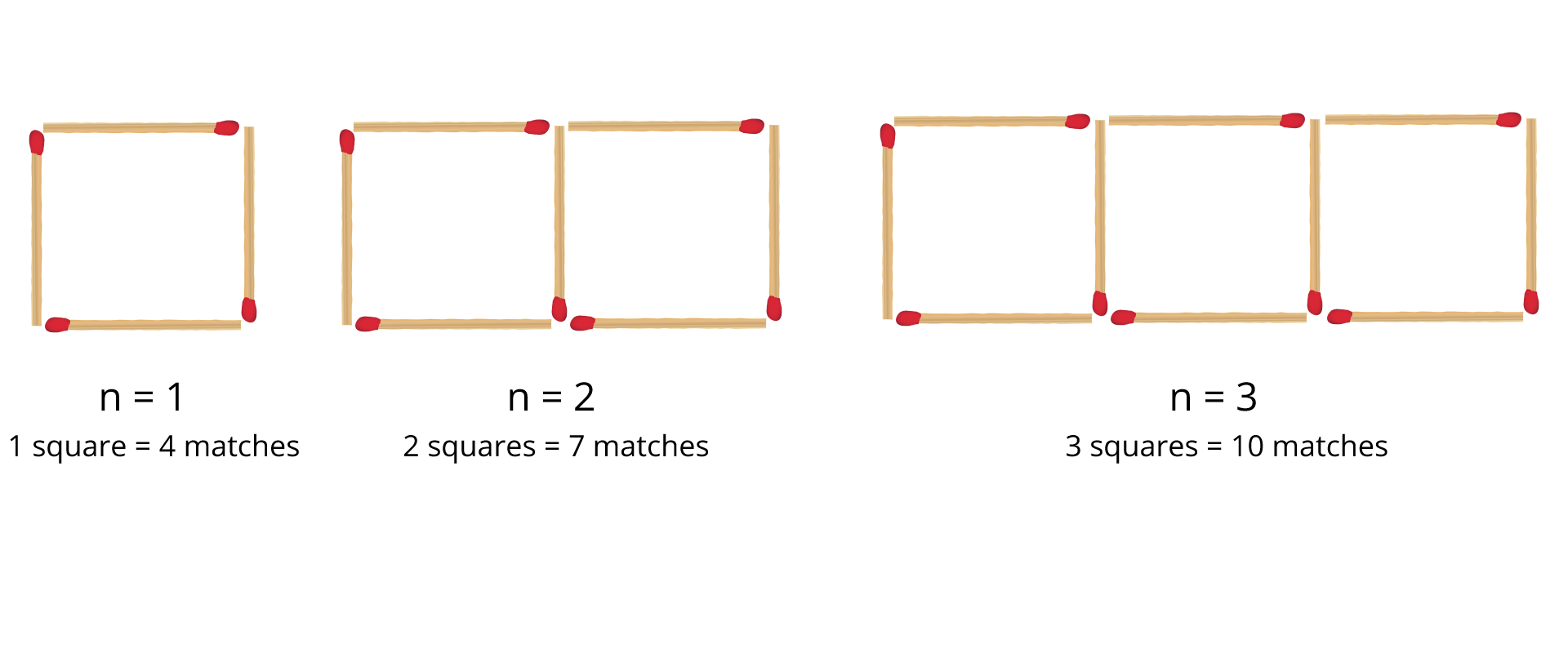
Rysunek przedstawia trzy figury zbudowane z zapałek. Pierwsza figura to kwadrat zbudowany z czterech zapałek, poniżej podpis n równa się 1, 1 square równa się 4 matches. Druga figura to dwa kwadraty o wspólnym boku zbudowane z siedmiu zapałek, poniżej podpis n równa się 2, 2 squares równa się 7 matches. Trzecia figura to trzy kwadraty (pierwszy i drugi mają wspólny bok, drugi i trzeci mają wspólny bok) zbudowane z dziesięciu zapałek, poniżej podpis n równa się 3, 3 squares równa się 10 matches.
a. Make four squares in the presented way. How many matches will you need?
b. Make five squares in the presented way. How many matches will you need?
c. Write the algebraic expression describing the number of matches you need to construct n number of the squares. Hint: Note, that to make any new square you need three matches (the fourth side belongs to the next square). We have to add another match when we want to finish our puzzle.
d. How many matches should be used to construct a hundred of squares in such a way?
b. Add the matches in such a way the polygons you have made have the common side. Make the second and the third figure using that method. How many matches do the figures consist of?
c. Write down the algebraic expression describing the number of matches used to construct the n number of polygons.
Find out on the Internet the information about the square numbers and their geometric interpretation.
a. Calculate the sum of the fifth, the seventh and the ninth square number. b. Write down the algebraic expression describing the sum of two subsequent square numbers.
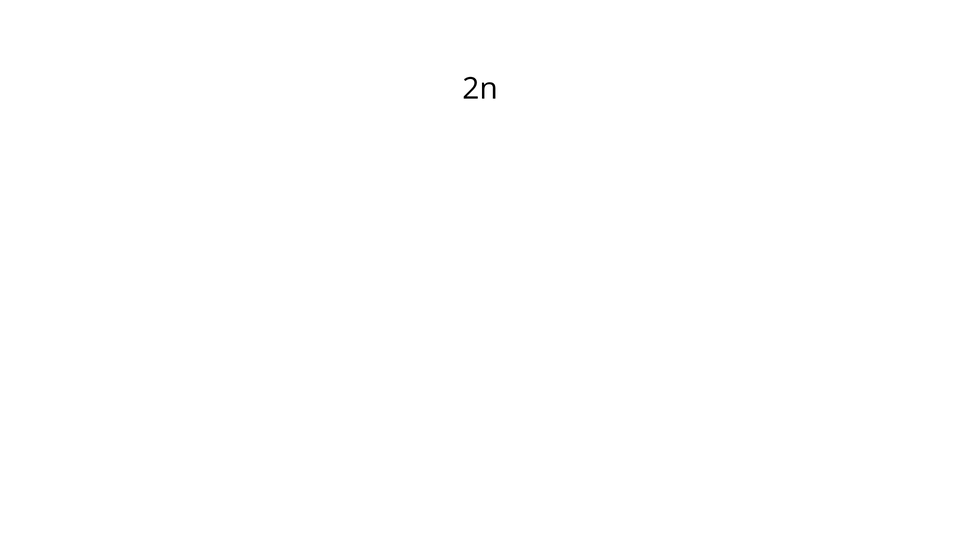
The even natural number can be described by using the algebraic expression 2n, where n means any natural number.
The odd natural number can be described by using the algebraic expression 2n + 1,where n means any natural number.
Exercises
RoApRjqAWCknQ
Exercise 1
Wersja alternatywna ćwiczenia: The algebraic expression describing the sum of three subsequent natural numbers divided by 5 is the expression number: Możliwe odpowiedzi: 1. 5n + 5b + 1 + 5n + 2, 2. 15n + 15, 3. 15n, 4. 15n + 3
Wersja alternatywna ćwiczenia: The algebraic expression describing the sum of three subsequent natural numbers divided by 5 is the expression number: Możliwe odpowiedzi: 1. 5n + 5b + 1 + 5n + 2, 2. 15n + 15, 3. 15n, 4. 15n + 3
The algebraic expression describing the sum of three subsequent natural numbers divided by 5 is the expression number:
5n + 5b + 1 + 5n + 2
15n + 15
15n
15n + 3
zadanie
Source: GroMar, licencja: CC BY 3.0.
Exercise 2
RN7gab4M5QbwQ1
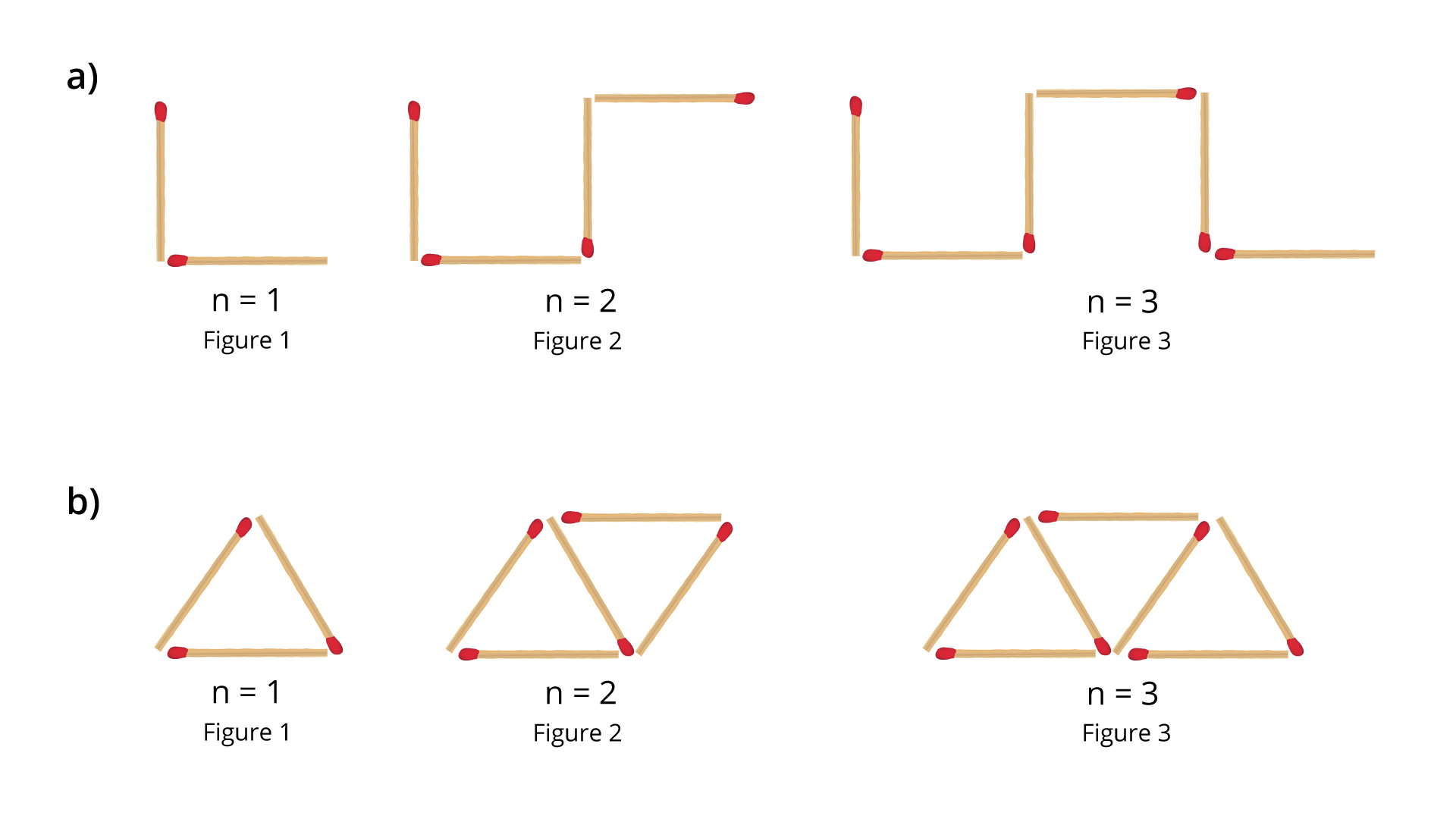
Rysunek przedstawia figury zbudowane z zapałek. W podpunkcie a: pierwsza figura składa się z dwóch zapałek ułożonych prostopadle do siebie, stycznych w końcach, poniżej napis n równa się 1, Figure 1; druga figura składa się z czterech zapałek ułożonych prostopadle do siebie, stycznych w końcach, poniżej napis n równa się 2, Figure 2; trzecia figura składa się z sześciu zapałek ułożonych prostopadle do siebie, stycznych w końcach, poniżej napis n równa się 3, Figure 3. W podpunkcie b: pierwsza figura składa się z trzech zapałek ułożonych w trójkąt równoboczny poniżej napis n równa się 1, Figure 1; druga figura składa się z pięciu zapałek i przedstawia dwa trójkąty równoboczne o wspólnym boku, poniżej napis n równa się 2, Figure 2; trzecia figura składa się siedmiu zapałek i przedstawia trzy trójkąty równoboczne (pierwszy i drugi mają wspólny bok, drugi i trzeci mają wspólny bok), poniżej napis n równa się 3, Figure 3.
Source: GroMar, licencja: CC BY 3.0.
How many matches will the fifth figure be made of?
What algebraic expression describes the number of matches needed to construct n number of figure?
a) 1. 10 matches
2. 2n
b) 1. 11 matches
2. 2n + 1
Exercise 3
Rtbc5GcuTEFj41
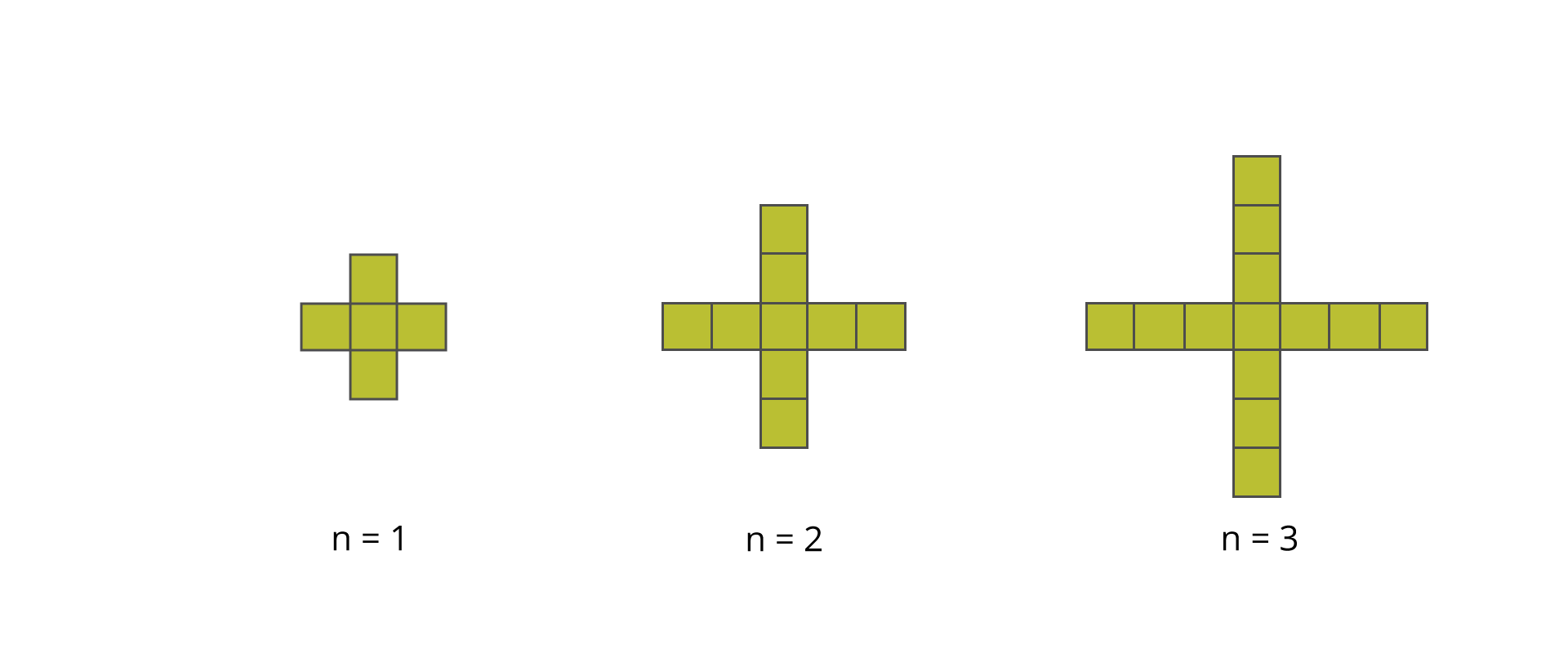
Rysunek przedstawia figury zbudowane z kwadratów. Pierwsza figura, n = 1, składa się z 5 kwadratów. Kształtem przypomina symbol dodawania. Druga figura, n = 2, składa się z 9 kwadratów. Kształtem przypomina symbol dodawania. Trzecia figura, n = 3, składa się z 13 kwadratów. Kształtem przypomina symbol dodawania.
Source: GroMar, licencja: CC BY 3.0.
a) Describe in English the method the next figure is made.
b) How many squares will the fourth figure consist of? And the fifth one?
c) How many squares will the n figure consist of?
d) Which figure will consist of 77 squares? Rearrange the appropriate equation and solve it. Describe in English step by step the operations you have done.
a) The next figure is made by adding four squares to the previous one.
b) The fourth figure is made of 17 squares, the fifth of 21 squares.
c) 4n + 1
d) 4n + 1 = 77
4n = 77 - 1
4n = 76
n = 76 : 4
n = 19
The nineteenth figure.
RXC4YriWm0X9N
Exercise 4
Wersja alternatywna ćwiczenia: Indicate which pairs of expressions or words are translated correctly. Możliwe odpowiedzi: 1. liczba naturalna - natural number, 2. wyrażenie algebraiczne - algebraic expression, 3. równanie - equation, 4. liczba parzysta - even number, 5. liczba nieparzysta - triangular number, 6. kwadrat - figure
Wersja alternatywna ćwiczenia: Indicate which pairs of expressions or words are translated correctly. Możliwe odpowiedzi: 1. liczba naturalna - natural number, 2. wyrażenie algebraiczne - algebraic expression, 3. równanie - equation, 4. liczba parzysta - even number, 5. liczba nieparzysta - triangular number, 6. kwadrat - figure
Indicate which pairs of expressions or words are translated correctly.
równanie - dwa wyrażenia algebraiczne połączone znakiem równości, przy czym przynajmniej w jednym z tych wyrażeń występuje co najmniej jedna niewiadoma, oznaczona literą