A conductor is characterized by the electrical resistance. It is in no way dependent on the voltage applied to the conductor or the current flowing through the conductor.
So the main question arises. What determines the resistance of the conductor?
Let us assume in further considerations that the temperature of the conductor is constantconstantconstant.
Experiment No. 1 (verification of research Hypothesis No. 1)
1. You will need several identical wire wound resistors, ammeter, voltmeter and voltage source to perform the experiment.
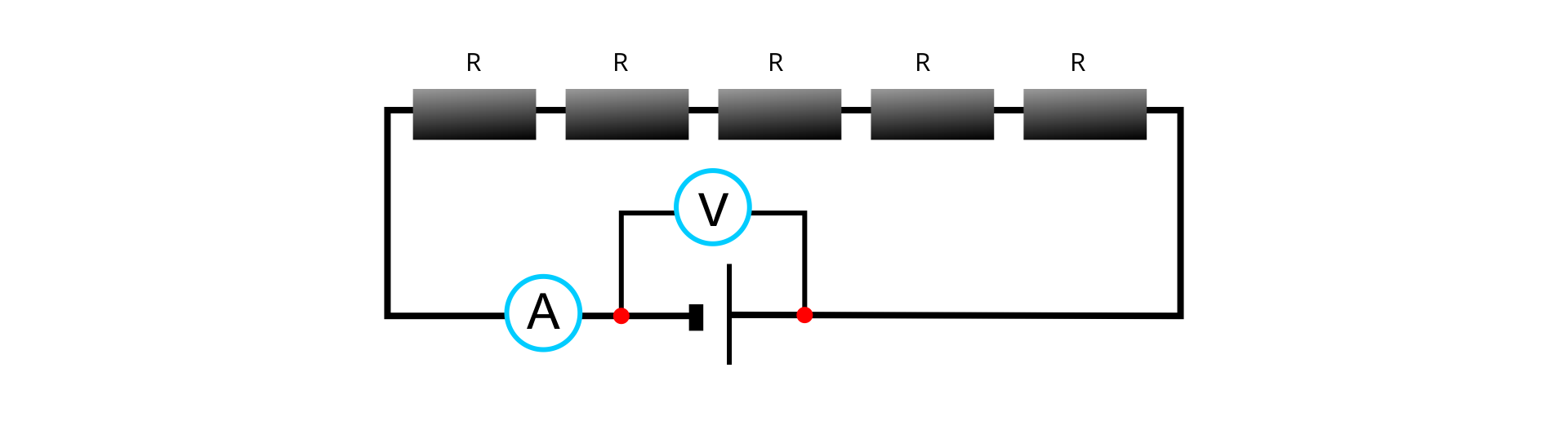
2. Build the system according to the diagram below.
RlIMBbemitALH
Ilustracja przedstawia schemat układu elektrycznego. Na obrysie prostokąta, na górnym boku pięć prostokątów R narysowanych jest obok siebie - oporników połączonych szeregowo. Na dolnym boku prostokąta od lewej kółko z literą A symbolizujące amperomierz, dalej punkt łączenia, dalej ogniwo (szeroka krótka kreska pionowa, puste miejsce, pionowa dłuższa kreska), dalej punkt łączenia. Od punktów łączenia wychodzą dwie kreski pionowe do środka układu. Między nimi kreska pozioma, na niej kółko z literą V symbolizujące woltomierz.
3. Perform measurements of the current flowing in the system and the voltage supplying the circuit for 5 resistors, 4 resistors, etc. Start with measurements for all resistors and then disconnect one after another.
4. Write down the measurement results into the measurement table.
Note: We are not able to determine the length of the wire used to build a single resistor, but we have the right to say that if we connect resistors in series, the total length of the wire increases n - times, where n is the number of resistors used.
5. Perform the measurements for a given number of resistors several times and write down the average value into the measurement table. This will eliminate possible gross errors (mistakes).
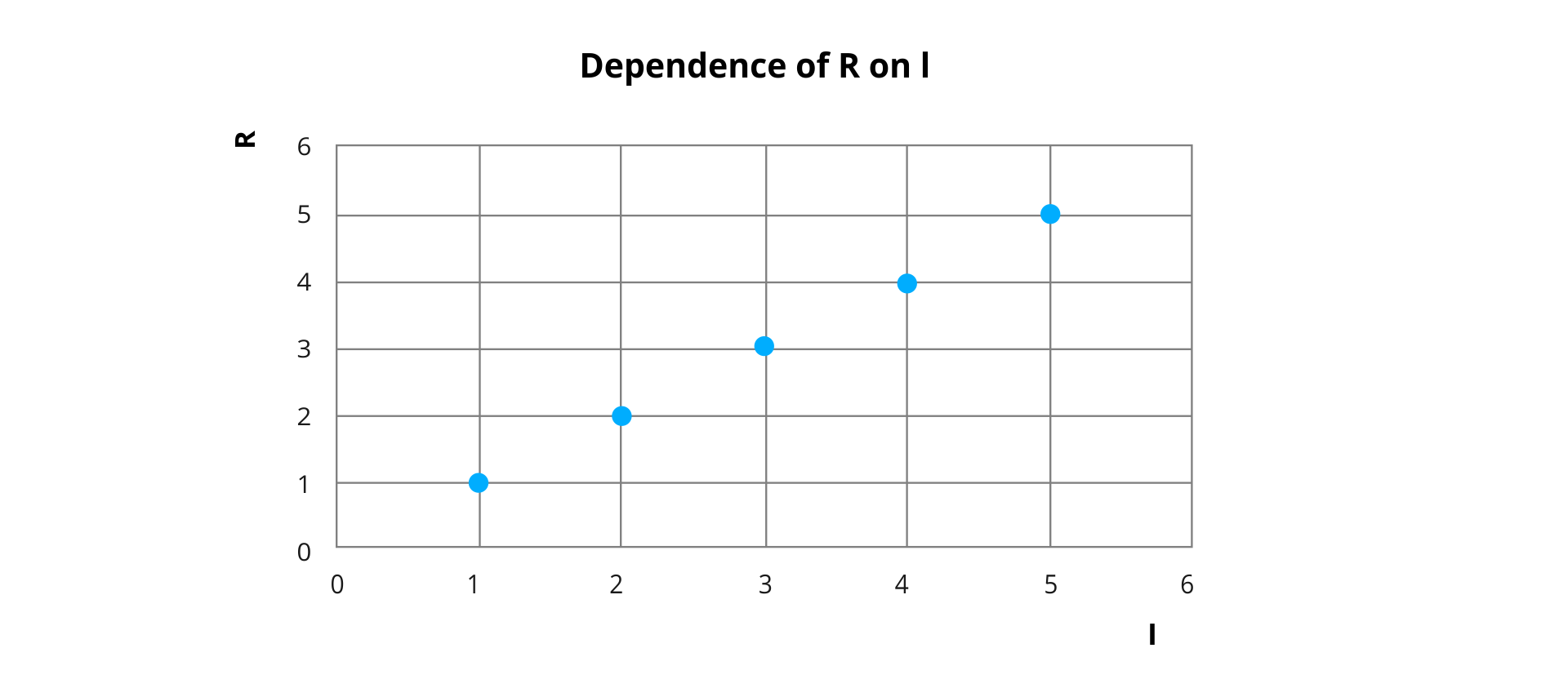
6. After making the measurements and their averaging, make a graph of the dependence of the total resistance of the conductor on its length.
7. Discuss the obtained result.
If you have correctly performed Experiment No. 1, the graph of the dependence of R on l should look like this.
R12An23jMZ5Jz
Ilustracja przedstawia wykres zależności oporu przewodnika od jego długości - Dependance of R on l. Oś pozioma opisana małe l, skala od 0 do 6, odcinek jednostkowy 1. Oś pionowa opisana wielkie R, skala od 0 do 6, odcinek jednostkowy 1. Zaznaczone punkty: (1, 1), (2, 2), (3, 3), (4, 4), (5, 5).
Dependence of the conductor resistance on its length
Experiment No. 2 (verification of research Hypothesis No. 2)
1. You will need several identical resistors made of resistance wire, ammeter, voltmeter and voltage source to perform the experiment.
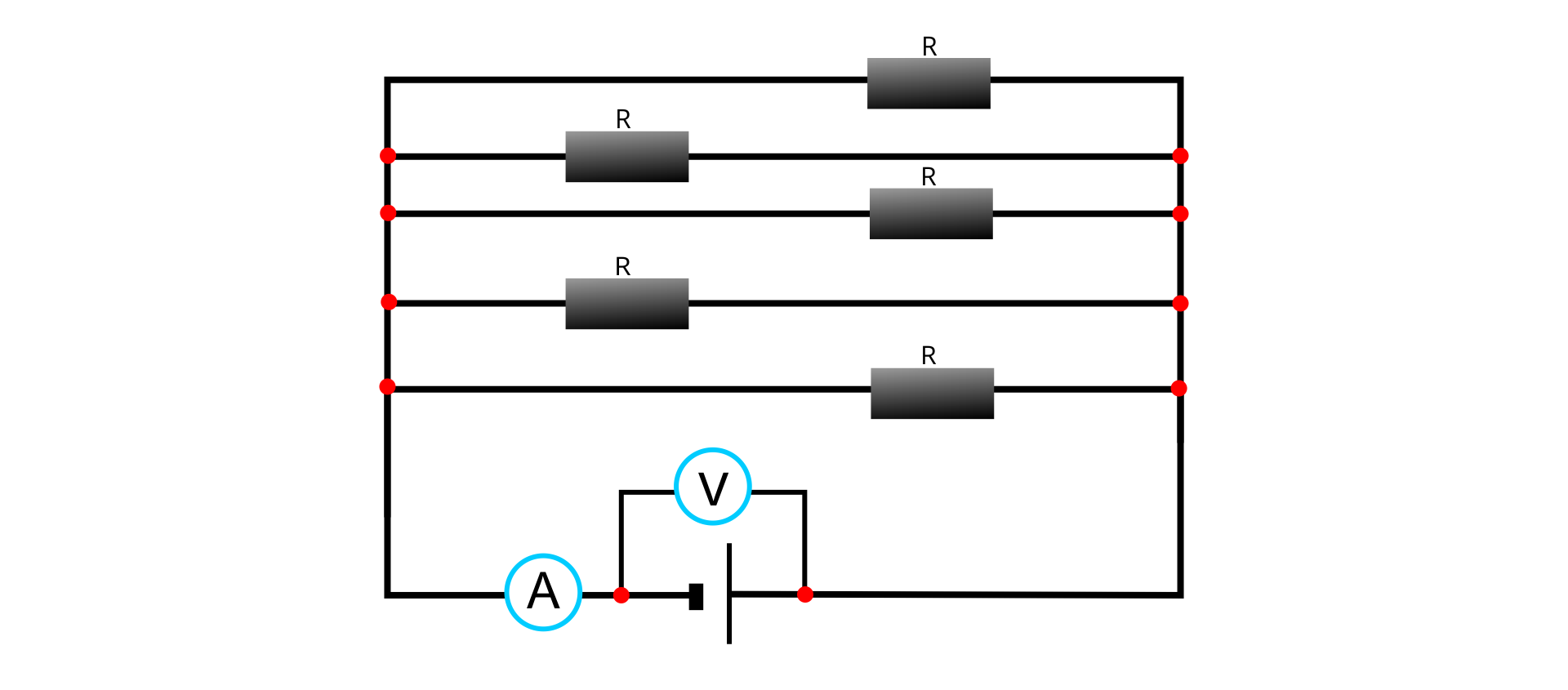
2. Build the system according to the diagram below.
R17rJNhrVH7Ls
Ilustracja przedstawia schemat układu elektrycznego, w którym oporniki połączone są równolegle. Na obrysie prostokąta, na górnym boku prostokąt R symbolizujący opornik). Na prawym i lewym boku po jednym punkcie, które połączone są kreską poziomą, na której narysowany jest prostokąt R symbolizujący opornik. Poniżej na prawym i lewym boku po jednym punkcie, które połączone są kreską poziomą, na której narysowany jest prostokąt R symbolizujący opornik. Poniżej na prawym i lewym boku po jednym punkcie, które połączone są kreską poziomą, na której narysowany jest prostokąt R symbolizujący opornik. Poniżej na prawym i lewym boku po jednym punkcie, które połączone są kreską poziomą, na której narysowany jest prostokąt R symbolizujący opornik. Na dolnym boku prostokąta od lewej kółko z literą A symbolizujące amperomierz, dalej punkt łączenia, dalej ogniwo (szeroka krótka kreska pionowa, puste miejsce, pionowa dłuższa kreska), dalej punkt łączenia. Od punktów łączenia wychodzą dwie kreski pionowe do środka układu. Między nimi kreska pozioma, na niej kółko z literą V symbolizujące woltomierz.
3. Perform measurements of the current flowing in the system and the voltage supplying the circuit for 5 resistors, 4 resistors, etc. Start with measurements for all resistors and then disconnect one after another.
4. Write down the measurement results into the measurement table.
Note: We are not able to determine the cross‑sectional area of the wire used to build a single resistor, but we have the right to say that if we connect resistors in parallel, the cross‑sectional area S of the wire increases n times, where n is the number of resistors used.
5. Perform the measurements for a given number of resistors several times and write down the average value into the measurement table. This will eliminate possible gross errors (mistakes).
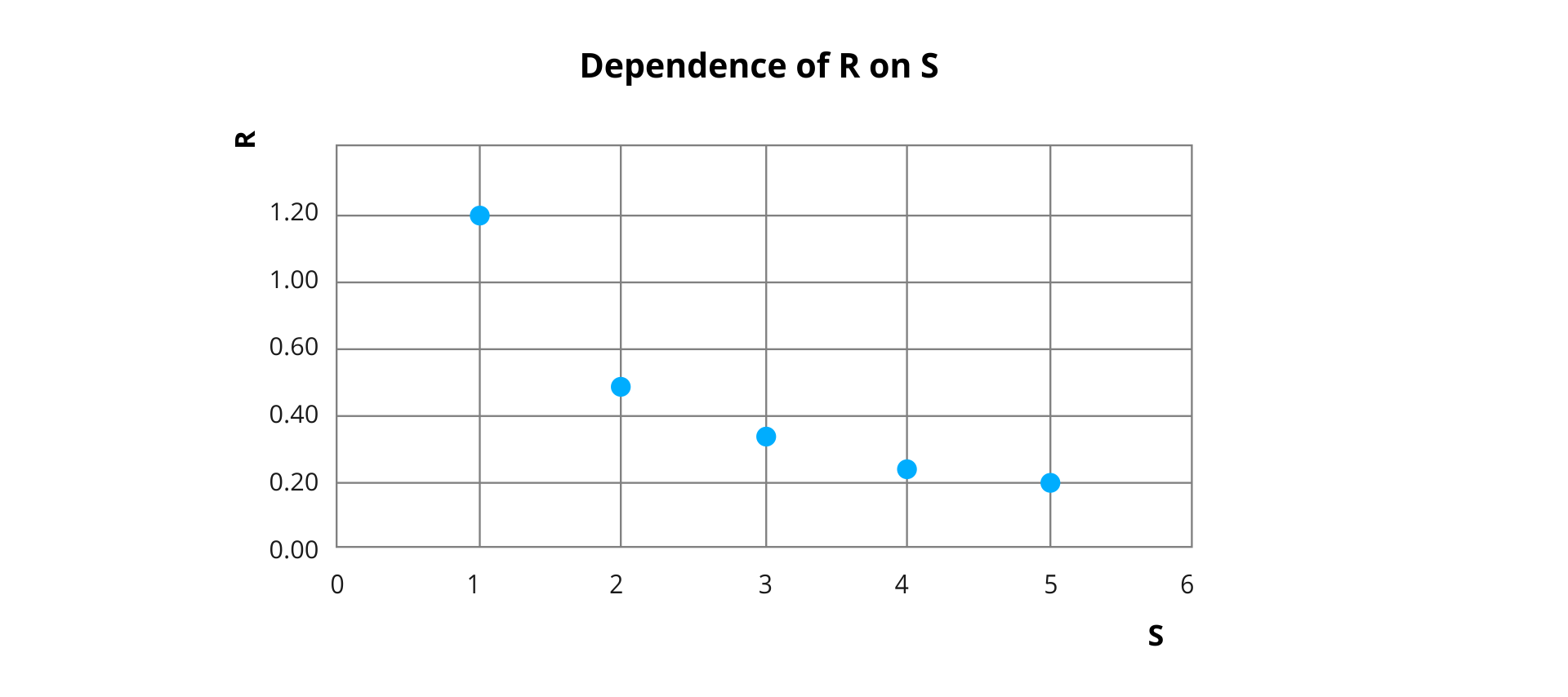
6. After making the measurements and their averaging, make a graph of the dependence of the total resistance of the conductor on its cross‑sectional area.
7. Discuss the obtained result.
If you have correctly performed Experiment No. 2, the graph of the dependence of R on S should look like this:
R50lkYG0UC54p
Ilustracja przedstawia wykres zależności oporu przewodnika od jego pola przekroju poprzecznego - Dependance of R on S. Oś pozioma opisana wielkie S, skala od 0 do 6, odcinek jednostkowy 1. Oś pionowa opisana wielkie R, skala od 0,00 do 1,20, odcinek jednostkowy 0,20. Zaznaczone punkty: (1, 1,20), (2, 0,50), (3, 0,35), (4, 0,24), (5, 0,20).
Dependence of conductor resistance on its cross-sectional area
The answer to this question is not so difficult. Just remember that not every conductor is built in the same way. The conductors are most often metals. Electron configuration of each metal is different and the number of valence electrons is also different.
Resistance of the conductor also depends on the type of such a conductor, on what metal the conductor is made up.
To write such a relation mathematically, a material constantconstantconstant describing a given conductor, called the resistivityresistivityresistivity (specific resistance), is introduced. Most often, we label this quantity with the letter ρ.
Eventually, we can write the formula for the resistance of the conductor:
Below are examples of values of resistivity for selected substances:
Tabela zbudowana dwóch kolumn: Substance, Resistivity [ohm razy metr]. W kolejnych wierszach przedstawiona jest oporność różnych substancji. Silver 1,59 razy 10 do potęgi minus 8, copper 1,72 razy 10 do potęgi minus 8, gold 2,44 razy 10 do potęgi minus 8, aluminium 2,82 razy 10 do potęgi minus 8, tungsten 5,60 razy 10 do potęgi minus 8, nickel 6,99 razy 10 do potęgi minus 8, iron 10 razy 10 do potęgi minus 8, tin 10,9 razy 10 do potęgi minus 8, platinum 11 razy 10 do potęgi minus 8, lead 22 razy 10 do potęgi minus 8, nichrome 150 razy 10 do potęgi minus 8, carbon 3,5 razy 10 do potęgi minus 5, germanium 0,46, silicon 640, glass 10 do potęgi 10 do 10 do potęgi 14, gum about 10 do potęgi 13, sulfur razy 10 do potęgi 15.
Tabela zbudowana dwóch kolumn: Substance, Resistivity [ohm razy metr]. W kolejnych wierszach przedstawiona jest oporność różnych substancji. Silver 1,59 razy 10 do potęgi minus 8, copper 1,72 razy 10 do potęgi minus 8, gold 2,44 razy 10 do potęgi minus 8, aluminium 2,82 razy 10 do potęgi minus 8, tungsten 5,60 razy 10 do potęgi minus 8, nickel 6,99 razy 10 do potęgi minus 8, iron 10 razy 10 do potęgi minus 8, tin 10,9 razy 10 do potęgi minus 8, platinum 11 razy 10 do potęgi minus 8, lead 22 razy 10 do potęgi minus 8, nichrome 150 razy 10 do potęgi minus 8, carbon 3,5 razy 10 do potęgi minus 5, germanium 0,46, silicon 640, glass 10 do potęgi 10 do 10 do potęgi 14, gum about 10 do potęgi 13, sulfur razy 10 do potęgi 15.
Po lewej stronie ilustracji interaktywnej znajduje się lista różnych metali i ich stopów: gold, bronze, brass, steel, copper, lead, cast iron, aluminium, silver. Po prawej stronie znajdują się rysunki obrazujące elementy z listy. Sztabki złota oznaczone są numerem 1, stal oznaczona jest numerem 2, srebro oznaczone jest numerem 3. Na ilustracji widoczne są numery, a na nich podpisy. 1. gold conducts electricity very well {audio}, 2. steel is not a good conductor for electricity {audio}, 3. silver conducts electricity very well {audio}.
Po lewej stronie ilustracji interaktywnej znajduje się lista różnych metali i ich stopów: gold, bronze, brass, steel, copper, lead, cast iron, aluminium, silver. Po prawej stronie znajdują się rysunki obrazujące elementy z listy. Sztabki złota oznaczone są numerem 1, stal oznaczona jest numerem 2, srebro oznaczone jest numerem 3. Na ilustracji widoczne są numery, a na nich podpisy. 1. gold conducts electricity very well {audio}, 2. steel is not a good conductor for electricity {audio}, 3. silver conducts electricity very well {audio}.
Metals and their alloys - some conduct electricity well and others much worse
Source: GroMar, licencja: CC BY 3.0.
Summary
The current flowing in the conductor is proportional to the potential difference (voltage) at its ends:
The proportionality factor is the inverse of the electrical resistance R of the conductor.
We also know that the resistance of a homogeneous conductor with a constantconstantconstant cross‑section is proportional to its length and inversely proportionalinversely proportionalinversely proportional to the cross‑sectional area:
The proportionality factor ρ is called the resistivityresistivityresistivity of the substance from which the conductor is made.
Exercises
RxrkQoWAcLC4i
Exercise 1
Wersja alternatywna ćwiczenia: Determine which sentence is true. Możliwe odpowiedzi: 1. The resistivity depends on the shape of the conductor., 2. For insulators, the resistivity is much smaller than for metals., 3. If we increase the length of the conductor twice, its resistivity remains constant., 4. If we reduce the diameter of the conductor twice, its resistivity decreases 4 times.
Wersja alternatywna ćwiczenia: Determine which sentence is true. Możliwe odpowiedzi: 1. The resistivity depends on the shape of the conductor., 2. For insulators, the resistivity is much smaller than for metals., 3. If we increase the length of the conductor twice, its resistivity remains constant., 4. If we reduce the diameter of the conductor twice, its resistivity decreases 4 times.
Determine which sentence is true.
The resistivity depends on the shape of the conductor.
For insulators, the resistivity is much smaller than for metals.
If we increase the length of the conductor twice, its resistivity remains constant.
If we reduce the diameter of the conductor twice, its resistivity decreases 4 times.
Exercise 2
There are two conductors with the same length and cross‑section area. One of them was made of gold and the other of copper. Calculate which one has greater resistance and how many times greater. Use the table above.
Gold approximately 1,42 times greater than copper.
Exercise 3
Write in English shortly why the resistance of the conductor is directly proportionaldirectly proportionaldirectly proportional to its length and inversely proportionalinversely proportionalinversely proportional to the cross‑sectional area. Refer to the microscopic structure of metallic conductors.
RowHLOEL833bE
Exercise 4
Wersja alternatywna ćwiczenia: Indicate which pairs of expressions or words are translated correctly. Możliwe odpowiedzi: 1. odwrotnie proporcjonalny - conductor resistance , 2. opór właściwy - resistivity, 3. wartość stała - constant, 4. wprost proporcjonalny - directly proportional, 5. opór przewodnika - inversely proportional
Wersja alternatywna ćwiczenia: Indicate which pairs of expressions or words are translated correctly. Możliwe odpowiedzi: 1. odwrotnie proporcjonalny - conductor resistance , 2. opór właściwy - resistivity, 3. wartość stała - constant, 4. wprost proporcjonalny - directly proportional, 5. opór przewodnika - inversely proportional
Indicate which pairs of expressions or words are translated correctly.
odwrotnie proporcjonalny - conductor resistance
opór właściwy - resistivity
wartość stała - constant
wprost proporcjonalny - directly proportional
opór przewodnika - inversely proportional
zadanie
Source: GroMar, licencja: CC BY 3.0.
RtBFiQy4vrJ0R1
Interaktywna gra, polegająca na łączeniu wyrazów w pary w ciągu jednej minuty. Czas zaczyna upływać wraz z rozpoczęciem gry. Jeden ruch to odkrywanie najpierw jednej potem drugiej karty z wyrazem. Każdy wyraz jest odczytywany. Kolejny ruch to odkrywanie trzeciej i czwartej karty. W ten sposób odsłuchasz wszystkie wyrazy. Nawigacja z poziomu klawiatury za pomocą strzałek, odsłuchiwanie wyrazów enterem lub spacją. Znajdź wszystkie pary wyrazów.
Interaktywna gra, polegająca na łączeniu wyrazów w pary w ciągu jednej minuty. Czas zaczyna upływać wraz z rozpoczęciem gry. Jeden ruch to odkrywanie najpierw jednej potem drugiej karty z wyrazem. Każdy wyraz jest odczytywany. Kolejny ruch to odkrywanie trzeciej i czwartej karty. W ten sposób odsłuchasz wszystkie wyrazy. Nawigacja z poziomu klawiatury za pomocą strzałek, odsłuchiwanie wyrazów enterem lub spacją. Znajdź wszystkie pary wyrazów.
Match Polish terms with their English equivalents.
directly proportional
conductor resistance
resistivity
inversely proportional
constant
wprost proporcjonalny
wartość stała
opór przewodnika
opór właściwy
odwrotnie proporcjonalny
Source: Zespół autorski Politechniki Łódzkiej, licencja: CC BY 3.0.