A transparent structure behind the pupil that refracts incoming light and focuses it onto the retinaretinaretina. The lens is able to change shape in order to improve the focus.
The coloured part of the eye that controls the amount of light that enters the eye, it is able to contact and dilate in order to control the size of the pupil depending on the light intensity.
This is the light sensitive layer inside the eye that contains light sensitive photoreceptive cells called rods and cones. These cells change light into sight by converting light into electrical impulses. These electrical impulses are sent from the retina to the brain by means of optic nerve and interpreted as images.
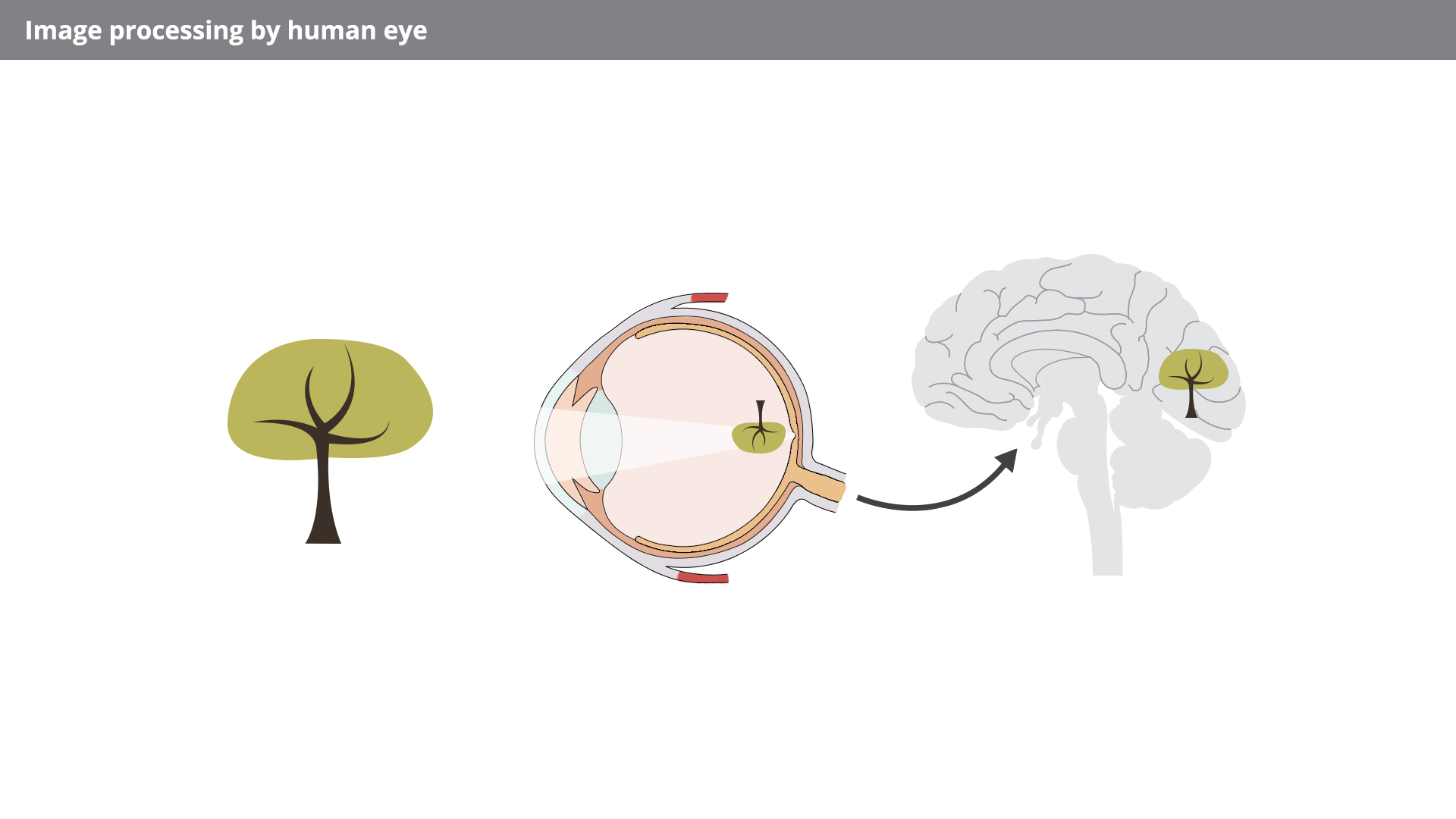
The objects reflect light. This light enters the eye through the corneacorneacornea. The amount of light entering the eye is controlled by the pupil, surrounded by the irisirisiris. The lens refracts and focuses light on the retina. The formed image is inverted. The ciliary muscleciliary muscleciliary muscle controls the shape changes of the lens, so the lens can focus light reflected from objects located at different distances. Once the image is clearly focused on the sensitive part of the retina, an electrical signal is created and carried to the brain through the optic nerveoptic nerveoptic nerve. In addition to inverting the image formed on the retinaretinaretina, the brain is also able to combine the images from both eyes to give us the perception of image depth.
R1M0VBS97kU1O
Schemat przedstawia formowanie się na siatkówce odwróconego obrazu obserwowanego przedmiotu - drzewa, a następnie jego ponowne obrócenie dokonywane przez mózg. Po lewej rysunek drzewa. Na środku rysunek gałki ocznej zwrócony w stronę drzewa, na której końcu narysowane jest odwrócone i pomniejszone drzewo. Od gałki strzałka w prawo do rysunku mózgu, na którego końcu narysowane jest pomniejszone drzewo.
The eye can adapt the shape and curvature of the lens to adjust the degree of refraction. The ability of the eye to adjust its focal length is known as accommodation. It allows light reflected from near or distant objects to be focused onto the retinaretinaretina. Accommodation is automatic and occurs instantaneously.
Accommodation is achieved by the contraction or relaxation of the ciliary muscles, which slacken or stretch the suspensory ligaments of lens.
A normal, healthy eye can see objects clearly at very far distances down to about 25 cm from the eye.
Human eye is the natural convex lens which refracts light. The most common vision problems are refractive errors, more commonly known as short‑sightedness, long‑sightedness and astigmatism. Defects of the eye can be either congenital or acquired.
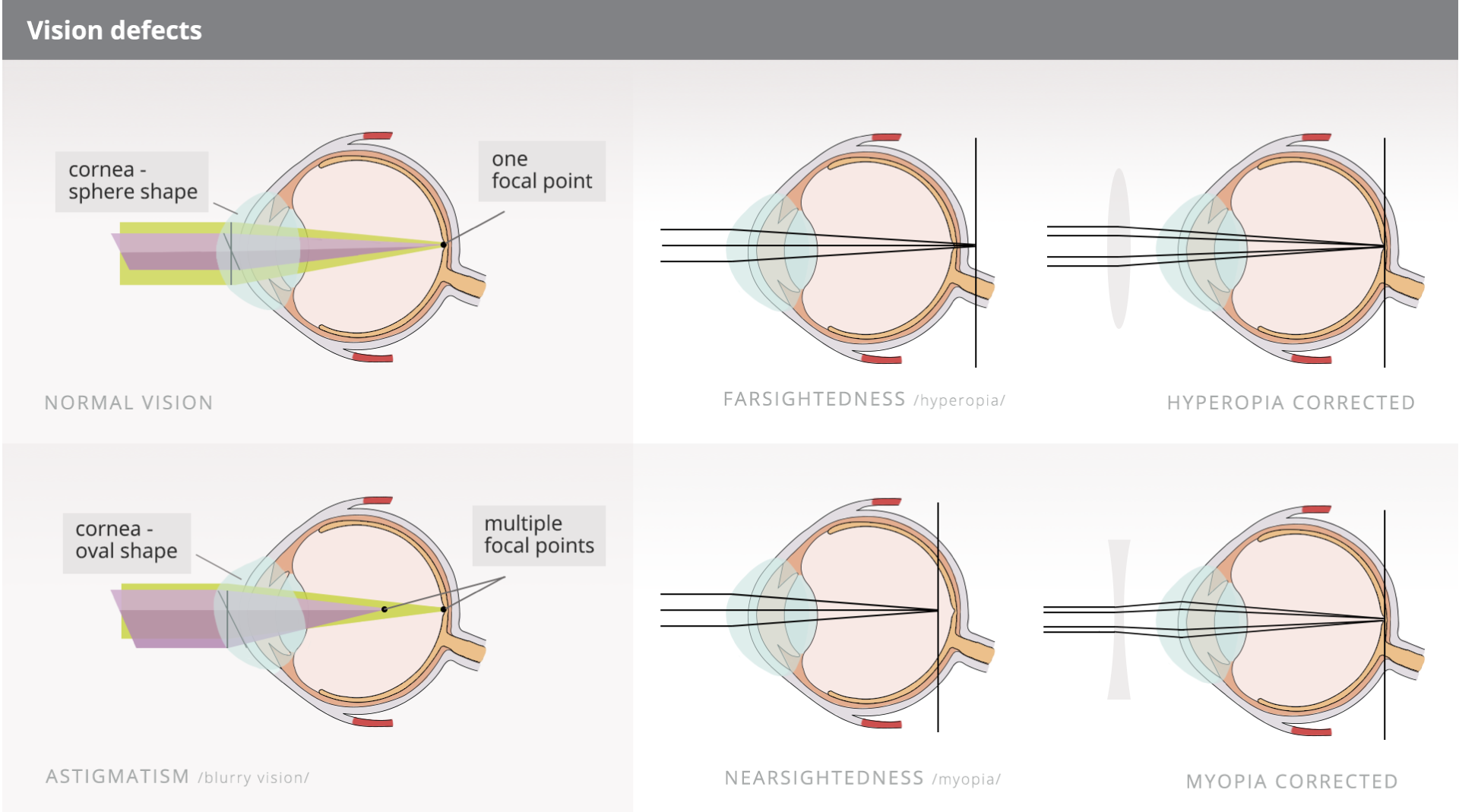
It is common vision condition that causes blurred vision. The light rays do not all come to a single focal point on the retina, instead some focus on the retinaretinaretina and some focus in front of or behind it. The reason can be irregularly shaped corneacorneacornea or sometimes the curvature of the lens inside the eye. Astigmatism can usually be corrected by using a special cylindrical lens.
This is a defect of vision in which there is difficulty with near vision but far objects can be seen easily. The image is focused behind the retina rather than upon it. This occurs when the eyeball is too short or the refractive power of the lens is too weak. Hyperopia can be corrected by wearing glasses or contacts that contain convex lenses.
This is a defect of vision in which far objects appear blurred but near objects are seen clearly. The image is focused in front of the retinaretinaretina rather than on it usually because the eyeball is too long or the refractive power of the eye's lens too strong. Myopia can be corrected by wearing glasses or contacts that contain concave lenses.
R1SX0sfmkm3JU
Rysunek zatytułowany Vision defects prezentuje różne wady wzroku i metody ich korekcji. Na górze po lewej schemat opisany normal vision: gałka oczna i padające promienie zbiegające się w jednym punkcie opisanym one focal point. Zaznaczo rogówkę opisaną cornea - sphere shape. Na dole po lewej schemat opisany astigmatism, blurry vision: gałka oczna i padające promienie zbiegające się w dwóch punktach opisanych multiple focal points. Zaznaczo rogówkę opisaną cornea - oval shape. Na górze po prawej schemat opisany farsightedness, hyperopia: gałka oczna i padające promienie zbiegające się w jednym punkcie za gałką oczną. Obok schemat opisany hyperopia corrected: gałka oczna i padające promienie na soczewkę wypukłą znajdującą się przed gałką, promienie zbiegają się w jednym punkcie na końcu gałki ocznej. Na dole po prawej schemat opisany nearsightedness, myopia: gałka oczna i padające promienie zbiegające się w jednym punkcie wewnątrz gałki ocznej. Obok schemat opisany myopia corrected: gałka oczna i padające promienie na soczewkę wklęsłą znajdującą się przed gałką, promienie zbiegają się w jednym punkcie na końcu gałki ocznej.
AccommodationaccommodationAccommodation causes that a normal, healthy eye can see clearly very distant objects as well as these placed at about 25 cm in front of it. Sometimes refracting problems may occur, which could be either congenital or acquired. The commonly known are myopiamyopia myopia, hyperopiahyperopiahyperopia and astigmatismastigmatismastigmatism.
Exercises
RlTvGITXJ1HzB
Exercise 1
Wersja alternatywna ćwiczenia: Determine which sentences are true. Możliwe odpowiedzi: 1. Light enters eye through a transparent membrane known as cornea., 2. In a healthy human eye image is formed behind retina., 3. The lens can change its shape to focus on nearby and distant objects., 4. Variation of focal length by eye to form a sharp image on retina is called aperture.
Wersja alternatywna ćwiczenia: Determine which sentences are true. Możliwe odpowiedzi: 1. Light enters eye through a transparent membrane known as cornea., 2. In a healthy human eye image is formed behind retina., 3. The lens can change its shape to focus on nearby and distant objects., 4. Variation of focal length by eye to form a sharp image on retina is called aperture.
Determine which sentences are true.
Light enters eye through a transparent membrane known as cornea.
In a healthy human eye image is formed behind retina.
The lens can change its shape to focus on nearby and distant objects.
Variation of focal length by eye to form a sharp image on retina is called aperture.
R1M8W1d1Z9IP8
Exercise 2
Assign the correct words or expressions: ciliary muscle, optic nerve, retina, cornea, sclera, iris.
A tough white protective layer: [tu uzupełnij]
This contains a layer of receptor cells which are sensitive to light: [tu uzupełnij]
This controls the shape of lens: [tu uzupełnij]
The cells of the retina send signal to the brain along: [tu uzupełnij]
This is the transparent part of the sclera: [tu uzupełnij]
Assign the correct words or expressions: ciliary muscle, optic nerve, retina, cornea, sclera, iris.
A tough white protective layer: [tu uzupełnij]
This contains a layer of receptor cells which are sensitive to light: [tu uzupełnij]
This controls the shape of lens: [tu uzupełnij]
The cells of the retina send signal to the brain along: [tu uzupełnij]
This is the transparent part of the sclera: [tu uzupełnij]
A tough white protective layer: ............................
This contains a layer of receptor cells which are sensitive to light: ............................
This controls the shape of lens: ............................
The cells of the retina send signal to the brain along: ............................
This is the transparent part of the sclera: ............................
Exercise 3
Explain in English what astigmatism, myopia and hyperopia are.
R1ENTzS4jvhyh
Exercise 4
Wersja alternatywna ćwiczenia: Indicate which pairs of expressions or words are translated correctly. Możliwe odpowiedzi: 1. akomodacja - accommodation, 2. nerw wzrokowy - optic nerve, 3. siatkówka - retina, 4. twardówka - sclera, 5. krótkowzroczność - hyperopia, 6. nadwzroczność - myopia
Wersja alternatywna ćwiczenia: Indicate which pairs of expressions or words are translated correctly. Możliwe odpowiedzi: 1. akomodacja - accommodation, 2. nerw wzrokowy - optic nerve, 3. siatkówka - retina, 4. twardówka - sclera, 5. krótkowzroczność - hyperopia, 6. nadwzroczność - myopia
Indicate which pairs of expressions or words are translated correctly.
akomodacja - accommodation
nerw wzrokowy - optic nerve
siatkówka - retina
twardówka - sclera
krótkowzroczność - hyperopia
nadwzroczność - myopia
zadanie
Source: GroMar, licencja: CC BY 3.0.
RZpcemb5JzjbR1
Interaktywna gra, polegająca na łączeniu wyrazów w pary w ciągu jednej minuty. Czas zaczyna upływać wraz z rozpoczęciem gry. Jeden ruch to odkrywanie najpierw jednej potem drugiej karty z wyrazem. Każdy wyraz jest odczytywany. Kolejny ruch to odkrywanie trzeciej i czwartej karty. W ten sposób odsłuchasz wszystkie wyrazy. Nawigacja z poziomu klawiatury za pomocą strzałek, odsłuchiwanie wyrazów enterem lub spacją. Znajdź wszystkie pary wyrazów.
Interaktywna gra, polegająca na łączeniu wyrazów w pary w ciągu jednej minuty. Czas zaczyna upływać wraz z rozpoczęciem gry. Jeden ruch to odkrywanie najpierw jednej potem drugiej karty z wyrazem. Każdy wyraz jest odczytywany. Kolejny ruch to odkrywanie trzeciej i czwartej karty. W ten sposób odsłuchasz wszystkie wyrazy. Nawigacja z poziomu klawiatury za pomocą strzałek, odsłuchiwanie wyrazów enterem lub spacją. Znajdź wszystkie pary wyrazów.
Match Polish terms with their English equivalents.
dalekowzroczność
siatkówka
krótkowzroczność
rogówka
cornea
retina
hyperopia
astygmatyzm
astigmatism
myopia
Source: Zespół autorski Politechniki Łódzkiej, licencja: CC BY 3.0.
myopiamyopia myopia – wada oka polegająca na wyraźnym widzeniu przedmiotów znajdujących się blisko, podczas gdy przedmioty znajdujące się w oddali wydają się być nieostre
hyperopiahyperopiahyperopia – wada oka polegająca na wyraźnym widzeniu przedmiotów znajdujących się daleko, podczas gdy przedmioty blisko oka widziane są nieostro