bg‑azure

In this section, you are going to learn more about how the problems mentioned in the reading section can be solved. Click on the pictures to listen to people talking about each SDOH and what measures can be taken to increase the well‑being and health of people.

W tej części dowiesz się, jak można rozwiązać problemy wymienione w części poświęconej czytaniu. Kliknij w ilustracje, aby posłuchać, jak ludzie rozmawiają o poszczególnych SDOH i jakie działania można podjąć, aby poprawić samopoczucie i stan zdrowia ludzi.

RhQkz9TQ24SOw
Having support is vital in your life
Wsparcie jest kluczowe w twoim życiu
Źródło: dostępny w internecie: www.pixabay.com [dostęp 20.04.2022], domena publiczna.
Exercise 1
R4okHXBEaMeDa
drop out of Możliwe odpowiedzi: 1. easily hurt or attacked, 2. providing the right conditions for something, 3. difference, discrepancy, 4. not to do something you were going to do, 5. share your secrets and feelings with someone, 6. giving advice about somebody’s problems, 7. a young person who commits crimes, 8. chances to do something conducive to Możliwe odpowiedzi: 1. easily hurt or attacked, 2. providing the right conditions for something, 3. difference, discrepancy, 4. not to do something you were going to do, 5. share your secrets and feelings with someone, 6. giving advice about somebody’s problems, 7. a young person who commits crimes, 8. chances to do something opportunities Możliwe odpowiedzi: 1. easily hurt or attacked, 2. providing the right conditions for something, 3. difference, discrepancy, 4. not to do something you were going to do, 5. share your secrets and feelings with someone, 6. giving advice about somebody’s problems, 7. a young person who commits crimes, 8. chances to do something counselling Możliwe odpowiedzi: 1. easily hurt or attacked, 2. providing the right conditions for something, 3. difference, discrepancy, 4. not to do something you were going to do, 5. share your secrets and feelings with someone, 6. giving advice about somebody’s problems, 7. a young person who commits crimes, 8. chances to do something juvenile delinquent Możliwe odpowiedzi: 1. easily hurt or attacked, 2. providing the right conditions for something, 3. difference, discrepancy, 4. not to do something you were going to do, 5. share your secrets and feelings with someone, 6. giving advice about somebody’s problems, 7. a young person who commits crimes, 8. chances to do something confide in Możliwe odpowiedzi: 1. easily hurt or attacked, 2. providing the right conditions for something, 3. difference, discrepancy, 4. not to do something you were going to do, 5. share your secrets and feelings with someone, 6. giving advice about somebody’s problems, 7. a young person who commits crimes, 8. chances to do something disparity Możliwe odpowiedzi: 1. easily hurt or attacked, 2. providing the right conditions for something, 3. difference, discrepancy, 4. not to do something you were going to do, 5. share your secrets and feelings with someone, 6. giving advice about somebody’s problems, 7. a young person who commits crimes, 8. chances to do something vulnerable Możliwe odpowiedzi: 1. easily hurt or attacked, 2. providing the right conditions for something, 3. difference, discrepancy, 4. not to do something you were going to do, 5. share your secrets and feelings with someone, 6. giving advice about somebody’s problems, 7. a young person who commits crimes, 8. chances to do something
Źródło: GroMar Sp. z o.o., licencja: CC BY-SA 3.0.
R1bf5kfQqJjJY
Źródło: GroMar Sp. z o.o., licencja: CC BY-SA 3.0.

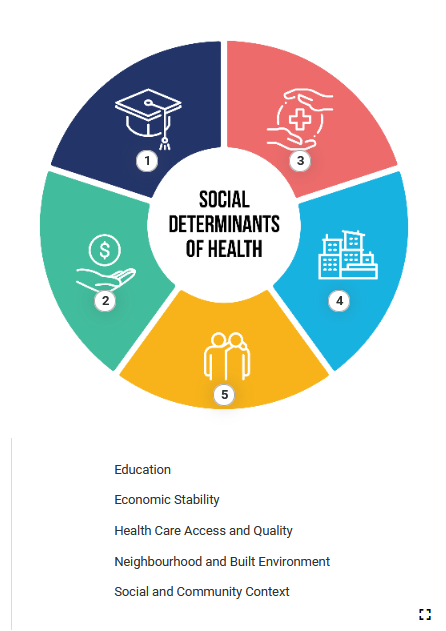
Ilustracja przedstawia wykres kołowy składający się z pięciu pól w kolorze czerwonym, niebieskim, żółtym, zielonym i granatowym. Na każdym polu widoczny jest symbol. Pośrodku widoczne jest białe koło z napisem z czarnych liter w języku angielskim: SOCIAL DETERMINANTS OF HEALTH.

Do każdego pola przypisany jest numer od 1 do 5. Po naciśnięciu numerka można odsłuchać nagranie przypisane do punktu interaktywnego.

Transkrypcja do nagrań znajduje się poniżej.

11
Education

Na granatowym polu widoczny jest zarys czapki studenckiej, tak zwanego biretu absolwenta, z frędzlem po prawej stronie.

Economic Stability

Na zielonym polu widoczny jest zarys otwartej prawej dłoni, nad którą widoczny jest symbol dolara wpisany w okrąg.

Health Care Access and Quality

Na czerwonym polu widoczny jest czteroramienny krzyż otoczony parą dłoni tworzących wokół niego koło.

Neighbourhood and Built Environment

Na niebieskiem polu widoczny jest zarys budynków wielopiętrowych, o różnej wysokości, ułożonych piętrowo.

Social and Community Context

Na żółtym polu widoczny jest zarys dwóch stojących postaci. Postać po lewej ma lewą rękę założoną na bark postaci po prawej.

TRANSCRIPTazurewhite
Exercise 2

Get familiar with the recordings and match the speaker (1–5) with the correct sentence.

RgPwfHVIJQAMe
This speaker mentions: people with fear of treatment Możliwe odpowiedzi: 1. 5, 2. 1, 3. 3, 4. 4, 5. 2 disabled people Możliwe odpowiedzi: 1. 5, 2. 1, 3. 3, 4. 4, 5. 2 young people who need to talk to someone Możliwe odpowiedzi: 1. 5, 2. 1, 3. 3, 4. 4, 5. 2 children with only one parent Możliwe odpowiedzi: 1. 5, 2. 1, 3. 3, 4. 4, 5. 2 teenagers who commit crimes where they live Możliwe odpowiedzi: 1. 5, 2. 1, 3. 3, 4. 4, 5. 2
Źródło: GroMar Sp. z o.o., licencja: CC BY-SA 3.0.
Exercise 3
ROiaFrWKXrD6D
1. There are many ways in which the problem of students’ dropping out of schools 1. capacity, 2. take advantage of, 3. be beneficial for, 4. emphasis should be put, 5. be introduced, 6. can be tackled, 7. contribute to.
2. Any type of intervention which will increase graduation rates and help young people in the world of work will 1. capacity, 2. take advantage of, 3. be beneficial for, 4. emphasis should be put, 5. be introduced, 6. can be tackled, 7. contribute to their mental and physical health.
3. People who suffer from diseases should be taught to manage their condition in order to increase their ability to work, and therefore, their 1. capacity, 2. take advantage of, 3. be beneficial for, 4. emphasis should be put, 5. be introduced, 6. can be tackled, 7. contribute to to keep a steady job.
4. The solution would be to increase the numbers, allowing more people to 1. capacity, 2. take advantage of, 3. be beneficial for, 4. emphasis should be put, 5. be introduced, 6. can be tackled, 7. contribute to medical services.
5. A special 1. capacity, 2. take advantage of, 3. be beneficial for, 4. emphasis should be put, 5. be introduced, 6. can be tackled, 7. contribute to on reaching the people who refuse to be treated or who are afraid to do so.
6. Preventive programmes should 1. capacity, 2. take advantage of, 3. be beneficial for, 4. emphasis should be put, 5. be introduced, 6. can be tackled, 7. contribute to to reduce the number of crimes committed by young people
7. Fostering a positive attitude and atmosphere at home, school, and at work can significantly 1. capacity, 2. take advantage of, 3. be beneficial for, 4. emphasis should be put, 5. be introduced, 6. can be tackled, 7. contribute to our personal and as a result, public well-being.
Źródło: GroMar Sp. z o.o., licencja: CC BY-SA 3.0.
Exercise 4
R1Ki7MbWQAySV
1. There are many ways in which the problem of students who don’t graduate Tu uzupełnij can be solved. 2. Developing conditions adequate for students to learn Tu uzupełnij e.g. preventing bullying and providing healthy food is something schools can do. 3. People need employment programmes in which they will be given advice on their employment Tu uzupełnij. 4. Single parents should be helped by increasing their chances of employment Tu uzupełnij and providing care for their children. 5. There are still differences and discrepancies Tu uzupełnij around the world in the number of people who have access to screening, testing, and vaccinations. 6. Young people who commit crime Tu uzupełnij often have problems at school and they are more likely to suffer from health disorders and substance abuse. 7. Preventive programmes should decrease the number of arrests, especially in neighbourhoods where easily hurt or attacked Tu uzupełnij people live. 8. Teeneagers who have an adult they can share their secrets and feelings with Tu uzupełnij are less prone to exhibiting antisocial behaviour.
Źródło: GroMar Sp. z o.o., licencja: CC BY-SA 3.0.
Exercise 5

Answer the questions.

  1. Which problem mentioned in the recording concerns your town/city the most? Why?

  2. Which solutions mentioned in the recordings seem to be the most urgent to introduce in the area where you live? Why?

R18gcTLGlH0Er
(Uzupełnij).
Źródło: GroMar Sp. z o.o., licencja: CC BY-SA 3.0.