Reflections on the water, your reflection in the mirror, squinting in the intense light - you meet all these phenomena in everyday life. Think at it and answer your questions.
What types of surfaces reflect light best?
What is a mirror?
Formulate your definition and then compare it with the one below.
A plane mirror is a flat, polished surfacesurfacesurface which in ideal case neither absorbs nor scatters light, but only reflects it.
You already know that light propagates in straight lines. Think and answer the question in which direction light rays reflected off the smooth polished surface?
You already know that light propagates in straight lines. Think and answer the question in which direction light rays reflected off the smooth polished surface?
You already know that light propagates in straight lines. Complete the experiment and answer the question in which directiondirectiondirection light rays reflected off the smooth polished surfacesurfacesurface.
Experiment 1
Law of light reflection
Research problem
What is the directiondirectiondirection of light rays reflected off a smooth polished surfacesurfacesurface?
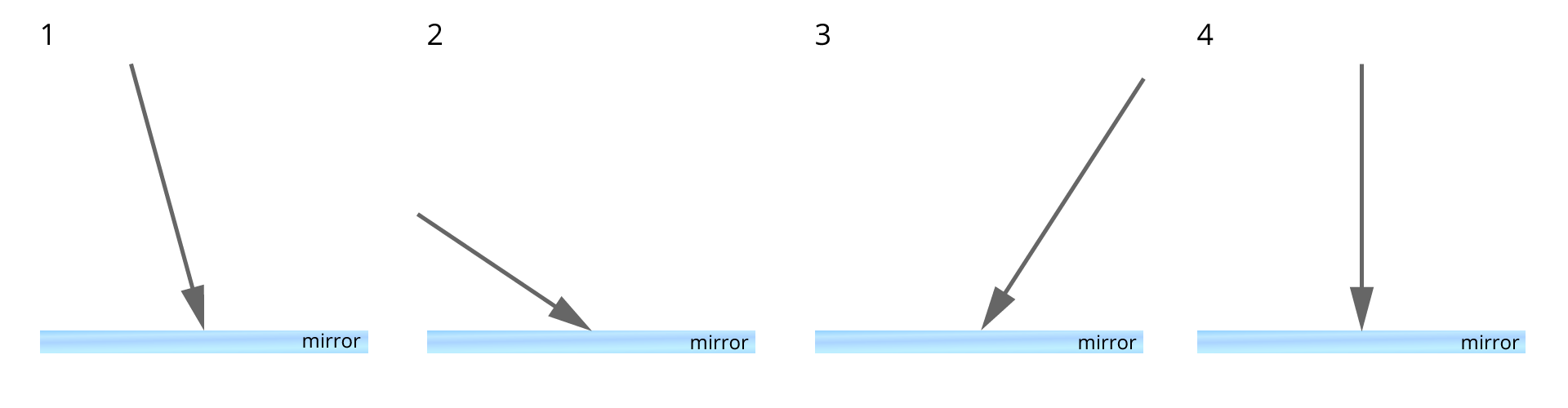
According to the instruction prepare and cut off four diagrams. Place the plane mirrorplane mirrorplane mirror in a position shown in the picture. Put the light beam exactly along the drawn arrow. Then, as precisely as possible, draw using a pencil the path of a reflected rayreflected rayreflected ray. Repeat that for all four diagrams.
Fold every diagram in a way that the both incident rayincident rayincident ray and the reflected rayrayray lie on top of each other. Unfold and flatten the diagrams and place them next to each other. Note down your observations.
Measure an angle between the incident ray and the fold line as well as an angle between the reflected rayreflected rayreflected ray and the fold line. Mark them as α and β and note their values into your exercise book.
Attach the diagrams to your exercise book.
RZJ3W0o5DvJpI1
Ilustracja przedstawia cztery rysunki promieni światła padającego (strzałki) na lustra leżące na poziomej powierzchni pod różnymi kątami. Lustra podpisane mirror. Rysunek 1 - strzałka skierowana w prawo w dół, lekko odchylona od pionu w lewą stronę. Rysunek 2 - strzałka skierowana w prawo w dół, bardzo odchylona od pionu w lewą stronę. Rysunek 3 - strzałka skierowana w lewo w dół, lekko odchylona od pionu w prawą stronę. Rysunek 4 - strzałka skierowana pionowo w dół.
Formulate the lawlawlaw of reflection based on the results you obtained.
Task 1
Formulate the law of light reflection. Make captions on every element of the diagram.
Formulate the law of light reflection. Make captions on every element of the diagram.
Draw a diagram summarizing the experiment. Formulate the lawlawlaw of light reflection. Make captions on every element of the diagram.
R1Ox5aN5zvk7L
Ilustracja interaktywna przedstawia schemat odbicia światła. Lustro opisane mirror leży na poziomej powierzchni. Strzałka pomarańczowa skierowana w dół w prawo do lustra opisana numerem 1 symbolizuje promień światła padającego, w miejscu styku strzałki z lustrem linia przerywana pionowa opisana numerem 3 oraz strzałka zielona od lustra w górę w prawo opisana numerem 5. Zaznaczony kąt alfa między strzałką pomarańczową i prostą opisany numerem 2 oraz kąt beta między prostą i strzałką zieloną opisany numerem 4. Po prawej zapis alfa równa się beta. Na ilustracji widoczne są numery, a na nich podpisy. 1. incident ray {audio}, 2. angle of incidence {audio}, 3. normal {audio}, 4. angle of reflection {audio}, 5. reflected ray {audio}.
Ilustracja interaktywna przedstawia schemat odbicia światła. Lustro opisane mirror leży na poziomej powierzchni. Strzałka pomarańczowa skierowana w dół w prawo do lustra opisana numerem 1 symbolizuje promień światła padającego, w miejscu styku strzałki z lustrem linia przerywana pionowa opisana numerem 3 oraz strzałka zielona od lustra w górę w prawo opisana numerem 5. Zaznaczony kąt alfa między strzałką pomarańczową i prostą opisany numerem 2 oraz kąt beta między prostą i strzałką zieloną opisany numerem 4. Po prawej zapis alfa równa się beta. Na ilustracji widoczne są numery, a na nich podpisy. 1. incident ray {audio}, 2. angle of incidence {audio}, 3. normal {audio}, 4. angle of reflection {audio}, 5. reflected ray {audio}.
The reflection law
Source: GroMar, licencja: CC BY 3.0.
Apply the law of reflection in cases where we deal with more than one reflecting surface.
Apply the law of reflection in cases where we deal with more than one reflecting surface.
Apply the lawlawlaw of reflection in cases where we deal with more than one reflecting surfacesurfacesurface. Draw precisely and use a protractor.
Task 2
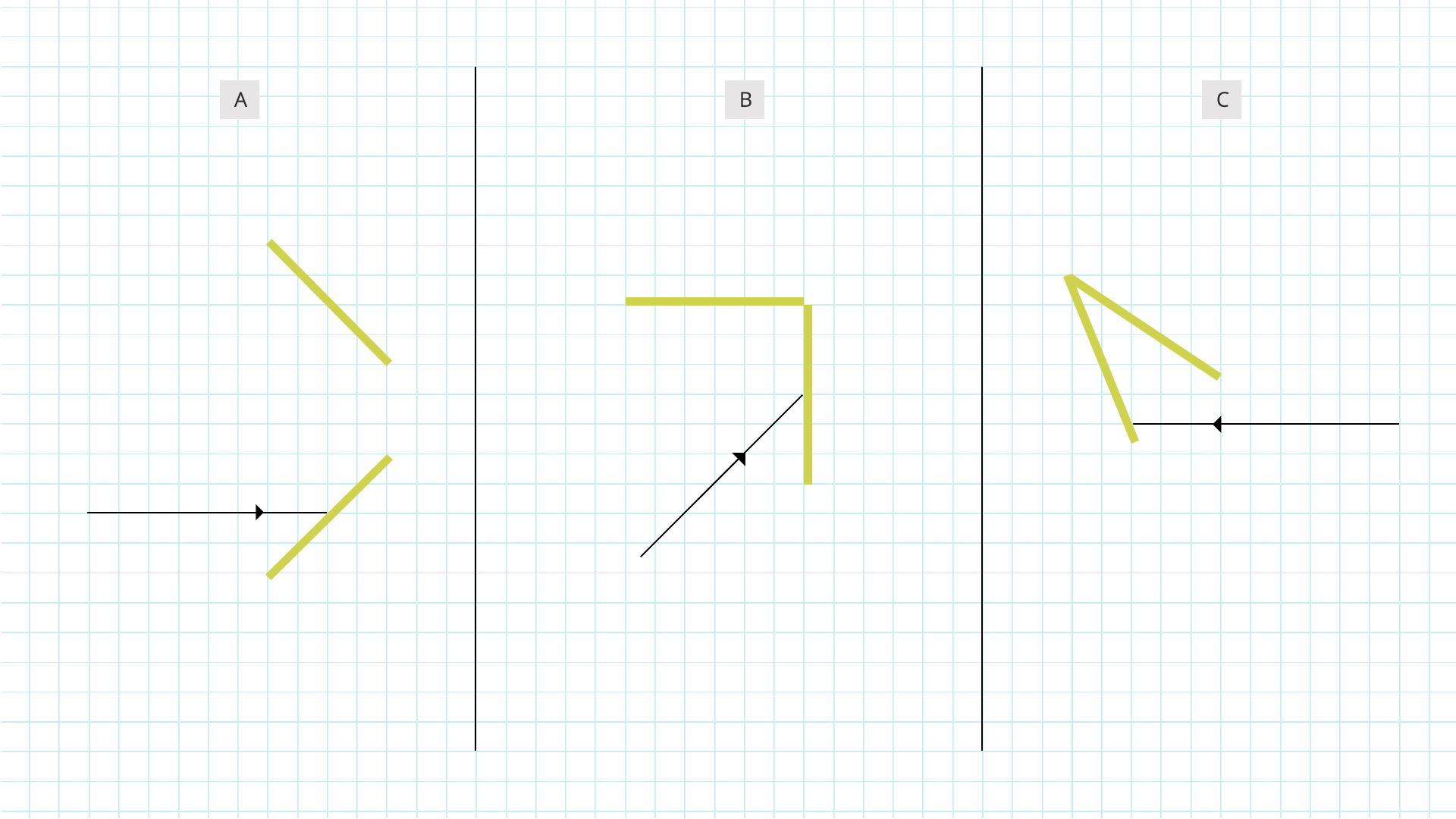
The drawings show two mirrors in different settings. Try to describe the path of the light ray after reflection off their surfaces for each case.
The drawings show two mirrors in different settings. Try to describe the path of the light ray after reflection off their surfaces for each case.
The drawings show two mirrors in different settings. Draw the path of the light rayrayray after reflection off their surfaces for each case.
RsJ3D2FpkJ5L31
Rysunek przedstawia trzy schematy na kratce, na każdym zaznaczone są dwa lustra (jako pogrubione linie) oraz początkowy bieg promienia świetlnego (odcinek ze strzałką). Na rysunku A zaznaczone są dwa odsunięte od siebie o 3 kratki lustra, między którymi kąt wynosi 45 stopni. Promień zaznaczony poziomo, styka się prawym końcem z środkiem dolnego lustra. Na rysunku B dwa lustra ustawione prostopadle względem siebie dotykają się narożnikami. Promień zaznaczony pod kątem 45 stopni, styka się prawym końcem z środkiem dolnego lustra. Na rysunku C dwa lustra stykają się narożnikami tworząc kąt ostry. Promień zaznaczony poziomo, styka się prawym końcem z dolnym lustrem.
Source: GroMar, licencja: CC BY 3.0.
Odpowiedź. Przypadek pierwszy na podstawie rysunku A: dwa odsunięte od siebie lustra, między którymi kąt wynosi 45 stopni. Promień biegnie od lewej strony i pada poziomo w środek dolnego lustra, następnie odbija się pionowo do góry i pada w środek górnego lustra. Następnie odbija się i biegnie poziomo w lewą stronę. Przypadek drugi na podstawie rysunku B: dwa lustra ustawione prostopadle względem siebie dotykają się narożnikami. Promień biegnie z lewej strony od dołu i pada pod kątem 45 stopni w środek dolnego lustra. Następnie odbija się pod kątem 45 stopni i pada w środek górnego lustra. Następnie odbija się pod kątem 45 stopni i biegnie w lewo, w dół. Przypadek trzeci na podstawie rysunku C: dwa lustra stykają się narożnikami tworząc kąt ostry. Promień biegnie z prawej strony i pada poziomo na lewy koniec dolnego lustra. Następnie odbija się pod kątem 45 stopni i pada na lustro na górze, odbija się od lustra górnego i biegnie pionowo w dół.
Odpowiedź. Przypadek pierwszy na podstawie rysunku A: dwa odsunięte od siebie lustra, między którymi kąt wynosi 45 stopni. Promień biegnie od lewej strony i pada poziomo w środek dolnego lustra, następnie odbija się pionowo do góry i pada w środek górnego lustra. Następnie odbija się i biegnie poziomo w lewą stronę. Przypadek drugi na podstawie rysunku B: dwa lustra ustawione prostopadle względem siebie dotykają się narożnikami. Promień biegnie z lewej strony od dołu i pada pod kątem 45 stopni w środek dolnego lustra. Następnie odbija się pod kątem 45 stopni i pada w środek górnego lustra. Następnie odbija się pod kątem 45 stopni i biegnie w lewo, w dół. Przypadek trzeci na podstawie rysunku C: dwa lustra stykają się narożnikami tworząc kąt ostry. Promień biegnie z prawej strony i pada poziomo na lewy koniec dolnego lustra. Następnie odbija się pod kątem 45 stopni i pada na lustro na górze, odbija się od lustra górnego i biegnie pionowo w dół.
Consider in which devices the lawlawlaw of reflection is used. Give some examples.
Task 3
A simple periscope using two plane mirrors inclined at 45⁰ allows observation from behind a high wall or an obstacle. Draw the path of a light rayrayray in a periscope as it travels from an object into an observer’s eye.
Apply the lawlawlaw of reflection in situations where the path of the light rayrayray is known but the location of the reflecting surfacesurfacesurface is not known.
Task 4
Zapoznaj się z treścią abstraktu i ułóż pytanie na kartkówkę.
Zapoznaj się z treścią abstraktu i ułóż pytanie na kartkówkę.
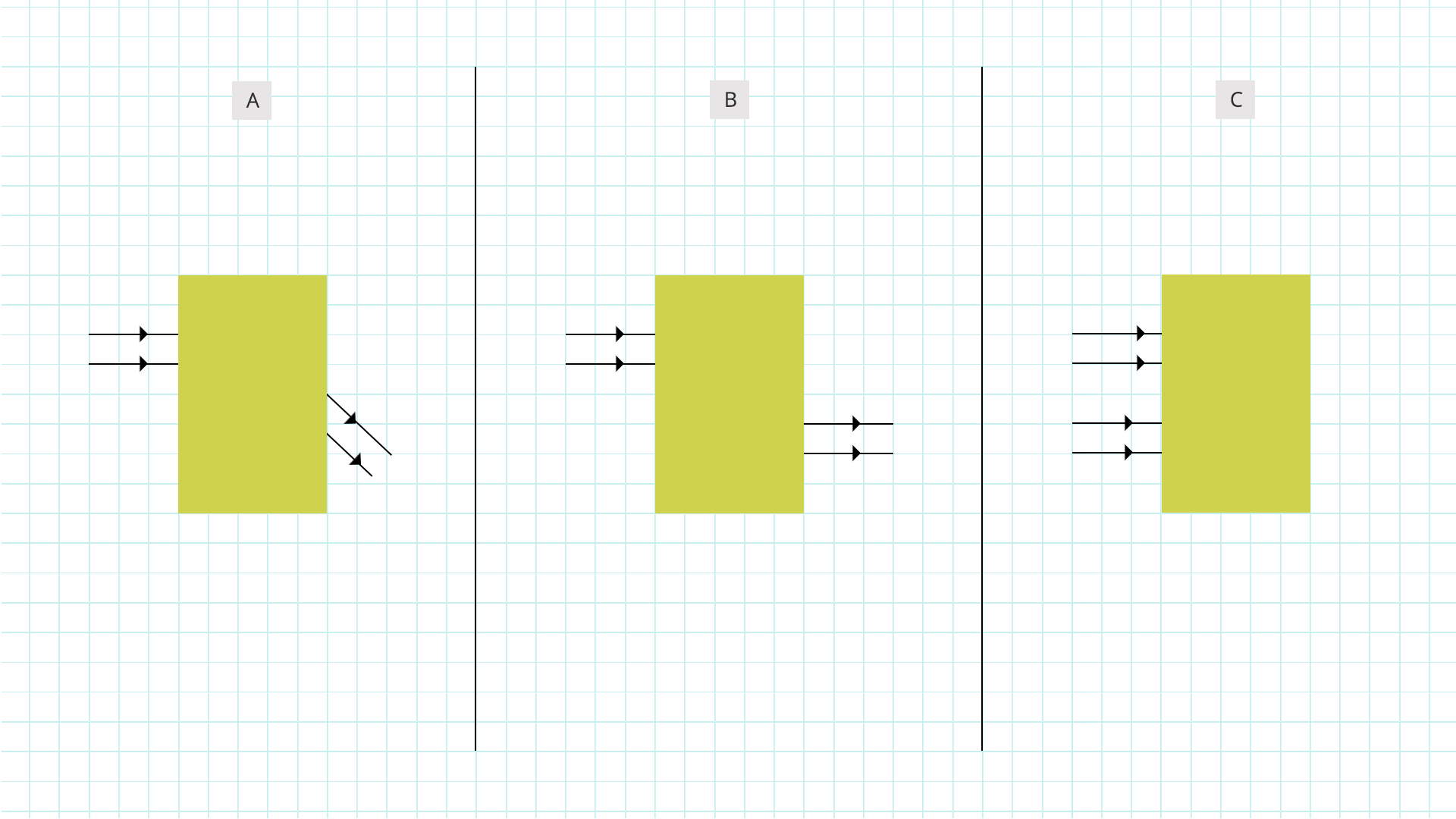
The boxes contain mirrors that direct the light rays as shown in the picture. Draw their location on the given schemes. Complete the path of light rays.
R137ZDl7IkZbV1
Rysunek przedstawia trzy schematy na kratce, na każdym narysowane są pudełka, w których w pewnych miejscach umieszczone są jedno lub dwa lustra. Na schematach pudełko jest oznaczone jako prostokąt. Promienie wpadające i wypadające oznaczone są liniami ze strzałkami pokazującymi kierunek ich biegu. Dwa promienie padające są we wszystkich trzech przypadkach prostopadłe do powierzchni prostokąta. Nie widać ich biegu wewnątrz pudełka. W przypadku A dwa promienie wychodzą po drugiej stronie pudełka pod kątem ostrym do jego powierzchni, poniżej poziomu promieni padających. W przypadku B promienie wychodzą pod kątem prostym do powierzchni prostokąta, poniżej poziomu promieni padających. W przypadku C promienie wychodzą prostopadle z pudełka po tej samej stronie, co promienie padające, lecz poniżej nich.
The angle of incidenceangle of incidenceangle of incidence and the angle of reflectionangle of reflectionangle of reflection are equalequalequal. The incident rayincident rayincident ray, the reflected rayreflected rayreflected ray and the normal in the point of reflection all lie in the same plane.
Exercises
RwXRr1jUlbfzX
Exercise 1
Wersja alternatywna ćwiczenia: Determine which sentences are true. Możliwe odpowiedzi: 1. The normal is the line parallel to a surface., 2. The angle of incidence equals the angle of reflection., 3. The incident ray is longer than the reflected ray., 4. When a plane mirror is rotated through an angle of 5⁰ the reflected ray is rotated through on angle of 5⁰., 5. The incident ray, the normal and the reflected ray all lie in the same plane.
Wersja alternatywna ćwiczenia: Determine which sentences are true. Możliwe odpowiedzi: 1. The normal is the line parallel to a surface., 2. The angle of incidence equals the angle of reflection., 3. The incident ray is longer than the reflected ray., 4. When a plane mirror is rotated through an angle of 5⁰ the reflected ray is rotated through on angle of 5⁰., 5. The incident ray, the normal and the reflected ray all lie in the same plane.
Determine which sentences are true.
The normal is the line parallel to a surface.
The angle of incidence equals the angle of reflection.
The incident ray is longer than the reflected ray.
When a plane mirror is rotated through an angle of 5⁰ the reflected ray is rotated through on angle of 5⁰.
The incident ray, the normal and the reflected ray all lie in the same plane.
zadanie
Source: GroMar, licencja: CC BY 3.0.
Exercise 2
Remind yourself how the inscription „ambulance” is placed on the front of the ambulances. Explain why.
The inscription „ambulance” is placed on ambulances in the form of a mirror reflection so that the driver traveling in front of an ambulance could see it correctly in his car mirror.
Exercise 3
Explain in English what the law of reflection of light is.
RnPEEDK58zedN
Exercise 4
Wersja alternatywna ćwiczenia: Indicate which pairs of expressions or words are translated correctly. Możliwe odpowiedzi: 1. kierunek - direction, 2. promień padający - incident ray, 3. prawo - law, 4. normalna - normal, 5. zwierciadło płaskie - plane mirror, 6. powierzchnia gładka - smooth surface, 7. kąt padania - angle of reflection, 8. kąt odbicia - angle of incidence
Wersja alternatywna ćwiczenia: Indicate which pairs of expressions or words are translated correctly. Możliwe odpowiedzi: 1. kierunek - direction, 2. promień padający - incident ray, 3. prawo - law, 4. normalna - normal, 5. zwierciadło płaskie - plane mirror, 6. powierzchnia gładka - smooth surface, 7. kąt padania - angle of reflection, 8. kąt odbicia - angle of incidence
Indicate which pairs of expressions or words are translated correctly.
kierunek - direction
promień padający - incident ray
prawo - law
normalna - normal
zwierciadło płaskie - plane mirror
powierzchnia gładka - smooth surface
kąt padania - angle of reflection
kąt odbicia - angle of incidence
zadanie
Source: GroMar, licencja: CC BY 3.0.
RTd2n6ePMnuVx1
Interaktywna gra, polegająca na łączeniu wyrazów w pary w ciągu jednej minuty. Czas zaczyna upływać wraz z rozpoczęciem gry. Jeden ruch to odkrywanie najpierw jednej potem drugiej karty z wyrazem. Każdy wyraz jest odczytywany. Kolejny ruch to odkrywanie trzeciej i czwartej karty. W ten sposób odsłuchasz wszystkie wyrazy. Nawigacja z poziomu klawiatury za pomocą strzałek, odsłuchiwanie wyrazów enterem lub spacją. Znajdź wszystkie pary wyrazów.
Interaktywna gra, polegająca na łączeniu wyrazów w pary w ciągu jednej minuty. Czas zaczyna upływać wraz z rozpoczęciem gry. Jeden ruch to odkrywanie najpierw jednej potem drugiej karty z wyrazem. Każdy wyraz jest odczytywany. Kolejny ruch to odkrywanie trzeciej i czwartej karty. W ten sposób odsłuchasz wszystkie wyrazy. Nawigacja z poziomu klawiatury za pomocą strzałek, odsłuchiwanie wyrazów enterem lub spacją. Znajdź wszystkie pary wyrazów.
Match Polish terms with their English equivalents.
kierunek
angle of reflection
promień odbity
direction
reflected ray
kąt odbicia
angle of incidence
promień padający
incident ray
kąt padania
Source: Zespół autorski Politechniki Łódzkiej, licencja: CC BY 3.0.