United States of America – economy / Role of the United States in the global economy
that the United Stated is an economically developed country;
that the United States is an immigrant country founded mainly by immigrants from Europe and slaves brought from Africa;
that a region’s natural environment influences its economic development.
to describe the relationship between the economy of selected US states and their natural features;
to assess the role of the United States in the global economy;
to show Silicon Valley on a map and list the reasons for the development of the hi‑tech industry and its importance for the global economy.
United States of America – economy
The United States of America is the most economically developed country in the world. In 2014, it generated 22.3% of the gross world product; China is second with 13.3%. What factors led to the emergence of such powerful country and the largest economy in the world?
Geographical factors include:
a large, conveniently located, continuous territory with access to two oceans;
favourable climatic conditions for the development of agriculture, fertile soils, abundance of natural resources.
Social and political factors that have contributed to the development of the USA include:
mass immigration of entrepreneurial, success‑seeking people with the right financial means and experience;
internal unity and no threats from the outside (the United States is bordered by Canada in the north and Mexico in the south);
great opportunities for growth supported by financial markets, exceptionally mobile workforce and strong entrepreneurial culture;
development of scientific research, introduction of new technologies and steady economic growth practically all the time;
The industry in the United States is based on its rich natural resources. Energy‑producing raw materials are of particular importance for the economy. Bituminous (black) coal is mined in the Appalachians, south of the Great Lakes and in northern Rocky Mountains. Oil and natural gas are found in the Gulf of Mexico, California and Alaska. Metal ore deposits are extracted in the Great Lakes region and in the Rocky Mountains.
Extraction of natural resources and production of industrial products | Share of world production | Place in the world |
Bituminous coal and lignite | 12.0% | 2nd |
Oil | 10.5% | 4th |
Natural gas | 19,6% | 1st |
Phosphates | 13.7% | 2nd |
Salt | 14.0% | 2nd |
Crude steel | 5.4% | 3rd |
Refined copper | 4.8% | 4th |
Primary aluminium | 4.1% | 4th |
Gold | 8.2% | 3rd |
Cars | 12.6% | 2nd |
Cement | 2.0% | 4th |
Sources: World Mineral Production 2009–2013, British Geological Survey; OICA
List decisive factors for the economic development of the most developed country in the world. Then draw conclusions.
The United States is one of the largest food producers in the world and its main exporter. Natural conditions favor the use of 45% of the area of his great state for agricultural purposes. The distribution of crops in the United States is adapted to natural conditions. The location of the country in several climatic zones allows the cultivation of many plant species appropriate for both temperate and subtropical climate. Soil quality and climatic conditions – mainly air temperatures and annual precipitation distribution – resulted in the creation of regions of agricultural specialties in specific areas. The largest number of agricultural areas is in the eastern and central states as well as on the west coast. The most important characteristics of agriculture.
USA are:
crop zonation and related agricultural farming method;
agricultural commodity, i.e. production for sale on the internal market and for export;
a high degree of mechanization in agriculture (only 1.6% of the active population work in agriculture);
dominance of large farms (farms) with an average area of approx. 200 ha;
high yields per hectare, eg maize 99.7 dt / ha (for comparison – in France 81.4, and in Poland 65.8);
the impact of the state on the size of agricultural production depending on global prices and demand for agricultural products;
introduction of modern methods of agricultural production: fertilization, drainage, plant protection, organic farming.
Role of the United States in the global economy
The United States of America is the world’s largest economic power today.
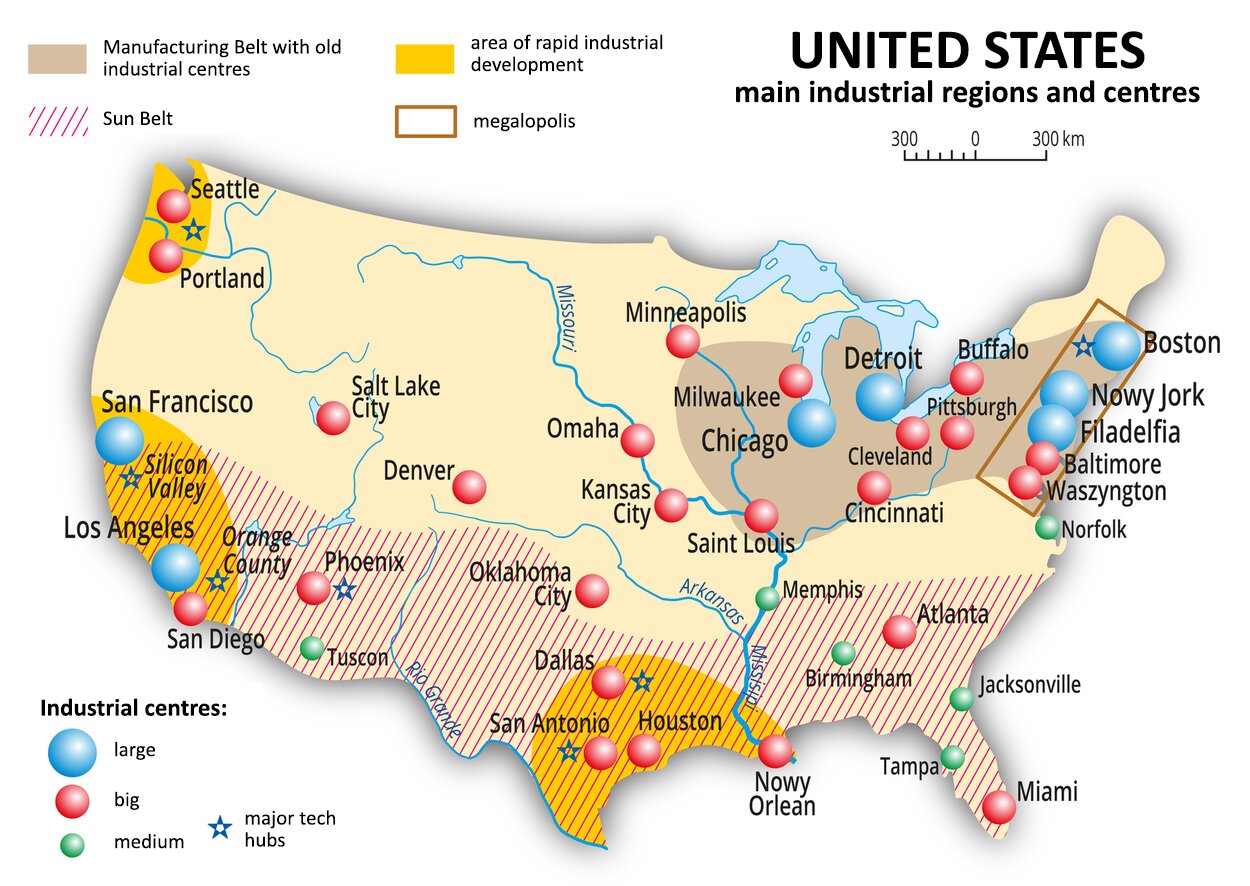
The economy of the United States of America generates more than 22% of the total gross world product. The USA plays an essential role in global trade. It is the largest country in the world by imports (12.3%) and second largest in exports (8.4%), only behind China. One of the most important groups of products exported by the United States are hi‑tech products, i.e. aircraft equipment, computers, electronic devices, pharmaceutical products, research and development equipment, chemicals and arms. These products account for 22.6% of all exports from the United States. The most important trading partners of the United States are: China, Canada, Mexico and Japan. These four countries account for as much as 50% of the overall value of American imports and exports. The high value of trade with Canada and Mexico follows from the fact that these two countries and the United States are parties to the North American Free Trade Agreement (NAFTA). The Agreement was signed in 1994 in order to remove trade barriers between the three largest countries of North America.
The United States is also the country that invests the most money abroad. In 2013, almost 30% of all international investments in the world were made by the USA. Trade in services is also of major importance for developed countries – and the United States is the largest importer and exporter of services in the world.
Country | GDP total value | Share of GDP | GDP per capita |
United States | USD 17,418,925 million | 22.5% | UDS 54,597 |
China | USD 10,380,380 million | 13.4% | USD 7,589 |
Japan | USD 4,616,335 million | 6.0% | USD 36,332 |
Germany | USD 3,859,547 million | 5.0% | USD 47,590 |
Source: International Monetary Fund
Using the textbook and the Internet sources, find out the places where these raw materials are found in the United States. Then drag them to the correct column.
Rocky Mountains, Louisiana, Alaska, Great Lakes Region, Texas, Appalachian Region, Alaska, California, Texas, Kansas, Kansas, Interior Region, Louisiana, Alaska
| Bituminous coal | |
|---|---|
| oil | |
| natural gas | |
| iron ores | |
| gold |
The United States are the seat of some of the largest industrial corporations in the world. Point two of them.
- General Motors
- General Electric
- Sinopec Group
- State Grid
Which state of the USA can be seen in each satellite image?
- Arizona
- Hawaii
- Florida
- Iowa

Mark the cities of the East Coast Region with blue, the cities of the Great Lakes Region with red and the cities of the Southern Region with green.
{blue} Boston{/blue} {green} San Antonio{/green} {blue} Washington{/blue} {red} Detroit{/red} {blue} New York{/blue} {red} Buffalo{/red} {red} Chicago{/red} {green} Dallas{/green} {blue} Baltimore{/blue} {green} New Orleans{/green} {red}Pittsburgh{/red} {blue} Philadelphia{/blue}
Summary
The distribution of industry over the territory of the United States is uneven. Old industrial centres and regions are concentrated in the so‑called Manufacturing Belt spreading across the north‑eastern part of the country. The last few decades have also seen rapid growth of industrial centres in the Pacific Coast and in the south of the country.
For several dozen years, the US industry has been characterised by rapid development of hi‑tech sectors: electronics, information technology, pharmaceutical, biotechnology, arms. Tech hubs play an important role in the country’s economy.
Keywords
economy, USA, US states
Glossary
import - zakup towarów lub usług za granicą w celu wykorzystania ich na rynku wewnętrznym.
eksport - sprzedaż towarów lub usług wytwarzanych w danym kraju podmiotom zagranicznym
hi‑tech (nowe technologie) - potoczne, często używane w mediach określenie na zaawansowane rozwiązania techniczne i zastosowania najnowszych odkryć naukowych w praktyce.