Polish–Lithuanian Commonwealth at war
with whom Poland waged wars in the 17th century;
how the Polish‑Russian war ended;
what the course of the Polish‑Turkish war was.
The 17th century was a period of armed conflicts for Poland, which weakened the country.
One of the countries with which Poland waged war was Russia. After the death of Ivan IV the Terrible, a tsar of the Rurik dynasty, Russia faced deep crisis, uprisings and riots. This time was called as the „Time of TroublesTime of Troubles”. This situation in the Tsardom of Russia was a consequence of the internal politics of the deceased tsar. In 1598 Tsar Feodor died, thus ending the reign of the Rurikids. The power was then seized by the boyarboyar Boris Godunow, who was accused of murdering tsar Feodor's brother - Dmitry. However, a man calling himself Dmitri and professing to be the rightful heir to the throne returned to Russia in unclear circumstances and took over power. He married a daughter of a Polish magnate, Marina Mniszchówna. His reign had no support from his compatriots, because he did not respect Orthodox customs and surrounded himself with Polish Catholics. This led to riots in which Dmitry was slain.
Power was then seized by the boyarboyar Vasili IV of Russia. During his reign Russia lost to Poland in the Battle of Klushino and the Poles managed to occupy Smolensk and Moscow. Stanisław Żółkiewski removed Vasili IV of Russia from power and proposed the crown to the Polish prince Władysław. However, in order to become a tsar, the prince would have to convert to Orthodoxy, which he did not do. An uprising broke out against Poles, as a result of which they were driven out of Kremlin.
In 1613, Michael Romanov ascended the Russian throne and began the process of state restoration. The stabilization of the situation in the country allowed the tsar to launch a new military intervention in order to try to recover Smolensk. The tsar was defeated and was forced to sign a peace treaty in Polyanovka in 1634. Władysław renounced his claim to the Russian throne, for which he received monetary compensation.
In 1654, the Russian tsar broke the peace arrangements and concluded the Treaty of Pereyaslav with the Cossacks. After many years of war, in 1667, a truce was signed in Andrusovo, under which Russia regained Smolensk and Ukraine got divided between Russia and Poland. In 1686, the Treaty of Perpetual Peace was concluded in Moscow. It confirmed the provisions of the Truce of Andrusovo, ending the Polish‑Russian conflict.
Another country with which Poland waged wars was the Ottoman Empire. Turkey sought to conquer the south‑eastern areas of Ukraine that belonged to Poland. In 1672, Turkey captured Kamianets‑Podilskyi. In the following years of wars with Turkey, the Poles were victorious, e.g. at the battle of Khotyn. In 1683, the army of John III Sobieski defeated the Turks commanded by Kara Mustafa at the Battle of Vienna. The Polish‑Turkish conflict ended in 1699 with the Treaty of Karlowitz, under which Poland regained Podolia with Kamianets‑Podilskyi and the right‑bank Ukraine.
Take a look at the Stephen Báthory at Pskov painting by Jan Matejko. The painting shows the reception of the diplomatic mission of Russian Tsar Ivan IV the Terrible by the king of Poland, Stephen Báthory, during the siege of Pskov.
The scene itself is fictitious and combines two events: the diplomatic missions of the boyarsboyars after conquering the fortress of Velikiye Luki and the truce of Yam‑Zapolsky. However, the persons presented here are real.
Evaluate, taking into account the interests of the Commonwealth, actions taken by the Polish side against the Russian Tsars at the beginning of 18th century:
benefits,
wasted chances,
threats for the future.
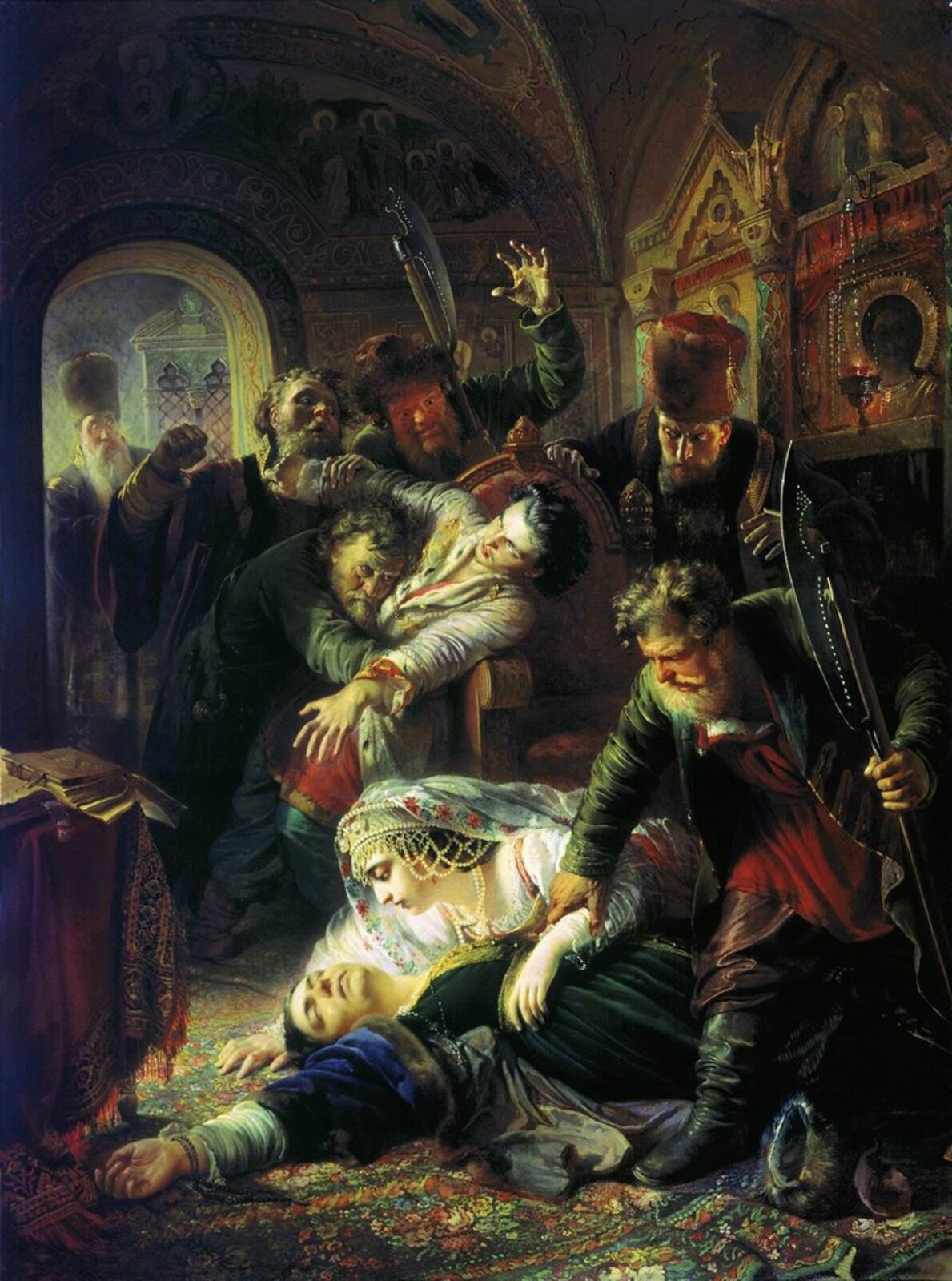
Answer the question, who murdered Fiodor, son of Boris Godunov. If necessary, get help from the teacher.
Match the terms with their definitions.
shock cavalry wearing heavy armour with characteristic metal wings., political crisis in Russia in the years 1605-1613., members of the upper Ruthenian social class; great landowners., in many Muslim countries, this is the title of the highest state officials.
| Boyars | |
| Polish hussars | |
| Time of Troubles | |
| Vizier |
Keywords
Livonian War, Stephen Báthory, Jan Zamoyski, Ivan IV the Terrible
Glossary
Carstwo Rosyjskie (Wielkie Księstwo Moskiewskie) – państwo będące kontynuacją Wielkiego Księstwa Moskiewskiego, powstałe w 1547 wraz z koronacją Iwana IV Groźnego na „cara Wszechrusi”. Przestało istnieć w 1721 roku na rzecz Imperium Rosyjskiego, kiedy to Piotr I przyjął tytuł cesarza‑imperatora.
Bojarzy – członkowie wyższej warstwy społecznej na Rusi; wielcy właściciele ziemscy.
Husaria – ciężka jazda konna nosząca półzbroję z charakterystycznymi metalowymi skrzydłami.
Wielka smuta – kryzys polityczny w Rosji w latach 1605–1613.
Wezyr – w wielu krajach muzułmańskich tytuł najwyższych urzędników państwowych.