The ABCs of addressing letters
you will address an envelope
you will tell who the sendersender and the addressee are
you will get to know what the rules for using upper and lower case in correspondencecorrespondence are
you will use Google Maps app
Do you like writing letters and/or postcards? Do you like receiving them from others? For a letter or postcard to reach its destination, it has to be correctly addressed.
Do you know what you should write on an envelope? Don’t worry, you’ll get to learn all about addressing letters today.
If you want to send letters and postcards, you must be able to address them correctly. What do you think which envelope is addressed correctly?
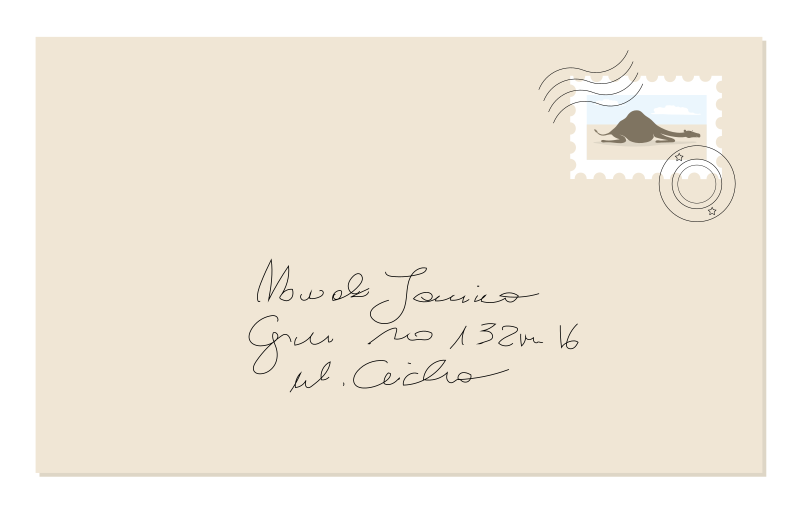
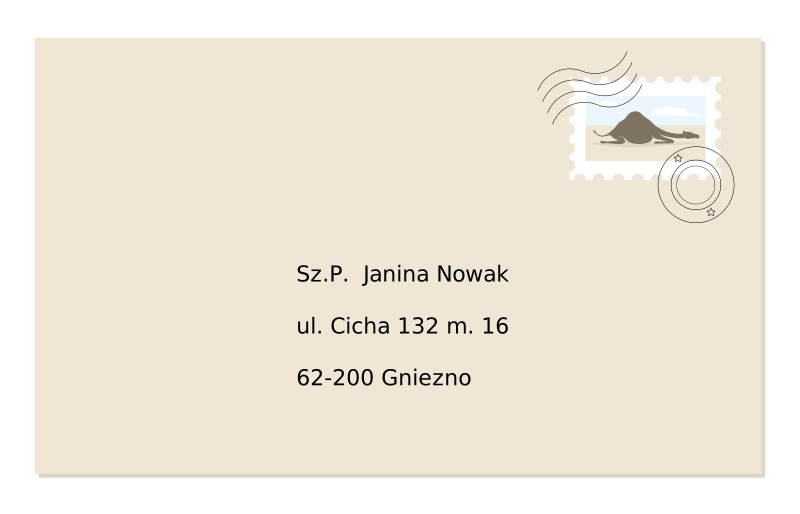
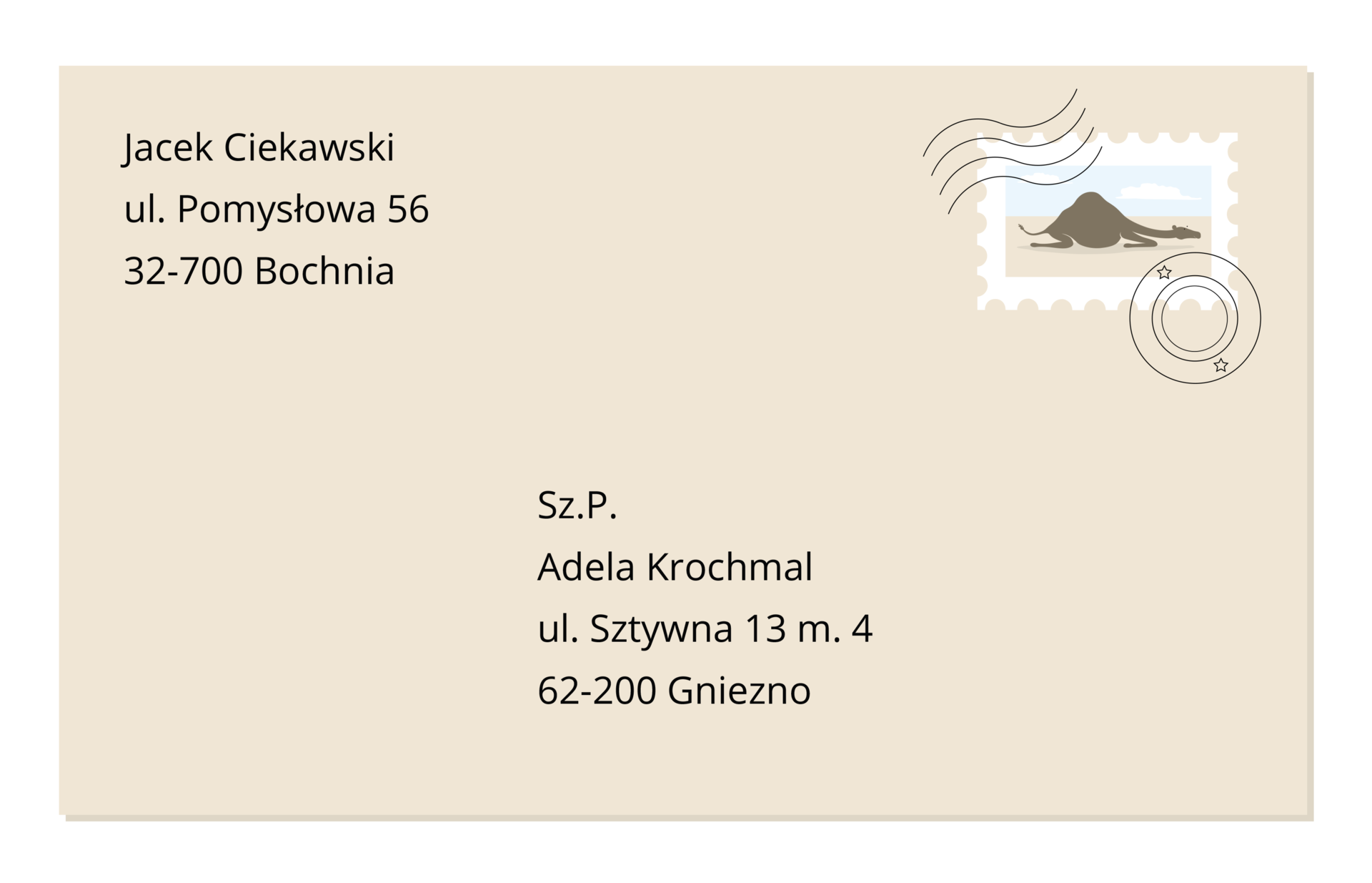
Look at the picture. Can you name the items that you see? If not, check it out!
Addressing correctly
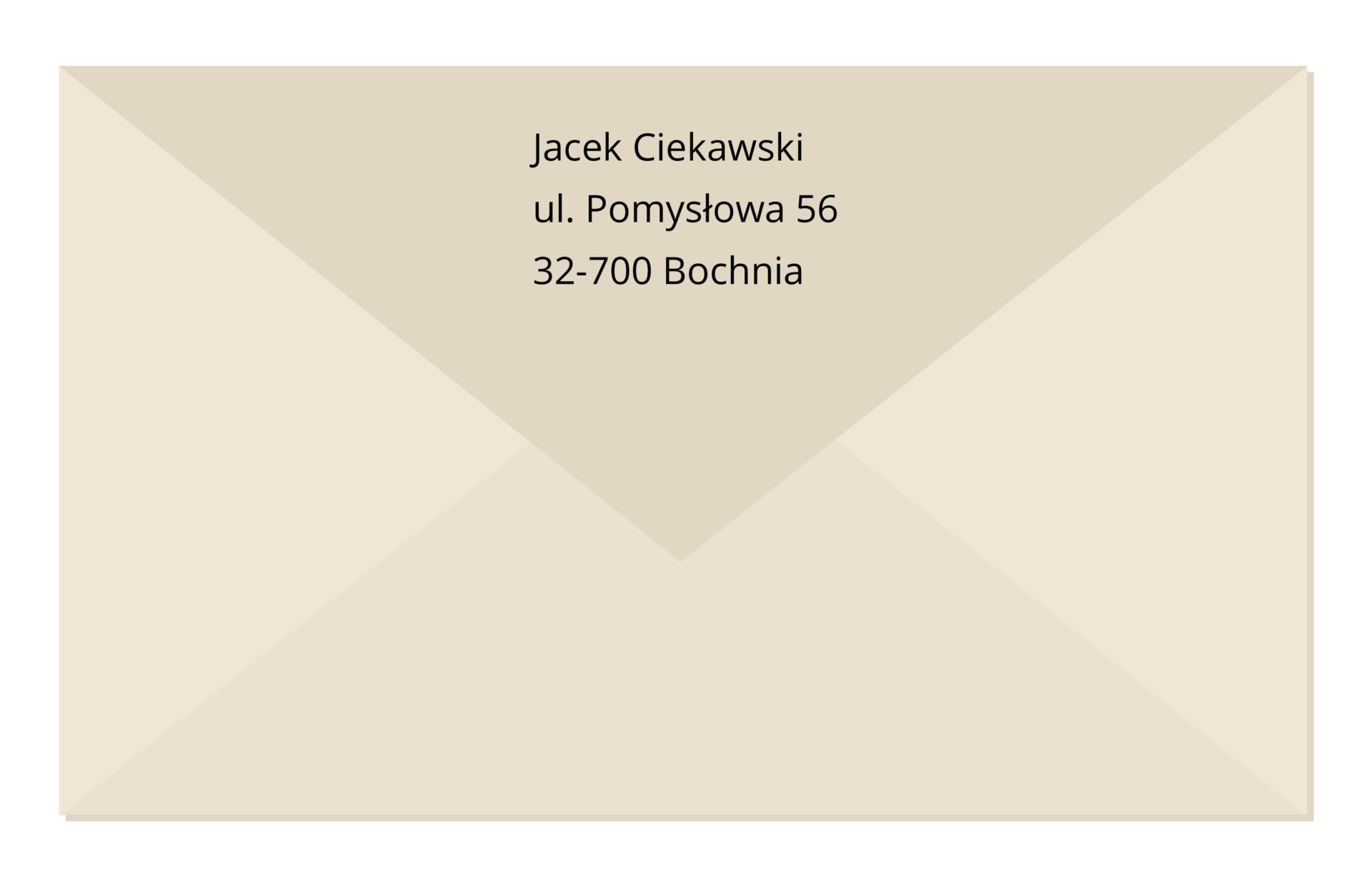
Remember to write the sender’s address on the envelope as well. That’s how the addressee knows where to send his or her reply. If a letter gets lost along the way and never reaches the addressee, the postman or the postwoman returns it to the sender.
As the sender, you can write your details in two places: either in the top left corner of the front of the envelope (the side without flaps) or at the top of the back of the envelope (the side with flaps). The addressee’s details should be on the front of the envelope, and, if you choose the first addressing option, you will have both addresses on the same side.
Look at the pictures. Compare and contrast.
The acronym “SZ.P.” is the short form of the greeting “Szanowni Państwo”/”Szanowna Pani”/”Szanowny Pan.” Match the acronyms with other greetings/formal correspondence phrases.
Prof., Dr, Kol., W.P.
| Wielmożni Państwo / Wielmożna Pani / Wielmożny Pan | |
| Kolega / Koleżanka | |
| Profesor | |
| Doktor |
Match formal correspondence phrases/greetings with the addressee. Read the information about the sender and addressee and insert the correct titles/greetings.
Kol., Sz.P., Sz.P. or W.P., Prof.
Your friend writes a letter to her grandmother. She will choose the expression .......................... Matylda Nowak.
Your parents write a letter to their old acquaintances from the university. They will choose the expression .......................... Ada i Jan Stańczykowie.
You are writing a letter to your friend. You will choose the expression .......................... Maja Tracz.
Marek writes a letter to a professor who teaches his son. He will choose the expression .......................... Alojzy Mucha.
Guiding codes
Postal codePostal code or postcode is a series of digits and forms part of an address. Postcodes make it easier to sort mail and help make sure a letter reaches the addressee indicated on the envelope. Each city, town, village and district has its distinct postal code. If you need a Polish postal code, just go to the Poczta Polska (Polish Post) website and use its postcode search engine.
Use a paper or online map, e.g. Google Maps, to locate the address written on the envelope. Go to the e‑textbook and watch the video on the Google Maps app.
Watch „Wyprawa do Torunia” video from the “Adresowe ABC” lesson at epodreczniki.pl. You will learn from it how to use Google Maps app.
Use Google Maps to locate your school and home. Click “Get directions” and Google Maps will display your home‑school route. What distance do you have to cover to complete this route? How many streets do you have to walk along/cross? Describe your route to your classmate.
Imagine that you are in a city and suddenly all street names and building numbers disappear. Someone asks you for directions from your house to your school. How do you explain the route? How do you explain the route from your city’s main street to your school? What about the way from the railway or bus station? Try to “guide” your friends to their destination.
At the Traveller Camp, there aren’t any stationery shops. When a traveller wants to send a letter, he or she has to make an envelope from scratch. Go to “Adresowe ABC” lesson at epodreczniki.pl and watch the video. Try to make an envelope yourself.
How was this lesson? Did you like it? Finish selected sentences.
Keywords
sendersender, addresseeaddressee, correspondencecorrespondence, letter, address
Glossary
nadawca, osoba nadająca list.
adresat, osoba, do której wysyłamy list.
korespondencja, wymiana informacji między ludźmi w formie pisemnej (na papierze lub elektronicznej).
zwrot grzecznościowy
kod pocztowy
W tej lekcji zostaną użyte m.in. następujące pojęcia oraz nagrania
Pojęcia
nadawca, osoba nadająca list.
adresat, osoba, do której wysyłamy list.
korespondencja, wymiana informacji między ludźmi w formie pisemnej (na papierze lub elektronicznej).
zwrot grzecznościowy
kod pocztowy
Teksty i nagrania
The ABCs of addressing letters
Do you like writing letters and/or postcards? Do you like receiving them from others? For a letter or postcard to reach its destination, it has to be correctly addressed.
Do you know what you should write on an envelope? Don’t worry, you’ll get to learn all about addressing letters today.
If you want to send letters and postcards, you must be able to address them correctly. What do you think which envelope is addressed correctly?
Remember to write the sender’s address on the envelope as well. That’s how the addressee knows where to send his or her reply. If a letter gets lost along the way and never reaches the addressee, the postman or the postwoman returns it to the sender.
As the sender, you can write your details in two places: either in the top left corner of the front of the envelope (the side without flaps) or at the top of the back of the envelope (the side with flaps). The addressee’s details should be on the front of the envelope, and, if you choose the first addressing option, you will have both addresses on the same side.
Look at the pictures. Compare and contrast.
Postal code or postcode is a series of digits and forms part of an address. Postcodes make it easier to sort mail and help make sure a letter reaches the addressee indicated on the envelope. Each city, town, village and district has its distinct postal code. If you need a Polish postal code, just go to the Poczta Polska (Polish Post) website and use its postcode search engine.
Use a paper or online map, e.g. Google Maps, to locate the address written on the envelope. Go to the e‑textbook and watch the video on the Google Maps app.
Watch „Wyprawa do Torunia” video from the “Adresowe ABC” lesson at epodreczniki.pl. You will learn from it how to use Google Maps app.