Masses of proton, neutron and electron are often given in terms of an atomic mass unit, where one atomic mass unit (u) is defined as 1/12th the mass of a carbon atom.
A nucleusnucleusnucleus consists of protons and neutrons, commonly called nucleons.
The original mass of nucleus is found to be less than the sum of individual masses of its constituents. Mass defectmass defectMass defect which is the difference between the sum of the masses of the nucleus constituents and its mass, is equivalent to the energy released during the formation of nucleusnucleusnucleus.
RU2mpfyqap4JM
Po lewej stronie ilustracji interaktywnej przedstawione jest jądro atomowe, opisane numerem 1, złożone z małych niebieskich kulek symbolizujących neutrony oraz zielonych kulek z zaznaczonym w środku plusem symbolizujących protony. Na środku rysunku zaznaczony jest plus, po którym napis binding energy oraz strzałka pozioma skierowana w prawo wskazująca na pojedyncze zielone i niebieskie kulki symbolizujące odseparowane nukleony, opisane numerem 2. Na ilustracji widoczne są numery, a na nich podpisy. 1. nucleus has smaller mass {audio}, 2. separated nucleons have greater mass {audio}.
Po lewej stronie ilustracji interaktywnej przedstawione jest jądro atomowe, opisane numerem 1, złożone z małych niebieskich kulek symbolizujących neutrony oraz zielonych kulek z zaznaczonym w środku plusem symbolizujących protony. Na środku rysunku zaznaczony jest plus, po którym napis binding energy oraz strzałka pozioma skierowana w prawo wskazująca na pojedyncze zielone i niebieskie kulki symbolizujące odseparowane nukleony, opisane numerem 2. Na ilustracji widoczne są numery, a na nich podpisy. 1. nucleus has smaller mass {audio}, 2. separated nucleons have greater mass {audio}.
Separation of a nucleus
Source: GroMar, licencja: CC BY 3.0.
The mass defectmass defectmass defect is given by the formula:
where: - mIndeks dolny pp is proton mass, - mIndeks dolny nn is neutron mass, - mIndeks dolny nucleusnucleus is mass of nucleus.
The nuclear binding energybinding energybinding energy accounts for the noticeable difference between the actual mass of nucleusnucleusnucleus and its expected mass. This is the energy necessary to hold the nucleus together.
According to the Einstein's law of conversion of mass to energy the binding energy of nucleus is given as:
where: - Δm is the mass defectmass defectmass defect, - c is the speed of the light.
To predict stabilitystabilitystability of nucleus binding energybinding energybinding energy per nucleonnucleonnucleon is often used:
where: - A is the mass number of a given nucleus.
The binding energybinding energybinding energy per nucleon is the amount of energy that must be delivered to the nucleusnucleusnucleus to extract one nucleonnucleonnucleon from it. If you want to obtain independent free particles instead of a nucleus, you should provide energy equal to the total binding energy.
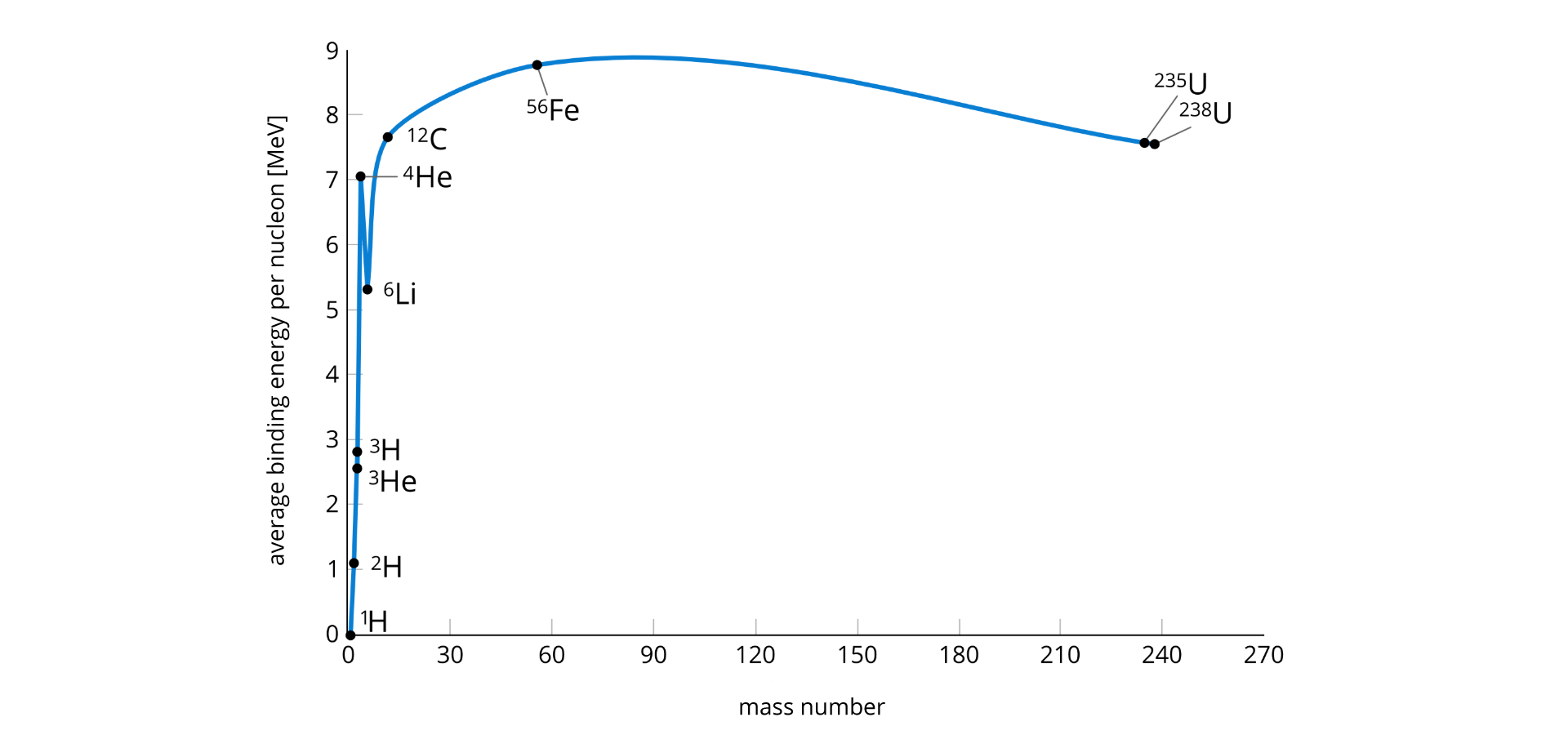
In the graph the binding energy per nucleon as a function of mass number is presented.
The averageaverageaverage binding energy per nucleon is about 8 MeV. Only the lighter nuclei have smaller binding energy per nucleon.
The maximum binding energy per nucleon is at about A = 50. The iron nucleusnucleusnucleus is located near the maximum. Its binding energy per nucleon is 8,8 MeV making it one of the most stable nuclide.
Nuclei with very low or very high mass numbers have smaller binding energy per nucleon and are less stable.
RIFiCIV0l9Rxt1
Na rysunku przedstawiony jest wykres zależności średniej energii wiązania przypadającej na nukleon od liczby masowej. Oś pozioma opisana mass number, skala od 0 do 270, z odcinkiem jednostkowym 30. Oś pionowa opisana average binding energy per nucleon w nawiasie kwadratowym MeV, symbolizujące megaelektronowolty, skala od 0 do 9, z odcinkiem jednostkowym 1. Krzywa opisująca przebieg energii zaznaczona jest kolorem niebieskim. Na niej zaznaczone są izotopy: wodoru, helu, litu, węgla, żelaza i uranu. Najmniejszą średnią wartość wiązania wynoszącą 0 ma H z indeksem górnym 1. Następnie H z indeksem górnym 2 około 1,1. Następnie He z indeksem górnym 3 około 2,6. Następnie H z indeksem górnym 3 około 2,8. Następnie Li z indeksem górnym 6 około 5,3. Następnie He z indeksem górnym 4 około 7. Następnie C z indeksem górnym 12 około 7,5. Następnie U z indeksem górnym 238 około 7,6. Następnie U z indeksem górnym 235 około 7,7. Następnie Fe z indeksem górnym 56 około 8,8. Z wykresu widać, że dla izotopów o liczbie masowej do 12 średnia energia wiązania zmienia się od 0 do około 7,5. Natomiast dla izotopów o liczbie masowej od 12 do 240 średnia energia wiązania jest na poziomie od około 7,5 do około 8,8.
Mass defectmass defectMass defect which is the difference between the sum of the masses of the nucleusnucleusnucleus constituents and its mass, is equivalent to the energy released during the formation of nucleus.
Binding energy is energy required to separate the protons and neutrons of an atomic nucleus.
Exercises
RJV6qQPqhpfA6
Exercise 3
Wersja alternatywna ćwiczenia: Determine which sentences are true. Możliwe odpowiedzi: 1. The binding energy of a nucleus is equivalent to the product of the mass defect and the square of the speed of light., 2. The mass of a hydrogen atom defines the atomic mass unit., 3. Iron is the most stable nuclide., 4. The mass defect represents the binding energy of the nucleons.
Wersja alternatywna ćwiczenia: Determine which sentences are true. Możliwe odpowiedzi: 1. The binding energy of a nucleus is equivalent to the product of the mass defect and the square of the speed of light., 2. The mass of a hydrogen atom defines the atomic mass unit., 3. Iron is the most stable nuclide., 4. The mass defect represents the binding energy of the nucleons.
Determine which sentences are true.
The binding energy of a nucleus is equivalent to the product of the mass defect and the square of the speed of light.
The mass of a hydrogen atom defines the atomic mass unit.
Iron is the most stable nuclide.
The mass defect represents the binding energy of the nucleons.
Exercise 4
The mass of a nucleus is exactly 12 u.
What is the mass defect of this nucleus? What is the binding energy of this nucleus?
Δm = 0,098940 u
ΔE = 92,1 MeV
Exercise 5
Present in English what information the binding energy curve delivers.
RIawwLzqesNmT
Exercise 6
Wersja alternatywna ćwiczenia: Indicate which pairs of expressions or words are translated correctly. Możliwe odpowiedzi: 1. deficyt masy - mass defect, 2. energia wiązania - binding energy, 3. średnia - average, 4. prawo zachowania - conservation law, 5. stabilność - abundant, 6. nukleon - nucleus
Wersja alternatywna ćwiczenia: Indicate which pairs of expressions or words are translated correctly. Możliwe odpowiedzi: 1. deficyt masy - mass defect, 2. energia wiązania - binding energy, 3. średnia - average, 4. prawo zachowania - conservation law, 5. stabilność - abundant, 6. nukleon - nucleus
Indicate which pairs of expressions or words are translated correctly.
deficyt masy - mass defect
energia wiązania - binding energy
średnia - average
prawo zachowania - conservation law
stabilność - abundant
nukleon - nucleus
zadanie
Source: GroMar, licencja: CC BY 3.0.
R1PQ85zgbdcAl1
Interaktywna gra, polegająca na łączeniu wyrazów w pary w ciągu jednej minuty. Czas zaczyna upływać wraz z rozpoczęciem gry. Jeden ruch to odkrywanie najpierw jednej potem drugiej karty z wyrazem. Każdy wyraz jest odczytywany. Kolejny ruch to odkrywanie trzeciej i czwartej karty. W ten sposób odsłuchasz wszystkie wyrazy. Nawigacja z poziomu klawiatury za pomocą strzałek, odsłuchiwanie wyrazów enterem lub spacją. Znajdź wszystkie pary wyrazów.
Interaktywna gra, polegająca na łączeniu wyrazów w pary w ciągu jednej minuty. Czas zaczyna upływać wraz z rozpoczęciem gry. Jeden ruch to odkrywanie najpierw jednej potem drugiej karty z wyrazem. Każdy wyraz jest odczytywany. Kolejny ruch to odkrywanie trzeciej i czwartej karty. W ten sposób odsłuchasz wszystkie wyrazy. Nawigacja z poziomu klawiatury za pomocą strzałek, odsłuchiwanie wyrazów enterem lub spacją. Znajdź wszystkie pary wyrazów.
Match Polish terms with their English equivalents.
defekt masy
prawo zachowania
stability
average
binding energy
stabilność
mass defect
przeciętny
conservation law
energia wiązania
Source: Zespół autorski Politechniki Łódzkiej, licencja: CC BY 3.0.