Army movements. Operations on the Eastern Front until 1916
to list the most important battles on the Eastern Front and in the Balkans;
to define the specifics of the operations on the Eastern Front;
to give examples of military engagement of Polish people on the Eastern Front
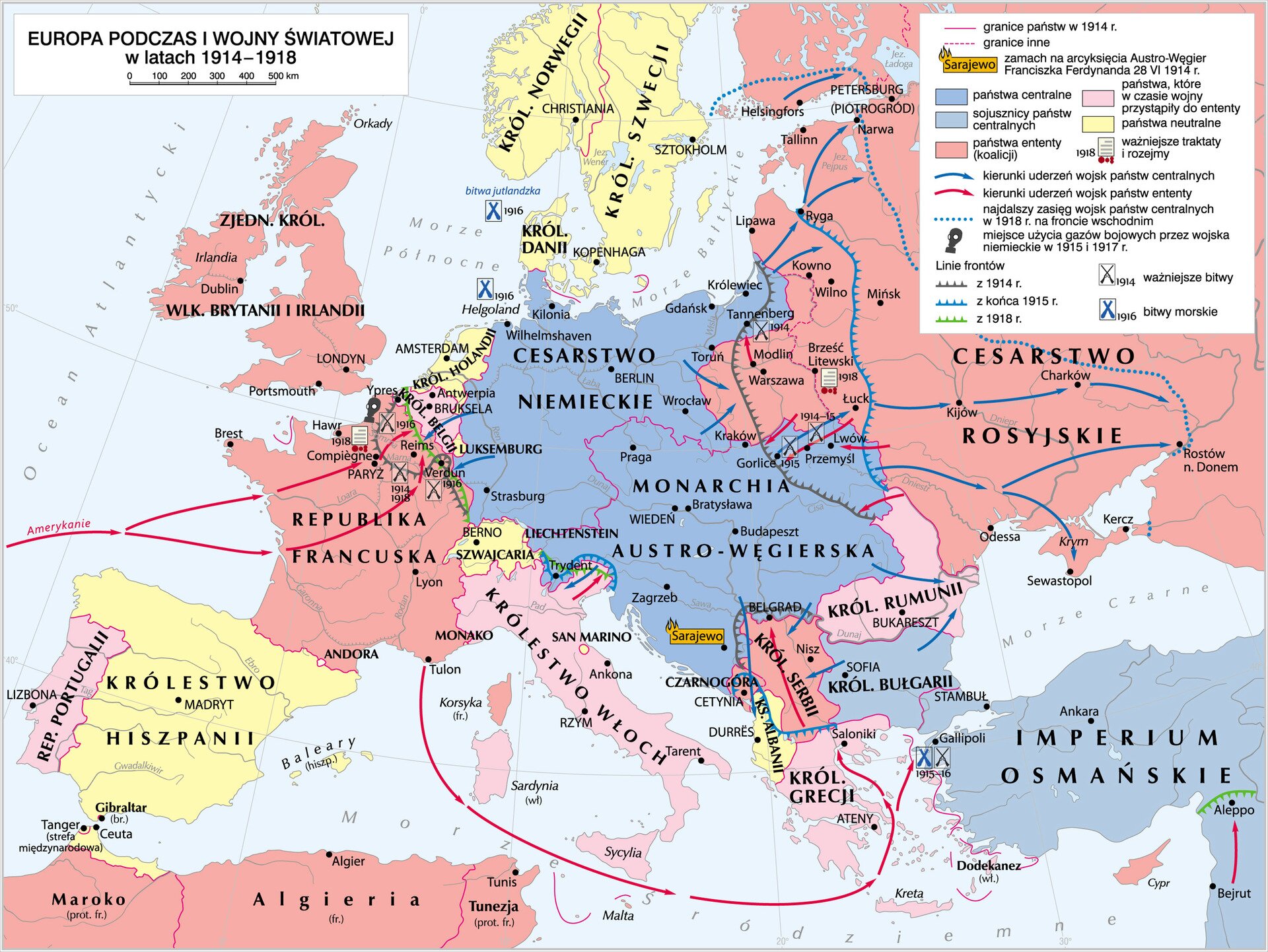
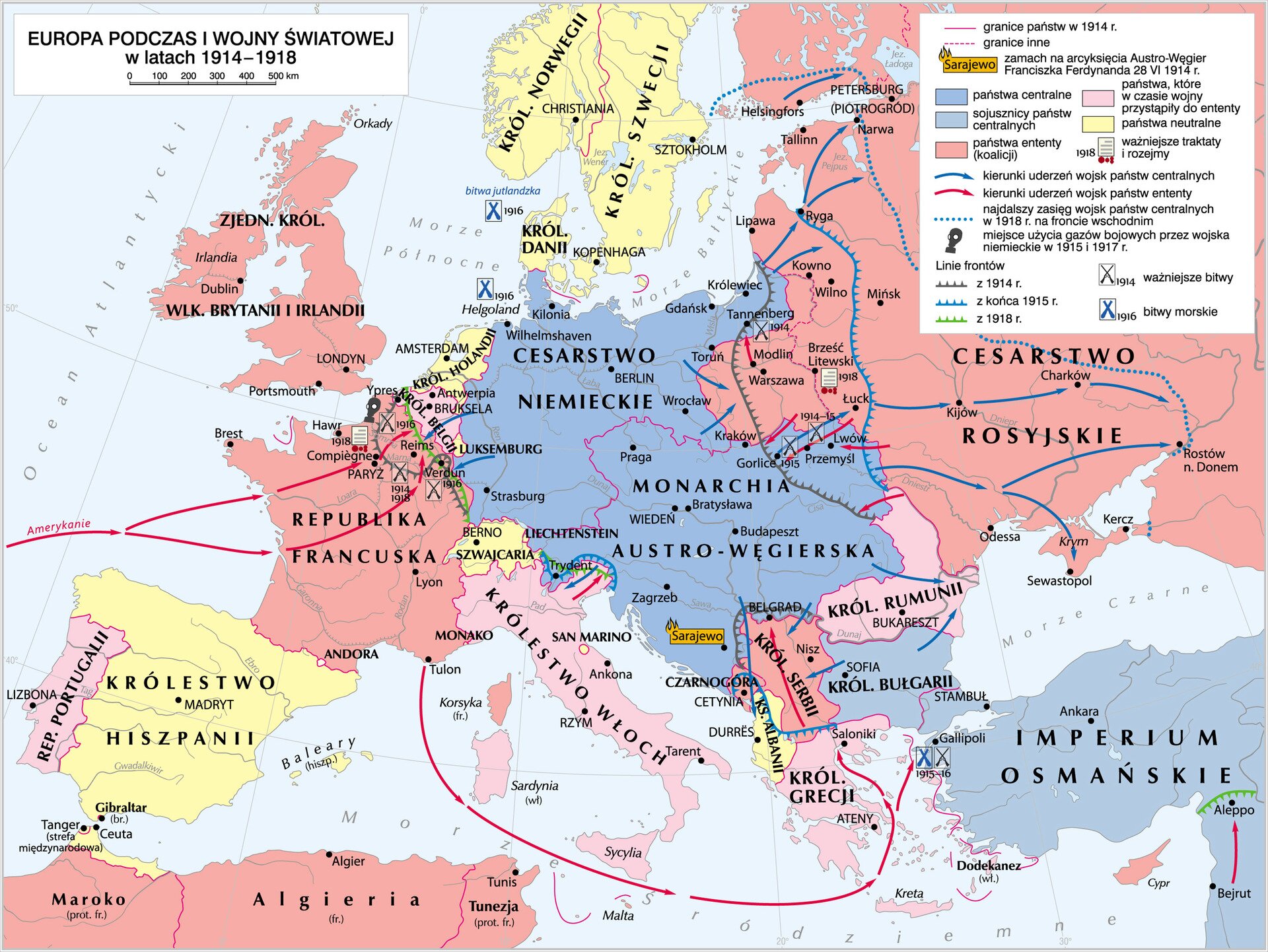
In the beginning, the military situation on the Eastern Front was more dynamic than on the Western Front. Between August and September 1914, the Russian offensive was stopped by Paul von Hindenburg, defeating them in the Battle of Tannenberg. In early September 1914, Russian troops seized Lviv, and the Przemyśl Fortress was conquered in March 1915 after several months of siege. German and Austrian offensive in the Carpathian mountains started in May 1915. Russia losing the Battle of Gorlice in May of the same year, sent a clear signal that the situation changed. Russia had to retreat from Przemyśl and, soon after, from Lviv. Germans invaded Warsaw in early August. At that time, the front line was fixed along the line of the Second Partition of Poland. The status was maintained until 1916. The Balkans was also a theatre of fierce fighting. In October 1915, the Central Powers’ troops attacked Serbia and Montenegro. The situation was definitely changed with Bulgaria joining the Central Powers in the war. The defeat of Serbia by the Bulgarians ensured the coveted direct connection to Bulgaria and Turkey. Eventually, the Balkan operations did not lead to the conflict, being settled between the two factions.
Listen to a broadcast about women serving during World War I alongside with Józef Piłsudski. What were their roles?
At first Józef Piłsudski was against enlisting women. However, he believed they could help in the support formations – commissariat, provisioning, sanitary corps and as couriers. And most certainly as spies. Therefore, in 1910 he agreed to create a women section at the Riflemen’s Association. They underwent military training as members of women rifle units. Józef Piłsudski anticipated their engagement in the upcoming war in courier and intelligence activities and to sabotagesabotage in the Russian Partition.
Just before the outbreak of the war, Piłsudski created independent women paramilitary units. Women were being prepared for paramilitary operations against Russia, they were trained in organization and dislocationdislocation of the Russian troops, topography, sabotagesabotage techniques and communication. Some of them were supposed to be assigned with special tasks – courier and intelligence operations, and sabotagesabotage in the Kingdom of Poland. On August 6th, 1914, women from the women rifle units – at that time about 300 – entered the Kingdom of Poland, following the men units. Their goal was to provoke a national uprising, which eventually did not start. When the rifle units were transformed into Polish Legions, women were removed from the service by the order of Piłsudski. However, Piłsudski did not completely gave up on women’s support, he decided to use their intelligence skills.
This is how, in September 1914, an elite Women Intelligence Unit was established, which became part of the 1st Legions Brigade three months later. The Unit operated until the spring of 1915 when it was dissolved by the Austrian command, prohibiting women from being enlisted to legion brigades. Aleksandra Szczerbińska, future wife of Piłsudski, was the head of it. There were 46 women in the intelligence service – in 1917, 20 of them were distinguished by Piłsudski with badge of the 1st Brigade “For Loyal Service”, 17 received Cross of Valour, and seven – Virtuti Militari order.
Women – disguised as men, using male names – fought also with real arms in the Legions, in the Carpathian mountains and in Volhynia. Historians estimate their number at around 130. One woman that is certain to had fought on the first line of the front is Wanda Gertz, alias Kazimierz Żuchowicz. She fought with the Russians upon Styr and Stochod in August 1916.
Many female legionaries transferred to operate in the secret PMOPMO. Their falsified passports, organized accommodation and board, stored arms, disseminated leaflets, worked and couriers and spies, collected money for the armed forces.
Upon establishing the Voluntary Legion of WomenVoluntary Legion of Women in 1918 – the first women army unit, Gertz became the commander of the Vilnius unit and defended the city against the Bolsheviks. She ended her career as major. Women from the VLW – including many former legionaries – were also involved in the Polish‑Soviet War.
After many years, Piłsudski described the legionaries (who at that time were called “legunki”): Women were the first to join us – he wrote – (...) they had a strong feeling of the beauty of life, they sensed the legion defiance that would defy the entire world, that succeeded despite its own society, demanding from it, if not recognition, at least respect for the Polish soldier.
Source: http://wyborcza.pl/alehistoria/7,121681,23573886,legionistki-pilsudskiego-zakladaly-mundury-i-udawaly.html.
Match the events with their consequences.
Stopped the Russian offensive in the East Prussia., forced the Central Powers to engage military and therefore relived the Western Front., Enabled the Central Power’s troops to break through the Russian front. As a result, in a few months Russia lost the Kingdom of Poland., made it possible to close the Black Sea straits and efficiently harm the Russian declining economy.
| Brusilov Offensive (1916) | |
| Battle of Tannenberg (1914) | |
| Turkey joining the Central Powers in the war (1914) | |
| Defeating Russia in the battle of Gorlice (1915) |
Keywords
World War I, PMO, Voluntary Legion of Women, Eastern Front, Entente, Central Powers, sabotage
Glossary
dyslokacja – rozmieszczenie lub przemieszczenie wojsk
dywersja – działania prowadzone na terytorium nieprzyjaciela w celu dezorganizacji jego działań wojennych; inaczej sabotaż.
POW – Polska Organizacja Wojskowa; tajna organizacja wojskowa pod politycznym i wojskowym zwierzchnictwem Józefa Piłsudskiego (który był komendantem głównym POW), powstała w sierpniu 1914 w Warszawie z inicjatywy Piłsudskiego w wyniku połączenia działających w Królestwie Polskim konspiracyjnych Związku Walki Czynnej i grup Armii Polskiej w celu walki z rosyjskim zaborcą
Ochotnicza Legia Kobiet – pierwsza kobieca formacja wojskowa, założona pod koniec wojny, w 1918 r.