Przeczytaj
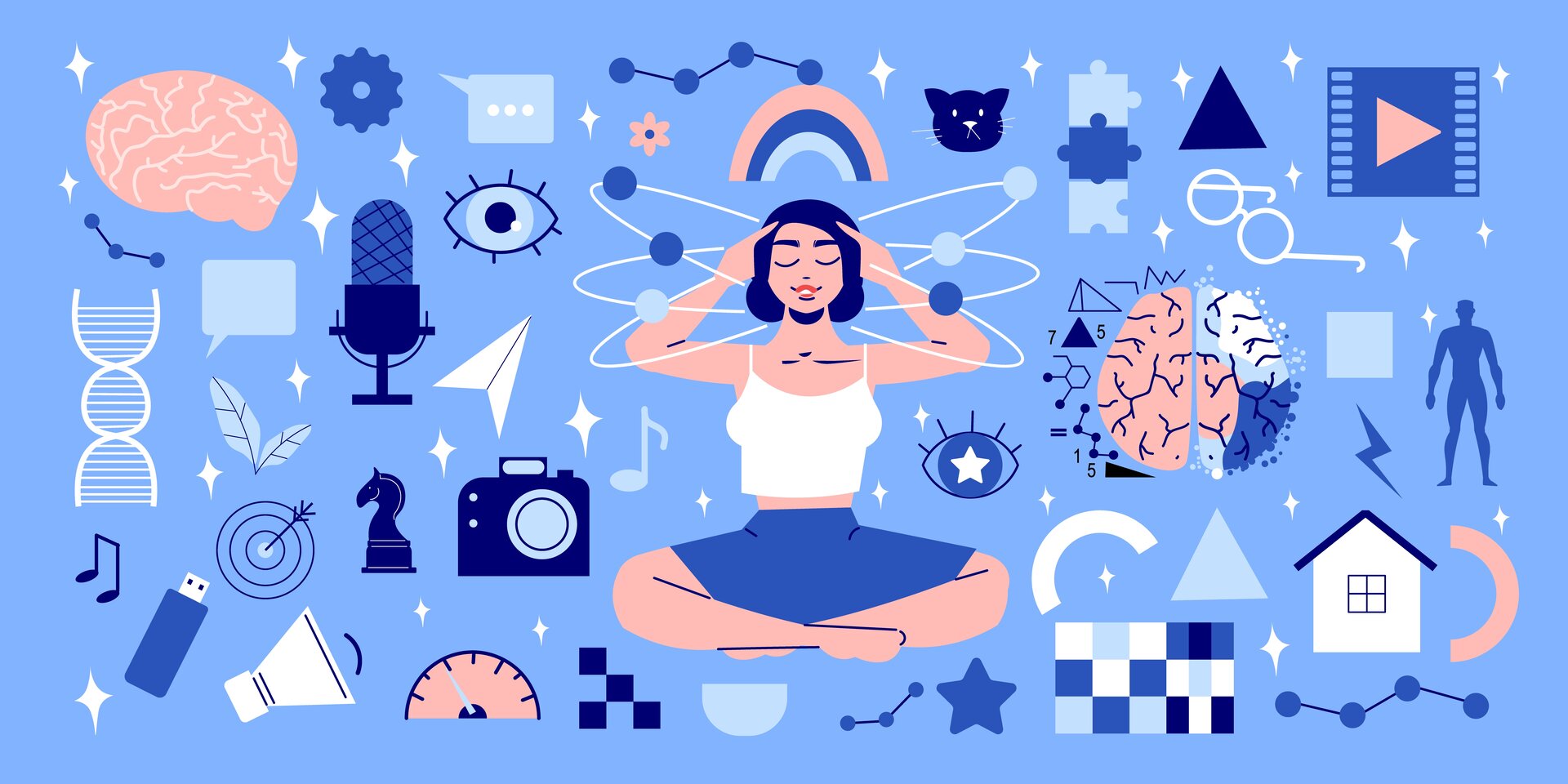
The picture shows a person trying to remember some things by making associations. Associations are an example of mnemonic techniques which facilitate memorisation as well as the organisation of a new material. Have you ever tried using mnemonics? What are the possible benefits of using them in learning foreign languages?
Grafika przedstawia osobę próbującą zapamiętać pewne rzeczy przez tworzenie skojarzeń. Skojarzenia stanowią przykład mnemotechnik, które ułatwiają zapamiętywanie oraz organizację materiału. Czy próbowałeś/próbowałaś kiedyś używać mnemotechnik? Jakie są korzyści ze stosowania technik zapamiętywania w nauce języków obcych?
Match the words with their translations.
Study the text and do the exercises below.
Mnemonic DevicesMnemonicsMnemonics are a very common waycommon way of aiding memoryaiding memory, but many people do not even know that they use them. There are mnemonic devices helping us memorisememorise how to spellspell difficult words, how to put a list of words in proper order, or even how to do something seemingly as simple as remember left from right. Mnemonics can help people who may find these difficultfind these difficult. These mnemonic devices can take ontake on many forms, whether it be a song or a musical jinglemusical jingle, or an acronymacronym, a funny phrase, or a meme. They all have something in commonin common, which is that they are easy to remember and relatablerelatable.
The most famous mnemonic device used is probably the ABC song which helps us memorise the alphabet. Singing the letters of the alphabet allows our brain to make the connection betweenmake the connection between the letters, and helps us remember the next letter. It is much like knowing the words to our favourite songs. We learn the song as opposed toas opposed to learning a list of 26 different letters.
„Never Ever Support Wednesdays.” „Richard Of York Gave Battle In VainIn Vain.” „My Very Educated Mother Just Served Us Nachos.” Sentences like those don't really make much sense on their own, but each is a mnemonic device. The purpose ofpurpose of each of them is to aid the memory of a certain topic and help people remember the correct order of something. „Never Ever Support Wednesdays” was created as a mnemonic to help remember the directions of a compass in clockwise orderin clockwise order: „Never” stands forstands for North, „Ever” stands for East, „Support” stands for South, and „Wednesdays” stands for West. These mnemonic phrases are coined to be memorablememorable to people, and “Never Ever Support Wednesdays” in particularin particular is commonly usedcommonly used in Yorkshire, as Sheffield Wednesday is a famous football club of the region, which makes it easy to remember the directions for both the supporters and the rivals of the Yorkkshire team.
„Richard Of York Gave Battle In Vain” is used to help people remember the colours of the rainbow and the order in which they appear. The first letter of each word corresponds to the first letter in the name of a colour: Red, Orange, Yellow, Green, Blue, Indigo and Violet. A phrase or sentence is often much easier to remember than a list of items. „My Very Educated Mother Just Served Us Nachos” is another example of a list of something that is important to know in the correct order. This mnemonic device refers to the planets within our Solar System, starting with Mercury which is the closest to the Sun and ending with Neptune which is the furthest. However, before 2006, the Solar System was thought to comprise nine planets, including Pluto as the furthest one. So, a different version of the mnemonic was used back then: „My Very Educated Mother Just Served Us Nine Potatoes.” These acrostic devicesacrostic devices, or acrostics, are very commonly used with many different subjects, and people often have their own personal versions.
There are also other types of mnemonic devices, which do not use words at all. How to remember which months have 30, and which 31 days in them? Using the knuckles of your handknuckles of your hand to count the months is a very common technique. Make a fistfist with each hand and then place the fists together. Each knuckle represents a 31‑day long month, and the depressionsdepressions between knuckles stand for months with either 30 days or for the 28/29 for February. Counting from the outermostoutermost knuckle, you start with January, as it has 31 days. Then, you count the depression as February, then March as the next knuckle has 31 days, and so the pattern continues. After July and the final knuckle on your first hand, you start counting on the next hand, which begins with a knuckle, indicatingindicating that August also has 31 days. Another popular physical mnemonic device involving our hands is about telling the difference between left and right. Some people may find it difficult to remember which is which, so a very simple tricktrick can assistassist them: hold your hands out in front of you and, again, make a fist with them both, but this time extend your thumbthumb and index fingerindex finger (the first finger next to the thumb) so it points upwardspoints upwards. Your left hand will form the shape of an L, and this indicates it is your left hand. A quick and easy reminder to someone who may forget this, it could be very useful when getting or giving directions, as telling your left from right is of vital importanceis of vital importance. These forms of mnemonic devices account foraccount for visual aidsvisual aids to memory.
Another common mnemonic device, used to help people spell certain words correctly, is this little rhyme:
‘I before e, except after c,
And when sounding like a
As in neighbour and weigh.’
This is a way to help remember things by forming rhymes. Rhymes are much easier to remember than non‑rhyming sentences. Making a sentence or phrase fit a melody can also help, like with the alphabet song.
Another commonly used mnemonic is called chunkingchunking. This is where a large list is broken down into smaller chunks. Remembering phone numbers can be very tricky as they can contain 9 to 12 digitsdigits. This is a large amount of numbers to remember in a specific order, so breaking down the number into smaller, more manageablemanageable pieces can help.
You may already be using some mnemonic devices yourself, whether it be to remember a word you find tricky to spell or a phone number, or to tell some things apart from one another. Mnemonics are very common throughout the world as they do make it easier to remember certain things. Their use helps our brain accessaccess information that we store away in our subconscious long term memorylong term memory storagestorage, which can speed upspeed up how long it takes our brains to retrieveretrieve that info.
Źródło: Aneta Wilemska‑Rudnik, licencja: CC BY-SA 3.0.
Read the sentences below and choose the correct answer. Only one answer is correct.
- You can try using mnemonic devices to 1. aid, 2. stand for, 3. assist, 4. commonly used, 5. take on, 6. memorise, 7. reletable memory.
- Our mind more easily remembers humorous or 1. aid, 2. stand for, 3. assist, 4. commonly used, 5. take on, 6. memorise, 7. reletable information.
- You can use acrostics to 1. aid, 2. stand for, 3. assist, 4. commonly used, 5. take on, 6. memorise, 7. reletable new material better.
- Acrostics use letters which 1. aid, 2. stand for, 3. assist, 4. commonly used, 5. take on, 6. memorise, 7. reletablewords or phrases that you want to remember.
- Mnemonic devices are 1. aid, 2. stand for, 3. assist, 4. commonly used, 5. take on, 6. memorise, 7. reletable if we want to improve our memory of important information.
- (Celem) Tu uzupełnij using mnemonic devices is to enhance the memory of complex words or ideas.
- You can use the (kostek na swoich dłoniach) Tu uzupełnij to remember the number of days in each month.
- You can learn a song (zamiast) Tu uzupełnij remembering a list of 26 letters.
- The application of mnemonic devices helps our brain (uzyskać dostęp do)Tu uzupełnij information stored in our long term memory.
- Mnemonic devices have a lot (wspólnego) Tu uzupełnij because they help to memorise information better.
Słownik
/ ˈækses /
uzyskać dostęp (to approach or enter)
/ əˈkaʊnt fɔː /
stanowić (to be the explanation or cause of something)
/ ˈækrənɪm /
akronim (an abbreviation formed from the initial letters of other words and pronounced as a word)
/ əˈkrɒstɪk dɪˈvaɪs /
akrostych (a composition in which certain letters in each line form a word or words)
/ ˈeɪdɪŋ ˈmeməri /
wspomagający/wspomagająca pamięć (supporting memory)
/ əz əˈpəʊzd tuː /
w przeciwieństwie do, zamiast (in contrary to)
/ əˈsɪst /
pomóc (to help)
/ bi əv ˈvaɪtl̩ ɪmˈpɔːtns /
mieć szczególne, kluczowe znaczenie (to be crucial)
/ ˈtʃʌŋkɪŋ /
dzielenie (a way of remembering information by separating it into small groups)
/ ˈkɒmən ˈweɪ /
powszechny sposób (a usual way)
/ ˈkɒmənli juːst /
powszechnie stosowane (frequently used)
/ dɪˈpreʃn̩z / / dɪˈpreʃn̩ /
wgłębienia [wgłębienie] (a groove)
/ ˈdɪdʒɪts / / ˈdɪdʒɪt /
cyfry [cyfra] (a number)
/ faɪnd ˈɪt ˈsʌmthetaɪŋ ˈdɪfɪkəlt /
mieć z czymś trudności (to consider something as hard)
/ faɪnd ðiːz ˈdɪfɪkəlt / / faɪnd ˈsʌmthetaɪŋ ˈdɪfɪkəlt /
uważać je za trudne [uważać, że coś jest trudne] (a method improving the memory)
/ fɪst /
pięść (a person’s hand when the fingers are bent in towards the palm and held tightly)
/ həv ˈsʌmthetaɪŋ ɪn ˈkɒmən /
mieć coś wspólnego (to have same interest or opinion as someone)
/ ɪn ˈklɒkwaɪz ˈɔːdə /
zgodnie z ruchem wskazówek zegara (in the same direction as the way in which the hands of a clock move round)
/ ɪn pəˈtɪkjʊlə /
zwłaszcza, w szczególności (especially)
/ ɪn veɪn /
nadaremnie, na próżno (in a way that produces no result)
/ ˈɪndeks ˈfɪŋɡə /
palec wskazujący (the finger next to the thumb)
/ ˈɪndɪkeɪtɪŋ / / ˈɪndɪkeɪt /
wskazujące [wskazywać] (to point out, to show; to suggest that something is a desirable or necessary course of action)
/ ˈnʌkl̩z əv jə hænd / / ˈnʌkl̩ əv wʌnz hænd /
knykcie [knykieć] (a part of a finger at a joint where the bone is near the surface, especially where the finger joins the hand)
/ lɒŋ tɜ:m ˈmeməri /
pamięć długotrwała (a memory model in which informative knowledge is held indefinitely)
/ ˈmeɪk ðə kəˈnekʃn̩ bɪˈtwiːn /
połączyć coś, nawiązać połączenie (to join something to)
/ ˈmænɪdʒəbl̩ /
do opanowania, wykonalne (able to be controlled or dealt with without difficulty)
/ ˈmemərəbl̩ /
zapadający/zapadająca w pamięć (easy to remember)
/ ˈmeməraɪz /
zapamiętać (to learn by heart)
/ nɪˈmɒnɪk dɪˈvaɪsɪz / / nɪˈmɒnɪk dɪˈvaɪs /
narzędzia wspomagające pamięć [narzędzie wspomagające pamięć] (a method improving the memory)
/ nɪˈmɒnɪks /
mnemotechnika (the study and development of system for improving and assisting the memory)
/ ˈmju:zɪkl ˈdʒɪŋɡl̩ /
krótki utwór muzyczny, melodyjka, dzwonek (a short song or tune used in advertising and other commercial uses)
/ ˈaʊtəməʊst /
krańcowy/krańcowa (the one that is furthest from the centre)
/ poɪnt ˈʌpwədz /
wskazywać w górę, skierować w górę (to bring attention to something)
/ ˈpɜ:pəs ɒv /
cel, przeznaczenie (a goal of )
/ rɪˈleɪtəbl /
możliwy/możliwa do powiązania (able to be related to something else)
/ rɪˈtriːv /
pobrać, odzyskać (to get or bring back from somewhere)
/ spi:d ˈʌp /
przyspieszyć (to boost)
/ stænd fɔː /
reprezentować, oznaczać (to mean, represent)
/ spel /
literować (to write or name the letters that form a word in correct sequence)
/ ˈstɔːrɪdʒ /
przechowalnia, magazyn (the action or method of storing something for future use)
/ stɔːr əˈweɪ /
schować, przechować (to put something in a safe place until you need it)
/ ˈteɪk ɒn /
podjąć (to engage)
/ ˈthetaʌm /
kciuk (the short, thick first finger of the human hand)
/ trɪk /
sztuczka (a cunning act or scheme intended to deceive or outwit someone)
/ ˈvɪʒuəl eɪdz / / ˈvɪʒuəl eɪd /
pomoce wizualne [pomoc wizualna] (an item of illustrative matter, such as a film, slide or model, designed to supplement written or spoken information so that it can be understood more easily)
Źródło: GroMar Sp. z o.o., licencja: CC BY‑SA 3.0