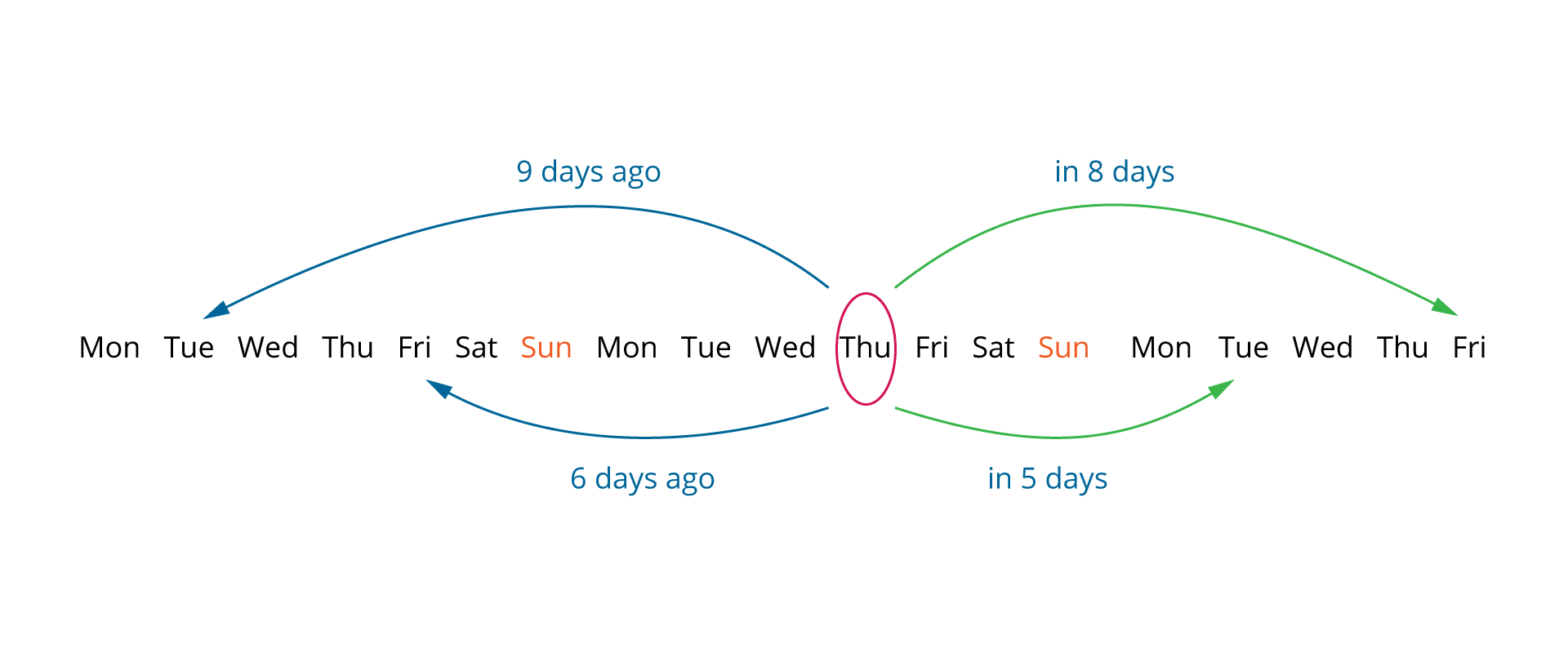
Based on information prepared before, fill in the blank spaces on the worksheets. Days of the week repeat every [tu uzupełnij] days. Days of the week] are: [tu uzupełnij]. If today is Thursday then Thursday will also be in [tu uzupełnij], [tu uzupełnij] and [tu uzupełnij] days. If today is Friday then Friday was also [tu uzupełnij], [tu uzupełnij] and [tu uzupełnij] days ago.
Based on information prepared before, fill in the blank spaces on the worksheets. Days of the week repeat every [tu uzupełnij] days. Days of the week] are: [tu uzupełnij]. If today is Thursday then Thursday will also be in [tu uzupełnij], [tu uzupełnij] and [tu uzupełnij] days. If today is Friday then Friday was also [tu uzupełnij], [tu uzupełnij] and [tu uzupełnij] days ago.
Based on information prepared before, fill in the blank spaces on the worksheets.
Days of the weekdays of the weekDays of the week repeat every ...... days.
Days of the weekdays of the weekDays of the week are: …............................................................................ .
If today is Thursday then Thursday will also be in ......, ...... and ...... days.
If today is Friday then Friday was also ......, ...... and ...... days ago.
Task 2
A normal year lasts [tu uzupełnij] days and a leap year [tu uzupełnij] days. During the regular year, February, the shortest months has [tu uzupełnij] days, and in the leap year [tu uzupełnij] days. A year is made of [tu uzupełnij] weeks. A year is made of [tu uzupełnij] quarters. I quarter are months: [tu uzupełnij], [tu uzupełnij] and [tu uzupełnij]. II quarter are months: [tu uzupełnij], [tu uzupełnij] and [tu uzupełnij]. III quarter are months [tu uzupełnij], [tu uzupełnij] and [tu uzupełnij]. IV quarter are months [tu uzupełnij], [tu uzupełnij] and [tu uzupełnij].
A normal year lasts [tu uzupełnij] days and a leap year [tu uzupełnij] days. During the regular year, February, the shortest months has [tu uzupełnij] days, and in the leap year [tu uzupełnij] days. A year is made of [tu uzupełnij] weeks. A year is made of [tu uzupełnij] quarters. I quarter are months: [tu uzupełnij], [tu uzupełnij] and [tu uzupełnij]. II quarter are months: [tu uzupełnij], [tu uzupełnij] and [tu uzupełnij]. III quarter are months [tu uzupełnij], [tu uzupełnij] and [tu uzupełnij]. IV quarter are months [tu uzupełnij], [tu uzupełnij] and [tu uzupełnij].
A normal yearyearyear lasts ...... days and a leap yearleap yearleap year ... days. During the regular yearregular yearregular year, February, the shortest months has ... days, and in the leap year ...... days.
A year is made of ...... weeks.
A year is made of ...... quarters.
I quarterquarterquarter are months: ......, ...... and ...... .
II quarter are months: ......, ...... and ...... .
III quarter are months ......, ...... and ...... .
IV quarter are months ......, ...... and ...... .
Task 3
Months can be written down using Roman numerals: January - [tu uzupełnij], February - [tu uzupełnij], March - [tu uzupełnij], April - [tu uzupełnij], Maj - [tu uzupełnij], June - [tu uzupełnij], July - [tu uzupełnij], August - [tu uzupełnij], September - [tu uzupełnij], October - [tu uzupełnij], November - [tu uzupełnij], December - [tu uzupełnij]. Or using Arabic numbers: January - [tu uzupełnij], February - [tu uzupełnij], March - [tu uzupełnij], April - [tu uzupełnij], Maj - [tu uzupełnij], June - [tu uzupełnij], July - [tu uzupełnij], August - [tu uzupełnij], September - [tu uzupełnij], October - [tu uzupełnij], November - [tu uzupełnij], December - [tu uzupełnij].
Months can be written down using Roman numerals: January - [tu uzupełnij], February - [tu uzupełnij], March - [tu uzupełnij], April - [tu uzupełnij], Maj - [tu uzupełnij], June - [tu uzupełnij], July - [tu uzupełnij], August - [tu uzupełnij], September - [tu uzupełnij], October - [tu uzupełnij], November - [tu uzupełnij], December - [tu uzupełnij]. Or using Arabic numbers: January - [tu uzupełnij], February - [tu uzupełnij], March - [tu uzupełnij], April - [tu uzupełnij], Maj - [tu uzupełnij], June - [tu uzupełnij], July - [tu uzupełnij], August - [tu uzupełnij], September - [tu uzupełnij], October - [tu uzupełnij], November - [tu uzupełnij], December - [tu uzupełnij].
Months can be written down using Roman numerals:
JanuaryJanuaryJanuary - ......, February - ......, March - ......, April - ......, Maj - ......, June - ......, July - ......, August - ......, SeptemberSeptemberSeptember - ......, October - ......, NovemberNovemberNovember - ......, December - ...... .
Or using Arabic numbers:
January - ......, February - ......, March - ......, April - ......, Maj - ......, June - ......, July - ......, August - ......, September - ......, October - ......, November - ......, December - ...... .
Open the interactive illustration and observe the method that allows to remember how many days each monthmonthmonth has.
After having completed the exercise, present results of your observations.
R1F3zauyJHPqJ
Ilustracja interaktywna przedstawia liczbę dni w kolejnych miesiącach roku. Ilustracja interaktywna przedstawia dwie zaciśnięte dłonie (pięści) z zaznaczonymi kostkami i dołkami, od których od lewej odchodzą po kolei strzałki do numerów 1, 2, 3, 4, 5, 6, 7, 8, 9, 10, 11, 12. Na ilustracji widoczne są numery, a na nich podpisy. 1. January – 31 days {audio}, 2. February – 28 or 29 days {audio}, 3. March – 31 days {audio}, 4. April – 30 days {audio}, 5. May – 31 days {audio}, 6. June – 30 days {audio}, 7. July – 31 days {audio}, 8. August – 31 days {audio}, 9. September – 30 days {audio}, 10. October – 31 days {audio}, 11. November – 30 days {audio}, 12. December – 31 days {audio}.
Ilustracja interaktywna przedstawia liczbę dni w kolejnych miesiącach roku. Ilustracja interaktywna przedstawia dwie zaciśnięte dłonie (pięści) z zaznaczonymi kostkami i dołkami, od których od lewej odchodzą po kolei strzałki do numerów 1, 2, 3, 4, 5, 6, 7, 8, 9, 10, 11, 12. Na ilustracji widoczne są numery, a na nich podpisy. 1. January – 31 days {audio}, 2. February – 28 or 29 days {audio}, 3. March – 31 days {audio}, 4. April – 30 days {audio}, 5. May – 31 days {audio}, 6. June – 30 days {audio}, 7. July – 31 days {audio}, 8. August – 31 days {audio}, 9. September – 30 days {audio}, 10. October – 31 days {audio}, 11. November – 30 days {audio}, 12. December – 31 days {audio}.
Knuckles and grooves on the fists can facilitate remembering how many days each monthmonthmonth has. Each knuckle and each groove (starting from the left) means one month. All months on the knuckles (JanuaryJanuaryJanuary, March, May, July, August, October and December) have 31 days and other months on grooves (February, April, June, SeptemberSeptemberSeptember, NovemberNovemberNovember) have 30 days (or 28/29 in case of February).
Rysunek przedstawia wymienione po kolei 19 dni tygodnia (2 pełne tygodnie i pięć dni; od poniedziałku zaczynając , na piątku kończąc). Czwartek drugiego tygodnia zaznaczony jest dla przykładu kolorem i od niego poprowadzone są strzałki do konkretnych dni: 9 days ago, 6 days ago, in 8 days, in 5 days.
Source: GroMar, licencja: CC BY 3.0.
a) If today is Thursday, then in 5 days will be [tu uzupełnij]. b) If today is Thursday, then in 8 days will be [tu uzupełnij]. c) If today is Friday, then in 3 days will be [tu uzupełnij]. d) If today is Wednesday, then in 15 days will be [tu uzupełnij]. e) If today is Thursday, then 9 days ago was [tu uzupełnij]. f) If today is Monday, then 4 days ago was [tu uzupełnij]. g) If today is Saturday, then 5 days ago was [tu uzupełnij]. h) If today is Sunday, then 12 days ago was [tu uzupełnij].
a) If today is Thursday, then in 5 days will be [tu uzupełnij]. b) If today is Thursday, then in 8 days will be [tu uzupełnij]. c) If today is Friday, then in 3 days will be [tu uzupełnij]. d) If today is Wednesday, then in 15 days will be [tu uzupełnij]. e) If today is Thursday, then 9 days ago was [tu uzupełnij]. f) If today is Monday, then 4 days ago was [tu uzupełnij]. g) If today is Saturday, then 5 days ago was [tu uzupełnij]. h) If today is Sunday, then 12 days ago was [tu uzupełnij].
a) If today is Thursday, then in 5 days will be …………. b) If today is Thursday, then in 8 days will be …………. c) If today is Friday, then in 3 days will be …………. d) If today is Wednesday, then in 15 days will be …………. e) If today is Thursday, then 9 days ago was …………. f) If today is Monday, then 4 days ago was ………… g) If today is Saturday, then 5 days ago was …………. h) If today is Sunday, then 12 days ago was ………….
Answer the following questions using the calendar:
a) Kasia planted seeds of beans on the 15th of April. Two weeks and three days later she saw the plant budding through the soil. What day was it? b) Tomek’s parents decided to renovate his room during the holidays. The renovation lasted a weekweekweek and 4 days and ended on the 12th of August. When did they start the renovation? c) Basia left for a trip to Greece with her parents. She left on the 26th of June and came back on the 5th of July. How many days did the trip last? d) How many days passed from the 1 till 28 of February? e) A discount for computers started on the first Monday of SeptemberSeptemberSeptemberand lasted 20 days. Give the date of the last day of the discount. What day of the week is that?
Using the calendar write what day of the day, what date and which quarterquarterquarter will be:
a) two weeks from Friday 15th of May, b) three weeks from Thursday, 25th of JanuaryJanuaryJanuary, c) four weeks and five days from the 9th of June.
Task 8
An extra task:
There is a uniform system determining the rules of numerating the weeks of the year. First weekweekweek of the calendar year of the given year is a week containing the first Thursday of the year or 4th of January and the last week of the year is the week containing the last Thursday of the year.
Fill in the sentences:
a) If 1st of January of 2016 was on Friday, then the first week of 2016 started [tu uzupełnij]. b) If 1st of January of 2017 was on Sunday, then the first week of 2017 started [tu uzupełnij]. c) If 1st of January of 2018 was on Monday, then the first week of 2018 started [tu uzupełnij].
a) If 1st of January of 2016 was on Friday, then the first week of 2016 started [tu uzupełnij]. b) If 1st of January of 2017 was on Sunday, then the first week of 2017 started [tu uzupełnij]. c) If 1st of January of 2018 was on Monday, then the first week of 2018 started [tu uzupełnij].
a) If 1st of JanuaryJanuaryJanuary of 2016 was on Friday, then the first week of 2016 started …... . b) If 1st of January of 2017 was on Sunday , then the first week of 2017 started …... . c) If 1st of January of 2018 was on Monday, then the first week of 2018 started …... .
Days of the week repeat every seven days. A normal year lasts 365 days and a leap yearleap yearleap year 366 days. During the regular yearregular yearregular year, February, the shortest months has 28 days, and in the leap year 29 days. A year is made of four quarters:
I quarter are months: January, February, March,
II quarter are months: April, May, June,
III quarter are months: July, August, September,
IV quarter are months: October, November, December.
Do the revision exercises.
Exercises
Exercise 1
R11DTRasMB9f3
Wersja alternatywna ćwiczenia: A leap year happens every 4 years, when the number of the year can be divided but 4. However, if a number of the year can be divided by 100, it also has to be divided by 400. Determine which sentences are true. Możliwe odpowiedzi: 1. The year 1900 was a leap year., 2. February of 1904 had 29 days., 3. The year 1600 had 366 days., 4. The first quarter of the year 1700 had 90 days.
Wersja alternatywna ćwiczenia: A leap year happens every 4 years, when the number of the year can be divided but 4. However, if a number of the year can be divided by 100, it also has to be divided by 400. Determine which sentences are true. Możliwe odpowiedzi: 1. The year 1900 was a leap year., 2. February of 1904 had 29 days., 3. The year 1600 had 366 days., 4. The first quarter of the year 1700 had 90 days.
A leap year happens every 4 years, when the number of the year can be divided but 4. However, if a number of the year can be divided by 100, it also has to be divided by 400. Determine which sentences are true.
The year 1900 was a leap year.
February of 1904 had 29 days.
The year 1600 had 366 days.
The first quarter of the year 1700 had 90 days.
zadanie
Source: GroMar, licencja: CC BY 3.0.
Exercise 2
Check in the calendar what day of the weekweekweek was 15th of September. Write what date was 2 weeks and 5 days earlier and what day of the week it was.
Exercise 3
Based on information presented in the table answer the questions.
Number of the camp
I
II
III
First day of the stay
2.07.2018
16 VII 2018
2018 – 08 - 06
Last day of the stay
15.07.2018
29 VII 2018
2018 – 08 - 19
a) How many days did each camp last?
b) How many days did breaks between camps last?
c) How many days passed from the start of the first camp till the last day of the first camp?
Write the answers in English.
Exercise 4
R12pZki5117Bm
Wersja alternatywna ćwiczenia: Indicate which pairs of expressions or words are translated correctly. Możliwe odpowiedzi: 1. dni tygodnia - days of the week, 2. rok zwykły - regular year, 3. rok przestępny - leap year, 4. miesiąc - month, 5. lata - week, 6. miesiąc - quarter
Wersja alternatywna ćwiczenia: Indicate which pairs of expressions or words are translated correctly. Możliwe odpowiedzi: 1. dni tygodnia - days of the week, 2. rok zwykły - regular year, 3. rok przestępny - leap year, 4. miesiąc - month, 5. lata - week, 6. miesiąc - quarter
Indicate which pairs of expressions or words are translated correctly.
dni tygodnia - days of the week
rok zwykły - regular year
rok przestępny - leap year
miesiąc - month
lata - week
miesiąc - quarter
zadanie
Source: GroMar, licencja: CC BY 3.0.
R1bHDSsdBeusX1
Interaktywna gra, polegająca na łączeniu wyrazów w pary w ciągu jednej minuty. Czas zaczyna upływać wraz z rozpoczęciem gry. Jeden ruch to odkrywanie najpierw jednej potem drugiej karty z wyrazem. Każdy wyraz jest odczytywany. Kolejny ruch to odkrywanie trzeciej i czwartej karty. W ten sposób odsłuchasz wszystkie wyrazy. Nawigacja z poziomu klawiatury za pomocą strzałek, odsłuchiwanie wyrazów enterem lub spacją. Znajdź wszystkie pary wyrazów.
Interaktywna gra, polegająca na łączeniu wyrazów w pary w ciągu jednej minuty. Czas zaczyna upływać wraz z rozpoczęciem gry. Jeden ruch to odkrywanie najpierw jednej potem drugiej karty z wyrazem. Każdy wyraz jest odczytywany. Kolejny ruch to odkrywanie trzeciej i czwartej karty. W ten sposób odsłuchasz wszystkie wyrazy. Nawigacja z poziomu klawiatury za pomocą strzałek, odsłuchiwanie wyrazów enterem lub spacją. Znajdź wszystkie pary wyrazów.
Match Polish terms with their English equivalents.
a leap year
a regular year
a quarter
kwartał
rok przestępny
days of the week
rok zwykły
miesiąc
dni tygodnia
a month
Source: Zespół autorski Politechniki Łódzkiej, licencja: CC BY 3.0.