that weather is a temporary state of the atmosphere in a given place and time;
that climate is a characteristic set of atmospheric processes and phenomena on a given area, determined according to observations and meteorological measurements conducted at least for 30 years;
what the reasons and consequences are for different access to sunlight for various zones on Earth’s surface.
You will learn
give and explain examples of climates on Earth;
based on the climograph for the selected region, discuss the distribution of monthly average air temperatures and precipitations in this region;
discuss the mountain climate variety;
list factors that are conducive to the formation of a mountain climate.
Why do people build houses? A Papuan protects himself against rain and sun in his home, an Arab – against the daily heat and night cold as well as against the dry wind. A Pole needs a house to hide from the rain, snow and cold, while an Eskimo hides from the cold and wind.
Each climate zone has its own characteristic zonal climatezonal climatezonal climate. There are different types of climates in each zone.
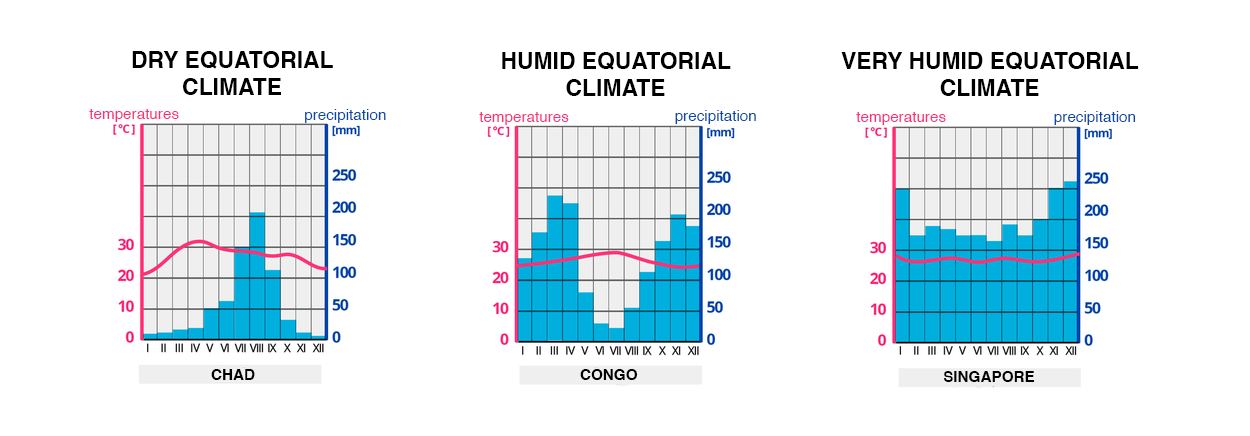
In equatorial climates, all types of climates (expect the highest mountain peaks) have really high air temperature. The types of climates characteristic for this zone are different in e.g. precipitation times. The humid equatorial climate is characterized by slight temperature variations and almost daily precipitation throughout the year; the wet subtropical climate is distinguished by slightly higher fluctuations in air temperature and slightly lower precipitation; the dry subtropical climate is equally warm, but has a few months of dry season.
RhcJlzgVPGVMG
Ilustracja przedstawiająca przykłady klimatogramów dla wybranych typów klimatu w strefie równikowej - klimatu podrównikowego suchego, dry equatorial climate (Czad), podrównikowego wilgotnego, humid equatorial climate, (Kongo), równikowego wybitnie wilgotnego, very humid equatorial climate (Singapur).1. Klimatogram pierwszy, Chad, Dry equatorial climate - miesięczne temperatury utrzymują się w zakresie od dwudziestu do ponad trzydziestu stopni. Suma opadów od blisko zera w grudniu i styczniu do ponad dwustu milimetrów w sierpniu. 2. Klimatogram drugi, Congo, Humid equatorial climate - prawie stała temperatura przekraczająca dwadzieścia stopni. Wysoka suma opadów sięgająca nawet dwustu pięćdziesięciu milimetrów, oprócz miesięcy letnich, gdy suma opadów spada do około trzydziestu milimetrów. 3. Klimatogram trzeci, Singapore, Very humid equatorial climate - stała temperatura około 28 stopni i stała suma opadów od stu osiemdziesięciu do 250 milimetrów.
Examples of climographes for selected types of climates in the equatorial climate zone.
Source: Tomorrow sp.z o.o., Wikimedia Commons, licencja: CC BY 3.0.
In the tropical climate zone, we can distinguish, among other things, the humid climate in the monsoon zone, the continental dry climate further from the shores, the extremely dry climate within the continents.
In the subtropical climate zone, the further from the coast, the drier the climate is: the humid (Mediterranean) climate occurs on the coast, the continental dry climate away from the sea, and the extremely dry climate is within the continents.
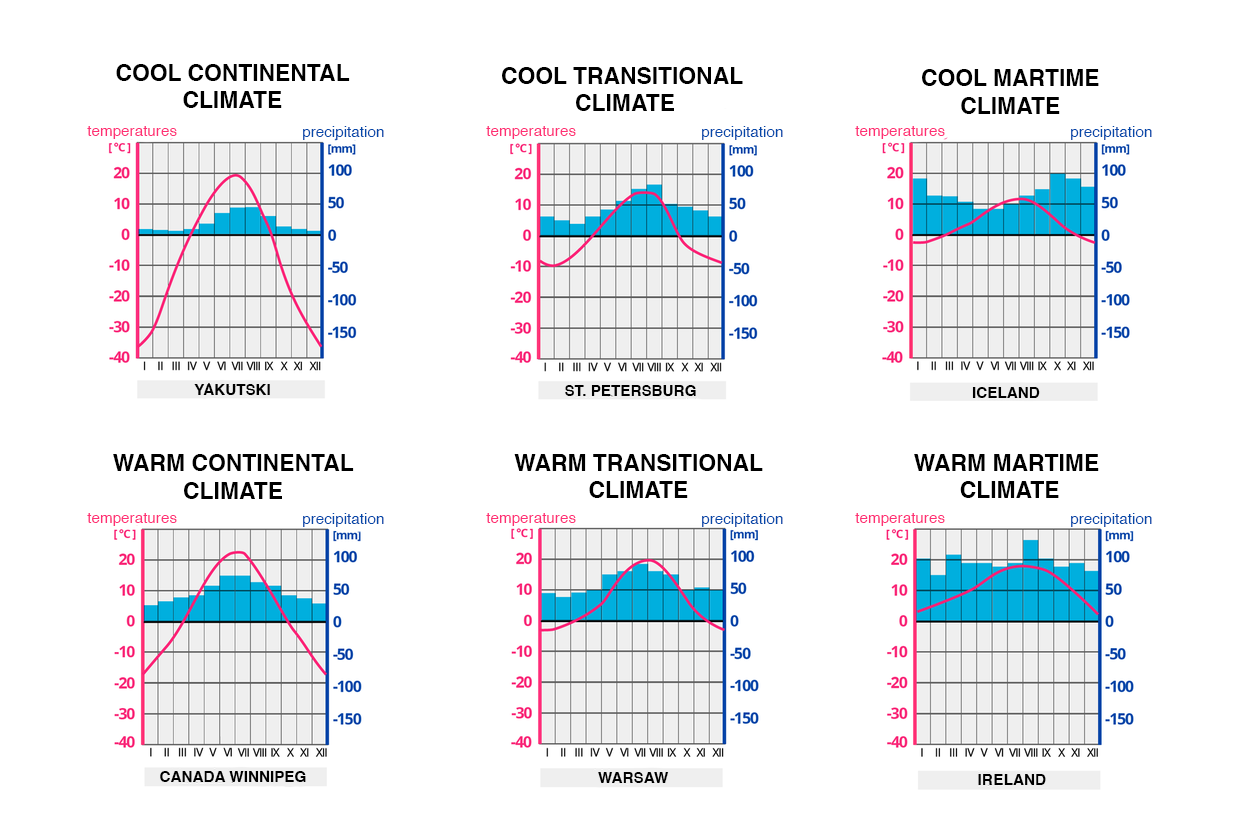
In the temperate climate zone – both hot and cold – we distinguish such climate types as: marine climate with small annual temperature variations, transitional climate and continental climate with very large annual temperature variations.
RxNiLXKtn0l9d
Ilustracja przedstawiająca przykłady klimatogramów dla poszczególnych typów klimatu w strefie umiarkowanej. 1. klimat umiarkowany chłodny kontynentalny (Jakuck), Cool continental climate - przez znaczną część roku temperatury są ujemne przekraczając w miesiącach zimowych nawet minus trzydzieści stopni. Jednocześnie suma opadów jest niewielka, latem dochodząc maksymalnie do 50 milimetrów w miesiącu. 2. klimat umiarkowany przejściowy (Sankt Petersburg), Cool transitional climate - temperatura waha się od minus dziesięciu do plus kilkunastu stopni. Opady w najcieplejszych miesiącach osiągają około 80 mm. 3. klimat umiarkowany chłodny morski (Iceland), Cool maritime climate - amplituda temperatur jest niewielka - od minus kilku stopni do około dwunastu stopni. Suma opadów zimą dochodzi do 100 mm miesięcznie. 4. klimat ciepły kontynentalny (Canada Winnipeg) Warm continental climate - amplituda temperatur od minus kilkunastu do około plus dwudziestu dwóch stopni. Opady do około siedemdziesięciu milimetrów. 5. klimat umiarkowany ciepły przejściowy (Warsaw) Warm transitional climate - amplituda temperatur waha się od kilku stopni poniżej zera do plus dwudziestu stopni Celsjusza. Jednocześnie notowana jest dość wysoka suma opadów od blisko 50 milimetrów miesięcznie do blisko stu milimetrów. 6. klimat ciepły morski (Ireland) Warm maritime climate - wysoka suma miesięcznych opadów od około siedemdziesięciu milimetrów do około stu dwudziestu milimetrów przy jednocześnie niewielkiej amplitudzie temperatur - od kilku do około dwudziestu stopni na plusie.
Examples of climographes for selected types of climates in the temperate climate zone.
Source: Tomorrow sp.z o.o., Wikimedia Commons, licencja: CC BY 3.0.
In the subarctic climate, characterized by very low precipitation and low temperatures, we are dealing with a subpolar climate, where short cold summers and long cold winters are typical, and with a polar climate with a negative temperature throughout the year.
Apart from the mountain climate, found in all climate zones, there is also the monsoon climate, typical for the equatorial, tropical, subtropical and temperate climate zones. The main areas of occurrence of the monsoon climate are South Asia, South‑East Asia, and Northern Australia. The monsoon climate is very important for agriculture, especially in Asia - it allows cultivation in areas deep within the continent.
RgEPmFAQAaMnW
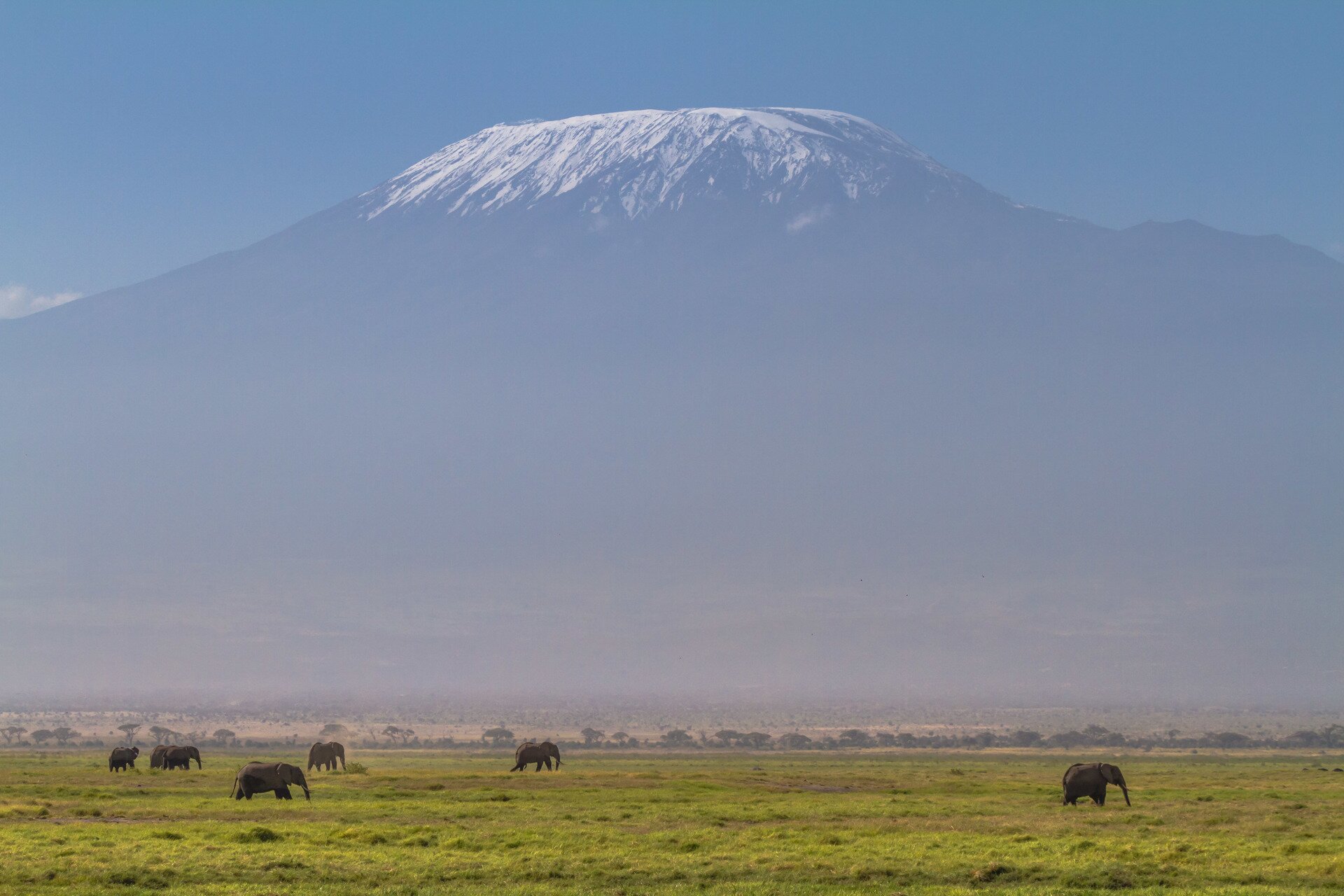
Zdjęcie przedstawia górę Kilimandżaro. Słoneczny dzień. Na pierwszym planie gęsto porastająca teren niska roślinność oraz słonie. Na drugim planie wysoki szczyt góry. Skalisty szczyt pokryty śniegiem. Góra w kształcie trapezu. Szczyt rozciąga się poziomo bez wyraźnego osobnego wierzchołka.
Mount Kilimanjaro is the highest peak of Africa - 5,895 m above sea level. Despite being located in the equatorial climate zone, its highest peak is always covered with snow and ice, although as a result of global warming, this snow cap is 26% smaller than 10 years ago.
Source: Benh LIEU SONG, Wikimedia Commons, licencja: CC BY-SA 2.0.
R2T2Rtl16Epyg
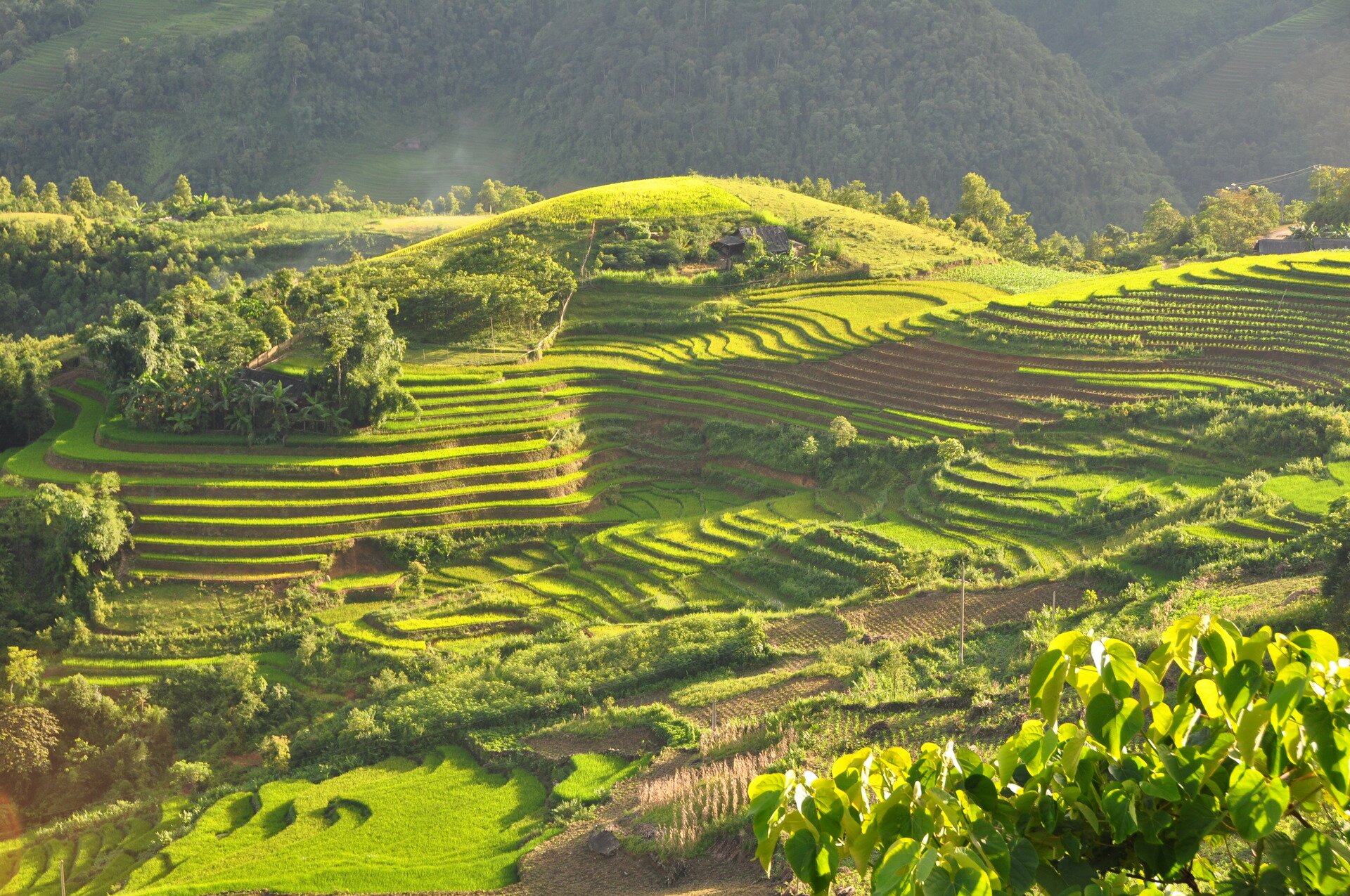
Zdjęcie przedstawia pola ryżowe w Wietnamie. Słoneczny dzień. Teren górzysty. Stoki o lekkim łagodnym nachyleniu. Stoki pokryte kaskadami pól ryżowych. Gdzieniegdzie pomiędzy tarasami niskie drzewa. W tle wysokie góry pokryte gęsto rosnącymi drzewami.
Thanks to the monsoons that bring heavy rainfall in the mid-summer, there are no deserts in the tropical areas of Southeast Asia, and the climate is so humid that it is possible to grow rice.
Source: Konstantin Krismer, Wikimedia Commons, licencja: CC BY 3.0.
Exercise 1
R12NvQbsEfbES
Opowiedz, czego się dowiedziałeś o górskim klimacie.
Opowiedz, czego się dowiedziałeś o górskim klimacie.
Source: Atif Gulzar, Massimo Macconi, Muhammad Mahdi Karim, ustill, licencja: CC BY-SA 2.0.
Exercise 2
R1RlbYqoXSCy7
Match the the name of the climate with the right description. very humid equatorial climate Możliwe odpowiedzi: 1. slight temperature variation and almost daily precipitation, 2. average monthly air temperatures above 20 stopni Celsjusza, there is a few months of dry season, 3. very high annual temperature fluctuation, 4. short summars and very long winters dry subequatorial climate Możliwe odpowiedzi: 1. slight temperature variation and almost daily precipitation, 2. average monthly air temperatures above 20 stopni Celsjusza, there is a few months of dry season, 3. very high annual temperature fluctuation, 4. short summars and very long winters continental temperate climate Możliwe odpowiedzi: 1. slight temperature variation and almost daily precipitation, 2. average monthly air temperatures above 20 stopni Celsjusza, there is a few months of dry season, 3. very high annual temperature fluctuation, 4. short summars and very long winters subarctic climate Możliwe odpowiedzi: 1. slight temperature variation and almost daily precipitation, 2. average monthly air temperatures above 20 stopni Celsjusza, there is a few months of dry season, 3. very high annual temperature fluctuation, 4. short summars and very long winters
Match the the name of the climate with the right description. very humid equatorial climate Możliwe odpowiedzi: 1. slight temperature variation and almost daily precipitation, 2. average monthly air temperatures above 20 stopni Celsjusza, there is a few months of dry season, 3. very high annual temperature fluctuation, 4. short summars and very long winters dry subequatorial climate Możliwe odpowiedzi: 1. slight temperature variation and almost daily precipitation, 2. average monthly air temperatures above 20 stopni Celsjusza, there is a few months of dry season, 3. very high annual temperature fluctuation, 4. short summars and very long winters continental temperate climate Możliwe odpowiedzi: 1. slight temperature variation and almost daily precipitation, 2. average monthly air temperatures above 20 stopni Celsjusza, there is a few months of dry season, 3. very high annual temperature fluctuation, 4. short summars and very long winters subarctic climate Możliwe odpowiedzi: 1. slight temperature variation and almost daily precipitation, 2. average monthly air temperatures above 20 stopni Celsjusza, there is a few months of dry season, 3. very high annual temperature fluctuation, 4. short summars and very long winters
Match the the name of the climate with the right description.
short summars and very long winters, slight temperature variation and almost daily precipitation, average monthly air temperatures above 20<sup>o</sup>C, there is a few months of dry season, very high annual temperature fluctuation
very humid equatorial climate
dry subequatorial climate
continental temperate climate
subarctic climate
Summary
There have been several climate zones distinguished on Earth: equatorial, tropical, subtropical, temperate and subarctic.
Climatic conditions in each climate zone are a result of latitude, but may be modified by the presence of other geographical factors.
There are different types of climates in each zone.
There are also, independently from climate zones, non‑zonal climates, e.g. on mountains.
The characteristic features of the climate can be simplified by using a climograph.
klimat strefowy – klimat o cechach uwarunkowanych szerokością geograficzną i związanymi z nią czynnikami: zróżnicowanym dopływem promieniowania słonecznego do powierzchni Ziemi, globalną cyrkulacją atmosferyczną, układem ośrodków barycznych itp.
strefa klimatyczna – największa jednostka w podziale klimatycznym świata – część powierzchni Ziemi przyjmująca w przybliżeniu kształt równoleżnikowego pasa o zmiennej szerokości, w obrębie którego występują podobne parametry klimatu, np. temperatura powietrza, opad, ciśnienie atmosferyczne itp.