Ancient Egypt
to describe where Ancient Egypt was located and about its conditions;
to explain who ruled the country and how the society of Ancient Egypt was structured;
to characterize the beliefs and funeral ceremonies of the Egyptians;
to list which domains of life were developed by the Egyptians and what we have inherited from them.
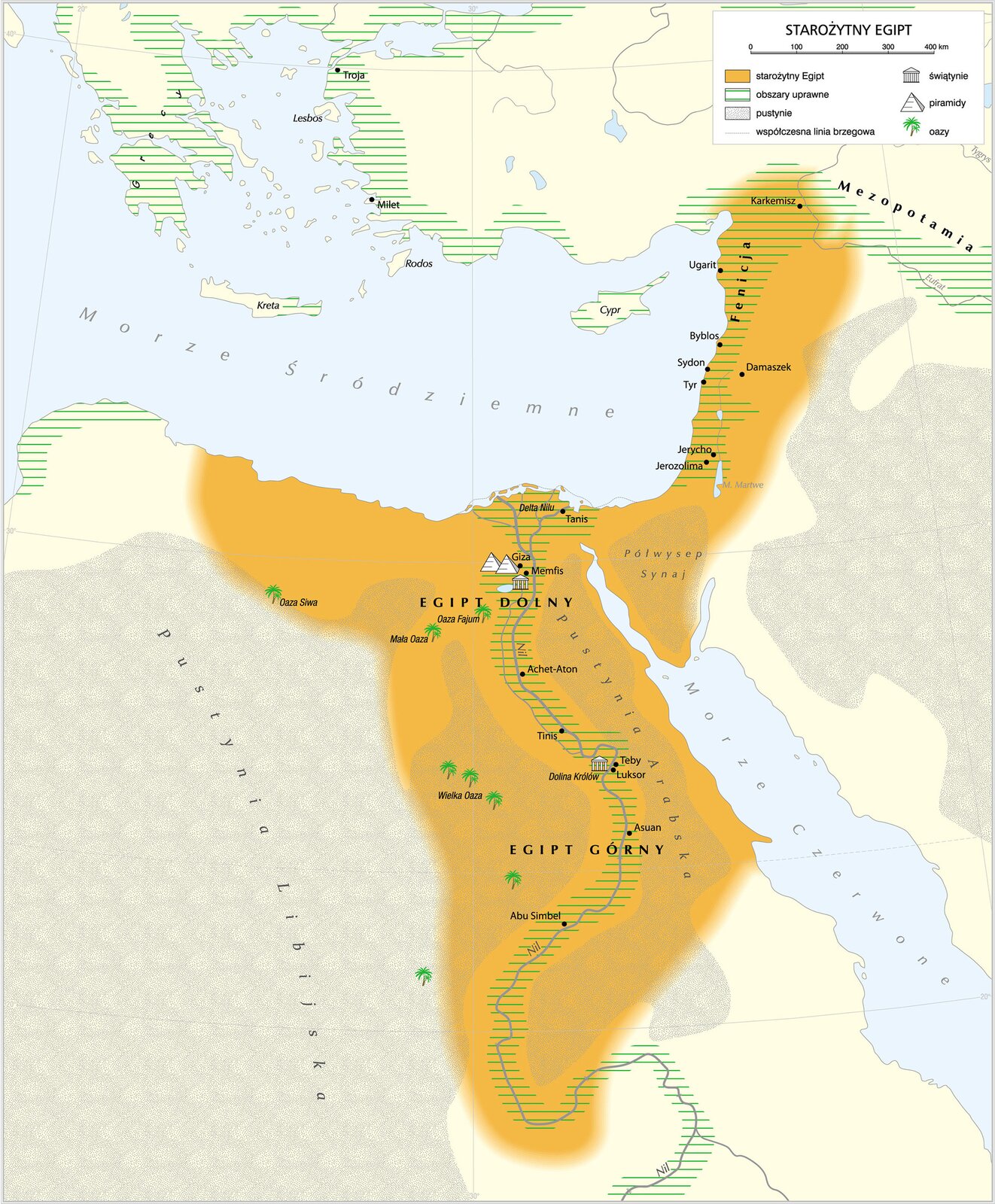
The country of Egypt was founded in the 4th century BC in North‑Eastern Africa, by the river Nile. The history of Ancient Egypt stretches out over the period of nearly 3 thousand years. It ceased to exist in 30 BC, when it was incorporated into the Roman Empire following the death of the queen Cleopatra. The regular flooding of the Nile made those areas perfect to be inhabited, however, it also meant that the whole country was dependent on the river, hence the expression „Egypt is the gift of the Nile.” The head of the country – Upper and Lower Egypt was the pharaohpharaoh. He was identified with the most important of gods – the sun god Ra and the sky god Horus, and he had an absolute, unlimited power. An important position in the country was also given to priests and country officials, whose main task was to supervise the efficiency of administrative work. The highest of the officials was the viziervizier, who had power over nomarchsnomarchs The next position in the social hierarchy was occupied by the soldiers, who were also a part of the social elite of the Ancient Egypt. Further down in this division, there were merchants, craftsmen and the most numerous group - the peasants. Their tasks included farming, construction work and maintaining the irrigationirrigation system. Egyptians' religious life was extremely rich. They believed in many gods (polytheismpolytheism), who were often portrayed as people with animal heads. Each god was responsible for a different area of life. An important aspect for the Egyptians was the belief in an afterlife. According to them, people, after death, go to the kingdom of the dead. It was possible thanks to the procedure of preparing the corpse and preventing it from decay – mummificationmummification. All the Egyptians were subject to this procedure after death, however, only the richest ones could afford a complex process of embalming, which could take up to 70 days. Dead bodies were usually buried in the sands of the desert or in tombs carved out in a rock. The most famous cemetery of the Ancient Egypt was the Valley of the Kings, where the pharaohs, kings and higher officials were buried in carved out tombs, together with some objects that they could find useful in the afterlife. Unfortunately, most of the pharaohs' tombs were robbed still in the ancient times, and the only one that remained intact until the present times is the tomb of – Pharaoh Tutankhamun. It was discovered by the British archaeologist Howard Carter in 1922, which became a worldwide revelation. It is related to a legend, which remained alive until today and talks about the curse on the daredevils. Moreover, the Ancient Egyptians were great builders. They built temples, statues and structures. The most famous examples include the pyramids and the SphinxSphinx, which are located in Giza. A part of their heritage is the hieroglyph writing, written, among others, on a new material called papyrus. The secret of hieroglyphs, the sacred characters, had not been deciphered until 1822. It was achieved by the French scientist Jean‑François Champollion thanks to the discovery and the analysis of the so‑called Rosetta Stone, which had the same text carved out in hieroglyph writing, demotic writing and in ancient Greek. The writing and the amazing structures, however, were not the only achievements of the Egyptians. They also contributed to the development of the mathematics, geometry, astronomy and medicine. They were the first people to invent a water clock, divide the calendar into 12 months and 365 days and write down a treaty about the art of medicine and pharmacy.
Read the text carefully and answer the question. What were the problems of an Egyptian peasant and how did his position influence the functioning of the country.
ChłopPozwól, że przypomnę Ci sytuację chłopa, gdy przybywają doń urzędnicy, by ustalić wysokość podatku żniwnego, a połowę zabrały węże, resztę zaś pożarł hipopotam. Żarłoczne jaskółki sprowadziły nieszczęście na głowę chłopa. Resztki zboża pozostawione na klepisku znikły, zabrali je złodzieje. Nie może chłop zapłacić tego, co jest winien za wynajęcie wołów, a jeśli chodzi o same woły – to padły, bo za dużo było orania i młócenia. A teraz na brzegu rzeki ląduje skryba, aby ustalić wysokość podatku, a towarzyszą mu słudzy z kijami i Nubijczycy z palowymi rózgami. Mówią: pokaż nam zboże! Ale zboża nie ma i chłop jest bity bez litości. Potem zostaje związany i wrzucony głową naprzód do stawu, gdzie dokładnie nasiąka wodą. Przy nim zostaje związana jego żona, dzieci jego zakute w kajdany. Ale skryba rozkazuje każdemu. On, który pracuje pisząc, nie jest opodatkowany: nic nie musi płacić (…).
Source: Chłop, [w:] Ricardo Caminos, Człowiek Egiptu, Warszawa 2000, s. 41.
Read the information about the mummies and the mummification process. What does such a way of burying the dead tell us about the Egyptians?
Look at the timeline. Put in it the most important events from the history of Egypt.
domination of Pharaoh Tutankhamen, establishment Alexandria in Egypt, creation of hieroglyphic writing, the death of Cleopatra, the incorporation of Egypt into the Roman Empire, domination of the pharaoh Hatshepsut woman, building the Cheops pyramid

Match the word with a corresponding definition.
the ruler of the Ancient Egypt., a higher official in the Ancient Egypt, whose task was to supervise the resources of the country., embalmed human or animal corpse., the god of underworld, death and rebirth., the highest official in the Ancient Egypt governing the country on behalf of the ruler., mythical creature pictured as a lion with a human head.
| Vizier | |
| Pharaoh | |
| Nomach | |
| Sphinx | |
| Mummy | |
| Osiris |
Keywords
Egypt, pharaoh, ancient, polytheism
Glossary
Cywilizacja – najwyższy poziom rozwoju danego społeczeństwa, charakteryzujący się wysokim poziomem kultury materialnej i obecnością m.in. zorganizowanego życia miejskiego, rozwiniętym handlem, obiektami sakralnymi i pismem.
Irygacja – sztuczne nawadnianie, dostarczanie wody w celu zapewnienia wzrostu roślin i umożliwienia ich uprawy.
Faraon – władca starożytnego Egiptu. Jego atrybutem był pszent – podwójna korona Dolnego i Górnego Egiptu, a insygniami nechacha (bicz), nemes (chusta w paski) oraz heka (pasterska laska).
Wezyr – w starożytnym Egipcie najwyższy urzędnik na dworze faraona, zarządzający krajem w jego imieniu. Podlegali mu nomarchowie – wyżsi urzędnicy.
Nomarcha – wyższy urzędnik w starożytnym Egipcie, zarządzający nomem, czyli podstawową jednostką administracyjną kraju. Do jego najważniejszych zadań należała kontrola oraz informowanie władcy o stanie zasobów państwa.
Dynastia – ród, z którego pochodzą panujący władcy, np. królowie. Dynastie uznaje się za panującą jeśli co najmniej jej dwaj przedstawiciele panują bezpośrednio po sobie lub z niewielkimi przerwami.
Dar Nilu – a gift of the river Nile - określenie opisujące starożytny Egiptu, którego funkcjonowanie było związane z corocznymi wylewami rzeki Nil.
Politeizm – wiara w wielu bogów, którzy zajmują się odrębnymi sferami życia.
Mitologia – zbiór opowieści o bogach, istotach nadprzyrodzonych i ich losie i przygodach.
Mumia – poddane procesowi mumifikacji ciało człowieka lub zwierzęcia.
Mumifikacja – proces polegający na zabezpieczeniu zwłok przed ich rozkładem. Starożytni Egipcjanie wierzyli, że ciało poddane mumifikacji, pozwoli na życie w świecie umarłych.
Sfinks – mityczne stworzenie przedstawiane jako lew z ludzką głową, obok piramid najsłynniejsza budowla egipska. Prawdopodobnie przedstawia on postać faraona Chefrena.
Hieroglify – rodzaj pisma starożytnych Egipcjan. Ich nazwa wywodzi się z greki i oznacza dosłownie święte znaki.
Egiptologia – nauka zajmująca się badaniem starożytnego Egiptu i jego historii.