The Polish Nature Conservation Act of 16 April 2004 defines the nature conservationnature conservationnature conservation as a set of actions aimed at the maintenance, the sustainable management and the recovery of resources, formations and elements of nature. Among them, there are:
wild species of plants, animals and fungi, especially the protected ones;
migratory animals;
natural habitats (especially those of plants, animals and fungi endangered with extinction);
animated, inanimate and forms of nature and fossilised remains of plants and animals;
landscape;
trees and the greenery landscape in towns and villages.
The Act also specifies the most important aims of nature conservation. These are:
maintenance of ecological processes and the stability of ecosystems;
conservation of biodiversity;
maintenance of the geological and paleontological heritage;
ensuring the continuity of species' existence, including plants, animals and fungi and their habitats, by means of their maintenance, or restoration of the proper state of nature conservation;
protection of trees and the greenery landscape in towns and villages;
maintenance or restoration of the proper protection of natural habitats and other resources, forms and elements of nature;
shaping of the proper attitude of people towards the nature conservation by means of education, explanation and promotion concerning the nature conservation.
Task 1
Present a natural landmark from your town which, in your opinion, should be protected. Justify your decision indicating the aim of nature conservation which would be achieved in this way.
R1QpoL9sFSW5E1
Ilustracja przedstawia mapę świata, na której są oznaczone:
1. protected areas,
2. Yellowstone National Park,
3. Grand Canyon,
4. Białowieża National Park,
5. Lake Baikal,
6. Great Barrier Reef,
7. Serengeti National Park,
8. Central Kalahari Game Reserve
Ilustracja przedstawia mapę świata, na której są oznaczone:
1. protected areas,
2. Yellowstone National Park,
3. Grand Canyon,
4. Białowieża National Park,
5. Lake Baikal,
6. Great Barrier Reef,
7. Serengeti National Park,
8. Central Kalahari Game Reserve
World nature conservation
Source: licencja: CC BY-SA 3.0.
Reasons for nature conservation
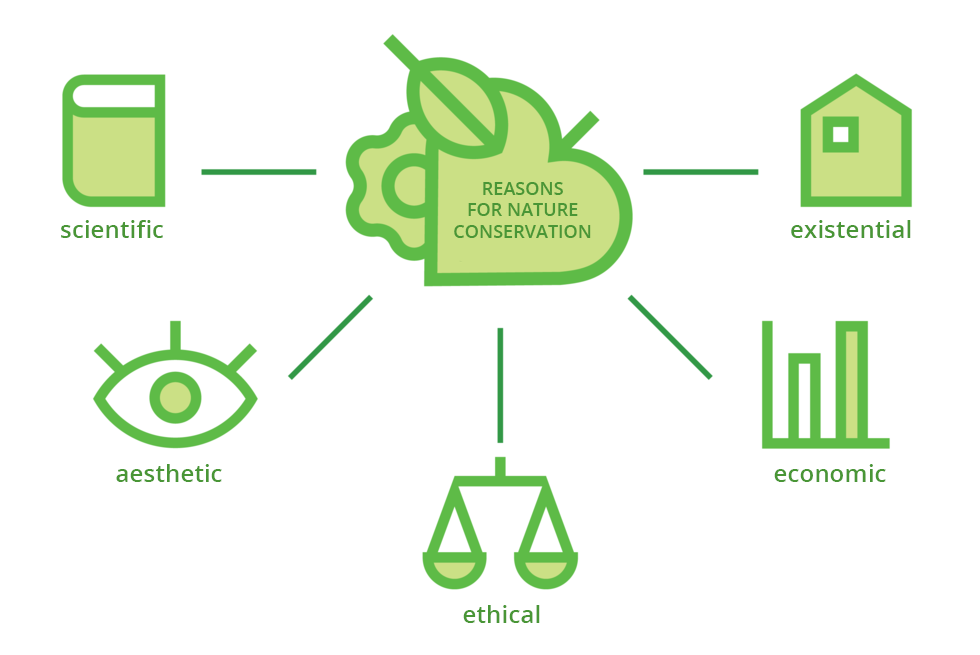
There may be various reasons for which people undertake activities aimed at nature conservation. The nature abounds in non‑renewable and renewable resources, which we can use provided that we take care of them. Among the reasons for nature conservation, there are: existential, economic, aesthetic, ethical and scientific reasons.
R1FaocUYVacIs
Ilustracja przedstawia schemat w zielonym kolorze. W centrum znajduje się napis: reasons for nature conservation. Kreski prowadzą do graficznych symboli czynników, motywujących do ochrony: scientific; aesthetic; ethical; econimic; existential
Reasons for nature conservation
Source: Anita Mowczan, licencja: CC BY 3.0.
Task 2
Explain which reason for nature conservation is most important from your point of view.
RtmLhX0kYVZyo
Exercise 1
Ćwiczenie wskaż prawidłową odpowiedź. How does the Polish Nature Conservation Act of 16 April 2004 define nature conservation? Please mark the correct answer. Możliwe odpowiedzi: 1. This is a set of actions aimed at maintaining animated and inanimate nature in an unchanged or optimal state as well as the sustainable management and recovery of its resources., 2. This is the entirety of activities aimed at acquiring and managing natural resources in such a way that they are distributed as fairly as possible among all people on Earth., 3. These are actions aimed at promoting the idea of human's return to nature by giving up most of the achievements of the today's civilization., 4. This is the entirety of activities aimed at educating the society on issues related to the negative impact of modern civilization on living organisms.
Ćwiczenie wskaż prawidłową odpowiedź. How does the Polish Nature Conservation Act of 16 April 2004 define nature conservation? Please mark the correct answer. Możliwe odpowiedzi: 1. This is a set of actions aimed at maintaining animated and inanimate nature in an unchanged or optimal state as well as the sustainable management and recovery of its resources., 2. This is the entirety of activities aimed at acquiring and managing natural resources in such a way that they are distributed as fairly as possible among all people on Earth., 3. These are actions aimed at promoting the idea of human's return to nature by giving up most of the achievements of the today's civilization., 4. This is the entirety of activities aimed at educating the society on issues related to the negative impact of modern civilization on living organisms.
How does the Polish Nature Conservation Act of 16 April 2004 define nature conservation? Please mark the correct answer.
This is a set of actions aimed at maintaining animated and inanimate nature in an unchanged or optimal state as well as the sustainable management and recovery of its resources.
This is the entirety of activities aimed at acquiring and managing natural resources in such a way that they are distributed as fairly as possible among all people on Earth.
These are actions aimed at promoting the idea of human's return to nature by giving up most of the achievements of the today's civilization.
This is the entirety of activities aimed at educating the society on issues related to the negative impact of modern civilization on living organisms.
RS5V14vQkG5ak
Exercise 2
Ćwiczenie wskaż prawidłowe odpowiedzi. Mark all activities specified in the Polish Nature Conservation Act as the most important objectives of nature protection in Poland. Możliwe odpowiedzi: 1. conservation of biodiversity, 2. conversion of uncultivated land into agricultural land, 3. maintenance of ecological processes and the stability of ecosystems, 4. protection of trees and the greenery landscape in towns and villages, 5. active support of fishing and hunting and fishing association, 6. shaping of the proper attitude towards the nature protection
Ćwiczenie wskaż prawidłowe odpowiedzi. Mark all activities specified in the Polish Nature Conservation Act as the most important objectives of nature protection in Poland. Możliwe odpowiedzi: 1. conservation of biodiversity, 2. conversion of uncultivated land into agricultural land, 3. maintenance of ecological processes and the stability of ecosystems, 4. protection of trees and the greenery landscape in towns and villages, 5. active support of fishing and hunting and fishing association, 6. shaping of the proper attitude towards the nature protection
Mark all activities specified in the Polish Nature Conservation Act as the most important objectives of nature protection in Poland.
conservation of biodiversity
conversion of uncultivated land into agricultural land
maintenance of ecological processes and the stability of ecosystems
protection of trees and the greenery landscape in towns and villages
active support of fishing and hunting and fishing association
shaping of the proper attitude towards the nature protection
RSaH1plfgeNmy
Exercise 3
Ćwiczenie połącz w pary. Match each reason for nature conservation with the general attitude it stems from. existential reasons Możliwe odpowiedzi: 1. awareness of the fact that natural resources have a measurable economic value, 2. respect for life in its all forms, 3. the need to ensure adequate living conditions for people, 4. seeing and admiring the beauty of nature, 5. the need to acquire knowledge concerning the elements of nature and the laws that govern it. economic reasons Możliwe odpowiedzi: 1. awareness of the fact that natural resources have a measurable economic value, 2. respect for life in its all forms, 3. the need to ensure adequate living conditions for people, 4. seeing and admiring the beauty of nature, 5. the need to acquire knowledge concerning the elements of nature and the laws that govern it. ethical reasons Możliwe odpowiedzi: 1. awareness of the fact that natural resources have a measurable economic value, 2. respect for life in its all forms, 3. the need to ensure adequate living conditions for people, 4. seeing and admiring the beauty of nature, 5. the need to acquire knowledge concerning the elements of nature and the laws that govern it. aesthetic reasons Możliwe odpowiedzi: 1. awareness of the fact that natural resources have a measurable economic value, 2. respect for life in its all forms, 3. the need to ensure adequate living conditions for people, 4. seeing and admiring the beauty of nature, 5. the need to acquire knowledge concerning the elements of nature and the laws that govern it. scientific reasons Możliwe odpowiedzi: 1. awareness of the fact that natural resources have a measurable economic value, 2. respect for life in its all forms, 3. the need to ensure adequate living conditions for people, 4. seeing and admiring the beauty of nature, 5. the need to acquire knowledge concerning the elements of nature and the laws that govern it
Ćwiczenie połącz w pary. Match each reason for nature conservation with the general attitude it stems from. existential reasons Możliwe odpowiedzi: 1. awareness of the fact that natural resources have a measurable economic value, 2. respect for life in its all forms, 3. the need to ensure adequate living conditions for people, 4. seeing and admiring the beauty of nature, 5. the need to acquire knowledge concerning the elements of nature and the laws that govern it. economic reasons Możliwe odpowiedzi: 1. awareness of the fact that natural resources have a measurable economic value, 2. respect for life in its all forms, 3. the need to ensure adequate living conditions for people, 4. seeing and admiring the beauty of nature, 5. the need to acquire knowledge concerning the elements of nature and the laws that govern it. ethical reasons Możliwe odpowiedzi: 1. awareness of the fact that natural resources have a measurable economic value, 2. respect for life in its all forms, 3. the need to ensure adequate living conditions for people, 4. seeing and admiring the beauty of nature, 5. the need to acquire knowledge concerning the elements of nature and the laws that govern it. aesthetic reasons Możliwe odpowiedzi: 1. awareness of the fact that natural resources have a measurable economic value, 2. respect for life in its all forms, 3. the need to ensure adequate living conditions for people, 4. seeing and admiring the beauty of nature, 5. the need to acquire knowledge concerning the elements of nature and the laws that govern it. scientific reasons Możliwe odpowiedzi: 1. awareness of the fact that natural resources have a measurable economic value, 2. respect for life in its all forms, 3. the need to ensure adequate living conditions for people, 4. seeing and admiring the beauty of nature, 5. the need to acquire knowledge concerning the elements of nature and the laws that govern it
Match each reason for nature conservation with the general attitude it stems from.
awareness of the fact that natural resources have a measurable economic value, seeing and admiring the beauty of nature, the need to ensure adequate living conditions for people, the need to acquire knowledge concerning the elements of nature and the laws that govern it, respect for life in its all forms
existential reasons
economic reasons
ethical reasons
aesthetic reasons
scientific reasons
Summary
The nature conservation are all actions aimed at the maintenance of animated and inanimate nature in an unchanged state, the sustainable management of its resources and the provision of a possibility of their recovery.
R1MruvmrX9mVM
Dokończ zdania. How was this lesson? Did you like it? Finish selected sentences. Propozycje It was easy for me (uzupełnij), It was difficult for me (uzupełnij), Today I learned (uzupełnij), I understood that (uzupełnij), It surprised me (uzupełnij).
Dokończ zdania. How was this lesson? Did you like it? Finish selected sentences. Propozycje It was easy for me (uzupełnij), It was difficult for me (uzupełnij), Today I learned (uzupełnij), I understood that (uzupełnij), It surprised me (uzupełnij).
How was this lesson? Did you like it? Finish selected sentences.
How was this lesson? Did you like it? Finish selected sentences.
ochrona przyrody – ogół działań mających na celu zachowanie w niezmienionym lub optymalnym stanie przyrody ożywionej i nieożywionej, zrównoważone gospodarowanie jej zasobami i zapewnienie możliwości ich odnawiania się