bg‑azure

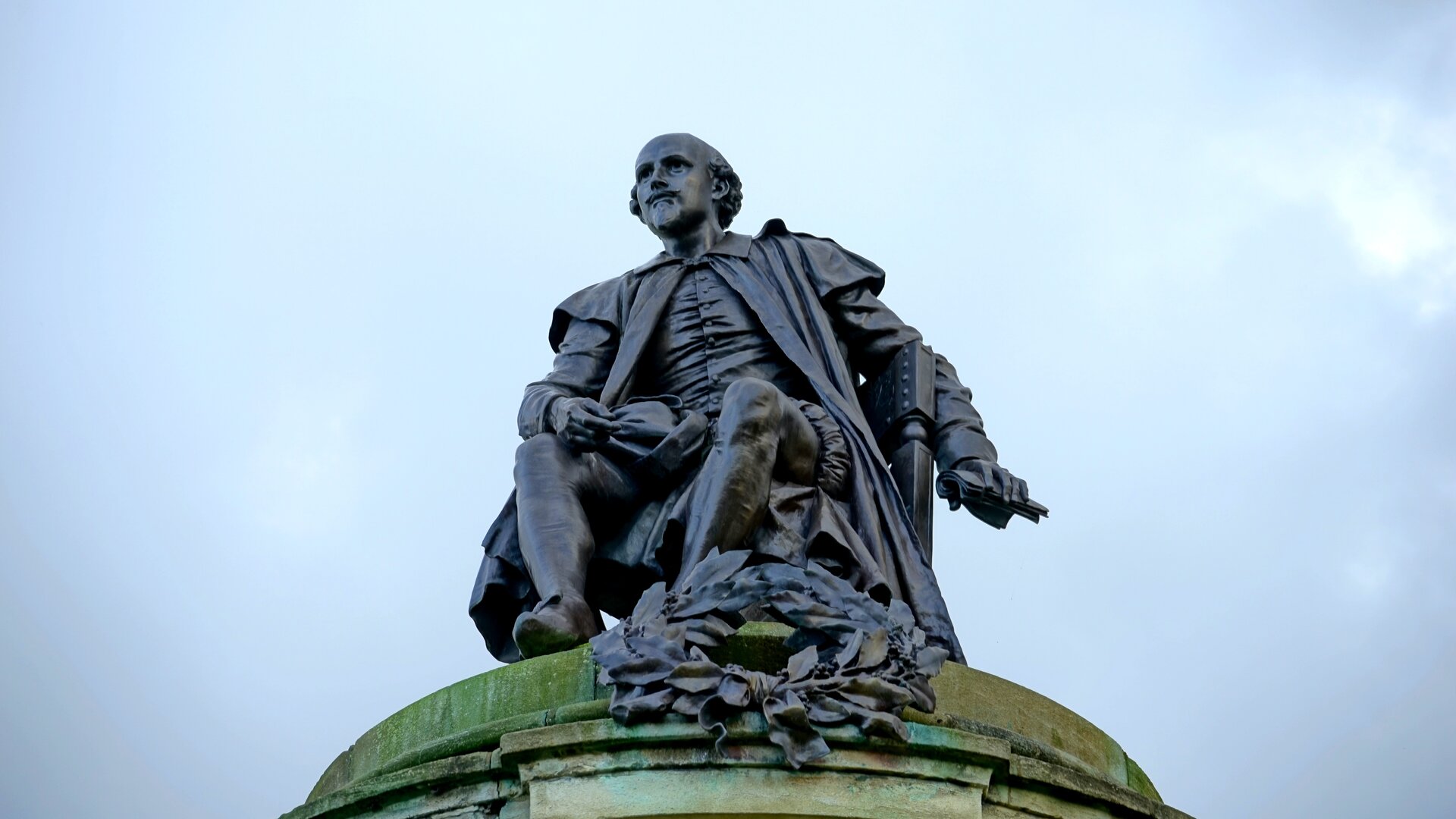
The picture shows one of the greatest English authors of all time, William Shakespeare. You are going to study a text about him and find out why some people started to question his authorship after his death.

Na zdjęciu widzisz rzeźbę przedstawiającą Williama Szekspira, jednego z najważniejszych angielskich pisarzy. W tej części materiału przeanalizujesz tekst, z którego dowiesz się, dlaczego po jego śmierci niektórzy podawali w wątpliwość autorstwo jego dzieł.
R12I87tjmIRLh
William Shakespeare’s monument in Stratford-upon-Avon
Pomnik Williama Szekspira w Stratford‑upon‑Avon
Źródło: dostępny w internecie: www.pexels.com [dostęp 15.03.2022], domena publiczna.
1
Exercise 1

Drag the elements in the correct place to make the correct William Shakespeare’s quotation.

R1RKEkrheEJRP
Źródło: GroMar Sp. z o.o., licencja: CC BY-SA 3.0.
Exercise 1
R1BzpODzyA3Ne
Complete the puzzle below with William Shakespeare’s quotation.
Źródło: Daniel Łyżwiński, domena publiczna.

Study the text to find out about a controversy surrounding William Shakespeare's works.

Did Shakespeare Really Write Shakespeare?
Anna Faszcza Did Shakespeare Really Write Shakespeare?

“To be or not to be, that is a question” and “All the world's a stage….” Sounds familiar? Shakespeare’s words are so frequently used in everyday language that some of us probably don't realise that we quotequote (verb)quote from a classic. Shakespeare was the author of about 38 playsplays [play]plays and 154 sonnetssonnets [sonnet]sonnets. It is said that he is the second most eagerly quoted English writer and the world’s pre‑eminent dramatistpre‑eminent dramatistpre‑eminent dramatist of a nickname Bard of Avon with an IQ of 210.

(1)

We don't know much about Shakespeare’s private life. Scientists suggest that he was born, brought up, and buried in Stratford‑upon‑Avon as the son of John Shakespeare, a glovergloverglover and the town officialtown officialtown official. At the age of 18 he got married to Anne Hathaway who gave birth to three of their children. Soon after getting married, he disappeared for seven years between 1585‑1592, known as the “lost years.” Nobody knew what he was doing during this period because there were no documents about his education and private life.

(2)

The lack of Shakespeare’s biographical information has been a reason to questionquestion (verb)question his identity and consequently his authorshipauthorshipauthorship. No letters or signed manuscriptsmanuscripts [manuscript]manuscripts survived. Only six examples of his signature remained today, which are described as “an illiterate scrawlilliterate scrawlilliterate scrawl” by the sceptics. As a person with a rather humble backgroundhumble backgroundhumble background, his deep knowledge in the fields of the Elisabethan courtcourtcourt, law, politics, foreign countries, hunting, falconryfalconryfalconry, and history presented in his works might raise suspicionraise suspicionraise suspicion. His vocabulary rangevocabulary rangevocabulary range was astonishingly rich. Each and every single piece of his writing was thoroughly examined by experts who say that Shakespeare knew about 30 thousand words while the average language user knows about 12–20 thousand.

(3)

Joseph Hart, an American writer, in his book The Romance of Yachting released in 1848, was the first to declare that William Shakespeare was not the true author of the works attributed to himattributed to him [attribute to sb]attributed to him. He argued that William’s plays involved a number of authors working on them. Hart’s book marked the beginning of the rapidly growing movement of anti‑Stratfordians who questioned Shakespeare’s authorship. They even suggested his being illiterate. But the most fishyfishyfishy thing for them was Shakespeare’s last will, written in an entirely unpoetic, mundanemundanemundane way, which they saw as evidence confirming they suspicions. In the middle of the 19th century, there were about 80 candidates put forward as true authors.

(4)

The leading one was Sir Francis Bacon, an English scientist, lawyer, and philosopher of Cambridge education. He was a member of the Privy CouncilPrivy CouncilPrivy Council and Lord High Chancellor of EnglandLord High Chancellor of EnglandLord High Chancellor of England. The experts noticed that his life experiences were similar to the ones described in Shakespeare’s plays and their style of writing was also very much alike in some passagespassages [passage]passages. Baconian theory of Shakespeare authorship was rejected by legendary cryptographerscryptographers [cryptographer] cryptographers William and Elisabeth Friedman, whose studies proved that all the claims were false.

Another  “real” Shakespeare was Edward DeVere. Due to his knowledge of court life and frequent travels in France and Italy, common settings for Shakespeare’s plays, he was considered one of the most likely alternative candidates. Numerous affinitiesaffinities [affinity]affinities can be seen between his known writings and Shakespeare’s plays in terms of language, motifsmotifs [motif]motifs and rhetorical devicesrhetorical devices [rhetorical device]rhetorical devices. There is one fact, though, that excludes DeVere. He died in 1604, and 12 of Shakespeare’s plays had not been written by then.

The final candidate is Christopher Marlowe, a well‑known playwrightplaywrightplaywright, of almost the exact age as Shakespeare (2 months apart). People thought he was a spy for the British government. He was charged with rebellious atheism, and arranged his fake death to avoid the execution. He went underground and continued writing his famous plays under a pseudonym. Only 13 days after his reported death, there was the first mention of Shakespeare.

(5)

Is there any way to figure out if Shakespeare was genuinely Shakespeare indeed? Linguists have been examining syntaxsyntaxsyntax, grammar, semanticssemanticssemantics, and vocabulary, and comparing pieces of writing from other writers. In the late 1800s, a Polish philosopher Wincenty Lutosławski formalised a method called stylometrystylometrystylometry, which recognised each writer’s style by measuring the average sentence length and the specific arrangement of words.

The problem with the authenticity of Shakespeare’s works results from one thing: there is no surviving evidence if Shakespeare ever received any formal education. Most scholarsscholars [scholar]scholars dismiss all theories based on historical and biographical evidence. The stylometristsstylometrists [stylometrist]stylometrists proved that Shakespeare is… Shakespeare, indeed. The studies, however, point to some cooperation, e.g. sometimes William might have worked together with Christopher Marlowe. It turns out that stylometry can help solve the problem of authorship and determine when the work was written and what makes it structurally distinctdistinctdistinct. And to prove that, after all, the Bard is the Bard.

1 Źródło: Anna Faszcza, licencja: CC BY-SA 3.0.
Exercise 2
Rwh7IqrwUn4d8
Study the text about Shakespeare’s authorship and match the headings below to the correct paragraphs. 1. Możliwe odpowiedzi: 1. Puzzle Solved, 2. A Brief Overview, 3. Most Plausible Figures, 4. Unschooled Genius?, 5. First Doubts Voiced 2. Możliwe odpowiedzi: 1. Puzzle Solved, 2. A Brief Overview, 3. Most Plausible Figures, 4. Unschooled Genius?, 5. First Doubts Voiced 3. Możliwe odpowiedzi: 1. Puzzle Solved, 2. A Brief Overview, 3. Most Plausible Figures, 4. Unschooled Genius?, 5. First Doubts Voiced 4. Możliwe odpowiedzi: 1. Puzzle Solved, 2. A Brief Overview, 3. Most Plausible Figures, 4. Unschooled Genius?, 5. First Doubts Voiced 5. Możliwe odpowiedzi: 1. Puzzle Solved, 2. A Brief Overview, 3. Most Plausible Figures, 4. Unschooled Genius?, 5. First Doubts Voiced
Źródło: GroMar Sp. z o.o., licencja: CC BY-SA 3.0.
Exercise 3
R3XpDMrzevR2d
Based on the information from the text, match the numbers that appear in it with the information they correspond to. 80 Możliwe odpowiedzi: 1. When Wincenty Lutosławki invented stylometry, 2. The number of years when there was no record of Shakespeare, 3. The number of sonnets Shakespeare wrote, 4. Shakespeare’s IQ, 5. The difference in months between Shakespeare’s and Marlowe’s births, 6. The number of possible candidates for the “real” Shakespeare, 7. His age when he got married, 8. The number of words Shakespeare used, 9. The number of plays Shakespeare wrote 154 Możliwe odpowiedzi: 1. When Wincenty Lutosławki invented stylometry, 2. The number of years when there was no record of Shakespeare, 3. The number of sonnets Shakespeare wrote, 4. Shakespeare’s IQ, 5. The difference in months between Shakespeare’s and Marlowe’s births, 6. The number of possible candidates for the “real” Shakespeare, 7. His age when he got married, 8. The number of words Shakespeare used, 9. The number of plays Shakespeare wrote 38 Możliwe odpowiedzi: 1. When Wincenty Lutosławki invented stylometry, 2. The number of years when there was no record of Shakespeare, 3. The number of sonnets Shakespeare wrote, 4. Shakespeare’s IQ, 5. The difference in months between Shakespeare’s and Marlowe’s births, 6. The number of possible candidates for the “real” Shakespeare, 7. His age when he got married, 8. The number of words Shakespeare used, 9. The number of plays Shakespeare wrote 210 Możliwe odpowiedzi: 1. When Wincenty Lutosławki invented stylometry, 2. The number of years when there was no record of Shakespeare, 3. The number of sonnets Shakespeare wrote, 4. Shakespeare’s IQ, 5. The difference in months between Shakespeare’s and Marlowe’s births, 6. The number of possible candidates for the “real” Shakespeare, 7. His age when he got married, 8. The number of words Shakespeare used, 9. The number of plays Shakespeare wrote 18 Możliwe odpowiedzi: 1. When Wincenty Lutosławki invented stylometry, 2. The number of years when there was no record of Shakespeare, 3. The number of sonnets Shakespeare wrote, 4. Shakespeare’s IQ, 5. The difference in months between Shakespeare’s and Marlowe’s births, 6. The number of possible candidates for the “real” Shakespeare, 7. His age when he got married, 8. The number of words Shakespeare used, 9. The number of plays Shakespeare wrote 7 Możliwe odpowiedzi: 1. When Wincenty Lutosławki invented stylometry, 2. The number of years when there was no record of Shakespeare, 3. The number of sonnets Shakespeare wrote, 4. Shakespeare’s IQ, 5. The difference in months between Shakespeare’s and Marlowe’s births, 6. The number of possible candidates for the “real” Shakespeare, 7. His age when he got married, 8. The number of words Shakespeare used, 9. The number of plays Shakespeare wrote 2 Możliwe odpowiedzi: 1. When Wincenty Lutosławki invented stylometry, 2. The number of years when there was no record of Shakespeare, 3. The number of sonnets Shakespeare wrote, 4. Shakespeare’s IQ, 5. The difference in months between Shakespeare’s and Marlowe’s births, 6. The number of possible candidates for the “real” Shakespeare, 7. His age when he got married, 8. The number of words Shakespeare used, 9. The number of plays Shakespeare wrote 30,000 Możliwe odpowiedzi: 1. When Wincenty Lutosławki invented stylometry, 2. The number of years when there was no record of Shakespeare, 3. The number of sonnets Shakespeare wrote, 4. Shakespeare’s IQ, 5. The difference in months between Shakespeare’s and Marlowe’s births, 6. The number of possible candidates for the “real” Shakespeare, 7. His age when he got married, 8. The number of words Shakespeare used, 9. The number of plays Shakespeare wrote 1800s Możliwe odpowiedzi: 1. When Wincenty Lutosławki invented stylometry, 2. The number of years when there was no record of Shakespeare, 3. The number of sonnets Shakespeare wrote, 4. Shakespeare’s IQ, 5. The difference in months between Shakespeare’s and Marlowe’s births, 6. The number of possible candidates for the “real” Shakespeare, 7. His age when he got married, 8. The number of words Shakespeare used, 9. The number of plays Shakespeare wrote
Źródło: GroMar Sp. z o.o., licencja: CC BY-SA 3.0.
Exercise 4

Study the question about Shakespeare and answer it in 5‑6 sentences.

What is your opinion on questioning Shakespeare’s authorship?

R1aY8yTsuSxTN
(Uzupełnij).
Źródło: GroMar Sp. z o.o., licencja: CC BY-SA 3.0.

Słownik

affinities [affinity]

/ əˈfɪnətiz / / əˈfɪnəti /

RxLLdmVkVZydr1
Nagranie dźwiękowe

podobieństwa [podobieństwo] (similarities)

R14sIz78F5Pir1
Nagranie dźwiękowe
attributed to him [attribute to sb]

/ əˈtrɪbjʊtɪd tu hɪm / / ˈætrɪbjuːt tu ˈsʌmbədi /

R18Mu0vOnOcIO1
Nagranie dźwiękowe

przypisywany jemu [przypisywany/przypisywana komuś] (to believe that something is the result of somebody’s work)

R1K6mFps8UZzL1
Nagranie dźwiękowe
authorship
authorship

/ ˈɔːthetaəʃɪp /

RBxLmE7lT8VG41
Nagranie dźwiękowe

autorstwo (stated fact of being the author of something e.g a book)

R8yycRALSxJBe1
Nagranie dźwiękowe
court
court

/ kɔːt /

RL239AvGVTqDo1
Nagranie dźwiękowe

dwór (royal household)

R1I3Zick90CxQ1
Nagranie dźwiękowe
cryptographers [cryptographer]

/ krɪpˈtɒɡrəfəz / / krɪpˈtɒɡrəfə /

R11uVLrBBRAgi1
Nagranie dźwiękowe

kryptografowie [kryptograf/kryptografka] (a person who use specialistic methods to study the characteristics of the author’s style and authenticity)

R15R7leowdKAF1
Nagranie dźwiękowe
distinct
distinct

/ dɪˈstɪŋkt /

R11sBzexKUcDy1
Nagranie dźwiękowe

odrębny/odrębna, wyraźnie różniący/różniąca się od innych (separate and different in a way that is clear)

RtnrEB92hAXiV1
Nagranie dźwiękowe
falconry
falconry

/ ˈfɒlkənri /

RIQSI0ctwNafh1
Nagranie dźwiękowe

sokolnictwo (sport of hunting with falcons)

REI2lUC3vWvAe1
Nagranie dźwiękowe
fishy
fishy

/ ˈfɪʃi /

RExVocUd9RcLk1
Nagranie dźwiękowe

podejrzane (giving the feeling of suspicion)

R12ZjgIGiDbcH1
Nagranie dźwiękowe
glover
glover

/ ˈɡləvə /

R1Gq0ACrO63oM1
Nagranie dźwiękowe

rękawicznik/rękawiczniczka (a person who makes and sells gloves)

RzEB8xUHJ0p1w1
Nagranie dźwiękowe
humble background
humble background

/ ˈhʌmbl̩ ˈbækɡraʊnd /

RZfx1VuCHEDbn1
Nagranie dźwiękowe

skromne pochodzenie (of a rather poor family you come from)

R1NG05FjMVrOh1
Nagranie dźwiękowe
illiterate scrawl
illiterate scrawl

/ ɪˈlɪtərət skrɔːl /

RjOpbwRzoYFZC1
Nagranie dźwiękowe

nieczytelny bazgroł (careless writing)

R1JiFp95n3dCk1
Nagranie dźwiękowe
Lord High Chancellor of England

/ lɔːd ˌhaɪ ˈtʃɑːnsələr əv ˈɪŋɡlənd /

RAjHROIcgbimA1
Nagranie dźwiękowe

Lord Kanclerz (the highest officer of the Crown who is head of the judiciary and who presides in the House of Lords)

RA89IRkVuJXCr1
Nagranie dźwiękowe
manuscripts [manuscript]

/ ˈmænjʊskrɪpts / / ˈmænjʊskrɪpt /

R4ueUA62ubtR11
Nagranie dźwiękowe

rękopisy [rękopis] (a writer’s original pages of a book, article, or document before it is published)

RHDYveJf0iMcU1
Nagranie dźwiękowe
motifs [motif]
motifs [motif]

/ məʊˈtiːfs / / məʊˈtiːf /

RVUnbZXrYDBSe1
Nagranie dźwiękowe

motywy [motyw] (an idea that appears e.g in a book)

R1XH35LNAYOZD1
Nagranie dźwiękowe
mundane
mundane

/ mʌnˈdeɪn /

RCmb2Nr5VD8Nl1
Nagranie dźwiękowe

przyziemny/przyziemna (ordinary and not interesting or exciting, especially because of happening too regularly)

Rlqs5anwWOua61
Nagranie dźwiękowe
passages [passage]
passages [passage]

/ ˈpæsɪdʒɪz / / ˈpæsɪdʒ /

R1TxIPc6KS2441
Nagranie dźwiękowe

fragment (a short piece of text)

RoqOHMDEC3uwN1
Nagranie dźwiękowe
plays [play]
plays [play]

/ ˈpleɪz / / ˈpleɪ /

RdEey6za3Yk0l1
Nagranie dźwiękowe

sztuki teatralne [sztuka teatralna] (a performance in the theatre)

RzGpK5XDUPMXo1
Nagranie dźwiękowe
playwright
playwright

/ ˈpleɪraɪt /

R1Ptn0SGWLjVJ1
Nagranie dźwiękowe

dramatopisarz/dramatopisarka (a person who writes plays)

R1HM9eVdQqhGr1
Nagranie dźwiękowe
pre‑eminent dramatist

/ ˌpriː ˈemɪnənt ˈdræmətɪst /

R1FPSmwWelHJc1
Nagranie dźwiękowe

wybitny dramaturg/wybitna dramaturżka (outstanding writer of dramas)

RGrS5FepTlfpm1
Nagranie dźwiękowe
Privy Council
Privy Council

/ ˈprɪvi ˈkaʊnsl̩ /

R1cbWikC8tJLh1
Nagranie dźwiękowe

Tajna Rada Królewska (an advisory council to a ruler, especially to the British Crown)

RSIlFOBDh9JKY1
Nagranie dźwiękowe
question (verb)
question (verb)

/ ˈkwestʃən /

R1DI3gY8a3SUz1
Nagranie dźwiękowe

podać w wątpliwość (feel doubt about something)

R4vmE1Y9FmMgT1
Nagranie dźwiękowe
quote (verb)
quote (verb)

/ kwəʊt /

R17ObbEApVlLu1
Nagranie dźwiękowe

cytować (repeat something exactly the way somebody said it)

RGb3CJ0UiRrkL1
Nagranie dźwiękowe
raise suspicion
raise suspicion

/ reɪz səˈspɪʃn̩ /

RAdSDRivfAObf1
Nagranie dźwiękowe

wzbudzać podejrzenia (a feeling that something is wrong)

R1MAv3g0Pov4l1
Nagranie dźwiękowe
rhetorical devices [rhetorical device]

/ rɪˈtɒrɪkl̩ dɪˈvaɪsɪz / / rɪˈtɒrɪkl̩ dɪˈvaɪs /

R1JlW7zFJgFZc1
Nagranie dźwiękowe

zabiegi stylistyczne [zabieg stylistyczny] (use of language to make an impression e.g on the readers)

RkuUpc1aHzJXB1
Nagranie dźwiękowe
scholars [scholar]
scholars [scholar]

/ ˈskɒləz / / ˈskɒlə /

RlHk0DL6VxoWu1
Nagranie dźwiękowe

uczeni [uczony/uczona] (well educated people)

R1NJpvzCgeTtJ1
Nagranie dźwiękowe
semantics
semantics

/ sɪˈmæntɪks /

R1EUpK0k9LaFH1
Nagranie dźwiękowe

semantyka (the study of meanings)

R1SanE1MTwAgw1
Nagranie dźwiękowe
sonnets [sonnet]
sonnets [sonnet]

/ ˈsɒnɪts / / ˈsɒnɪt /

R1Rm1uDirKVGl1
Nagranie dźwiękowe

sonety [sonet] (a poem that consists of 14 lines)

R1S1ukvha4eDq1
Nagranie dźwiękowe
stylometry
stylometry

/ staɪˈlɒmətri /

RT8lVZgCOm39R1
Nagranie dźwiękowe

stylometria (the quantitative analysis of writing styles to identify and differentiate authors based on their linguistic patterns)

Rl4iX6x0r80Hx1
Nagranie dźwiękowe
stylometrists [stylometrist]

/ staɪˈlɒmətrɪsts / / staɪˈlɒmətrɪst /

R15JvnMjSKLGy1
Nagranie dźwiękowe

stylometryści/stylometrystki [stylometrysta/stylometrystka] (a specialist who uses stylometry techniques to analyze and compare writing styles to attribute or differentiate authors)

RwKCG3kiIZuwQ1
Nagranie dźwiękowe
syntax
syntax

/ ˈsɪntæks /

R1DUfW8UEzDuX1
Nagranie dźwiękowe

składnia zdania (the study of arrangement of words in a sentence)

R1GocCnWbRVA21
Nagranie dźwiękowe
town official
town official

/ taʊn əˈfɪʃl̩ /

R1MyWYAARFAKw1
Nagranie dźwiękowe

urzędnik miejski / urzędniczka miejska (a person who is elected to work for the city)

R5Anz5muHxIn11
Nagranie dźwiękowe
vocabulary range
vocabulary range

/ vəˈkæbjʊləri reɪndʒ /

R1HjinGwxblXe1
Nagranie dźwiękowe

zakres słownictwa (all the words in the language)

R18luVKwsKL8i1
Nagranie dźwiękowe
RfEv5aDghEtcL
(Uzupełnij).
Źródło: GroMar Sp. z o.o., licencja: CC BY-SA 3.0.