You jump, you run, you perform a myriad of actions every day. You also enter different states, e.g. when you fall asleep. We use verbsverbverbs to talk about all these actions.
Exercise 1
Try to recall what you do every morning. Take turns to answer the question: “What do you do in the morning?” Give a different answer each time. For example:
– What do you do in the morning? – I wake up.
Exercise 2
Opisz, jak uczniowie powinni zachowywać się podczas lekcji.
Opisz, jak uczniowie powinni zachowywać się podczas lekcji.
Look at the picture above and answer the questions. Write down your answers here or in your notebook. Underline the verbs.
RjmHSrPwzb1gd
Wyobraź sobie klasę, uczniów i nauczyciela. Odpowiedz na pytania: What is the teacher doing? What are the students doing?
Wyobraź sobie klasę, uczniów i nauczyciela. Odpowiedz na pytania: What is the teacher doing? What are the students doing?
A verb is a very important part of speech. You can’t build a sentence without a verb. We group all other words around a verb.
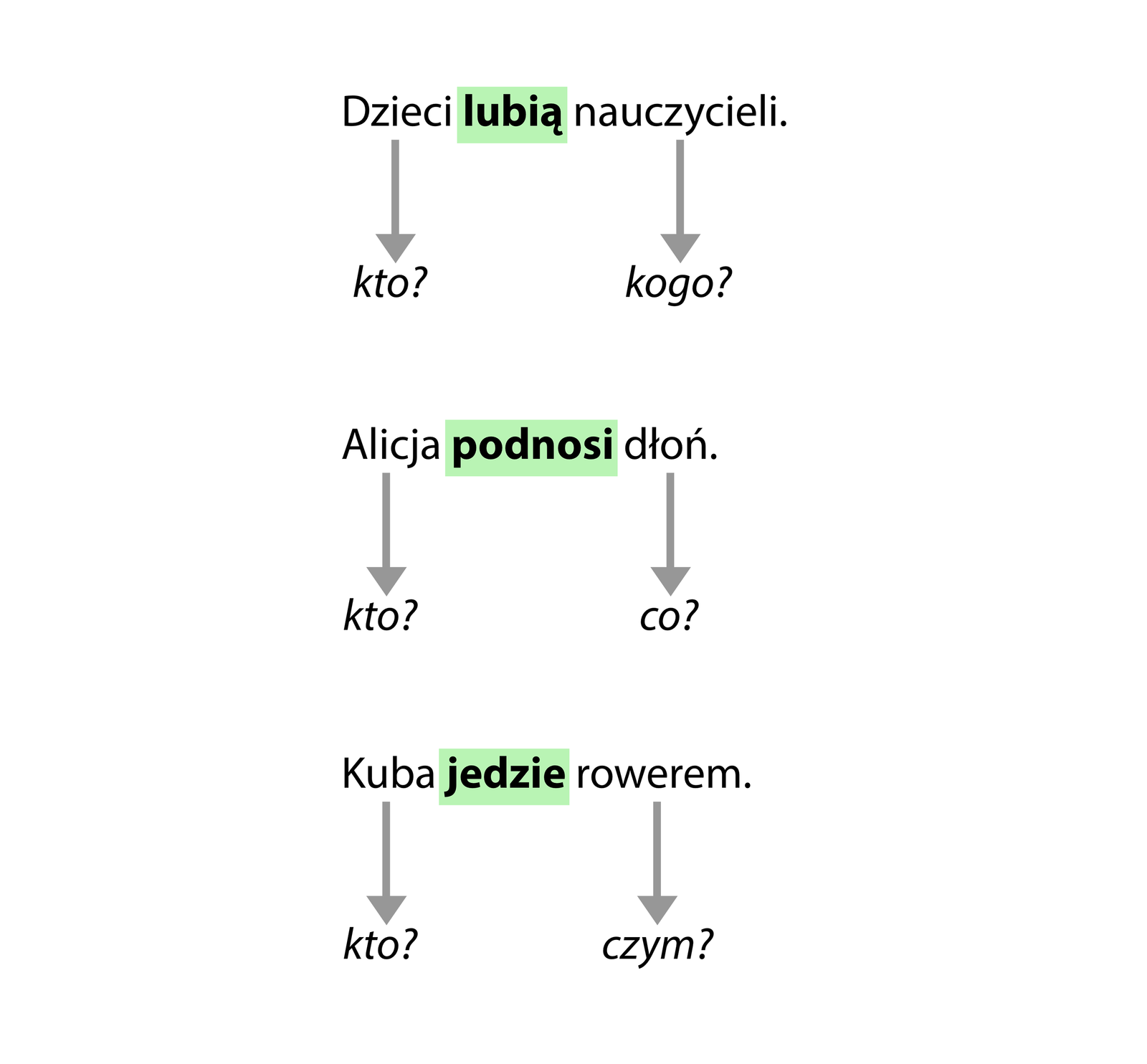
Verbs are central. You start with a verb, and then add other words. These other words are dependent on the verb. Our infographic illustrates this.
R18scqiTcBBmw
Grafika przedstawiająca schemat zdań z użyciem czasowników. Dzieci (kto?) lubią (kogo?) nauczycieli. Alicja (kto?) podnosi (co?) dłoń. Kuba (kto?) jedzie rowerem (czym?).
Source: Contentplus.pl sp. z o.o., licencja: CC BY 3.0.
R5pvfwQpiAvyB
Exercise 3
Ułóż pięć zdań, które będą odpowiadały na pytanie: Kto? Co robi? Możesz zadbać również o dalsze określenia, np. Piekarz piecze - co? - ciasto. Wskaż w wymyślonych przez Ciebie zdaniach czasowniki.
Ułóż pięć zdań, które będą odpowiadały na pytanie: Kto? Co robi? Możesz zadbać również o dalsze określenia, np. Piekarz piecze - co? - ciasto. Wskaż w wymyślonych przez Ciebie zdaniach czasowniki.
Match the verbs below with other parts of the sentence. Drag and drop the words in their respective places. Use questions for guidance. Make sure your sentences make sense.
The players, home, a whale, The artist, the guitar, The chef, The musician, Dzieci, to the trainer, The cats, a picture, by bus, the chicken
Who? ............................ is baking what? ............................. Who? ............................ are going where? ............................ by what? ............................. Who? ............................ is playing what? ............................. Who? ............................ is painting what? ............................. Who? ............................ are talking to who? .............................
RXJUEil4xk4wo
Exercise 4
Listen to the sentences. Tell out the verbs. Then listen once again and tell out the nouns. Fairies are dancing near quiet streams of water. Snow White is eating a poisoned apple. Cinderella is trying on the glass slipper. Shrek lives in a remote area. At sunrise dwarfs hide in the wood.
Listen to the sentences. Tell out the verbs. Then listen once again and tell out the nouns. Fairies are dancing near quiet streams of water. Snow White is eating a poisoned apple. Cinderella is trying on the glass slipper. Shrek lives in a remote area. At sunrise dwarfs hide in the wood.
Indicate verbs in sentences below. Highlight verbs with green. Highlight nouns with red.
{nouns}Fairies{/nouns} {verbs}are dancing{/verbs} near quiet {nouns}streams{/nouns} of {nouns}water{/nouns}.
{nouns}Snow White{/nouns} {verbs}is eating{/verbs} a poisoned {nouns}apple{/nouns}.
{nouns}Cinderella{/nouns} {verbs}is trying on{/verbs} the glass {nouns}slipper{/nouns}.
{nouns}Shrek{/nouns} {verbs}lives{/verbs} in a remote {nouns}area{/nouns}.
At {nouns}sunrise{/nouns} {nouns}dwarfs{/nouns} {verbs}hide{/verbs} in the {nouns}wood{/nouns}.
Animal sounds and idioms
What do you call the sounds that animals make? Can you name them?
R155rieQRWWOs
Exercise 5
What sounds do the animals make?
Find the animals making following sounds:
1. oinks,
2. clucks,
3. barks,
4. quacks,
5. croaks,
6. squeaks,
7. roars,
8. meows
What sounds do the animals make?
Find the animals making following sounds:
1. oinks,
2. clucks,
3. barks,
4. quacks,
5. croaks,
6. squeaks,
7. roars,
8. meows
What sounds do the animals make? Match the answers.
Words we use to name sounds are called onomatopoeias.
When we tell a story we often use proverbsproverbproverbs or idioms. There are idioms in every language. It is not always possible to translate them. Make sure that you know Polish and English idioms.
R1KysSSbe0UYD
Exercise 6
Complete idioms with proper verbs. Czasowniki do wyboru: bujać, ukraść, strzec, złapać, spaść, ruszać, kłamać, wziąć. Związki frazeologiczne:
pierwszy (tu uzupełnij) jak źrenicy oka,
drugi (tu uzupełnij) nogi za pas,
trzeci (tu uzupełnij) w obłokach,
czwarty (tu uzupełnij) na cztery łapy,
piąty (tu uzupełnij) się jak mucha w smole,
szósty (tu uzupełnij) jak z nut,
siódmy (tu uzupełnij) Pana Boga za nogi.
Complete idioms with proper verbs. Czasowniki do wyboru: bujać, ukraść, strzec, złapać, spaść, ruszać, kłamać, wziąć. Związki frazeologiczne:
pierwszy (tu uzupełnij) jak źrenicy oka,
drugi (tu uzupełnij) nogi za pas,
trzeci (tu uzupełnij) w obłokach,
czwarty (tu uzupełnij) na cztery łapy,
piąty (tu uzupełnij) się jak mucha w smole,
szósty (tu uzupełnij) jak z nut,
siódmy (tu uzupełnij) Pana Boga za nogi.
Please read the following idioms carefully. There's something missing... Complete these idioms with proper verbs. Drag and drop items to the right places.
................ jak źrenicy oka
................ nogi za pas
................ w obłokach
................ na cztery łapy
................ się jak mucha w smole
................ jak z nut
................ Pana Boga za nogi
RVvByZNIvsVI2
Exercise 7
Here are some phrasal verbs.
Check their meaning and compose sentences with the two of them:
come back,
wake up,
rain down,
check out,
throw away,
carry on.
Here are some phrasal verbs.
Check their meaning and compose sentences with the two of them:
come back,
wake up,
rain down,
check out,
throw away,
carry on.
Read the following phrasal verbs. They aren't complete. Drag and drop the right words to make them not lacking.
away, carry, come, down, up, check
............ back
wake ............
rain ............
............ out
throw ............
............ on
RbS6GoQTbzVKq
Exercise 8
Do you know what the following Polish idioms mean?
Explain their meanings:
strzec jak źrenicy oka,
wziąć nogi za pas,
bujać w obłokach,
spaść na cztery łapy,
ruszać się jak mucha w smole,
kłamać jak z nut,
złapać Pana Boga za nogi.
Do you know what the following Polish idioms mean?
Explain their meanings:
strzec jak źrenicy oka,
wziąć nogi za pas,
bujać w obłokach,
spaść na cztery łapy,
ruszać się jak mucha w smole,
kłamać jak z nut,
złapać Pana Boga za nogi.
Do you know what the following Polish idioms mean? Match them with the right meanings.
to watch something caringly, to get out of a difficult situation, to achieve success and feel happy about it, to speak untruths without hesitation, without stumbling, to run away quickly, to dream, to fantasize, to do something very slowly, lazily
strzec jak źrenicy oka
wziąć nogi za pas
bujać w obłokach
spaść na cztery łapy
ruszać się jak mucha w smole
kłamać jak z nut
złapać Pana Boga za nogi
Exercise 9
Select two English idiomatic phrases from Exercise 7 and include them in a short story.
RwCfL3NADUxIB
Wykonaj ćwiczenie zgodnie z poleceniem.
Wykonaj ćwiczenie zgodnie z poleceniem.
R1AS0MivpEkhE
Grafika przedstawiająca tablicę szkolną, na której znajdują się zdania do dokończenia. Finish selected sentences. 1 It was easy for me (uzupełnij). 2 It was difficult for me (uzupełnij). 3 Today I learned (uzupełnij). 4 I understood that (uzupełnij). 5 It surprised me (uzupełnij).
Grafika przedstawiająca tablicę szkolną, na której znajdują się zdania do dokończenia. Finish selected sentences. 1 It was easy for me (uzupełnij). 2 It was difficult for me (uzupełnij). 3 Today I learned (uzupełnij). 4 I understood that (uzupełnij). 5 It surprised me (uzupełnij).
przysłowie - krótkie zdanie zaczerpnięte ze źródeł literackich lub ludowych i utrwalone w tradycji ustnej, wyrażające jakąś myśl ogólną: wskazówkę, przestrogę.