The unity of the great anti‑Hitler coalition did not last long. After having defeated Nazi Germany and Japan, the common enemy – the only element uniting the leaders of the Big ThreeBig ThreeBig Three – disappeared. Despite the ongoing reconstruction of Europe after the damage incurred during the war, supported with the means coming from the UNRRAUNRRAUNRRA (since 1945) and the Marshall PlanMarshall PlanMarshall Plan (since 1948), the sides quickly started tossing accusations towards each other, which, along with their misunderstandings, led to the breakup of the coalition. The causes for it lay in their deep ideological differences, contradictory interests, and the fight for domination in the post‑war world. The rift’s first manifestations were the conflicts of interest in Greece (civil war between the Communists and the government supported by Great Britain), Turkey (the question of control over the Black Sea straits) and Iran (the control over the sources of oil). The escalating conflict was also heralded by the statements of politicians. A particularly grave opinion on the division of the world and the conquest of part of it was expressed in 1946 by Winston Churchill, who described an Iron CurtainIron CurtainIron Curtain drawn down upon the middle of Europe. In his speech of 1947, Harry Truman presented the elements of his doctrine of containmentdoctrine of containmentdoctrine of containment, meant to prevent the expansion of Communism in the world. Those factors led to the formation of a polarized word concentrated around two superpowers - the United States and the Soviet Union. The rivalry between them was best visible in occupied Germany, as the Allies and the Soviets could not reach an agreement on the country (see: the Berlin Blockade of 1948‑1949).
The last factor that led to the beginning of the Cold WarCold WarCold War, as the status quo after 1947 was called, was the military integration of the Western states and the creation of the North Atlantic Treaty Organization (NATO)North Atlantic Treaty Organization (NATO)North Atlantic Treaty Organization (NATO) in 1949.
Despite the divisions and rivalry of the superpowers after the end of the war, positive events took place as well. One of them was the creation of the United NationsUNUnited Nations, a measure which aimed to prevent future wars and ensure international peace and security. Apart from that, a number of legal measures was adopted, the most important of which being the Universal Declaration of Human RightsUniversal Declaration of Human RightsUniversal Declaration of Human Rights of 1948.
Task 1
RAwY8W4C5krTH
Look at the timeline presenting the most important events leading up to the cold war. Which of the events were the most important and why? 6.1945 Founding conference of the UN in San Francisco The ceremony of signing the United Nations Charter., 5.3.1946 Churchill’s Fulton speech, 1.1947 The creation of Bisonia The detailed borders between the Allied occupation zones in Germany, lands granted to Poland and to the Soviet Union., 12.3.1947 Truman’s announcement of his “doctrine of containment” President Harry S. Truman, 5.6.1947 Announcement of the Marshall Plan George Marshall, the US Secretary of State, 1948 UN General Assembly adopts the Universal Declaration of Human Rights Eleanor Roosevelt with the Universal Declaration of Human Rights, 24.6.1948 - 12.5.1949 Berlin Blockade An American cargo airplane, Douglas C-54 Skymaster, lands at the Tempelhof airport during the Berlin Blockade, 1949 Creation of the NATO NATO’s member states marked with green
Look at the timeline presenting the most important events leading up to the cold war. Which of the events were the most important and why? 6.1945 Founding conference of the UN in San Francisco The ceremony of signing the United Nations Charter., 5.3.1946 Churchill’s Fulton speech, 1.1947 The creation of Bisonia The detailed borders between the Allied occupation zones in Germany, lands granted to Poland and to the Soviet Union., 12.3.1947 Truman’s announcement of his “doctrine of containment” President Harry S. Truman, 5.6.1947 Announcement of the Marshall Plan George Marshall, the US Secretary of State, 1948 UN General Assembly adopts the Universal Declaration of Human Rights Eleanor Roosevelt with the Universal Declaration of Human Rights, 24.6.1948 - 12.5.1949 Berlin Blockade An American cargo airplane, Douglas C-54 Skymaster, lands at the Tempelhof airport during the Berlin Blockade, 1949 Creation of the NATO NATO’s member states marked with green
Source: Addicted04, National Archives and Records Administration. Office of Presidential Libraries. Harry S. Truman Library., PAP/EPA/PA, US Army, USAF, licencja: CC BY 3.0.
Task 2
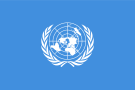
Explain the meaning of the symbols on the UN flag.
RunFAHZjLtZup
Grafika przedstawiająca flagę Organizacji Narodów Zjednoczonych. Na jednolitym tle umieszczono okrągłą siatkę kartograficzną, na której znajdują się zarysy wszystkich kontynentów bez Antarktydy, otoczoną wieńcem gałązek oliwnych, który jest symbolem pokoju.
Flag of the United Nations
Source: a. nn., Wikimedia Commons, domena publiczna.
Task 3
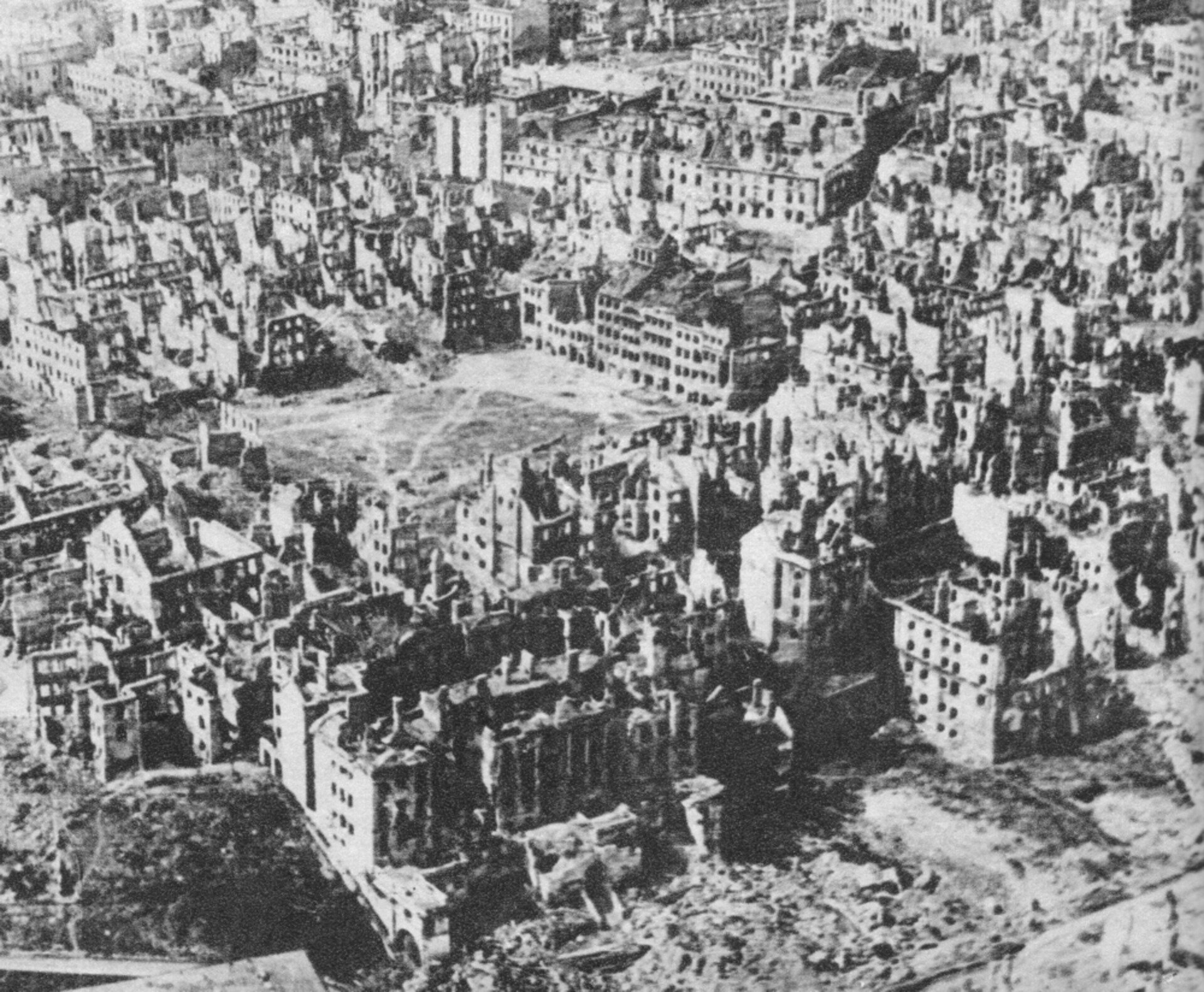
How did World War II affect the European economy?
RLkMquc9ZvxJZ
Fotografia czarno-biała przedstawiająca krajobraz zniszczonej Warszawy.
Destroyed Warsaw, January 1945
Source: M. Swierczynski, domena publiczna.
RFKoh9RDcvnPQ1
Exercise 1
Match the terms and their definitions. UN – the United Nations Możliwe odpowiedzi: 1. a military pact signed in 1949 between the Western countries in order to defend against potential military attacks of the Soviet Union., 2. an international organization that succeeded the League of Nations, formed in October 1945. Its main objectives are to ensure international peace and security, the development of cooperation between the nations, and the promotion of respect for human rights., 3. the program to rebuild Europe’s economies after World War II proposed by the United States in 1947. Its aim was to provide material (raw materials, food), financial and investment-related aid to the war-ravaged Europe. As a result of the Russian pressure, it was not joined by the countries remaining under the influence of the USSR., 4. United Nations Relief and Rehabilitation Administration – an initially autonomous organization formed in 1943 (since 1945, under the UN’s authority) whose aim was to provide aid to the countries that suffered as a result of World War II., 5. United Nations Educational, Scientific and Cultural Organization – an organization formed in 1946 in order to support international cooperation pertaining to culture, science and art., 6. an expression used by Winston Churchill that subsequently became a popular way to describe the form of the post-war world and its division into the spheres of influence of the democratic countries (in the West) and the USSR (in the East). UNESCO Możliwe odpowiedzi: 1. a military pact signed in 1949 between the Western countries in order to defend against potential military attacks of the Soviet Union., 2. an international organization that succeeded the League of Nations, formed in October 1945. Its main objectives are to ensure international peace and security, the development of cooperation between the nations, and the promotion of respect for human rights., 3. the program to rebuild Europe’s economies after World War II proposed by the United States in 1947. Its aim was to provide material (raw materials, food), financial and investment-related aid to the war-ravaged Europe. As a result of the Russian pressure, it was not joined by the countries remaining under the influence of the USSR., 4. United Nations Relief and Rehabilitation Administration – an initially autonomous organization formed in 1943 (since 1945, under the UN’s authority) whose aim was to provide aid to the countries that suffered as a result of World War II., 5. United Nations Educational, Scientific and Cultural Organization – an organization formed in 1946 in order to support international cooperation pertaining to culture, science and art., 6. an expression used by Winston Churchill that subsequently became a popular way to describe the form of the post-war world and its division into the spheres of influence of the democratic countries (in the West) and the USSR (in the East). UNRRA Możliwe odpowiedzi: 1. a military pact signed in 1949 between the Western countries in order to defend against potential military attacks of the Soviet Union., 2. an international organization that succeeded the League of Nations, formed in October 1945. Its main objectives are to ensure international peace and security, the development of cooperation between the nations, and the promotion of respect for human rights., 3. the program to rebuild Europe’s economies after World War II proposed by the United States in 1947. Its aim was to provide material (raw materials, food), financial and investment-related aid to the war-ravaged Europe. As a result of the Russian pressure, it was not joined by the countries remaining under the influence of the USSR., 4. United Nations Relief and Rehabilitation Administration – an initially autonomous organization formed in 1943 (since 1945, under the UN’s authority) whose aim was to provide aid to the countries that suffered as a result of World War II., 5. United Nations Educational, Scientific and Cultural Organization – an organization formed in 1946 in order to support international cooperation pertaining to culture, science and art., 6. an expression used by Winston Churchill that subsequently became a popular way to describe the form of the post-war world and its division into the spheres of influence of the democratic countries (in the West) and the USSR (in the East). Marshall Plan Możliwe odpowiedzi: 1. a military pact signed in 1949 between the Western countries in order to defend against potential military attacks of the Soviet Union., 2. an international organization that succeeded the League of Nations, formed in October 1945. Its main objectives are to ensure international peace and security, the development of cooperation between the nations, and the promotion of respect for human rights., 3. the program to rebuild Europe’s economies after World War II proposed by the United States in 1947. Its aim was to provide material (raw materials, food), financial and investment-related aid to the war-ravaged Europe. As a result of the Russian pressure, it was not joined by the countries remaining under the influence of the USSR., 4. United Nations Relief and Rehabilitation Administration – an initially autonomous organization formed in 1943 (since 1945, under the UN’s authority) whose aim was to provide aid to the countries that suffered as a result of World War II., 5. United Nations Educational, Scientific and Cultural Organization – an organization formed in 1946 in order to support international cooperation pertaining to culture, science and art., 6. an expression used by Winston Churchill that subsequently became a popular way to describe the form of the post-war world and its division into the spheres of influence of the democratic countries (in the West) and the USSR (in the East). Iron Curtain Możliwe odpowiedzi: 1. a military pact signed in 1949 between the Western countries in order to defend against potential military attacks of the Soviet Union., 2. an international organization that succeeded the League of Nations, formed in October 1945. Its main objectives are to ensure international peace and security, the development of cooperation between the nations, and the promotion of respect for human rights., 3. the program to rebuild Europe’s economies after World War II proposed by the United States in 1947. Its aim was to provide material (raw materials, food), financial and investment-related aid to the war-ravaged Europe. As a result of the Russian pressure, it was not joined by the countries remaining under the influence of the USSR., 4. United Nations Relief and Rehabilitation Administration – an initially autonomous organization formed in 1943 (since 1945, under the UN’s authority) whose aim was to provide aid to the countries that suffered as a result of World War II., 5. United Nations Educational, Scientific and Cultural Organization – an organization formed in 1946 in order to support international cooperation pertaining to culture, science and art., 6. an expression used by Winston Churchill that subsequently became a popular way to describe the form of the post-war world and its division into the spheres of influence of the democratic countries (in the West) and the USSR (in the East). North Atlantic Treaty Organization (NATO) Możliwe odpowiedzi: 1. a military pact signed in 1949 between the Western countries in order to defend against potential military attacks of the Soviet Union., 2. an international organization that succeeded the League of Nations, formed in October 1945. Its main objectives are to ensure international peace and security, the development of cooperation between the nations, and the promotion of respect for human rights., 3. the program to rebuild Europe’s economies after World War II proposed by the United States in 1947. Its aim was to provide material (raw materials, food), financial and investment-related aid to the war-ravaged Europe. As a result of the Russian pressure, it was not joined by the countries remaining under the influence of the USSR., 4. United Nations Relief and Rehabilitation Administration – an initially autonomous organization formed in 1943 (since 1945, under the UN’s authority) whose aim was to provide aid to the countries that suffered as a result of World War II., 5. United Nations Educational, Scientific and Cultural Organization – an organization formed in 1946 in order to support international cooperation pertaining to culture, science and art., 6. an expression used by Winston Churchill that subsequently became a popular way to describe the form of the post-war world and its division into the spheres of influence of the democratic countries (in the West) and the USSR (in the East).
Match the terms and their definitions. UN – the United Nations Możliwe odpowiedzi: 1. a military pact signed in 1949 between the Western countries in order to defend against potential military attacks of the Soviet Union., 2. an international organization that succeeded the League of Nations, formed in October 1945. Its main objectives are to ensure international peace and security, the development of cooperation between the nations, and the promotion of respect for human rights., 3. the program to rebuild Europe’s economies after World War II proposed by the United States in 1947. Its aim was to provide material (raw materials, food), financial and investment-related aid to the war-ravaged Europe. As a result of the Russian pressure, it was not joined by the countries remaining under the influence of the USSR., 4. United Nations Relief and Rehabilitation Administration – an initially autonomous organization formed in 1943 (since 1945, under the UN’s authority) whose aim was to provide aid to the countries that suffered as a result of World War II., 5. United Nations Educational, Scientific and Cultural Organization – an organization formed in 1946 in order to support international cooperation pertaining to culture, science and art., 6. an expression used by Winston Churchill that subsequently became a popular way to describe the form of the post-war world and its division into the spheres of influence of the democratic countries (in the West) and the USSR (in the East). UNESCO Możliwe odpowiedzi: 1. a military pact signed in 1949 between the Western countries in order to defend against potential military attacks of the Soviet Union., 2. an international organization that succeeded the League of Nations, formed in October 1945. Its main objectives are to ensure international peace and security, the development of cooperation between the nations, and the promotion of respect for human rights., 3. the program to rebuild Europe’s economies after World War II proposed by the United States in 1947. Its aim was to provide material (raw materials, food), financial and investment-related aid to the war-ravaged Europe. As a result of the Russian pressure, it was not joined by the countries remaining under the influence of the USSR., 4. United Nations Relief and Rehabilitation Administration – an initially autonomous organization formed in 1943 (since 1945, under the UN’s authority) whose aim was to provide aid to the countries that suffered as a result of World War II., 5. United Nations Educational, Scientific and Cultural Organization – an organization formed in 1946 in order to support international cooperation pertaining to culture, science and art., 6. an expression used by Winston Churchill that subsequently became a popular way to describe the form of the post-war world and its division into the spheres of influence of the democratic countries (in the West) and the USSR (in the East). UNRRA Możliwe odpowiedzi: 1. a military pact signed in 1949 between the Western countries in order to defend against potential military attacks of the Soviet Union., 2. an international organization that succeeded the League of Nations, formed in October 1945. Its main objectives are to ensure international peace and security, the development of cooperation between the nations, and the promotion of respect for human rights., 3. the program to rebuild Europe’s economies after World War II proposed by the United States in 1947. Its aim was to provide material (raw materials, food), financial and investment-related aid to the war-ravaged Europe. As a result of the Russian pressure, it was not joined by the countries remaining under the influence of the USSR., 4. United Nations Relief and Rehabilitation Administration – an initially autonomous organization formed in 1943 (since 1945, under the UN’s authority) whose aim was to provide aid to the countries that suffered as a result of World War II., 5. United Nations Educational, Scientific and Cultural Organization – an organization formed in 1946 in order to support international cooperation pertaining to culture, science and art., 6. an expression used by Winston Churchill that subsequently became a popular way to describe the form of the post-war world and its division into the spheres of influence of the democratic countries (in the West) and the USSR (in the East). Marshall Plan Możliwe odpowiedzi: 1. a military pact signed in 1949 between the Western countries in order to defend against potential military attacks of the Soviet Union., 2. an international organization that succeeded the League of Nations, formed in October 1945. Its main objectives are to ensure international peace and security, the development of cooperation between the nations, and the promotion of respect for human rights., 3. the program to rebuild Europe’s economies after World War II proposed by the United States in 1947. Its aim was to provide material (raw materials, food), financial and investment-related aid to the war-ravaged Europe. As a result of the Russian pressure, it was not joined by the countries remaining under the influence of the USSR., 4. United Nations Relief and Rehabilitation Administration – an initially autonomous organization formed in 1943 (since 1945, under the UN’s authority) whose aim was to provide aid to the countries that suffered as a result of World War II., 5. United Nations Educational, Scientific and Cultural Organization – an organization formed in 1946 in order to support international cooperation pertaining to culture, science and art., 6. an expression used by Winston Churchill that subsequently became a popular way to describe the form of the post-war world and its division into the spheres of influence of the democratic countries (in the West) and the USSR (in the East). Iron Curtain Możliwe odpowiedzi: 1. a military pact signed in 1949 between the Western countries in order to defend against potential military attacks of the Soviet Union., 2. an international organization that succeeded the League of Nations, formed in October 1945. Its main objectives are to ensure international peace and security, the development of cooperation between the nations, and the promotion of respect for human rights., 3. the program to rebuild Europe’s economies after World War II proposed by the United States in 1947. Its aim was to provide material (raw materials, food), financial and investment-related aid to the war-ravaged Europe. As a result of the Russian pressure, it was not joined by the countries remaining under the influence of the USSR., 4. United Nations Relief and Rehabilitation Administration – an initially autonomous organization formed in 1943 (since 1945, under the UN’s authority) whose aim was to provide aid to the countries that suffered as a result of World War II., 5. United Nations Educational, Scientific and Cultural Organization – an organization formed in 1946 in order to support international cooperation pertaining to culture, science and art., 6. an expression used by Winston Churchill that subsequently became a popular way to describe the form of the post-war world and its division into the spheres of influence of the democratic countries (in the West) and the USSR (in the East). North Atlantic Treaty Organization (NATO) Możliwe odpowiedzi: 1. a military pact signed in 1949 between the Western countries in order to defend against potential military attacks of the Soviet Union., 2. an international organization that succeeded the League of Nations, formed in October 1945. Its main objectives are to ensure international peace and security, the development of cooperation between the nations, and the promotion of respect for human rights., 3. the program to rebuild Europe’s economies after World War II proposed by the United States in 1947. Its aim was to provide material (raw materials, food), financial and investment-related aid to the war-ravaged Europe. As a result of the Russian pressure, it was not joined by the countries remaining under the influence of the USSR., 4. United Nations Relief and Rehabilitation Administration – an initially autonomous organization formed in 1943 (since 1945, under the UN’s authority) whose aim was to provide aid to the countries that suffered as a result of World War II., 5. United Nations Educational, Scientific and Cultural Organization – an organization formed in 1946 in order to support international cooperation pertaining to culture, science and art., 6. an expression used by Winston Churchill that subsequently became a popular way to describe the form of the post-war world and its division into the spheres of influence of the democratic countries (in the West) and the USSR (in the East).
Match the terms and their definitions.
an international organization that succeeded the League of Nations, formed in October 1945. Its main objectives are to ensure international peace and security, the development of cooperation between the nations, and the promotion of respect for human rights., United Nations Educational, Scientific and Cultural Organization – an organization formed in 1946 in order to support international cooperation pertaining to culture, science and art., the program to rebuild Europe’s economies after World War II proposed by the United States in 1947. Its aim was to provide material (raw materials, food), financial and investment-related aid to the war-ravaged Europe. As a result of the Russian pressure, it was not joined by the countries remaining under the influence of the USSR., an expression used by Winston Churchill that subsequently became a popular way to describe the form of the post-war world and its division into the spheres of influence of the democratic countries (in the West) and the USSR (in the East)., United Nations Relief and Rehabilitation Administration – an initially autonomous organization formed in 1943 (since 1945, under the UN’s authority) whose aim was to provide aid to the countries that suffered as a result of World War II., a military pact signed in 1949 between the Western countries in order to defend against potential military attacks of the Soviet Union.
UN – the United Nations
UNESCO
UNRRA
Marshall Plan
Iron Curtain
North Atlantic Treaty Organization (NATO)
Task 4
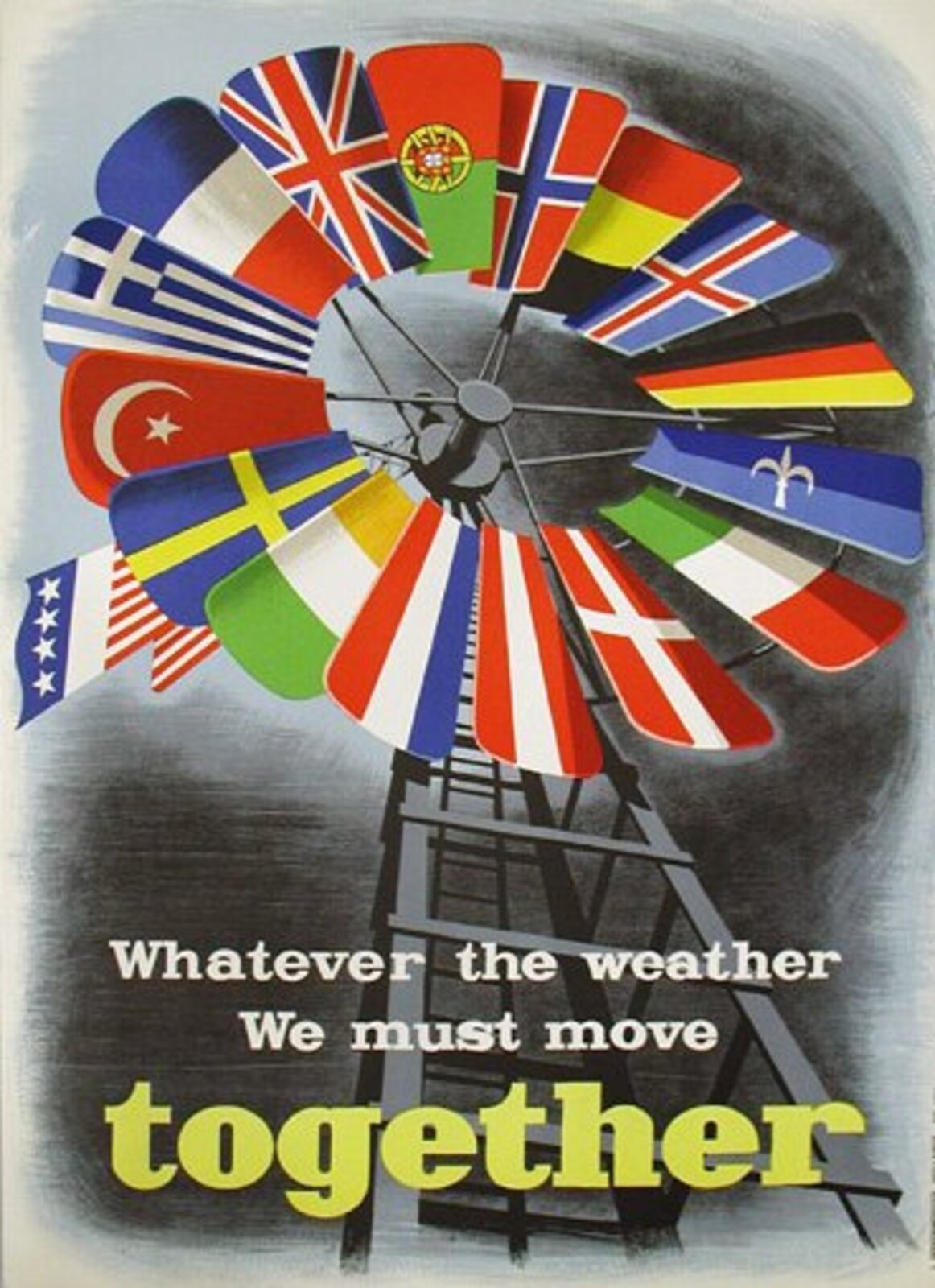
Explain how the poster promoting the Marshall Plan refers to Churchill's Fulton speech.
R6OYK1padYuKg
Plakat propagandowy. Kraje biorące udział w realizacji Plany Marshalla są zobrazowane jako skrzydła wiatraka - każde w barwach innej flagi. Poniżej napis: "Niezależnie od pogody, musimy poruszać się razem"
"Whatever the weather, we must move together"
Source: E. Spreckmeester, Economic Cooperation Administration, domena publiczna.
Keywords
UN, UNESCO, Marshall Plan, North Atlantic Treaty Organization (NATO), Cold War
Wielka Trójka – określenie przywódców mocarstw alianckich podczas II wojny światowej (Stanów Zjednoczonych – Roosevelt; Wielkiej Brytanii – Churchill; ZSRS - Stalin), którzy omawiali sprawy wojenne i kształt przyszłego świata na konferencjach międzynarodowych w Teheranie (1943), Jałcie i Poczdamie (obie 1945).
ONZ – Organizacja Narodów Zjednoczonych – organizacja międzynarodowa, następczyni Ligii Narodów, powstała w październiku 1945 r. Jej głównymi celami są zapewnienie pokoju i bezpieczeństwa międzynarodowego, rozwój współpracy między narodami oraz promocja przestrzegania praw człowieka.
Universal Declaration of Human Rights
Universal Declaration of Human Rights
R1djNcrAVYfVE
Nagranie słówka: Universal Declaration of Human Rights
Nagranie słówka: Universal Declaration of Human Rights
UNESCO – Organizacja Narodów Zjednoczonych do spraw Oświaty, Nauki i Kultury – powstała w 1946 r. organizacja, której celem jest wspieranie międzynarodowej współpracy w dziedzinie kultury, nauki i sztuki.
UNRRA – Administracja Narodów Zjednoczonych do spraw Pomocy i Odbudowy – utworzona w 1943 r i początkowo samodzielna organizacja, od 1945 r. podległa ONZ,której celem było udzielanie wsparcia krajom poszkodowanym w wyniku II wojny światowej.
Plan Marshalla – program odbudowy gospodarek Europy po II wojnie światowej zaproponowany przez Stany Zjednoczone w 1947 roku. Jego celem była pomoc materialna (surowce, żywność), finansowa i inwestycyjna zniszczonej wojną Europy. W wyniku nacisków rosyjskich, nie przystąpiły do niego kraje będące pod wpływem ZSRS.
Żelazna kurtyna – określenie zastosowane przez Winstona Churchilla, a następnie spopularyzowane, określające kształt powojennego świata i jego podział na strefę wpływów państw demokratycznych (na Zachodzie) i ZSRS (na Wschodzie).
Doktryna powstrzymywania – doktryna polityczna, która miała na celu powstrzymywanie wpływów ZSRSpoprzez zahamowanie i niedopuszczanie do ekspansji komunizmu na świecie. Stała się jedną z podstaw polityki prezydenta USA Harrego Trumana.
Sojusznicza Rada Kontroli – urząd powołany do życia po kapitulacji Niemiec w maju 1945 r., w skład którego wchodzili przedstawiciele zwycięskich mocarstw – Wielkiej Brytanii, USA, ZSRS oraz Francji. Był najwyższym organem prawodawczym i administracyjnym działającym na terenie okupowanych Niemiec. Jego powołanie przewidziano na konferencji w Jałcie w lutym 1945 r.
Blokada Berlina – jeden z pierwszych poważnych kryzysów powojennych z lat 1948‑1949, do którego doprowadziła blokada zachodnich sektorów podzielonego Berlina przez wojska radzieckie. Zaopatrzenie do alianckich części miasta dostarczano utworzonym mostem powietrznym.
North Atlantic Treaty Organization (NATO)
North Atlantic Treaty Organization (NATO)
RSp313pgiAq1q
Nagranie słówka: North Atlantic Treaty Organization (NATO)
Nagranie słówka: North Atlantic Treaty Organization (NATO)
Nagranie słówka: North Atlantic Treaty Organization (NATO)
Organizacja Traktatu Północnoatlantyckiego (NATO) – układ wojskowy zawarty w 1949 r. między państwami zachodnimi, którego celem była obrona przez militarnym atakiem ze strony Związku Radzieckiego.
Zimna wojna – potoczna nazwa napięcia jakie zapanowało na świecie po zakończeniu II wojny światowej (1947‑1991) oraz podziałowi świata na strefy wpływów i ich rywalizacji między politycznej, militarnej i ideologicznej. Trwał do momentu rozpadu ZSRR w 1991 r.