a) Provide the definition and unit of accelerationaccelerationacceleration. b) Provide the definition of uniformly accelerated rectilinear motionuniformly accelerated rectilinear motionuniformly accelerated rectilinear motion. c) What conditions must be met for the body to remain at rest? d) What condition must be fulfilled by forces acting on the body so that it moves in uniform rectilinear motionuniform rectilinear motionuniform rectilinear motion?
a) Acceleration is a vector physical quantity equal to the change of body speed per unit of time. The unit of acceleration in the SI system is . b) Uniformly accelerated motion is a motion that takes place in a straight line (the trajectory is a straight line) and in each unit of time the speed increases by the same value (the acceleration is constant). c) The body remains at rest if the sum of forces acting on this body is equal to zero and the speed of the body relative to the selected reference frame is 0 . d) The body moves in uniform rectilinear motion if any forces doesn't act or sum of all forces acting on this body is equal to zero. In this case we are talking about inertial reference frame that is, such in which the forces don't act on the body, they balance out.
The action of unbalanced forceunbalanced forceunbalanced force on the body causes a change in its speed, or giving it a specific accelerationaccelerationacceleration. This acceleration can be constant, and thus body motion - uniformly accelerated.
1. a cart with a weight of approx. 200 g, 2. tape measure, 3. stopwatch, 4. a table with a length of approx. 2 m, 5. paper tape, 6. marker for marking, 7. pulley, 8. weight of 5 g - 10 g, 9. durable thread.
1. Build the system according to the drawing below. 2. Attach the paper tape to the table. 3. Place the cart at the beginning of the table.
R1YDGrAhkZP2K1
Ilustracja przedstawia długi prostokąt, na nim linia opisana paper tape. Na lewym końcu narysowany jest wózek (prostokąt z dwoma kołami) z 4 kwadratami takiej samej wielkości na nim. Od niego linia pozioma do kółka narysowanego na prawym końcu prostokąta. Od kółka linia pionowa w dół, na jej końcu kwadrat wielkości takiej samej, jak kwadraty na wózku.
Source: GroMar, licencja: CC BY 3.0.
4. Turn on the stopwatch, release the weight. 5. At equal time intervals, mark the distance travelled. 6. Measure the length of the marked segments on the tape. 7. Record the results in the table.
The ratio of the change of speed of a moving body to the time when this change occurred within the limits of measurement errors is constant.
It follows that the action on the body of a constant, unbalanced external forceexternal forceexternal force causes the body to move with constant accelerationaccelerationacceleration, i.e. it moves in a uniformly accelerated motion.
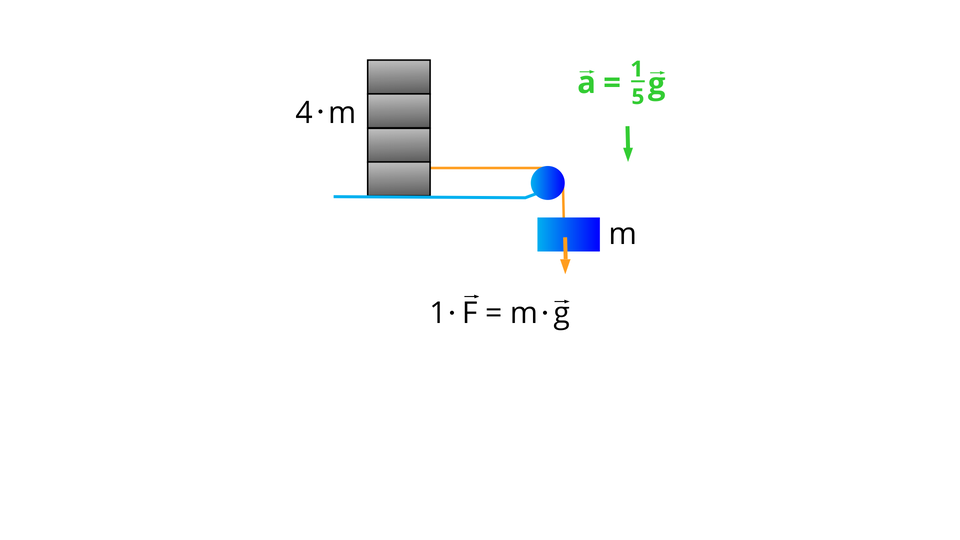
Provide conclusions that you could draw after seeing the drawings below.
R18QZOf0ReN8d1
Pokaz slajdów - Wartość siły nadającej ruch a uzyskiwane przyspieszenie. Instrukcja obsługi z poziomu klawiatury: 1. Uruchomienie aplikacji - ENTER, 2. Na każdym ze slajdów czytany jest automatycznie tekst alternatywny po polsku, 3. Przy pierwszym uruchomieniu na pierwszym slajdzie, czytanie tekstu po angielsku - TAB, 4. Przejście między slajdami: do następnego slajdu - TAB, do poprzedniego slajdu - TAB + SHIFT, 5. Przejście do czytania napisu po angielsku - strzałka w górę + strzałka w dół (czyta tekst po angielsku widoczny na slajdzie).
Pokaz slajdów - Wartość siły nadającej ruch a uzyskiwane przyspieszenie. Instrukcja obsługi z poziomu klawiatury: 1. Uruchomienie aplikacji - ENTER, 2. Na każdym ze slajdów czytany jest automatycznie tekst alternatywny po polsku, 3. Przy pierwszym uruchomieniu na pierwszym slajdzie, czytanie tekstu po angielsku - TAB, 4. Przejście między slajdami: do następnego slajdu - TAB, do poprzedniego slajdu - TAB + SHIFT, 5. Przejście do czytania napisu po angielsku - strzałka w górę + strzałka w dół (czyta tekst po angielsku widoczny na slajdzie).
1. The mass of the entire system has not changed. 2. Under the influence of the applied force, the body system moved in a uniformly accelerated motion. 3. If the force increases, the acceleration of the system increases. This means that the acceleration value is directly proportional to the value of the acting force.
If a constant unbalanced forceunbalanced forceunbalanced force acts on the body, the body moves in a uniformly variable motion with an acceleration directly proportional to the applied force and dependent on the body mass. If body weight will be greater the acceleration of the body will be lesser. This means that the mass is inversely proportional to the acting unbalanced force.
We write the second Newton's law as:
or
where:
a [] - accelerationaccelerationacceleration, F [N] - force, m [kg] - body mass.
If different forces act on a body of constant mass, the higher the magnitude of the resultant forceresultant forceresultant force, the larger the acceleration of the body.
If the same force acts successively on bodies with different masses, the smaller the mass of the body, the larger the acceleration of the body.
If the same forces is applied on bodies with different masses, smaller acceleration is obtained by a body with a larger mass.
The second Newton's law allows us to define a unit of force.
1 N (newton) - 1 newton is the magnitude of the force that causes accelerationaccelerationacceleration of 1 of a body with a mass of 1 kg.
Exercise 2
RcV5ZbJH8jAjm
Wersja alternatywna ćwiczenia: A body with a constant mass under the influence of a constant unbalanced force can move in: Możliwe odpowiedzi: 1. uniform rectilinear motion, 2. uniformly accelerated motion, 3. uniformly decelerated motion, 4. none of these motions
Wersja alternatywna ćwiczenia: A body with a constant mass under the influence of a constant unbalanced force can move in: Możliwe odpowiedzi: 1. uniform rectilinear motion, 2. uniformly accelerated motion, 3. uniformly decelerated motion, 4. none of these motions
A body with a constant mass under the influence of a constant unbalanced force can move in:
A resultant force giving the body an accelerationaccelerationacceleration of 4 acts on the body with a mass of 10 kg. Calculate the magnitude of the resultant force.
Analysis
Given:
Unknown:
Solution:
Answer:
The magnitude of the resultant forceresultant forceresultant force is 40 N.
The friction force acting on the car is 400 N, while the applied force is 1000 N. The mass of the car is 1,5 t. Calculate the acceleration of the car under the action of a constant force.
In the 17th century, an outstanding physicist and mathematician Sir Isaac Newton formulated three laws of dynamics. A special role in the development of physics was played by the second one: „If a constant unbalanced forceunbalanced forceunbalanced force acts on the body, the body moves in a uniformly variable motion with an acceleration directly proportional to the applied force and dependent (inversely proportional) on the body mass”.
The second Newton’s law shows that if different forces act on a body with a constant mass, the higher the magnitude of the resultant forceresultant forceresultant force, the larger the acceleration of the body. In turn, if the same force acts successively on bodies with different masses, the smaller the mass of the body, the larger the acceleration of the body.
The second Newton’s lawsecond Newton’s law second Newton’s law is written using the formulas:
where: a [] - acceleration, F [N] - force, m [kg] - body mass.
The second Newton’s law allows us to define a unit of force - 1 N (newton). 1 newton is the magnitude of the force that causes accelerationaccelerationacceleration of 1 of a body with a mass of 1 kg.
Exercises
R1WKnv3aQyVeR
Exercise 5
Wersja alternatywna ćwiczenia: The car on the horizontal road section moves in a uniformly accelerated motion. Which sentences are true? Możliwe odpowiedzi: 1. The resultant of all forces acting on the car is 0 N., 2. The resultant of all forces acting on a car is constant and different from 0 N., 3. Acceleration of the car changes over time., 4. Acceleration of the car is directly proportional to the resultant force., 5. The distance travelled is directly proportional to the applied force.
Wersja alternatywna ćwiczenia: The car on the horizontal road section moves in a uniformly accelerated motion. Which sentences are true? Możliwe odpowiedzi: 1. The resultant of all forces acting on the car is 0 N., 2. The resultant of all forces acting on a car is constant and different from 0 N., 3. Acceleration of the car changes over time., 4. Acceleration of the car is directly proportional to the resultant force., 5. The distance travelled is directly proportional to the applied force.
The car on the horizontal road section moves in a uniformly accelerated motion. Which sentences are true?
The resultant of all forces acting on the car is 0 N.
The resultant of all forces acting on a car is constant and different from 0 N.
Acceleration of the car changes over time.
Acceleration of the car is directly proportional to the resultant force.
The distance travelled is directly proportional to the applied force.
zadanie
Source: GroMar, licencja: CC BY 3.0.
Exercise 6
The force of 8 N began to act in the direction of its movement, on a body with a mass of 2 kg moving at a speed of 4 . How much time is needed to increase the body speed three times?
Analysis
Given:
Unknown:
Answer:
The body speed will increase three times after 2 seconds.
Exercise 7
Write in English, in which case the bus passengers will feel less shakes while driving, when it is full or empty. Justify the answer.
Passengers will experience smaller shakes in a crowded bus. This is due to the fact that forces acting on the bus body at larger mass cause less acceleration in the vertical direction. The heavier bus body has larger inertia in the vertical direction, making it less susceptible to shakes, as it is more difficult for springs and shock absorbers to transfer the vibrations of the chassis caused by uneven road on the body with passengers.
RDF57V6atJx2r
Exercise 8
Wersja alternatywna ćwiczenia: Indicate which pairs of expressions or words are translated correctly. Możliwe odpowiedzi: 1. przyspieszenie - acceleration, 2. układ odniesienia - reference frame, 3. wzór - formula, 4. siła niezrównoważona - unbalanced force, 5. siła wypadkowa - extenal force, 6. siła zewnętrzna - resultant force
Wersja alternatywna ćwiczenia: Indicate which pairs of expressions or words are translated correctly. Możliwe odpowiedzi: 1. przyspieszenie - acceleration, 2. układ odniesienia - reference frame, 3. wzór - formula, 4. siła niezrównoważona - unbalanced force, 5. siła wypadkowa - extenal force, 6. siła zewnętrzna - resultant force
Indicate which pairs of expressions or words are translated correctly.
przyspieszenie - acceleration
układ odniesienia - reference frame
wzór - formula
siła niezrównoważona - unbalanced force
siła wypadkowa - extenal force
siła zewnętrzna - resultant force
zadanie
Source: GroMar, licencja: CC BY 3.0.
R1TBFj0VIKUbL1
Interaktywna gra, polegająca na łączeniu wyrazów w pary w ciągu jednej minuty. Czas zaczyna upływać wraz z rozpoczęciem gry. Jeden ruch to odkrywanie najpierw jednej potem drugiej karty z wyrazem. Każdy wyraz jest odczytywany. Kolejny ruch to odkrywanie trzeciej i czwartej karty. W ten sposób odsłuchasz wszystkie wyrazy. Nawigacja z poziomu klawiatury za pomocą strzałek, odsłuchiwanie wyrazów enterem lub spacją. Znajdź wszystkie pary wyrazów.
Interaktywna gra, polegająca na łączeniu wyrazów w pary w ciągu jednej minuty. Czas zaczyna upływać wraz z rozpoczęciem gry. Jeden ruch to odkrywanie najpierw jednej potem drugiej karty z wyrazem. Każdy wyraz jest odczytywany. Kolejny ruch to odkrywanie trzeciej i czwartej karty. W ten sposób odsłuchasz wszystkie wyrazy. Nawigacja z poziomu klawiatury za pomocą strzałek, odsłuchiwanie wyrazów enterem lub spacją. Znajdź wszystkie pary wyrazów.
Match Polish terms with their English equivalents.
siła wypadkowa
second Newton’s law
resultant force
druga zasada dynamiki Newtona
unbalanced force
siła zewnętrzna
siła niezrównoważona
acceleration
extenal force
przyspieszenie
Source: Zespół autorski Politechniki Łódzkiej, licencja: CC BY 3.0.