Let's do what we do! Attitudes of Poles under partitions
to describe the consequences of the Poles' struggle against the invaders;
to characterize what russification and germanization were and how they manifested;
to indicate which partition had the Poles most freedoms in;
to describe the ways and actions of Poles against the policy of denationalization;
to list the outstanding personages of the nineteenth century Poland.
Under the partitions Poles caused numerous armed uprisings in which they died. But most of them tried to survive. They learnt and worked. Based on organic workorganic work, so the economic development of the country and the citizens. A large number of educational, scientific and cultural organizations and institutions were created in spite of situation in Poland. The self‑government spirit developed the most in Greater Poland (in the Prussian Partition). In the Prussian partition, Poles fought to progress germanization. The symbol of resistance were the children from the school in Wrzesnia and peasant Michal Drzymala.
Read the text carefully and answer the questions: How do you call the German authorities' policy against Polish children? How was this policy expressed?
At the turn of the 19th and 20th centuries in folk schools [which meant: primary schools] in Greater Poland region the lessons were held in German. Only religious and church singing were taught in Polish. However, in March 1901 (...) since the new school year, religious education should also be taught in German. German catechisms were ordered to buy for poorer learners.
When the new school year began, the children of the oldest class decided not to accept German catechisms and refused to answer in German – they used passive resistancepassive resistance. At first, the teachers gently urged and persuaded resistant children. However later, the threats appeared, two‑hour arrests and even the punishment of flogging (...). The application of mass detention did not change the attitude of the learners, and their parents stood in their defence.
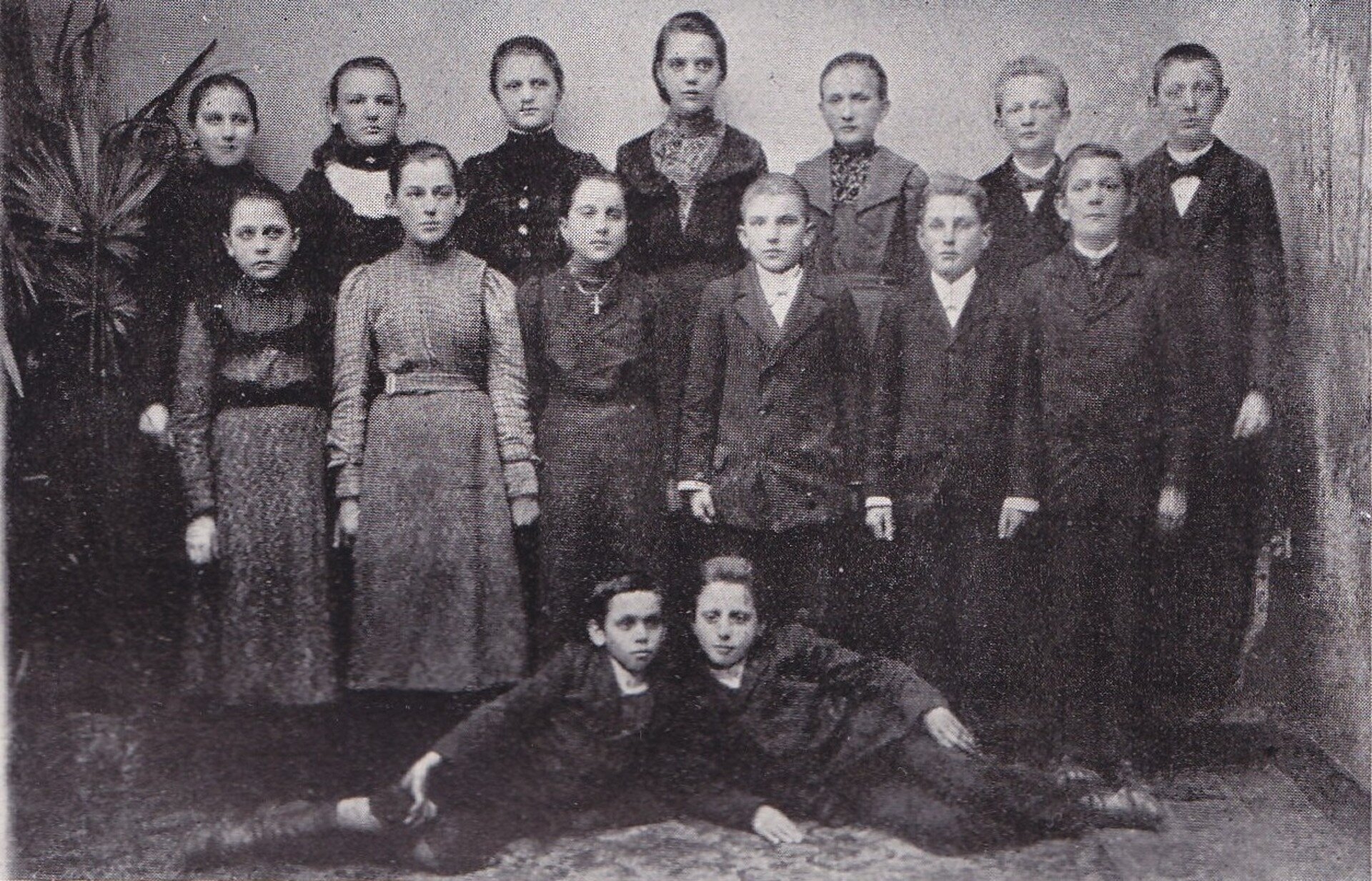
The culmination of the events in Wrzesnia happened on May 20, when the inspector Winter came to school. He ordered a two‑hour detention against 26 pupils of the first class who were to learn German words of the religiuos song „Who is in custody”. At 12 o'clock, those who carried out the task were released to the houses. „Fourteen children – later reported by inspector Winter – who said they would not learn German in religion, I decided to punish by example. I ordered flogging them all by the teacher Schölzchen. The children received from 4 to 8 beats to buttocks and hands”. Beaten children left the school crying. NSome of them had their hands so swollen that they carried books under their armpits. Sixty years later, Leokadia Wojciechowska‑Stankowska recalled this event: „after examining my hands, the doctor wrote that I had a physical injury. I had such swollen and sore hands that I could not write or draw for two weeks.”
Which words can be linked (associated) with the concept of autonomy?
- cars
- addiction
- independence
- repressions
- persecutions
- independence
- union
- separateness
- self-governance
Based on the source text, answer the questions.
About the policy of tsarDue to the fact that Poles were not accepted as teachers at all, the number of Russian teachers rapidly began to increase and the russification and oppression of schoolchildren came to monstrous proportions (…).
It was strictly forbidden to read and have Polish books and the control was so strict that during visits in learners' dormitory rooms, all books of each student were reviewed, beds and trunks with clothes were verified to find any hidden Polish books. In case of finding a Polish book, the learner was registered for a punishment journal and he had to stay in a closed room for a few hours after school or during holidays, and if the case repeated several times in the same dormitory, the dormitory was closed. When a political content book was found in learner's room – including foreign editions of our bards – or anti‑state socialist content, the middle school student was unconditionally expelled and the dormitory was closed.But none of the repressions helped. The learners had Polish books, read them, created libraries and also self‑study clubs in the Polish language. The libraries were located in certain places, usually the rooms of colleagues living with parents of a freelance profession, where the meetings of the clubs took place.
Source: Jan Wołyński (polish language teacher), About the policy of tsar, [w:] Historia 1789-1990. Wybór tekstów źródłowych do szkół średnich, oprac. J. Eisler, M. Sobańska-Bondaruk, s. 390–391.
Select true sentences.
- The possession of Polish books was forbidden.
- The number of Russian teachers has increased because Poles demanded higher wages for work.
- Having Polish books at the dormitory rooms was punished with coming to school on Saturdays.
- Students were expelled from schools for having Mickiewicz or Slowacki's books.
- Anti-socialist books were favorable to the tsarist authorities.
- Despite the prohibitions and repressions, students had Polish books and even founded libraries.
- The students participated in Polish language self-study clubs that took place at school.
- The text above is a manifestation of russification.
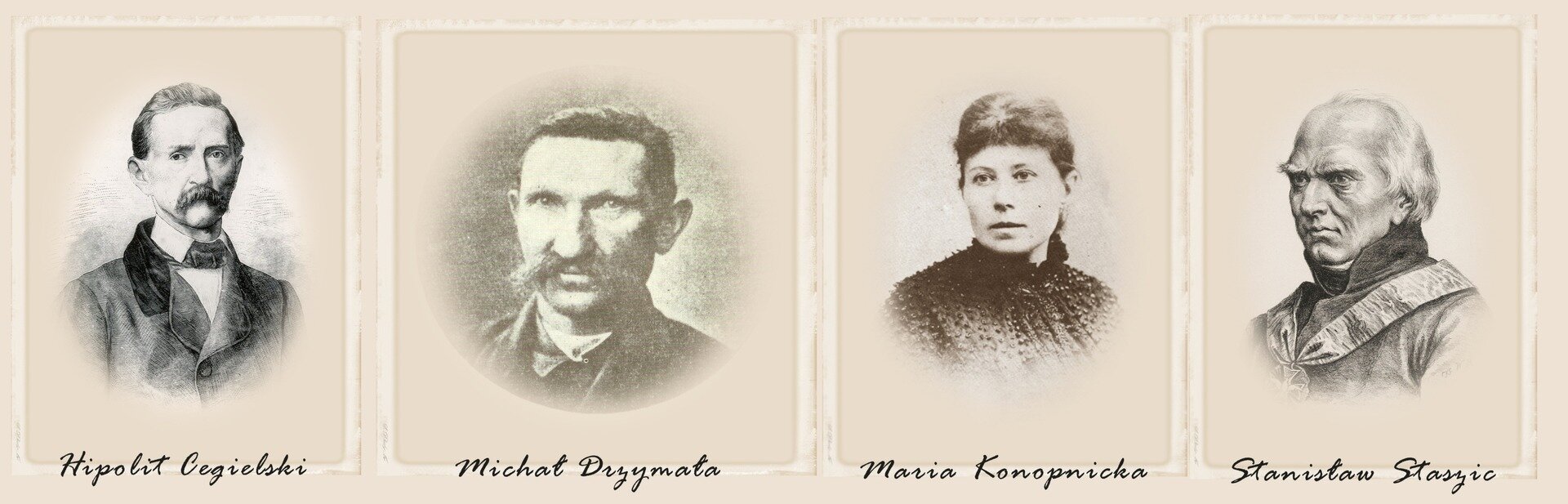
Drag the items to the right places.
Hipolit Cegielski(1813-1868), Michal Drzymala(1857-1937), Maria Konopnicka(11842-1910), Stanislaw Staszic(1755-1826)
| Name and surname | Partition | Profession | What they became famous for | What they wrote about? |
|---|---|---|---|---|
| Hipolit Cegielski(1813-1868) | ||||
| Michal Drzymala(1857-1937) | ||||
| Maria Konopnicka(11842-1910) | ||||
| Stanislaw Staszic(1755-1826) |
Match each expression with the corresponding definition
culture struggle, an attempt to limit the influence of the Catholic Church in the German Empire during the time of the chancellor Otto von Bismarck., a policy of severer russification introduced after the fall of the January Uprising., conspiratorial courses and self-education meetings, where the young people got familiarized with the literature and history of Poland., a form of opposition to the authorities, but without violence, often associated with civil disobedience., a rule that allowed public speaking in Polish only in places where Poles made up the vast majority., mass expelling and deportations of Poles, Russian and Austro-Hungarian citizens conducted under the banner of protecting the German labor market., the colloquial name of the German organization - the German Union of Eastern Marches, whose aim was the germanization of Polish territories in the Prussian Partition.
| Secret teaching | |
| Kulturkampf | |
| Apukhtin's night | |
| Prussian evicts | |
| Hakata | |
| Passive resistance | |
| Muzzle Act |
Keywords
partitions, repressions, denationalization, organic work, germanization, russification
Glossary
Ziemie zabrane – obszar utracony przez Rzeczpospolitą podczas rozbiorów na rzecz Rosji, nie wliczały się w nie ziemie Królestwa Polskiego.
Bierny opór – forma sprzeciwu wobec władzy bez użycia przemocy, często związany z obywatelskim nieposłuszeństwem.
Germanizacja – element polityki niemieckiego zaborcy, którego celem było wynarodowienie podbitych narodów. Proces ten polegał na przyswajaniu (często pod przymusem) języka i kultury niemieckiej.
Rusyfikacja – element polityki rosyjskiego zaborcy, którego celem było wynarodowienie podbitych narodów. Proces ten polegał na przyswajaniu (często pod przymusem) języka i kultury rosyjskiej.
Autonomia – możliwość samodzielnego decydowania w pewnych sprawach (najczęściej wewnętrznych) w ramach przynależności do innego, zwierzchniego państwa.
Praca organiczna – podejmowane przez Polaków w XIX w. działania, których celem był rozwój gospodarczy kraju i wzmocnienie ekonomiczne, oświatowe i kulturowe Polaków.
Trójlojalizm – pogląd i postawa części polskiego społeczeństwa po powstaniu styczniowym, która polegała na wyrzeczeniu się dążeń niepodległościowych w zamian za ekonomiczne i kulturalne ustępstwa ze strony zaborców.