RHXZix8Cf5vMg

The Polish or September campaign

Soldier of the Polish Army and civilians in Warsaw, September 1939
Source: Julien Bryan, fotografia, Wikimedia Commons, licencja: CC 0.

Link to lesson

You will learn
  • to characterise the most important events of the September campaigncampaigncampaign,

  • to show on a map the locations of the most important battles,

  • to list Poland's enemies and alliesalliesallies in September 1939, as well as their leaders,

  • to identify the heroes and commanders of the Polish army during the September campaign,

  • to understand and explain some concepts related to the Second World War (campaign, enigma, balance of power).

  • to explain what the Ribbentrop‑Molotow PactRibbentrop‑Molotow PactRibbentrop‑Molotow Pact was.

RfD7nUr23VNhO
Nagranie dźwiękowe abstraktu.

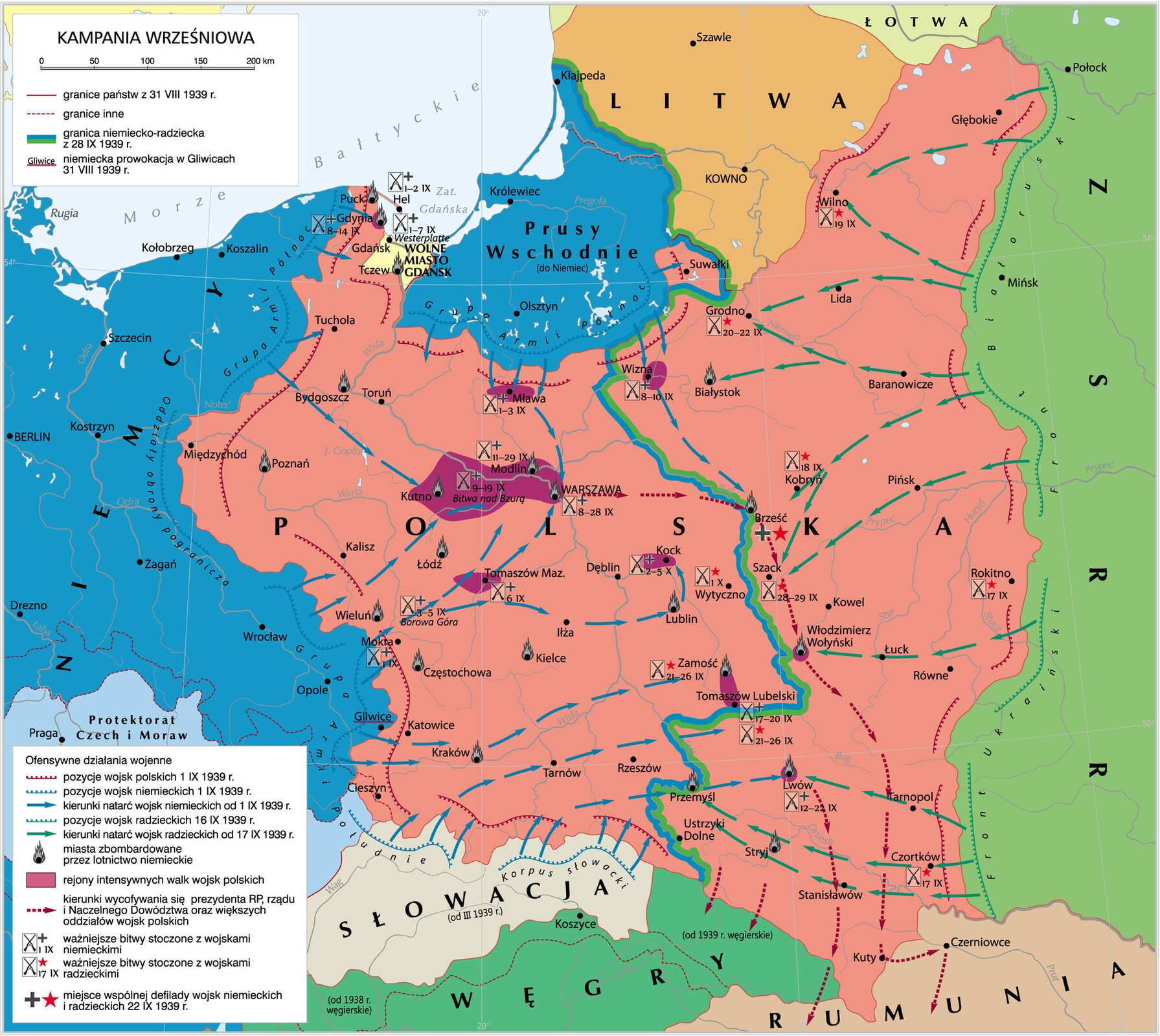
One of Hitler's main catch cries was revenge for the losses of the First World War and gathering all German people within the borders of a single state (Greater Germany). After he came to power, he quickly built up the German army (Wehrmacht) and began acts of aggression, occupying Austria and Czechoslovakia (where the Western powers, Britain and France, remained passive). In 1939, Germany made territorial demands on Poland. The Polish government refused these. At the end of August the Third ReichThird ReichThird Reich and the USSR concluded a secret agreement. The result was that on 1st September,1939, Germany invaded Poland without a declaration of war. A defensive warwarwar began, in which the Germans used their rapid war tactics (in German Blitzkrieg). Poland's allies, Britain and France, did not provide Poland with armed assistance. They limited themselves to declaring war on Germany. The Polish army fought bravely, but given the numerical and material advantages of the enemy, as well as some errors by commanders, they were quickly forced onto the defensive. The largest battle of the September campaign was the Battle of the Bzura, which ended with the Polish troops being defeated. On the 17th of September, 1939, the Soviet Red Army (acting together with Germany) attacked Poland from the east. The government fled to Romania. Poland was unable to fight on two fronts and capitulated. After three weeks of fighting, the German army captured Warsaw. The final battles took place in early October.

Task 1

Read the fragment of text and consider the emotions that inhabitants of a bombed city could feel.

Zeznania Gitli Rabinowicz

W Siedlcach i okolicy stacjonowało dużo wojska polskiego, wykopano tam rowy i okopy, szykowano się do oporu. Niemcy bombardowali Siedlce bardzo gwałtownie, a kiedy front zbliżał się, ostrzeliwano miasto z ciężkich dział. Porządek bombardowania był następujący: o 8 rano przylatywały samoloty wywiadowcze i strzelała do nich artyleria zenitowa, około 9 przylatywały bombowce i do 11 trwało bombardowanie. To samo powtarzało się po obiedzie. Miasto stało w ogniu. Ludzie pouciekali z domów, ponieważ okazało się, że piwnice stawały się grobami dla nieszczęsnych. Ludzie leżeli plackiem na ulicach, na polu, szukali schronienia pod drzewami, jedni uciekali na wieś, a kiedy wracali w czasie przerwy, nie znajdowali często śladu po swoim domu.

zeznania Source: Zeznania Gitli Rabinowicz, [w:] Feliks Tych, Maciej Siekierski, Widziałem Anioła Śmierci. Losy deportowanych Żydów polskich w ZSRR w latach II wojny światowej, Warszawa 2006.
Exercise 1
Gdzie i w jakich okolicznościach rozpoczęła się II wojna światowa?
R1BiqGDWcW4qJ
The September campaign
RXrQv0pYHLwm6
Based on the map, match the events of the September campaign to their corresponding dates. Monday, October 2, 1939 Możliwe odpowiedzi: 1. surrender of arms at Battle of Kock, 2. capitulation of Modlin, 3. capitualtion of Wizna, 4. war begins and battle of the Mokra, 5. capitulation of Westerplatte, 6. capitulation of Hel, 7. start of the Battle of the Bzura., 8. USSR attacks Poland Thursday, 5 October 1939 Możliwe odpowiedzi: 1. surrender of arms at Battle of Kock, 2. capitulation of Modlin, 3. capitualtion of Wizna, 4. war begins and battle of the Mokra, 5. capitulation of Westerplatte, 6. capitulation of Hel, 7. start of the Battle of the Bzura., 8. USSR attacks Poland Sunday, 10 September 1939 Możliwe odpowiedzi: 1. surrender of arms at Battle of Kock, 2. capitulation of Modlin, 3. capitualtion of Wizna, 4. war begins and battle of the Mokra, 5. capitulation of Westerplatte, 6. capitulation of Hel, 7. start of the Battle of the Bzura., 8. USSR attacks Poland Saturday, 9 September 1939 Możliwe odpowiedzi: 1. surrender of arms at Battle of Kock, 2. capitulation of Modlin, 3. capitualtion of Wizna, 4. war begins and battle of the Mokra, 5. capitulation of Westerplatte, 6. capitulation of Hel, 7. start of the Battle of the Bzura., 8. USSR attacks Poland Friday, 1 September 1939 Możliwe odpowiedzi: 1. surrender of arms at Battle of Kock, 2. capitulation of Modlin, 3. capitualtion of Wizna, 4. war begins and battle of the Mokra, 5. capitulation of Westerplatte, 6. capitulation of Hel, 7. start of the Battle of the Bzura., 8. USSR attacks Poland Friday, 29 September 1939 Możliwe odpowiedzi: 1. surrender of arms at Battle of Kock, 2. capitulation of Modlin, 3. capitualtion of Wizna, 4. war begins and battle of the Mokra, 5. capitulation of Westerplatte, 6. capitulation of Hel, 7. start of the Battle of the Bzura., 8. USSR attacks Poland Sunday, 17 September 1939 Możliwe odpowiedzi: 1. surrender of arms at Battle of Kock, 2. capitulation of Modlin, 3. capitualtion of Wizna, 4. war begins and battle of the Mokra, 5. capitulation of Westerplatte, 6. capitulation of Hel, 7. start of the Battle of the Bzura., 8. USSR attacks Poland Thursday, 7 September 1939 Możliwe odpowiedzi: 1. surrender of arms at Battle of Kock, 2. capitulation of Modlin, 3. capitualtion of Wizna, 4. war begins and battle of the Mokra, 5. capitulation of Westerplatte, 6. capitulation of Hel, 7. start of the Battle of the Bzura., 8. USSR attacks Poland
RZ0EAaVoMwHIi
Exercise 2
Put the events in chronological order Elementy do uszeregowania: 1. The fall of Westerplatte., 2. Capitulation of Wizna., 3. Surrender of arms at the Battle of Kock., 4. Capitulation of Hel., 5. USSR attacks Poland., 6. Capitulation of Modlin., 7. Battle of the Bzura begins., 8. Beginning of the war and the Battle of Mokra
Task 2
Jakie znacznie dla Polski miał pakt Ribbentrop‑Molotov ?
RaXyiO0v9RpTP1
Fotografia czarno-biała przedstawiająca podpisanie paktu Ribbentrop-Molotow. Przy fotografii widnieją podpisy. The public part. This was concluded on August 23rd, 1939 in Moscow and consists of two parts. In the public part, both countries have committed to refrain from combined aggressive actions, to remain neutral if the other party "became the object of hostilities from a third party". The secret protocol. A secret, additional protocol which discussed the question of "delimitation of bilateral interest zones in Eastern Europe". The zone of the Third Reich included Lithuania (and Vilnius) and the part of Poland west of the rivers Narew, Vistula, San and the majority of Romania. The USSR's zone included the Baltic States (Estonia and Latvia), the rest of Poland and Bessarabia. Joachim von Ribbentrop. Foreign Minister in the Third Reich from 1938-1945. Charged as a war criminal and sentenced to death. Vyacheslav Mikhaylovich Molotow. Soviet Foreign Minister from 1939-1949. He died in a hospital in Moscow in 1986. Jozef Stalin. Lifelong dictator of the USSR. He tried to re-establish Soviet/German relations even after Hitler and the Nazi Party came to power.
The signing of the Ribbentrop-Molotow Pact
Source: Peter Hanula, GroMar Sp. z o.o., licencja: CC BY-SA 3.0.
R1HMbqtUWNaCi
Exercise 3
Ilu polskich żołnierzy wzięło udział w kampanii wrześniowej? Możliwe odpowiedzi: 1. milion osiemset pięćdziesiąt tysięcy; 2. dziewięćset pięćdziesiąt tysięcy; 3. milion pięćset tysięcy.
R757jgOKYHQPK
Exercise 4
Ile czołgów wzięło udział po stronie polskiej w kampanii wrześniowej? Możliwe odpowiedzi: 1. dwa tysiące osiemset; 2. sześćset; 3. sześć tysięcy.
RzfA7HQyQOFMu
Exercise 5
Jaka liczba artylerii wzięła udział w kampanii wrześniowej po stronie polskiej? Możliwe odpowiedzi: jedenaście tysięcy, cztery i pół tysiąca, trzynaście i pół tysiąca.
R1Rqz7UOm92RX
Exercise 6
Jaka liczba samolotów wzięła udział w kampanii wrześniowej po stronie polskiej? Możliwe odpowiedzi: 1. dwa tysiące; 3. czterysta; 3. tysiąc osiemset.

Keywords

occupation, World War II, September campaign

Glossary

war
war
R1HQ5iPJDzgtd
Nagranie dźwiękowe słówka.

wojna – konflikt zbrojny, walka między państwami, narodami lub innymi grupami, która prowadzi do realizacji ich celów.

campaign
campaign
RxTpOeo7sZvnt
Nagranie dźwiękowe słówka.

kampania – zaplanowane działania zbrojne (etap wojny), które odbywają się na jakimś terytorium o określonym czasie. agresja – aggression – napaść jednego państwa na drugie.

occupation
occupation
RRpgKGF65BPXO
Nagranie dźwiękowe słówka.

okupacja – zajęcie obcego terytorium i sprawowanie nad nim kontroli i władzy. wojna obronna – defensive war – działania zbrojne, których celem jest obrona przed najeźdźcą.

invasion
invasion
R1BJX30hQXTAe
Nagranie dźwiękowe słówka.

inwazja – gwałtowny i niespodziewany atak na osobę lub państwo w celu obrabowania, pobicia (osoba) lub zagarnięcia jego terenów (państwo).

Allies
Allies
RkaYqODWCTtY3
Nagranie dźwiękowe słówka.

alianci – państwa walczące przeciwko Niemcom i ich sojusznikom podczas II wojny światowej.

Ribbentrop‑Molotow Pact
R1X0egSh7dcvM
Nagranie dźwiękowe słówka.

pakt Ribbentrop‑Mołotow – porozumienie zawarte między ZSRS i III Rzeszą 23 sierpnia 1939 r., jego tajny protokół przewidywał m.in. podział ziem polskich.

Third Reich
Third Reich
RmBJJulrmJHCH
Nagranie dźwiękowe słówka.

III Rzesza – nazwa państwa niemieckiego pod rządami Adolfa Hitlera w latach 1933‑1945.

Soviet Union
Soviet Union
R1Sj7YJQSYbMv
Nagranie dźwiękowe słówka.

Związek Sowiecki – Związek Socjalistycznych Republik Sowieckich, komunistyczne państwo istniejące w latach 1922‑1991 na terenie Europy i Azji.

Nazi Germany
Nazi Germany
R1M9xCYbTAZ7N
Nagranie dźwiękowe słówka.

nazistowskie Niemcy – potoczna nazwa III Rzeszy pochodząca z ideologii nazistowskiej.