Water resources and their protection
you need water to live;
innumerable organisms live in water;
water becomes contaminated, but has self‑cleaning properties.
to explain where drinking water comes from in nature;
to explain why so much water on Earth is not safe to drink;
to indicate sources of water contamination;
to list ways to save water.
Availability of water on Earth
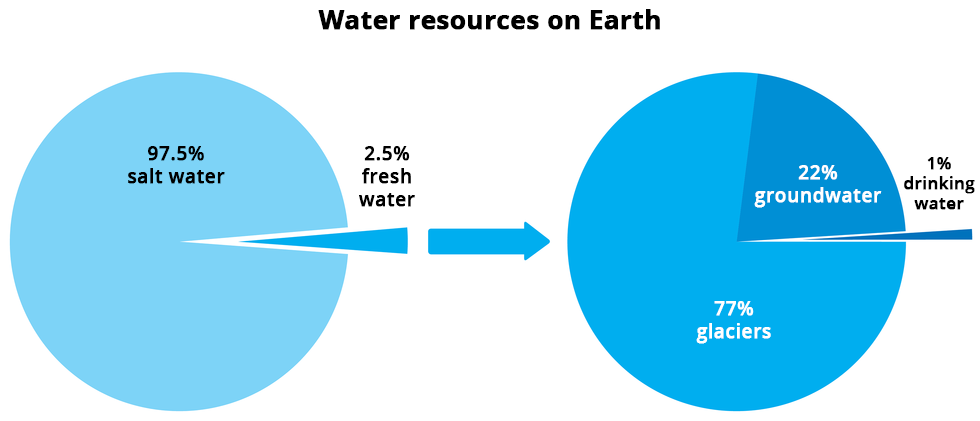
Earth observed from space is blue, because 71% of its surface is covered by water reflecting the blue part of the spectrum of sunlight. A huge amount of water on Earth is salty and therefore undrinkable. Freshwater resources on Earth are relatively small – they constitute only 3% of water resources in total.
Poland is one of European countries with the smallest drinking water resources per capita. Only Malta and Belgium have smaller water resources per capita. In Poland, one person can use about 1580 mIndeks górny 33 of water annually.
Circulation of water in nature
Water in nature constantly circulates between water reservoirs, the atmosphere and land surfaces. Oceans are key here. Their surface evaporates constantly and floating water vapor is carried by wind. When the air cools down, the water vapor condenses and forms clouds. When small droplets of water contained in the clouds coalesce into larger drops, they fall down as atmospheric precipitation on, among others, lands. Some part of rainwater infiltrates into the soil and the other part flows into streams and rivers. The rivers carry it to seas and oceans where it evaporates again.
Water evaporates also on land. Some part of the rainwater accumulates in freshwater reservoirs, the other part moistens the soil and is taken up by plants. They also lose water in the transpiration process, increasing air humidity. Some part of the rainwater infiltrates into the ground and accumulates in underground watercourses several to several dozen meters below the surface. The water penetrates rock layers and cleans itself from biological contaminants self‑cleaning, i.e. it does not contain, for example, any bacteria. Such water is located at least 3‑4 m below the surface and supplies, for example, drinking water intakes.
Water contamination
The availability of water is affected not only by its consumption in households and production plants. Rainfall in Poland would be sufficient for our needs if it wasn't for environmental pollution affecting directly and indirectly water quality.
Water saving
Saving water involves, among others, preventing its unnecessary outflow from a water system, rational use and limiting the use of artificial fertilisers, plant protection products and detergents.
Uses of water | Average use of water [l] |
Shower | 30 (5 min) |
Bath in a tub | 60 |
Washing in a washing machine | 95 |
Brushing teeth with your tap on | 6 |
Brushing teeth with your tap off | 1 |
Brushing teeth using water in a cup | 0.2 |
Dripping tap (1 drop/s) | 12 thousand annually |
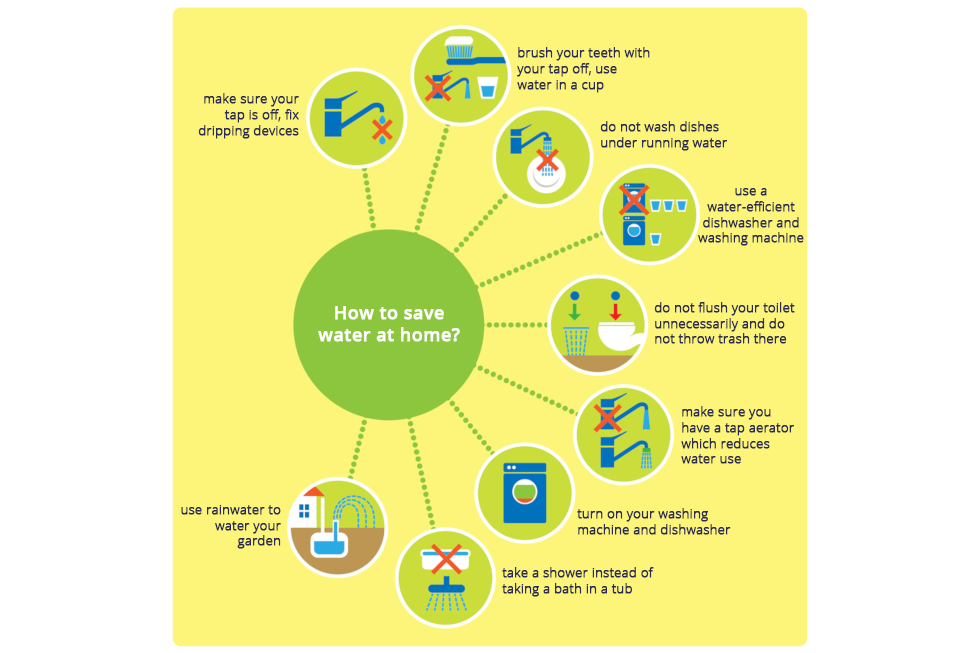
Rainwater is an unused source of water. It can be used, for example, for watering the grass or flushing toilets. This solution is used, among others, at the Municipal Stadium in Wrocław.
Water footprint
It takes much water to produce food and other goods, so you waste water when you buy them unnecessarily.
To estimate the use of water, including not only water needed for drinking, washing and laundering, but also for the production of food, objects and devices, the concept of water footprintwater footprint was introduced. It is a measure of water needed for the production of a particular good. For example, it was found that the production of 1 kg of chocolate takes over 17 thousand liters of water.
States, which are large food importers, use water resources of people inhabitating regions of its origin.
Why are there drinking water shortages, when almost ¾ of on Earth surface is covered by seas and oceans? Select the correct answer.
- Because transporting sea water inland is unprofitable.
- Because sea water is salty and its consumption is harmful to human body.
- Because sea water is too contaminated with bacteria to drink it.
- Because our priority is to use sea water for industrial purposes.
Put the steps leading to obtaining drinking water from the intake in the right order.
- soaking of some water into the soil
- evaporation of water from Earth surface and water reservoirs
- cooling and condensation of water vapor
- obtaining drinking water from the intake
- fusion of small droplets into larger drops
- self-cleaning of water during its infiltration through rocks
- atmospheric precipitation
- accumulation of water in underground watercourses
Select all factors contributing to water contamination in the list below.
- use of chemical plant protection products
- recreational use of rivers
- emission of sulfur, carbon and nitrogen compounds into the atmosphere
- fly-tipping
Match the average use of water with the appropriate activity.
60 l, 6 l, 1 l, 0.2 l, 30 l
| brushing teeth and using water in a cup | |
| brushing teeth with your tap off | |
| brushing teeth with your tap on | |
| bath in a tub | |
| few-minute shower |
Summary
Only 3% of water on Earth is fresh water and that is why its resources should be protected.
How was this lesson? Did you like it? Finish selected sentences.
Keywords
water resources, water contamination, water saving
Glossary
ślad wodny – sposób pomiaru ilości wody zużywanej przez daną osobę dla zaspokojenia potrzeb; szacunki te obejmują wodę potrzebną do picia, zabiegów higienicznych, produkcji kupowanych przedmiotów i żywności, a także zużywaną podczas budowy i eksploatacji maszyn czy budowy gmachów, z których dana osoba korzysta