Lesson plan (Polish)
Temat: Jestem uczniem
Autorka: Anna Rabiega
Adresat:
uczeń liceum ogólnokształcącego i technikum
Podstawa programowa:
stara podstawa programowa:
poziom podstawowy
4. Edukacja i praca w Polsce i Unii Europejskiej.
Uczeń:
1) wymienia prawa i obowiązki ucznia; wyszukuje gwarantujące je przepisy prawa oświatowego (np. w ustawie, statucie szkoły) oraz przepisy zawarte w innych aktach prawnych (np. w Konstytucji Rzeczypospolitej Polskiej).
poziom rozszerzony
10. Edukacja w XXI w.
Uczeń:
1) przedstawia rolę szkoły i edukacji nieformalnej we współczesnym społeczeństwie informacyjnym.
nowa podstawa programowa:
poziom podstawowy
VI. Wybrane problemy polityki publicznej w Rzeczypospolitej Polskiej.
Uczeń:
4) przedstawia możliwości kontynuacji edukacji (studia I stopnia i jednolite magisterskie, szkoły kształcące w zawodzie); wyjaśnia, w jaki sposób podnosić swoje kwalifikacje zawodowe.
Ogólny cel kształcenia:
Uczeń rozpoznaje różne aspekty, także prawne, problemów życia codziennego i podaje możliwe sposoby ich rozwiązania.
Cele operacyjne:
Uczeń:
analizuje zasady funkcjonowania szkoły.
przedstawia organy szkoły.
wyjaśnia, czym jest samorząd uczniowski i analizuje jego rolę w szkole.
Kształtowane kompetencje kluczowe:
porozumiewanie się w języku obcym,
kompetencje informatyczne,
umiejętność uczenia się,
kompetencje społeczne i obywatelskie,
inicjatywność i przedsiębiorczość,
świadomość i ekspresja kulturalna.
Metody nauczania:
dyskusja,
burza mózgów,
metaplan,
rozmowa nauczająca z wykorzystaniem schematu interaktywnego.
Formy pracy:
grupowa,
zbiorowa.
Środki dydaktyczne:
komputery z głośnikami i dostępem do internetu, słuchawki,
zasoby multimedialne zawarte w e‑podręczniku,
tablica interaktywna/tablica, pisak/kreda.
Przebieg zajęć:
Faza wstępna:
1. Nauczyciel przedstawia cel zajęć: Przeanalizujecie funkcjonowanie szkoły i samorządu uczniowskiego.
2. Nauczyciel informuje uczniów, że będą pracować metodą rybiego szkieletu, a ich zadaniem będzie ustalenie funkcji szkoły. W razie potrzeby wyjaśnia uczniom metodę. Rysuje na tablicy schemat rybiego szkieletu, a w jego głowie umieszcza problem do rozwiązania „Jakie funkcje pełni szkoła?”. Uczniowie podają swoje propozycje – przy głównych ościach ryby nauczyciel zapisuje nazwy i wyjaśnienia funkcji podawanych przez uczniów, przy mniejszych ościach – konkretne przykłady zadań i działań podejmowanych przez szkołę w ramach pełnienia danej funkcji. Po zakończeniu ćwiczenia nauczyciel prosi uczniów, aby porównali swoje pomysły ze schematem „The school functions” w abstrakcie i prosi ich o komentarz: Czy uwzględnili wszystkie funkcje? Czy jakichś zabrakło?
3. Nauczyciel inicjuje krótką dyskusję nt. tego, które funkcje szkoły wydają się uczniom najważniejsze i dlaczego. Uczniowie przedstawiają swoje propozycje i argumenty. Na zakończenie dyskusji nauczyciel prosi chętnego/wybranego ucznia o jej podsumowanie.
Faza realizacyjna:
1. Nauczyciel dzieli klasę na pięcioosobowe grupy. Informuje uczniów, że będą pracować metodą metaplanu i w razie potrzeby wyjaśnia ją. Zadanie uczniów polega na wspólnym ustaleniu problemu, jaki dostrzegają w szkole, a który chcieliby rozwiązać. Uczniowie najpierw przeprowadzają w grupach krótką burzę mózgów, a następnie wybierają problem, jaki przeanalizują metodą metaplanu. Nauczyciel rozdaje grupom arkusze papieru flipchart i flamastry. Uczniowie powinni rezultaty swojej pracy przelać na papier w formie plakatu:
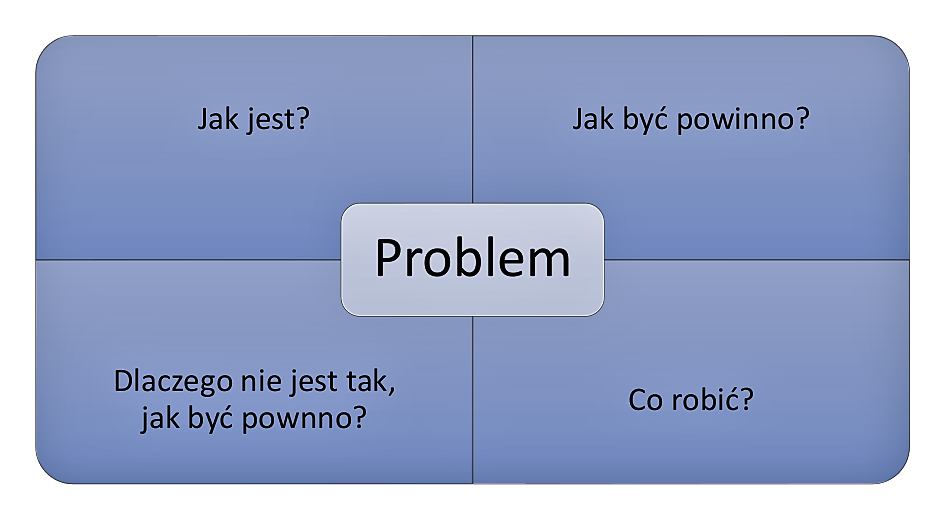
Przed przystąpieniem do realizacji zadania uczniowie powinni zapoznać się ze schematem interaktywnym „The rights of a student council”, przedyskutować ją i wykorzystać w swojej pracy informacje tam zawarte. Nauczyciel prosi również uczniów, aby zwrócili uwagę na różnorodne funkcje szkoły, jakie ustalili w poprzednim ćwiczeniu – mogą się one stać źródłem inspiracji dla przygotowywanych przez grupy projektów. Nauczyciel wyznacza czas na realizację zadania, monitoruje pracę uczniów i w razie potrzeby wspiera ich radą.
2. Po zakończeniu pracy w grupach reprezentanci kolejno prezentują jej rezultaty. Pozostali uczniowie mogą odnosić się do prezentowanych treści, wskazując mocne strony proponowanych rozwiązań i ewentualne możliwości ulepszenia propozycji.
Faza podsumowująca:
1. Na zakończenie nauczyciel dokonuje oceny pracy wylosowanej grupy. Prosi o samoocenę uczniów dotyczącą współpracy w zespole oraz wykonanego zadania. Dokonuje oceny pracy wybranych uczniów.
2. Propozycja zadania domowego:
a. Zajrzyj do statutu swojej szkoły i wypisz z niego zawarte tam prawa ucznia, do każdego z nich dopisując po jednym przykładzie zachowania zakazanego lub nakazanego w odniesieniu do realizacji tego prawa, np. „opieki zarówno podczas lekcji, jak i podczas przerw międzylekcyjnych” – nauczycielowi nie wolno opuszczać klasy podczas lekcji i pozostawiać uczniów samych, nauczyciele mają obowiązek pełnić dyżury na korytarzach podczas przerw międzylekcyjnych, aby zapewnić uczniom bezpieczeństwo.
b. Odsłuchaj nagranie abstraktu, aby powtórzyć materiał i utrwalić nowe słówka. Następnie wykonaj ćwiczenie słownikowe na końcu rozdziału.
W tej lekcji zostaną użyte m.in. następujące pojęcia oraz nagrania
Pojęcia
skarbnik
przewodniczący
bez względu na
zatem
składać wnioski
program nauczania
uzasadniony
utrzymywać
zaspokajać
opiekun samorządu uczniowskiego
zapisać (np. do szkoły)
zawodowy
szkoła policealna
odpowiedni
sposób
wsparcie
przemoc
sumienie
Nagranie dostępne na portalu epodreczniki.pl
Nagranie słówka: to familiarize oneself/get aquainted with
zapoznać się z
założenie
podmiotowe
wychowanie
zajęcia pozalekcyjne
przestrzeganie (praw)
przestrzeganie (zasad)
Teksty i nagrania
I am a student
Probably everyone knows the statement that “we learn and relearn our whole lives”. However, apart from the so‑called informal education (i.e. learning at home, at work or during contacts with peers), the most common form of learning is associated with education at school. The school is a learning and educating institution, but the school is also a community of teachers and students.
School organs are people and groups of people with legally assigned competences. School authorities include:
the school headmaster,
the teachers’ council,
the school council,
the student self‑government.
For the good functioning of the school, the cooperation of all its bodies is necessary.
The student self‑government
The student self‑government is not only the „class three” (the class president, vicepresident and the treasurer), the students’ council, its chairman or board. It is not just a narrow group of people who have been entrusted with all the responsibility for what is happening at school. The students' self‑government is created by all the students of the school, regardless of the class they are studying in, their age, grades from particular subjects, or behaviour assessment. „Everyone” means, therefore, that every student in a given school is also a member of its student self‑government.
The rules for choosing and functioning of self‑government bodies are set out in the regulations adopted by all students in equal, secret and universal voting. The self‑government bodies are the only representatives of all students.
The students’ self‑government may submit proposals and opinions to the school council, the teachers’ council and the headmaster on all matters of the school, particularly concerning the implementation of students' basic rights.
The students' self‑government may submit proposals (e.g. for introducing changes, adopting new solutions) and opinions (positive or negative) in all school matters. The mention of the above six specific examples serves only to emphasize that they are in particular within the scope of self‑government activities.
Pre‑school education is considered to be the first level of the education system. Pre‑schools are optional for 3-, 4- and 5‑year‑old children and obligatory for 6‑year‑olds. Every child has an entitlement to a place in a pre‑primary setting. Compulsory education in grade 1 of primary school starts at the age of 7. Parents of 6‑year‑olds have a choice – they can enroll their children in the 1 grade of primary school or keep them in a pre‑school institution. 8‑year primary school is compulsory for all pupils who are usually aged 6/7–15. It includes two stages:
grades 1–3 (early school education),
grades 4–8 where teaching is done by subject.
The compulsory external exam takes place in grade 8 of primary school and its results influence admission to secondary schools.
The new reformed structure of upper secondary education envisages the following types of schools:
4‑year general secondary school,
5‑year technical secondary school,
3‑year sectoral VET (vocational education and training) school (stage I),
2‑year sectoral VET (vocational education and training) school (stage II).
Students of vocational schools – basic vocational schools and technical upper secondary schools – may take exams confirming vocational qualifications in a given occupation during the course of study or upon completion of school to receive a diploma confirming their vocational qualifications. Graduates of general upper secondary schools and technical upper secondary schools may take the external upper secondary school leaving examination to obtain the Matura certificate, which gives access to higher education.
There are two types of Higher Education Institutions:
university‑type (uczelnia akademicka),
non‑university‑type (uczelnia zawodowa).
They both offer first- and second‑cycle programmes as well as long‑cycle Master’s degree programmes while only university‑type HEIs can offer third‑cycle programmes (doctoral studies) and are authorized to award doctoral degrees. Studies are organized in the form of full‑time or part‑time programmes. First‑cycle programmes lead to two types of degrees:
licencjat (equivalent of Bachelor’s degree) – 3–4 year programmes,
inżynier (equivalent of Bachelor’s degree) – 3.5–4 year programmes.
Holders of the Bachelor’s degree can enter second‑cycle programmes, which take 1.5–2 years depending on the area of study.
Only several fields of study offer long‑cycle Master’s degree programmes that last for 4–6 years (medicine, psychology, law). First‑cycle, second‑cycle and long‑cycle Master’s programmes end with a diploma examination and students who have passed it are granted a relevant degree.
The Master’s degree (magister or its equivalent) entitles its holder to practice a given profession and provides access to third‑cycle studies. They are organised in HEIs or research and development institutions other than HEIs and last for 3–4 years.
Getting an education and being a student is associated with many rights, but also duties.
The concept of human rights presupposes that every human being has certain rights resulting from human dignity. The Universal Declaration of Human Rights, adopted in 1948, recognizes education as a fundamental human right. This means that every person in the world has the right to receive free education at least at a basic level. The Convention on the Rights of the Child obliges national governments to provide free basic education for all children. The document also states that all children have the right to education, which will prepare them for active, responsible life in a free society, respecting the environment and dignity of others.
The observance of the student's rights is ensured, among others, by a Student Ombudsman, who may be a student or a teacher. The rules of the Ombudsman's operation are set out in the school statute. The Ombudsman acts on the request of the person concerned or on his own initiative. As part of his duties, he takes care of enforcing and adhering to the legal provisions concerning students. He may also propose new regulations concerning students. The Ombudsman participates in the meetings of the teachers’ council with the right to present the problems of students’ rights observance.
The catalog of students’ duties differs in individual institutions. There is not one „universal” regulation. However, the following duties are most often mentioned:
systematic and active participation in class and school life,
carrying required textbooks and school supplies,
adherence to the principles of a culture of social relations with regard to colleagues, teachers and other school staff,
responsibility for one's own life, health and hygiene,
being honest and truthful,
care for common good and order at school,
care for the aesthetic appearance of the school and the environment,
care for class and school honor,
wearing appropriate gym clothes for gym classes,
participation in ceremonies and events organized by the school.
The primary place of formal education is the school. It fulfills not only a teaching function, but also an educational or cultural one. In order to implement them, schools have bodies, including a headmaster or a teachers’ council. The student self‑government occupies a special position, thanks to the students’ self‑givernment all students participate in the life of a school. The studnets’ self‑government also plays an important role in ensuring the observance of the student's rights. The student's rights are regulated not only in internal school documents, such as school statutes, but in national law documents – the Constitution and statutes.