Polish–Lithuanian Commonwealth
the history of the Polish‑Lithuanian cooperation;
the difference between personal unionpersonal union and real unionreal union;
the reasons that led to the strengthening of relations between Poland and Lithuania;
the provisions and significance of the Union of Lublin;
the consequences of the union and the creation of the Polish‑Lithuanian Commonwealth.
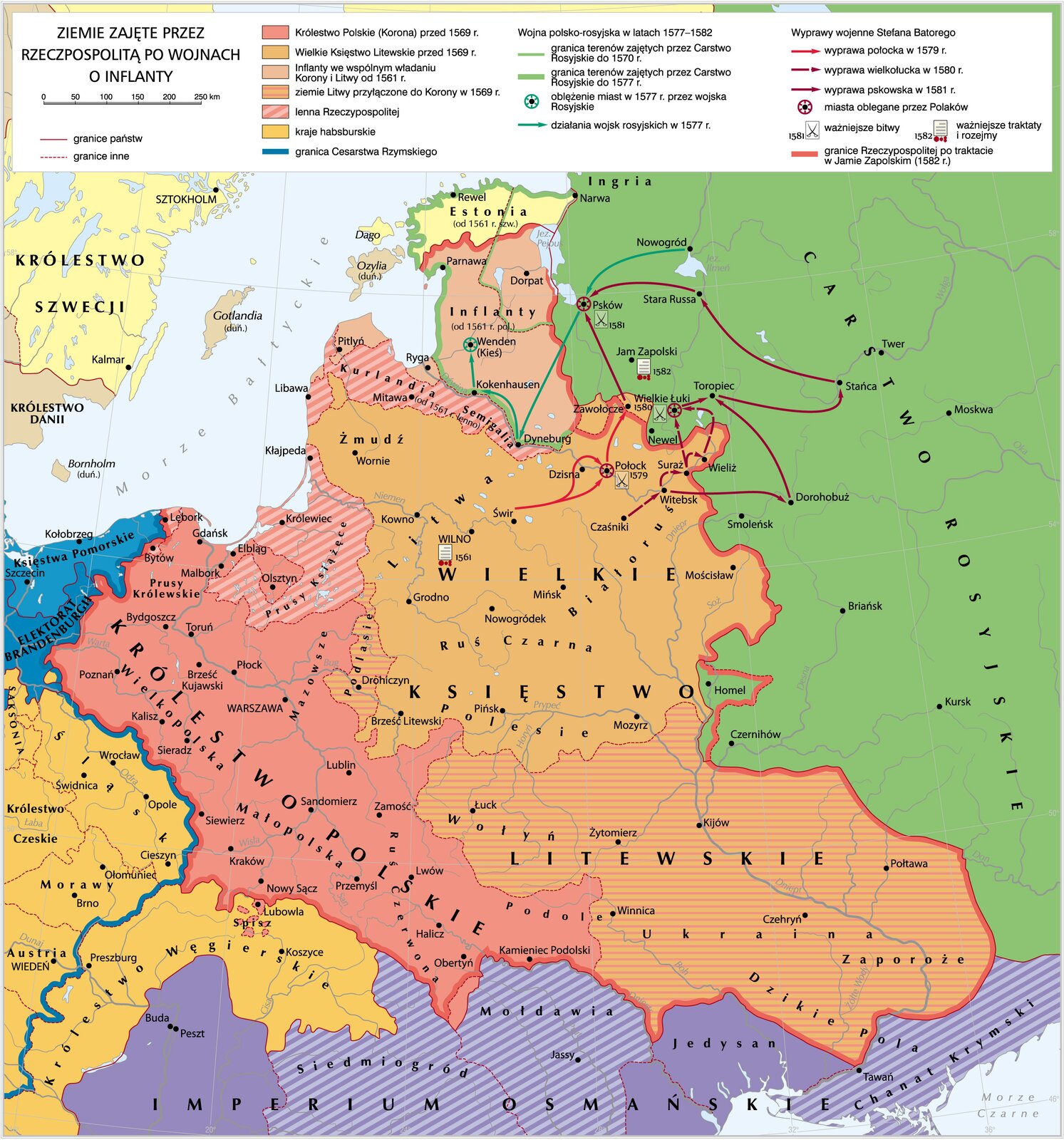
In 1569 a new state was established in the Lublin Sejm. The Crown of the Kingdom of Poland and the Grand Duchy of Lithuania merged to form the Polish–Lithuanian Commonwealth. Personal union transformed into a real union. From that moment on, both states shared the same monarch, Sejm and foreign policy. The central and land offices, the treasury, the army and the judiciary were to be separate. Lithuanian and Ruthenian nobles got Polonized over time. In practice, however, the separateness of the Crown and Lithuania had never been blurred. The Commonwealth (especially its eastern part) was inhabited by representatives of different nationalities, speaking different languages and being representatives of different religions and beliefs. They included Poles, Lithuanians, Russians, Germans, Jews, Armenians, Tartars, Wallachians and others. A wide religious tolerance prevailed in Poland of that times. Loyalty to the Commonwealth was the thing that mattered. Hence, many noblemen were Calvinists (mainly in Prussia and Livonia), Orthodox (descendants of Ruthenian boyarsboyars) or even Muslim (Tatars).
- demands of the Executionist movement
- pressure from Lithuanian magnates
- the fact that Sigismund II August had no issue, which could lead to the break-up of the unity of Poland and Lithuania
- the need to defend Livonia together against Sweden's aggression
- the growing threat posed to the Grand Duchy of Lithuania by its eastern neighbors
- the aspiration of the middle Lithuanian nobility - the boyars - to obtain the same rights and privileges as the Polish nobility
- threat posed by the Teutonic Knights both to Poland and Lithuania
- possibility of economic expansion to the east by the Polish nobility
- cultural approximation of Lithuania to Poland
- multinationalism of the state
- the promise of state union made at the baptism of Lithuania by Władysław Jagiełło
- the emergence of a powerful and strong state provided better opportunities for defense and international operations
- development of judiciary
- shared treasure allowed for the organization of a larger army
Choose the reasons for the conclusion of the Polish-Lithuanian Union called the Union of Lublin from the list below. Mark them in green. Mark other facts in red.

Jan Matejko painted his painting in 1869. The choice of this date was not random. This was...
- the 500th anniversary of the marriage of Grand Duke of Lithuania Władysław Jagiełło to Queen Jadwiga of Poland.
- the 300th anniversary of the signing of the Union of Lublin.
- the 500th anniversary of the Battle of Grunwald, during which Poles and Lithuanians fought together against the Teutonic Knights.
- the 900th anniversary of the baptism of Poland.
Read carefully the sections of the Union of Lublin and the answer to the question, and next, in pairs, find out in what historical circumstances the union came into being.
Akt unii lubelskiej z 1569 roku (fragmenty)l. W imię Pańskie, Amen. Ku wiecznej pamięci sprawy niże opisanej. [...]
3. Iż już Korona i Wielkie Księstwo Litewskie jest jedno nierozdzielone i nieróżne ciało, a także nieróżna, ale jedna spolna Rzeczpospolita która się ze dwu państw i narodów w jeden lud zniosła i spoiła.
4. A temu obojemu narodowi, żeby już wiecznymi czasy jedna głowa, jeden pan i jeden król spolny rozkazował, który spolnymi głosy Polaków i od Litwy obran, a miejsce obierania w Polszcze, a potym Królestwo Polskie pomazan i koronowan w Krakowie będzie, któremu obieraniu […] niebytność której strony przeszkadzać nie ma [...].
7. A przy koronacyi nowego króla mają być przez króla koronowanego poprzysiężone i zaraz konfirmowane [zatwierdzone] na jednym liście i jednymi słowy na wieczne czasy prawa, przywileje i wolności poddanych wszystkich obojga narodów i państw tak złączonych.
8. Sejmy i rady tej obój naród ma zawżdy mieć spolne koronne pod królem polskim panem swym i zasiadać tak panowie między panami osobami swemi jako posłowie między posły i radzić o spolnych potrzebach tak na sejmie jako i bez sejmu w Polszcze i na Litwie.
9. Też […] aby J. Kr. Mość prawa, przywileje, tak wszem ziemiom i narodom tak Korony Polskiej, jako i W. Księstwu Litewskiemu, i ziemiom do nich należących wszelakimi pismem nadane i wolności, dostojeństwa, prerogatywy, urzędy wszystkie obojga narodu całe i nieporuszone zachował. […]
Source: oprac. W. Szczygielski, Akt unii lubelskiej z 1569 roku (fragmenty) , Warszawa 1960.
Mark the true statements.
- The Polish-Lithuanian Commonwealth will have one king.
- The Polish-Lithuanian Commonwealth will have a common Sejm.
- The King will be elected by the Poles only.
- The King need not confirm the privileges previously granted.
Both states had a common (uzupełnij) Możliwe wybory: 1. coin, 2. foreign policy, 3. King, 4. Sejm, 5. armies, 6. offices.
The (uzupełnij) Możliwe wybory: 1. coin, 2. foreign policy, 3. King, 4. Sejm, 5. armies, 6. offices of Poland was also the monarch of Lithuania.
In Lithuania, separate (uzupełnij) Możliwe wybory: 1. coin, 2. foreign policy, 3. King, 4. Sejm, 5. armies, 6. offices were preserved.
The crown led its own (uzupełnij) Możliwe wybory: 1. coin, 2. foreign policy, 3. King, 4. Sejm, 5. armies, 6. offices.
There was no separate (uzupełnij) Możliwe wybory: 1. coin, 2. foreign policy, 3. King, 4. Sejm, 5. armies, 6. offices in Lithuania.
Complete the sentences based on an excerpt from the Union of Lublin.
armies, coin, foreign policy, Sejm, King, offices
Lithuania and Poland had separate ............................ with separate commanders: the Great Crown Hetman and the Great Lithuanian Hetman.
Both states had a common .............................
The ............................ of Poland was also the monarch of Lithuania.
In Lithuania, separate ............................ were preserved.
The crown led its own .............................
There was no separate ............................ in Lithuania.
Look at the illustration and then do the exercise.
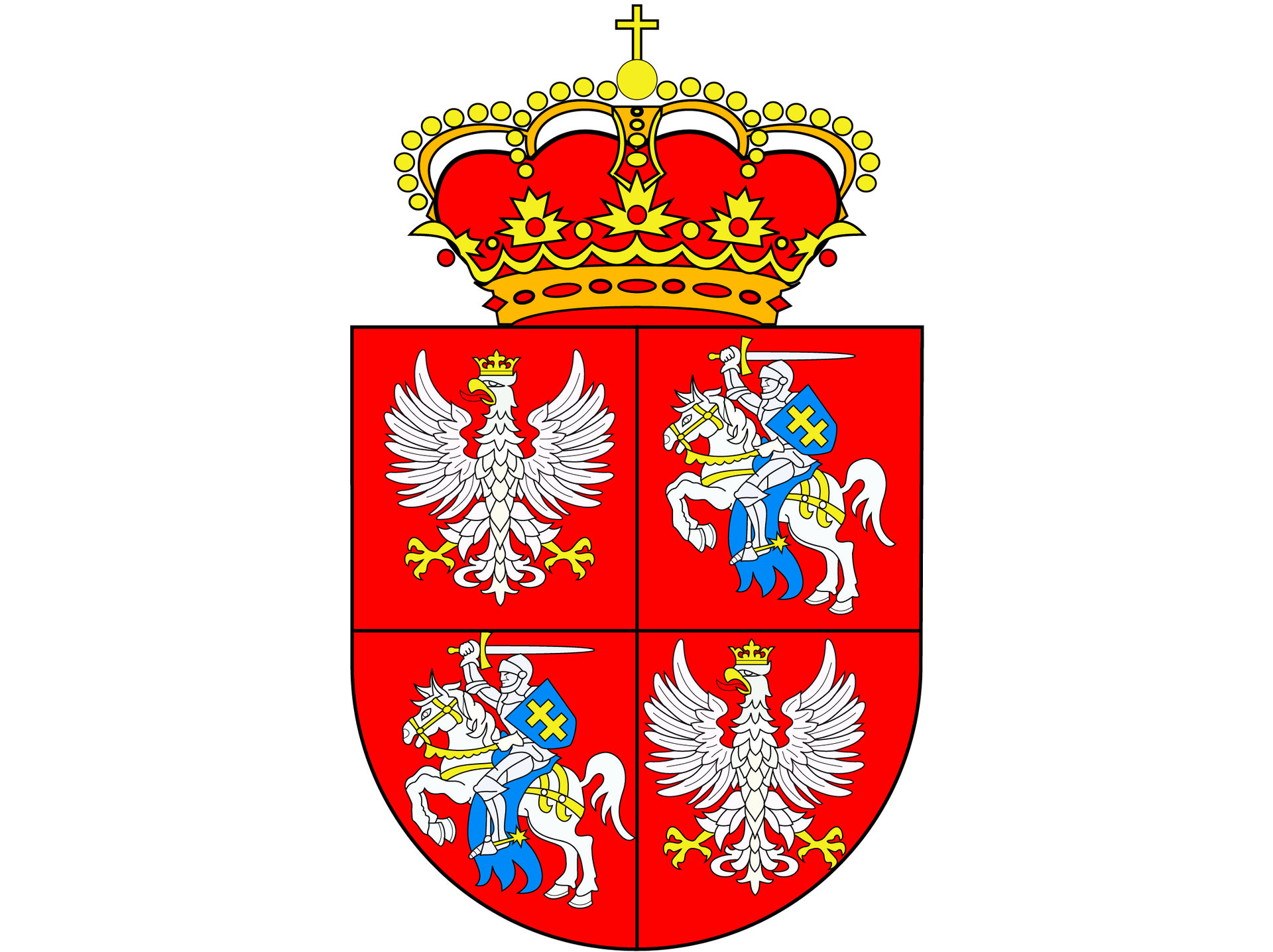
Complete the text by dragging the words and dropping them in the correct place.
Commonwealth, rider, White Eagle, Poland, sword, Lithuania, Pahonia, horse, Polish-Lithuanian
The coat of arms of the .................................. .................................. is a combination of the coat of arms of .................................. and the coat of arms of ................................... The symbol of Poland is the .................................. in the crown. The symbol of Lithuania is .................................., which depicts a .................................. with a shield and a .................................. on a white ...................................
Keywords
Polish–Lithuanian Commonwealth, Grand Duchy of Lithuania, personal union, real union, Union of Lublin, boyar, religious toleration
Glossary
Nagranie dostępne na portalu epodreczniki.pl
Nagranie słówka: Sejm of the Polish‑Lithuanian Commonwealth
Sejm walny – nazwa najwyższego organu przedstawicielskiego – parlamentu – najpierw w Królestwie Polskim, a od 1569 roku w Rzeczypospolitej Obojga Narodów, decydującego o ważnych sprawach w państwie. Składał się z dwóch izb – senatu i izby poselskiej oraz trzech stanów sejmujących króla, posłów i senatorów.
bojar – w Wielkim Księstwie Litewskim przedstawiciel niższej i średniej warstwy szlachty, na Rusi wielki właściciel ziemski.
unia personalna – związek dwóch lub więcej państw posiadających wspólnego władcę przy zachowaniu odrębności państwowej.
unia realna – związek dwóch lub więcej państw posiadających wspólne instytucje państwowe oraz monarchę. W jej ramach członkowie tworzą jedno wspólne państwo.
unia lubelska – porozumienie pomiędzy Królestwem Polski oraz Wielkim Księstwem Litewskim zawarte w 1569 roku w Lublinie. Porozumienie to skutkowało powstaniem unii realnej i utworzeniem Rzeczypospolitej Obojga Narodów ze wspólnym monarchą, sejmem, walutą, herbem, polityką zagraniczną i obronną. Zostały zachowane jednak odrębne skarby, sądownictwo, urzędy oraz wojsko.
pogoń – herb Wielkiego Księstwa Litewskiego, przedstawiający jeźdźca (rycerza) na koniu z mieczem w prawej ręce oraz tarczą ze złotym krzyżem litewskim w lewej ręce.
tolerancja religijna – postawa akceptacji i poszanowania czyichś wierzeń i przekonań religijnych.