What will happen if centripetal forceforceforce stops working.
Hypothesis
If the centripetal forcecentripetal forcecentripetal force does not act anymore, an object will change the path of its motion.
You will need
Glass (transparent mug), small ball.
Instruction
We cover the ball with a glass and move it around the circle. When the ball moves in a uniform motion, we raise the glass up. We observe the movement of the ball.
Summary
For the body to move in a circle, the centripetal force must act. In this case, the centripetal force is exerted on the ball by the glass’s surface. When the glass is raised up, the source of force does not exist anymore and the path of motion changes.
In the uniform circular motion, the direction of velocity is constantly changing, thus the acceleration vector is non‑zero. According to the first rule of dynamics to change the state of the body movement, in this case the direction of the velocity, a certain force must act on this body.
By Newton’s second law, accelerationaccelerationacceleration is linked to a force by the formula:
In uniform circular motionmotionmotion a force is directed toward the centre of curvature of the path. This force is called the centripetal forcecentripetal forcecentripetal force. “Centripetal” means “centre seeking” force. This force is described by the formula:
where v is the velocity of an object and r the radius of the circle.
R10qTZsmIdqy9
Ilustracja interaktywna symbolicznie przedstawia ruch po okręgu. Poruszający się obiekt zaznaczony jest jako kółko, a jego tor ruchu oznaczony jest linią przerywaną. Na rysunku zaznaczone są dwa wektory, wychodzące z środka kółka, czyli ze środka ciężkości ciała. Jeden wektor skierowany jest w kierunku środka okręgu opisany numerem 1, drugi wektor jest styczny do okręgu, opisany numerem 2. Na ilustracji widoczne są numery, a na nich podpisy. 1. force {audio}, 2. velocity – direction of movement {audio}.
Ilustracja interaktywna symbolicznie przedstawia ruch po okręgu. Poruszający się obiekt zaznaczony jest jako kółko, a jego tor ruchu oznaczony jest linią przerywaną. Na rysunku zaznaczone są dwa wektory, wychodzące z środka kółka, czyli ze środka ciężkości ciała. Jeden wektor skierowany jest w kierunku środka okręgu opisany numerem 1, drugi wektor jest styczny do okręgu, opisany numerem 2. Na ilustracji widoczne są numery, a na nich podpisy. 1. force {audio}, 2. velocity – direction of movement {audio}.
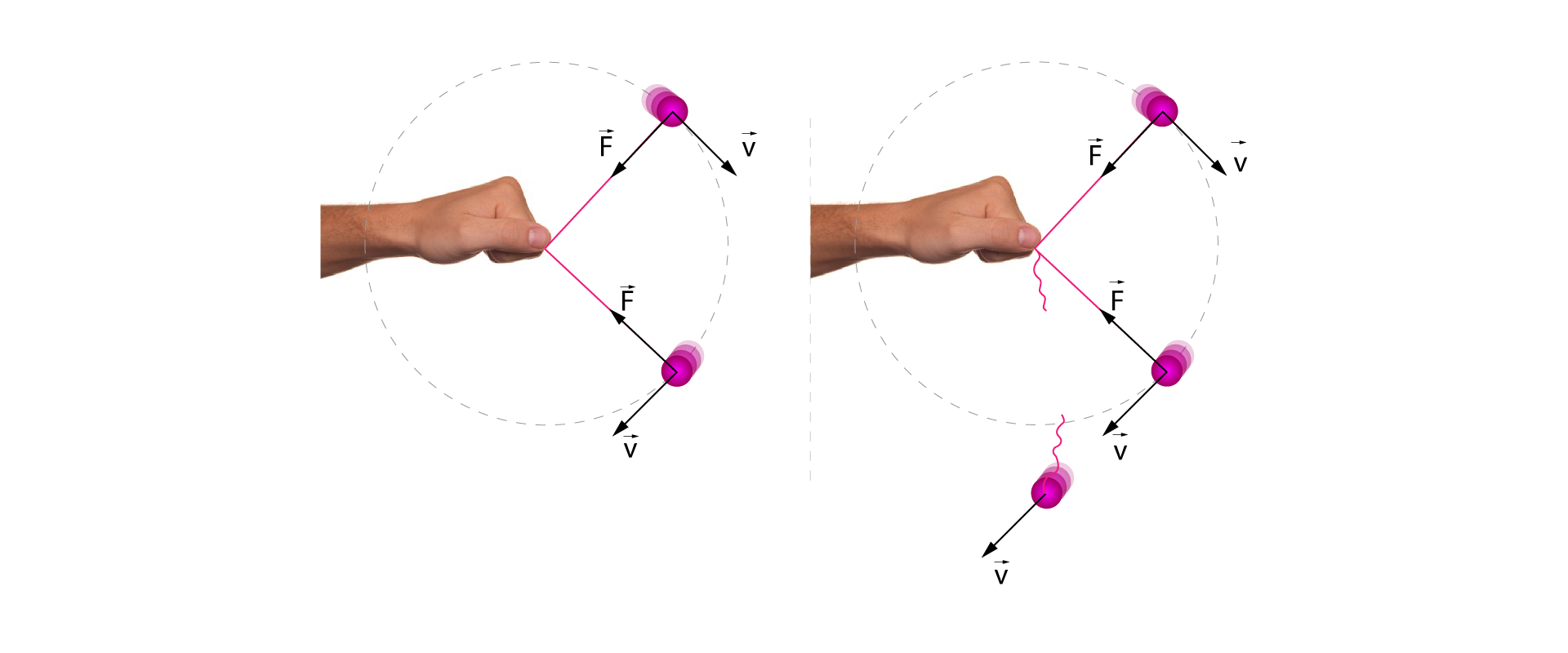
A centripetal forceforceforce acts on a whirling object on a string. If the string breaks, the object will continue its motion along a tangent line.
R1N4rFCL98odl
W lewej części rysunku przedstawiona jest dłoń kręcącą w koło obiekt przywiązany na sznurku. Pozycje obiektu (dwie) podczas ruchu widoczne są na tle przerywanej linii, będącej obwodem koła. Zaznaczone są wektory siły F, ze strzałką nad, oraz prędkości v, ze strzałką nad, dla obydwu pozycji. Po prawej stronie mamy identyczny rysunek, na którym dodatkowo zaznaczony jest pęknięty sznurek i dalszy tor ruchu obiektu.
Motion of a whirling object on a string. (left) Uniform circular motion. (right) The lack of force results in the change of the path of the object.
What centripetal force must act on a body moving in a circle with a constant radius if we want to double its speed? Provide some calculations to justify your answer.
If a 150 g plastic ball is tied with a string of length 1,5 m, and it is spinning with the speed of 30 , what is the centripetal forcecentripetal forcecentripetal force acting on it?
Centripetal forcecentripetal forceCentripetal force is directed toward the centre of a circle. This force keeps an object moving in a circular path at uniformuniformuniform speed.
Centrifugal forcecentrifugal forceCentrifugal force is an inertial force that occurs only in non‑inertial reference frames, in this case in a frame relative to an object in circular motion.
While centripetal force is an actual forceactual forceactual force, centrifugal forcecentrifugal forcecentrifugal force is defined as an apparent force. When an object is spinning on a string, the string exerts an inward centripetal force on the mass, while mass appears to exert an outward force on the string.
Both forces can be determined using the same formula. When an object is rotating uniformly, these two forces will be equal.
In order to keep the body moving in a uniformuniformuniform circular motionmotionmotion, the force directed to the centre of the circle must act on it. This force is called centripetal forcecentripetal forcecentripetal force.
Exercises
R15mJkEF5LKzG
Exercise 3
Wersja alternatywna ćwiczenia: Determine which sentence is true. Możliwe odpowiedzi: 1. Force that keeps objects in circular path is called centrifugal force., 2. In uniform circular motion the velocity is always tangent to a circle., 3. If the radius of a circle increases then the speed of an object decreases., 4. The direction of the object's velocity is constant.
Wersja alternatywna ćwiczenia: Determine which sentence is true. Możliwe odpowiedzi: 1. Force that keeps objects in circular path is called centrifugal force., 2. In uniform circular motion the velocity is always tangent to a circle., 3. If the radius of a circle increases then the speed of an object decreases., 4. The direction of the object's velocity is constant.
Determine which sentence is true.
Force that keeps objects in circular path is called centrifugal force.
In uniform circular motion the velocity is always tangent to a circle.
If the radius of a circle increases then the speed of an object decreases.
The direction of the object's velocity is constant.
zadanie
Source: GroMar, licencja: CC BY 3.0.
Exercise 4
Anna is holding on to the outer edge of a carousel with the diameter of 1,8 m. Anna's weight is 40 kg and the velocity of the carousel is 2,5 m/s. What is the centripetal force?
F = 277,8 N
Exercise 5
Explain in English what uniform circular motion causes.
RhAENJ5FL3QMq
Exercise 6
Wersja alternatywna ćwiczenia: Indicate which pairs of expressions or words are translated correctly. Możliwe odpowiedzi: 1. siła dośrodkowa - centripetal force, 2. siła odśrodkowa - centrifugal force, 3. przyspieszenie - acceleration, 4. siła rzeczywista - actual force, 5. siła - motion, 6. ruch - uniform
Wersja alternatywna ćwiczenia: Indicate which pairs of expressions or words are translated correctly. Możliwe odpowiedzi: 1. siła dośrodkowa - centripetal force, 2. siła odśrodkowa - centrifugal force, 3. przyspieszenie - acceleration, 4. siła rzeczywista - actual force, 5. siła - motion, 6. ruch - uniform
Indicate which pairs of expressions or words are translated correctly.
siła dośrodkowa - centripetal force
siła odśrodkowa - centrifugal force
przyspieszenie - acceleration
siła rzeczywista - actual force
siła - motion
ruch - uniform
zadanie
Source: GroMar, licencja: CC BY 3.0.
RR7r9BVsk34aM1
Interaktywna gra, polegająca na łączeniu wyrazów w pary w ciągu jednej minuty. Czas zaczyna upływać wraz z rozpoczęciem gry. Jeden ruch to odkrywanie najpierw jednej potem drugiej karty z wyrazem. Każdy wyraz jest odczytywany. Kolejny ruch to odkrywanie trzeciej i czwartej karty. W ten sposób odsłuchasz wszystkie wyrazy. Nawigacja z poziomu klawiatury za pomocą strzałek, odsłuchiwanie wyrazów enterem lub spacją. Znajdź wszystkie pary wyrazów.
Interaktywna gra, polegająca na łączeniu wyrazów w pary w ciągu jednej minuty. Czas zaczyna upływać wraz z rozpoczęciem gry. Jeden ruch to odkrywanie najpierw jednej potem drugiej karty z wyrazem. Każdy wyraz jest odczytywany. Kolejny ruch to odkrywanie trzeciej i czwartej karty. W ten sposób odsłuchasz wszystkie wyrazy. Nawigacja z poziomu klawiatury za pomocą strzałek, odsłuchiwanie wyrazów enterem lub spacją. Znajdź wszystkie pary wyrazów.
Match Polish terms with their English equivalents.
acceleration
siła dośrodkowa
actual force
przyspieszenie
siła rzeczywista
siła odśrodkowa
centripetal force
centrifugal force
apparent force
siła pozorna
Source: Zespół autorski Politechniki Łódzkiej, licencja: CC BY 3.0.