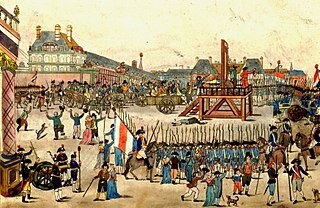
Since the third estate proclaimed itself as the National Assembly (National Constituent AssemblyNational Constituent AssemblyNational Constituent Assembly) in June 1789, the French were enjoying a time of euphoria and waiting for favorable changes. Rural areas were the first to be hit by revolutionary fever. It was there that the overthrow of the feudal system and the process of France's departure from absolutism began. On 14 July 1789 a crowd of Parisians robbed weapons from the city arsenals and set off to Bastille. On 26 August 1789 the National Constituent Assembly enacted the Declaration of the Rights of Man and of the Citizen. The estate privileges: tax, judiciary, as well as tax for the Catholic Church were completely abolished. Freedom of speech, press and expressing one's own views was guaranteed. In September 1791 the constitution was brought in. It confirmed the King's authority and, at the same time, put power over France in hands of the people. The parliamentary monarchy lasted until the end of the summer of 1792. On 22 September 1792 France became a republic. In January 1793 the deputies of the National Constituent Assembly decided to execute the king. After the establishment of the republic, the situation in France undergoing revolution did not improve at all. In June 1793, the Jacobins carried out a coup d'état with the support of the Parisian people. Power was taken over by the Committee of Public Safety, led by Maximilien Robespierre. As people were fed up with the terrorterrorterror and the members of the National Constituent Assembly feared for their lives, it was ultimately decided to overthrow the dictatorship. In July 1794, Robespierre was guillotinedguillotineguillotined. The revolution adopted a milder course. The Directory’s rule, the new executive government in France, which started in 1795, is considered by historians to be the finale of the French Revolution.
Exercise 1
Read or listen to a recording of the source text and answer the question.
Maximilien RobespierreReport on the rules of revolutionary governments
RxxCCeTMpI2pQ1
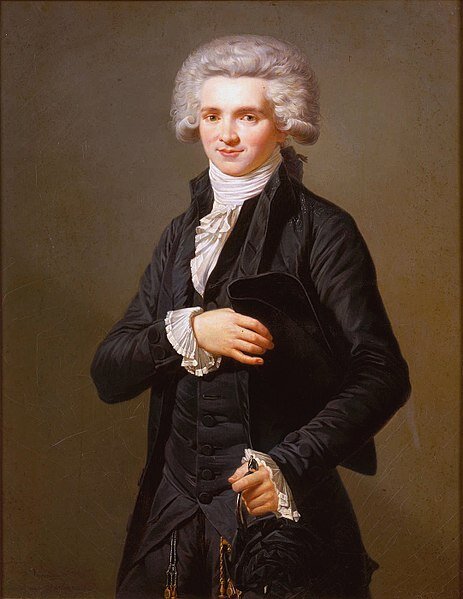
Obraz przedstawia portret Maximiliena Robespierra.
Portrait of Maximilien Robespierre
Source: Pierre Roch Vigneron, Maximilien Robespierre, 1790, oil on canvas, domena publiczna.
The theory of government is as new as revolution that brought it. We shouldn’t look for it in the books of political writers who never foresaw this revolution, nor in the acts of tyrants who, content with abusing their power, don’t bother with justifying their legality; these words for the aristocracy are just a matter of fear or a text that slanders the,; for tyrants, these words are just a scandal, whereas for many people they are simply a mystery; therefore it should be explained to everyone, so that good citizens could be attracted, for the sake of public interest. The function of the government is to direct moral and physical forces of the nation to achieve the goal for which the government was formed. The goal of the constitutional government is to retain the Republic; the goal of the revolutionary government is to establish a Republic. The revolution is the war of freedom with its enemies; The Constitution is a system of the victorious and calm freedom. The revolutionary government needs extraordinary actions, because he is fighting a war. It is subjected to less uniform and strict rules, because the circumstances the government finds itself it are turbulent and changeable, mainly because of this it is forced to constantly develop new methods of action towards new, sudden threats. A constitutional government is focused mainly on civil freedom, whereas the revolutionary government focuses mainly on public freedom. With constitutional government it is enough to almost protect the individuals from the abuse of public authority; in the case of the revolutionary government, the very public authority is forced to protect itself from all the enemies attacking it. The revolutionary government owes the good citizens every type of country protection; the enemies of the people are owed only death.
robespierre Source: Maximilien Robespierre, Report on the rules of revolutionary governments, oprac. Tadeusz Zawadzki, tłum. Halina Lubicz-Trawkowska.
R1PpsrMgwUIa2
Wersja alternatywna ćwiczenia: Indicate which of the sentences below describe the aims of the revolutionary government. Możliwe odpowiedzi: 1. protecting the individual from abuses of public authorities, 2. taking emergency action in wartime conditions, 3. protection against external and internal enemies
Wersja alternatywna ćwiczenia: Indicate which of the sentences below describe the aims of the revolutionary government. Możliwe odpowiedzi: 1. protecting the individual from abuses of public authorities, 2. taking emergency action in wartime conditions, 3. protection against external and internal enemies
Indicate which of the sentences below describe the aims of the revolutionary government.
protecting the individual from abuses of public authorities
taking emergency action in wartime conditions
protection against external and internal enemies
Task 1
Read the source text and summarize the basic principles of the declaration in your own words.
RtLRrX75doTtG1
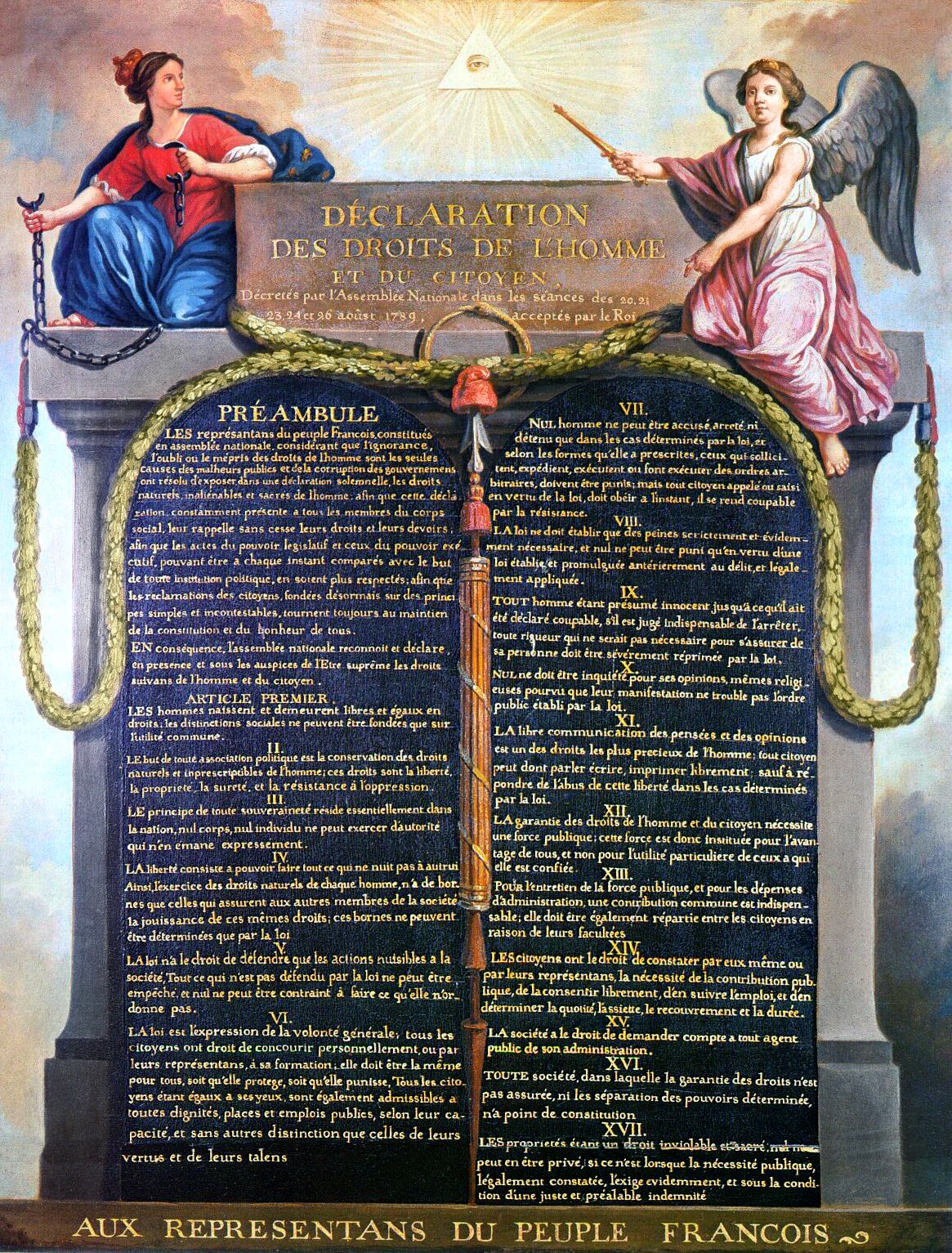
Obraz przedstawiający reprezentację Deklaracji Praw Człowieka i Obywatela w 1789 r.
Representation of the Declaration of the Rights of Man and of the Citizen in 1789
Source: Jean-Jacques-François Le Barbier, Déclaration des droits de l'homme et du citoyen, 1896, oil on panel, Musée Carnavalet, domena publiczna.
Declaration of human and civic rights (fragment)
Declaration of human and civic rights (fragment)
Art. 1. Men are born and remain free and equal in rights. Social distinctions may be based only on considerations of the common good.
Art. 2. The aim of every political association is the preservation of the natural and imprescriptible rights of Man. These rights are Liberty, Property, Safety and Resistance to Oppression.
Art. 3. The principle of any Sovereignty lies primarily in the Nation. No corporate body, no individual may exercise any authority that does not expressly emanate from it.
Art. 4. Liberty consists in being able to do anything that does not harm others: thus, the exercise of the natural rights of every man has no bounds other than those that ensure to the other members of society the enjoyment of these same rights. These bounds may be determined only by Law.
Art. 5. The Law has the right to forbid only those actions that are injurious to society. Nothing that is not forbidden by Law may be hindered, and no one may be compelled to do what the Law does not ordain.
Art. 6. The Law is the expression of the general will. All citizens have the right to take part, personally or through their representatives, in its making. It must be the same for all, whether it protects or punishes. All citizens, being equal in its eyes, shall be equally eligible to all high offices, public positions and employments, according to their ability, and without other distinction than that of their virtues and talents.
deklaracja Source: Declaration of human and civic rights (fragment), oprac. Grzegorz Chomicki, Leszek Śliwa, Kraków 2001, s. 29–31.
Task 2
Basing on your knowledge and information from the text below, explain how the term „natural law” is to be understood. Does the author think that it is of timeless and universal nature? Justify your answer.
Katarzyna Sójka-ZielińskaNatural law
In the area of philosophical and moral notions there is no homogeneous and unchangeable canon of rules. The notions of good, legitimacy, justice can be interpreted by anyone as they wish. Throughout thousands of years of civilization, the natural law, which has to be emphasized especially today, when it is so easy and so popular to abuse this notion, was used to justify radically different approaches. The inherent equality and inequality of men could be considered as natural law. Freedom of an individual could be understood as the need of that individual to completely subject to the group. Private property was considered natural law, whereas for others, natural and primary law was the collective (group) property.
prawo Source: Katarzyna Sójka-Zielińska, Natural law, Wrocław 2000, s. 55.
R1Nk18pAfASry
Exercise 2
Wybierz dowolne angielskie słówko ze słowniczka i zapytaj kolegę o jego znaczenie.
Wybierz dowolne angielskie słówko ze słowniczka i zapytaj kolegę o jego znaczenie.
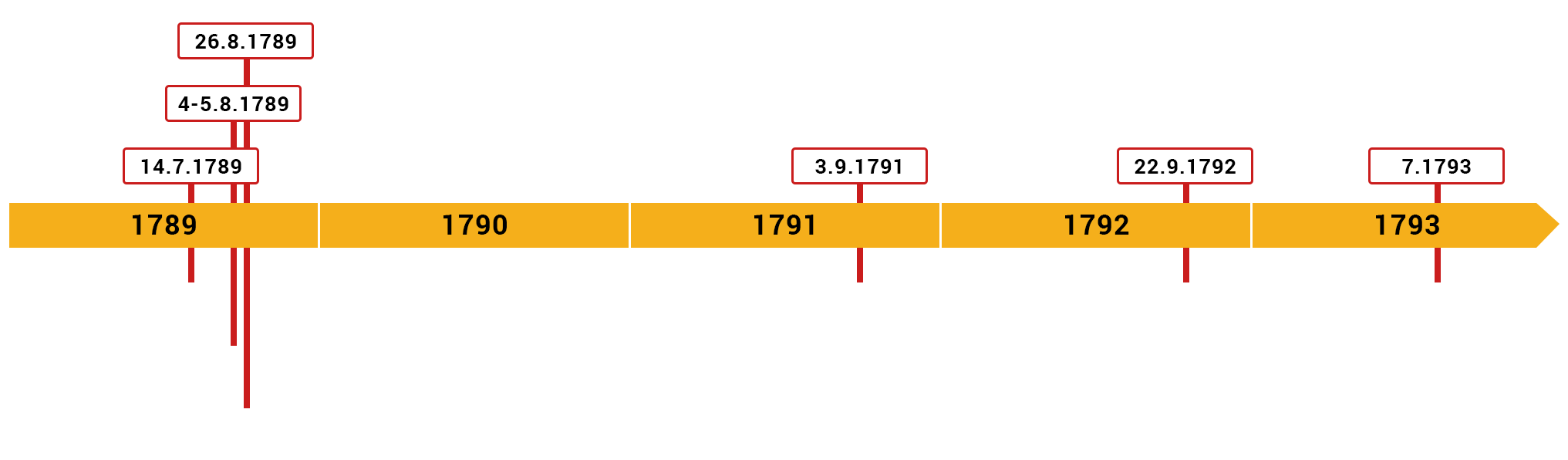
Place events on the timeline.
Declaration of the Rights of Man and of the Citizen, Storming of the Bastille, The First French Constitution, Abolishment of estate privileges, The beginning of the great terror under Robespierre, Establishment of the Republic
.................
.................
.................
.................
.................
.................
Rkh1UQRkpPYt0
Exercise 3
Wersja alternatywna ćwiczenia: Match the dates with the events. Storming of the Bastille Możliwe odpowiedzi: 1. 4-5 August 1789, 2. 14 July 1789, 3. 26 August 1789 Abolishment of estate privileges Możliwe odpowiedzi: 1. 4-5 August 1789, 2. 14 July 1789, 3. 26 August 1789 Declaration of the Rights of Man and of the Citizen Możliwe odpowiedzi: 1. 4-5 August 1789, 2. 14 July 1789, 3. 26 August 1789
Wersja alternatywna ćwiczenia: Match the dates with the events. Storming of the Bastille Możliwe odpowiedzi: 1. 4-5 August 1789, 2. 14 July 1789, 3. 26 August 1789 Abolishment of estate privileges Możliwe odpowiedzi: 1. 4-5 August 1789, 2. 14 July 1789, 3. 26 August 1789 Declaration of the Rights of Man and of the Citizen Możliwe odpowiedzi: 1. 4-5 August 1789, 2. 14 July 1789, 3. 26 August 1789
Match the dates with the events.
14 July 1789, 4-5 August 1789, 26 August 1789
Storming of the Bastille
Abolishment of estate privileges
Declaration of the Rights of Man and of the Citizen
Keywords
Great French Revolution, Robespierre, Declaration of the Rights of Man and of the Citizen, terror
constitution – the law determining the state system and the legal situation of the individual before the authorities; it takes precedence over other laws