Appeasement policy of the European countries towards the fascist countries
to enumerate Hitler’s actions aimed at overthrowing the arrangements of the Treaty of Versailles;
to characterize the political goals and aspirations of the superpowers;
to characterize the appeasement policy and its effects.
In January 1935 in Saarland a plebisciteplebiscite was organised, where 90% of the inhabitants voted to join the Third Reich. In 1935 Germany introduced mandatory military service. Western countries did not react. Also in 1935 Italy entered Abyssinia, an area of considerable economic significance for them. Abyssinia asked the League of Nations for help. They did nothing. On March 7, 1936, German troops entered Rhineland, which – according to the arrangements included in the Treaty of Versailles – was supposed to be a demilitarised zonedemilitarised zone. Once again, Western countries did not react. Hitler took one step further. In 1938 his troops entered Austria and the fascist Chancellor announced the annexation of Austria to the Third Reich. Hitler proclaimed the establishment of the Greater Germanic Reich. Then, Hitler “proceeded to defend” the 3 million Germans living in the Czech Sudetes. MediationMediation in order to solve the conflict amicably was proposed by Mussolini and approved by the western countries. On September 29‑30, 1938 in Munich a meeting was held of the British Prime Minister, Neville Chamberlein, the French Prime Minister Édouard Daladier, Hitler and Mussolini. Without the participation of Czechoslovakia, a decision was made to give the disputed territory to the Germans. In March 1939 Hitler initiated the request of Slovak nationalists who formed a formally independent state (in fact fully subordinated to the Third Reich). On March 15, Hitler’s troops entered Prague, and Czechoslovakia was transformed into the Protectorate of Bohemia and Moravia, under German rule. In the autumn 1938 Poland benefited from the difficult situation of Czechoslovakia and proceeded to occupy the Zaolzie and Hungary - the so‑called Carpathian Ruthenia, and the southern region of Slovakia. Also Italians started taking aggressive measures in Europe and in April 1939 they occupied Albania.
Explain why the annexation of Austria to Germany was a breach of the Treaty of Saint‑Germain.
Try to recall the event from the history of Germany, which was the inspiration behind the concept of the Greater German Reich.
- German Reunification.
- The Napoleonic era in the German territory.
- The Ottonian Empire
- The Revolutions of 1848
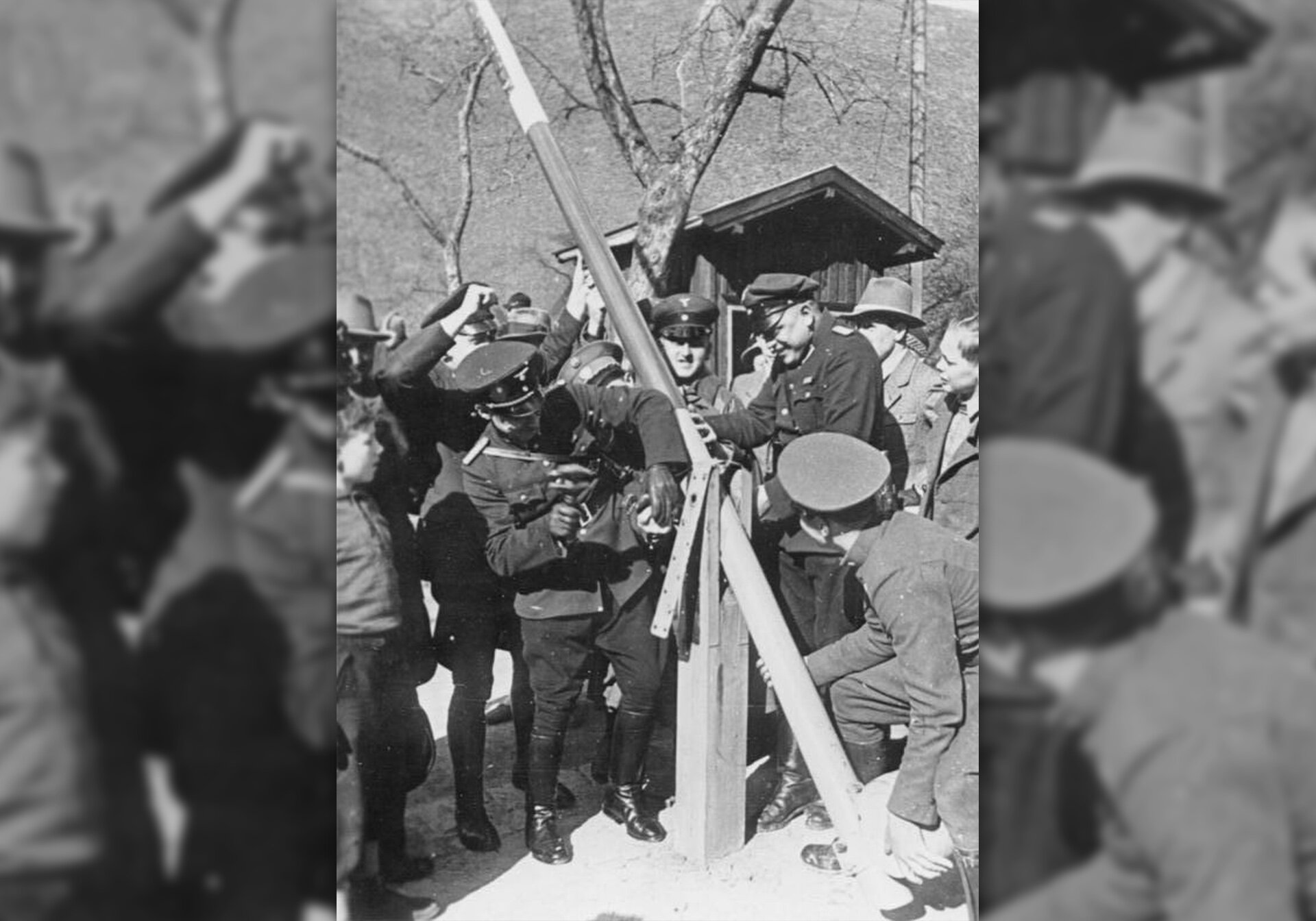
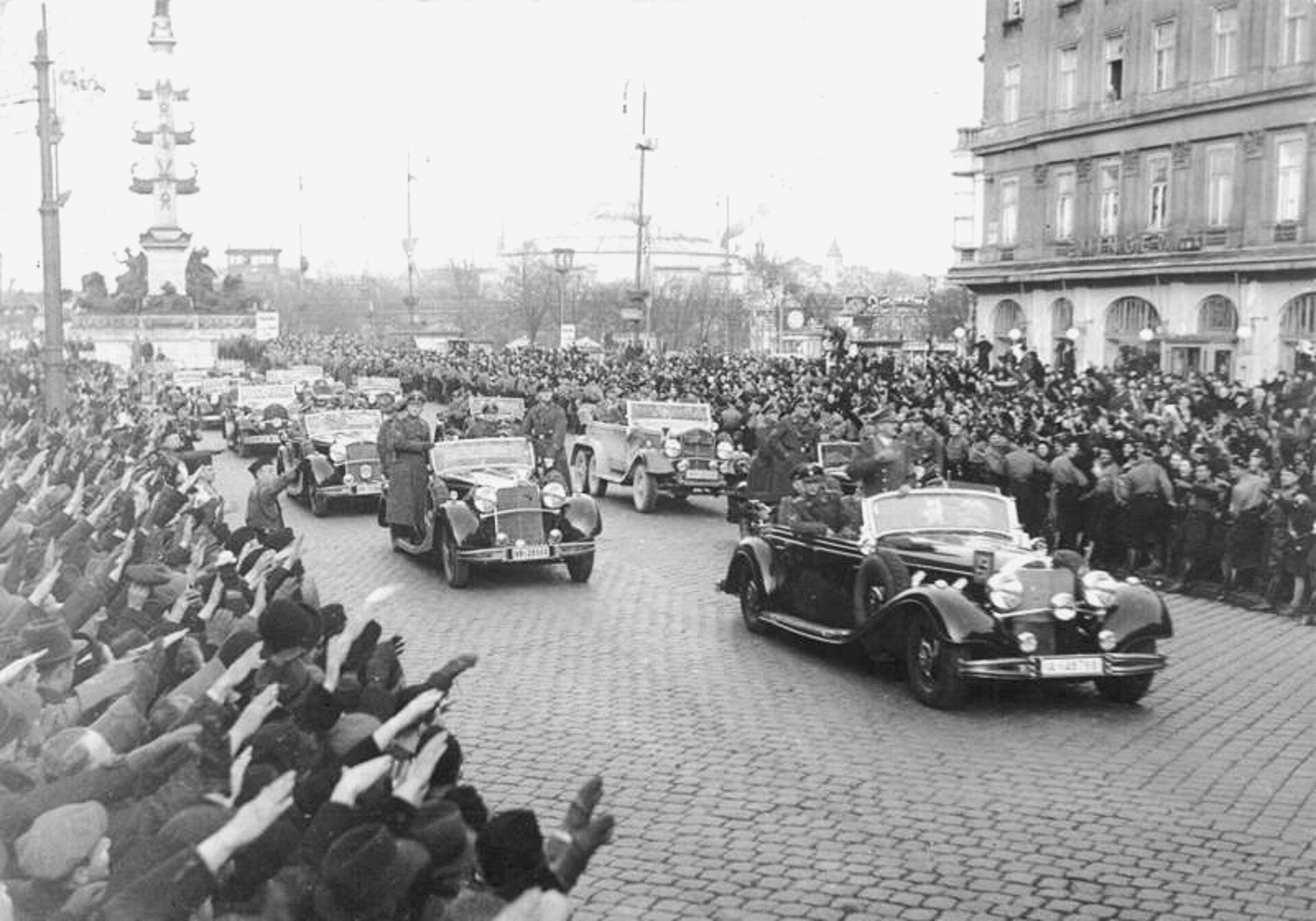
Which sentences best describe the message of these photographs?
- The Austrians were happy to adopt the act which joined their country to the Third Reich.
- Austrian customs officers happily took to dismantling border landmarks.
- The Austrians organised demonstrations against the annexation.
- Austrian customs officers tried to impede the dismantling of the border landmarks.
- The Austrians were very sceptical about the German troops entering their country.
Conference in Munich as seen by a Czechoslovakian official from the Ministry of Foreign Affairs, Hubert Masařik. Listen to the recording.
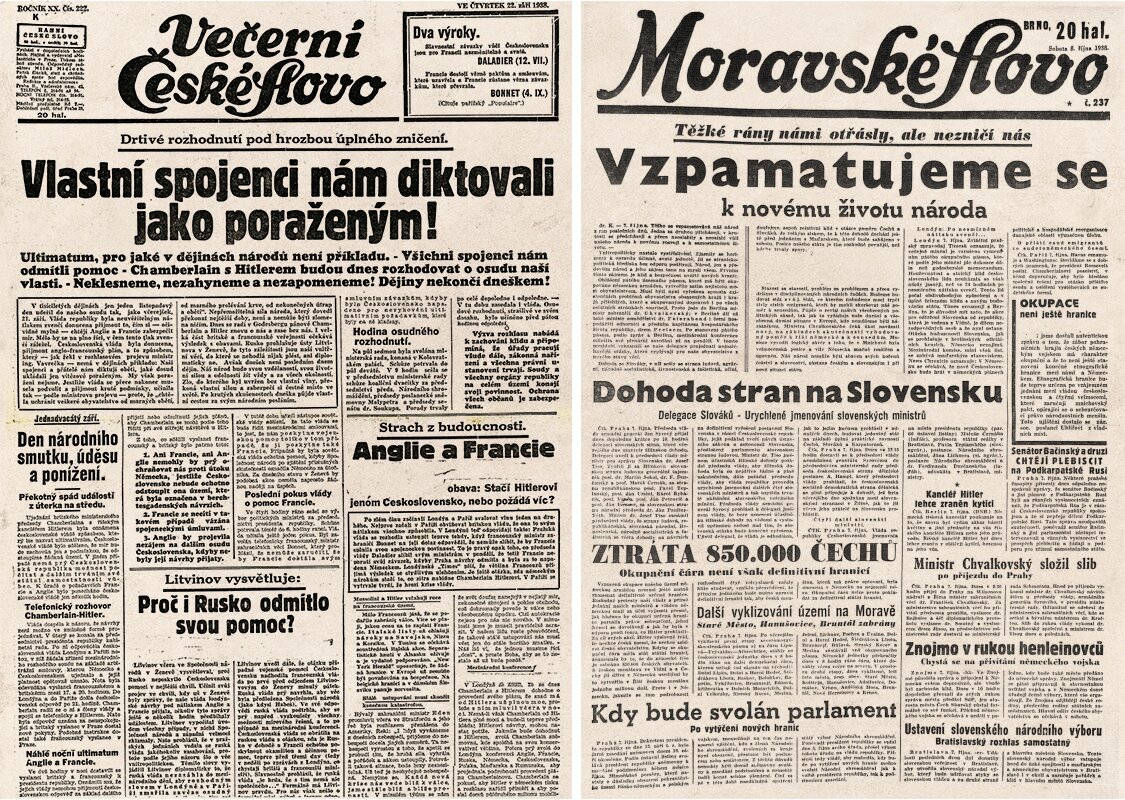
Our plane took off [...] at 3 on the afternoon of September 29, 1938. After eighty minutes of flight, we were in Munich. At the airport, we were accepted as people suspected by the police. We were taken by a police car in the company of Gestapo officers to the Hotel Regina [...].
At 1.30 am we were taken to the Hall where the conference took place. There were gentlemen Neville Chamberlain and Daladier, Sir Horace Wilson, Mr. Léger, [...] Dr. Mastny and myself. The atmosphere was depressing: the verdict was soon to be passed. The French were visibly confused and it seemed as if they realised what it means for the prestige of France. In a brief introduction Mr Chamberlain mentioned the agreement that was just reached and gave Mr Mastny the text of the agreement to read [...].
While dr Mastny was talking to Chamberlain about some matters of minor importance (Chamberlain kept yawning, without showing any shame), I asked Mr Daladier and Mr Léger, whether they expect any declaration from our government in regards of our response to the agreement. Mr Daladier was visibly embarrassed and did not reply. Mr Léger said that the four statesmen don’t have much time. He added expressly that they did not expect any response from us, as they already consider the plan approved [...].
We were told rather brutally [...] that no appeal may be made against this decision and that it is impossible to introduce any changes. Mr Chamberlain did not hide his fatigue. [...] We said goodbye and left. The Republic of Czechoslovakia with its borders as defined in 1918 just ceased to exist”.
Source: Artur Patek, Zdzisław Zblewski, Polska i świat w latach 1918‑1993. Teksty źródłowe, Krakow 1998, pp. 118‑119.
Become familiar with the arguments of the four main political players from 1938. Match the facts to the participants of the Munich conference.
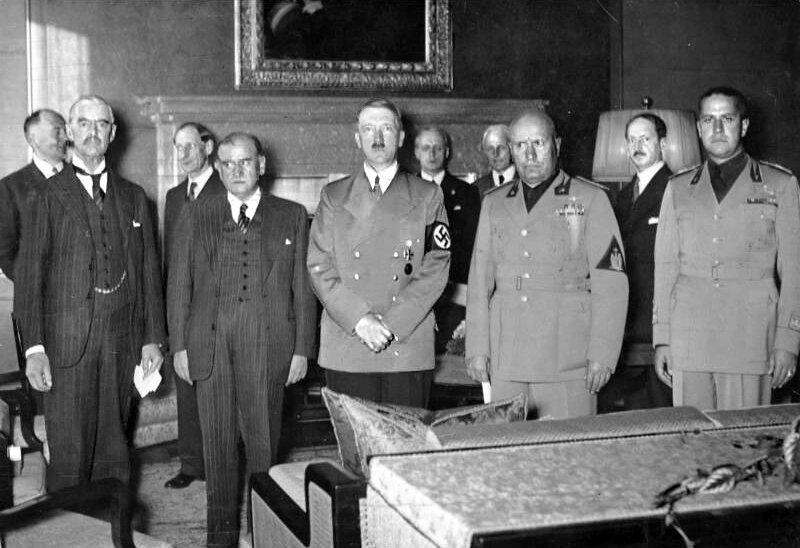
Indicate appropriate sentences.
{Neville Chamberlain – Great Britain} He did not want to take the risk to start a war with the Third Reich. {/Neville Chamberlain – Great Britain}
{Édouard Daladier – France} In the society, the dominant attitude was against the war.{/Édouard Daladier – France}
{Neville Chamberlain – Great Britain} He did not want to be involved in the Central European business .{/Neville Chamberlain – Great Britain}
{Adolf Hitler – Germany} Believed that conquests were just as important as diplomacy.{/Adolf Hitler – Germany}
{Neville Chamberlain – Great Britain} He though that he would guarantee peace in Europe this way. {/Neville Chamberlain – Great Britain}
{Édouard Daladier – France} He could not properly meet his obligations as an ally of the Central European countries.{/Édouard Daladier – France}
{Neville Chamberlain – Great Britain} Until May 1939 he had no regular draft army.{/Neville Chamberlain – Great Britain}
{Benito Mussolini – Italy} He proposed mediation in order to solve the conflict in a peaceful manner, and this idea was approved by the western countries.{/Benito Mussolini – Italy}
{Édouard Daladier – France} Would not be involved in an armed action to defend the last democratic country in this part of Europe.{/Édouard Daladier – France}
{Adolf Hitler – Germany} Took step to “defend” the 3 million Germans living in the Czech Sudetes.{/Adolf Hitler – Germany}
{Neville Chamberlain – Great Britain} He tried to discourage Italy from becoming too close to Germany.{/Neville Chamberlain – Great Britain}
{Édouard Daladier – France} He believed that it is impossible to guarantee peace and security and protect the interest of Czechoslovakia without recognising Hitler’s claim to the Sudetes .{/Édouard Daladier – France}
{Adolf Hitler – Germany} He wished to gain more “Lebensraum” (living space) for the “nation of masters”.{/Adolf Hitler – Germany}
{Adolf Hitler – Germany} He assured the participants that he would have no further territorial demands, which the western countries believed or wanted to believe.{/Adolf Hitler – Germany}
{Neville Chamberlain – Great Britain} He feared war, because he knew he was not prepared for it.{/Neville Chamberlain – Great Britain}
Keywords
Anschluss, appeasement, demilitarisation, Maginot Line, mediation, poll
Glossary
Anschluss – koncepcja polityczna nacjonalistów niemieckich i wielkoniemieckich nacjonalistów austriackich włączenia Austrii do Niemiec, wysuwana przez nich po upadku monarchii austro‑węgierskiej 1918, a zrealizowana przez III Rzeszę 1938.
appeasement – dosłownie: ugłaskiwanie; w stosunkach międzynarodowych — polityka ustępstw wobec żądań potencjalnego agresora w celu złagodzenia jego postawy, osiągnięcia ugody i utrzymania pokoju
demilitaryzacja – rozbrojenie
Linia Maginota - nazwa stosowana na określenie francuskiej linii umocnień fortyfikacyjnych, wzmocnionych w latach 1929–1940 na wschodnich granicach państwa. Najsłynniejsze umocnienia powstały na granicach z Niemcami i Luksemburgiem.
mediacja - pośredniczenie w sporze, mające na celu pogodzenie zwaśnionych stron, w celu równoczesnego zawarciu kompromisu kończącego spór
plebiscyt – głosowanie ludności zamieszkującej dane terytorium, w celu rozstrzygnięcia ważnej kwestii związanej z tym terytorium