Factors for the location of the advanced technology industry. New spatial forms and their functions.
what is understood as branches of industrial production;
the reasons for industrial changes;
how modern industry changes.
to name the location factors of the high‑tech industry;
to indicate the location of the major high‑tech industry centres;
to describe the industry branches considered part of high‑tech industry;
to name new functions of industrial centres;
to differentiate between technopolises, clusters and industrial districts.
High‑tech industry
Explain the term ‘high‑tech industry’.
Using reference material, classify those branches of the industry that are considered part of high‑tech industry.
Companies may be big, with departments in many countries, small, cooperating with giants, or taking advantage of market niches on their own.
Their development does not depend directly on access to raw materials, because in many cases their quantity does not need to be great. However, it is necessary to have the know‑how, and highly qualified, educated, creative, and well‑paid employees. In order to develop their potential, they need well‑equipped laboratories, modern workshops, new materials, which means more expenses. In addition, many ideas and inventions do not go to production, despite the cost of their development; therefore, high‑tech industry is very capital‑intensive.
It is essential to collaborate with scientific centres that do basic research. In this way, engineers get the knowledge, and scientists learn what the engineers need.
The table below presents outlays on research and development in certain countries.
Country | Outlays on research and development | Outlays on research and development |
Israel | 4.39 | 10.46 |
Finland | 3.78 | 7.50 |
Sweden | 3.37 | 13.03 |
Germany | 2.84 | 89.22 |
USA | 2.77 | 423.47 |
France | 2.25 | 50.53 |
Belgium | 2.04 | 8.55 |
Czech Republic | 1.84 | 5.31 |
Poland | 0.77 | 5.99 |
Mexico | 0.46 | 7.68 |
Mongolia | 0.27 | 0.04 |
The table shows that the outlays on research and development are clearly related to the level of economic development. Highly developed countries allocate a larger percent of their GDP to actions aimed to support development, contrary to the less developed countries. For this reason, high‑tech industry exists mainly in the richest countries. A smaller percentage of a lower value of GDP allocated to research and development results in even deeper gaps between less and more developed regions.
Location factors of the high‑tech industry
Around the world, there are several dozen centres of high‑tech industry. The most important ones are: The Silicon Valey (Silicon Valley) next to San Francisco, and the Orange County next to Los Angeles in California, as well as Road 128 by Boston. In Europe, some of the major centres are: Silicon Fen by Cambridge and the M4 Corridor between London and Cardiff in the UK, as well as Sophia Antipolis next to Nice, France. In Japan, we can mention the Kyushu Island called the Silicon Island.
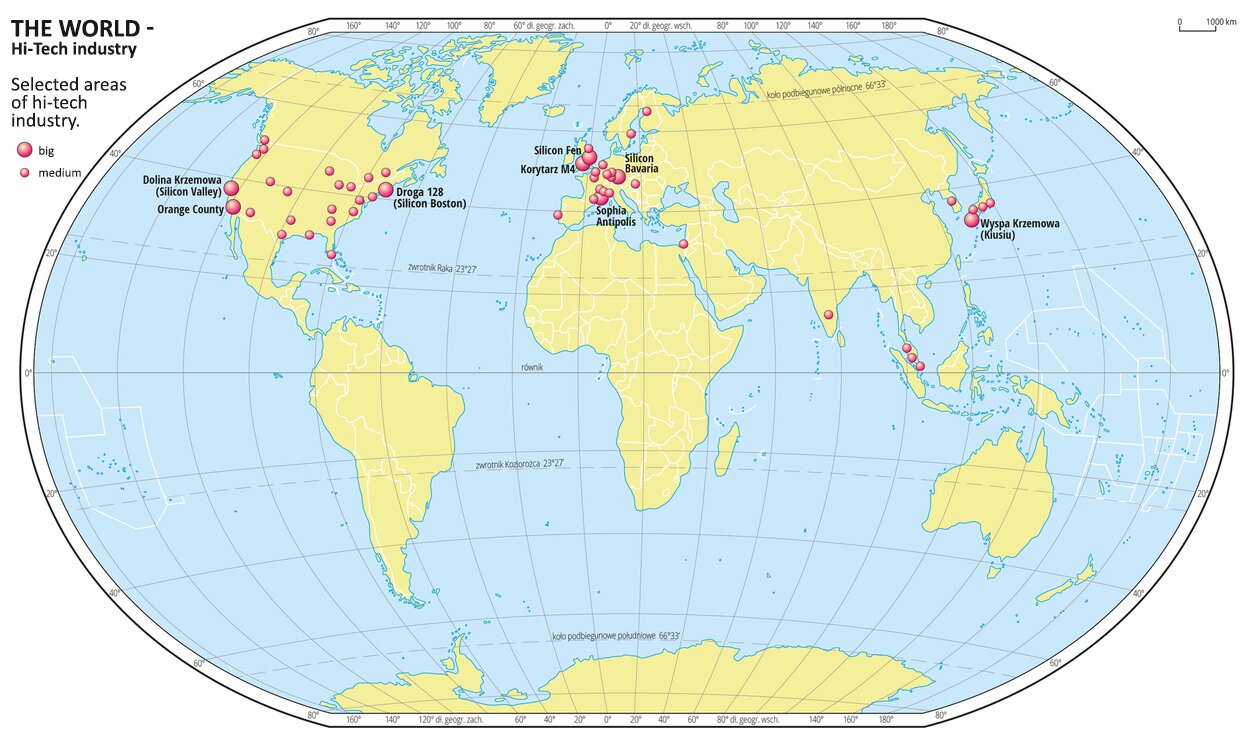
High‑tech plants are located in the vicinity of important scientific and research centres. On the one hand, they use research and implement the results in production, and on the other, they get highly qualified employees.
New spatial forms and their functions
Due to the complex nature of production processes and the large number of components comprising the final product, high‑tech industry plants are often located close to one another. They use the same infrastructure and the same universities; employees can change their workplaces without changing the industry in which they specialise. The final product of one company becomes a component for another company. Therefore, there is a dynamic balance between competition and collaboration. In this way, industrial clusters are formed.
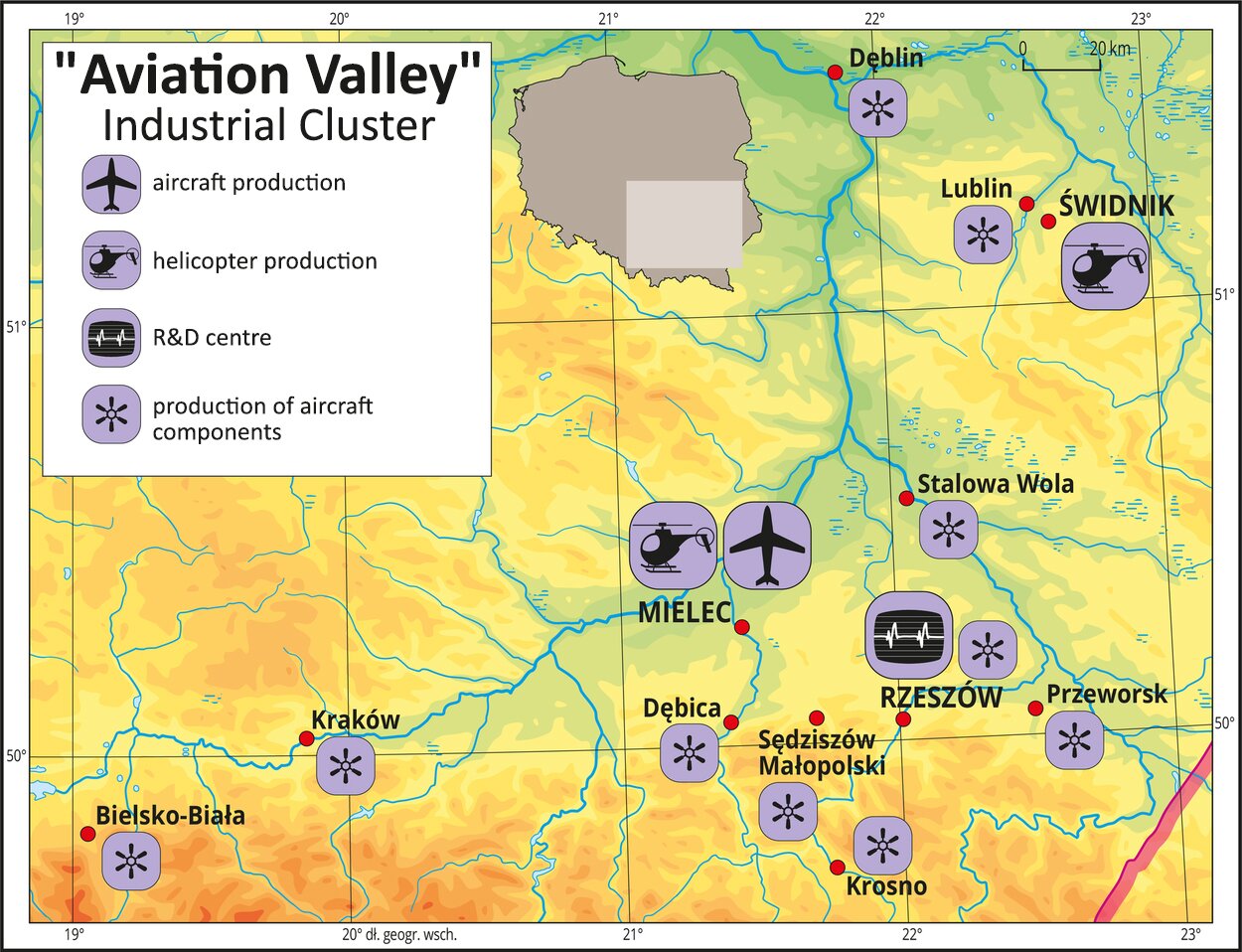
On the basis of available sources of information explain the difference between an industrial district and industrial clusters, and between a technopole and a technopolis. Name the functions played by areas and centres of modern technology.
Difference between a technopole and a technopolis:
Functions played by areas and centres of modern technology:
Mark those factors which determine the location of hi-tech industry.
- Proximity of scientific and research centres
- Outlet
- Long distance from culture centres
- Communication infrastructure
- Clean air
On the basis of the description, indicate the area of high-tech industry.
Silicon Fen next to Cambridge, Sophia Antipolis next to Nice, The Silicon Valley, Road 128 next to Boston
It came into existence under favourable circumstances. It was a place with a good climate. Rainfalls came only in winter, temperature would not drop below 15 °C, and did not exceed 30 °C in summer. Originally, it was farming land – small hills were covered by orange and peach orchards cultivated by local people. After WWII, it was decided to move part of research and production activities to Stanford. Excellent professionals were brought in, and the factories started to produce tanks and radars instead of ploughs and tractors. The university become to draw companies which gradually grew and multiplied, as their employees would later open their own businesses. In 1980, there were 90 enterprises with 25 thousand employees. Advanced industrial technologies were being developed. In 1985, there were more than 2500 plants with more than 220 thousand employees. Currently, there are more than 700 IT and computer companies.
The above description refers to:
..........................................................
Match the city where high-tech industry is present with the name of the area.
Sophia Antipolis, Road 128, Silicon Valley, Silicon Fen
| Nice | |
| San Francisco | |
| Cambridge | |
| Boston |
Indicate the branche of high-tech industry.
- chemical industry
- mining industry
- optical industry
- steel industry
- food industry
- pharmaceutical industry
Keywords
cluster, industrial district, technopolis, hi‑tech
Glossary
dystrykt przemysłowy – zespół małych lub średnich zakładów podobnych lub takich samych branż innowacyjnych silnie powiązanych nie tylko ekonomicznie, ale także rodzinnie lub kulturowo
klaster przemysłowy – zespół zakładów podobnych lub takich samych branż silnie powiązanych poprzez kooperację lub miejsce w cyklu produkcji
technopolia – zbiór biegunów technologicznych, czyli nowoczesny okręg przemysłowy najnowszej generacji, gdzie główną gałęzią przemysłu jest przemysł wysokich technologii – high‑tech