What are sounds and where do they come from? In order to answer that question, turn on the radion and put your hand near the speaker. Do you feel the air vibrations? Now place your hand close to your mouth and say something. Do you also feel similar vibrations? How is it that we’re even able to produce a voice? Perhaps you know something about vocal cords?
Sound production
Observation 1
Determination what part of the human body produces voice.
You will need
no items are needed.
Instruction
Place your fingers on your larynx.
Say a few words. What do you feel?
Summary
The larynx is where vocal cords are located. When you speak, the cords vibrate and produce sounds.
Sounds are nothing more than particle vibrations. They may travel only in a medium, i.e. an environment filled with particles, e.g. in water or in the air. Air density and pressure disruptions – sound wavessound wavesound waves – are produced at a fast rate around the vibrating object, i.e. the source of soundsource of soundsource of sound.
Task 1
Before you watch the film titled “Sounds that can be seen”, write down a research question and a hypothesis. While watching the film, write down your observations and, at the end, your conclusions.
Rp7Wgs1Kmo7gq
Before you watch the film titled “Sounds that can be seen”, write down a research question and a hypothesis. While watching the film, write down your observations and, at the end, your conclusions.
Analysis of the experiment
Research question (Uzupełnij). Hypothesis (Uzupełnij). Observations (Uzupełnij). Conclusions (Uzupełnij).
Before you watch the film titled “Sounds that can be seen”, write down a research question and a hypothesis. While watching the film, write down your observations and, at the end, your conclusions.
Analysis of the experiment
Research question (Uzupełnij). Hypothesis (Uzupełnij). Observations (Uzupełnij). Conclusions (Uzupełnij).
Analysis of the experiment
R1JprRtY1QURv
Nagranie filmowe przedstawiające eksperyment w laboratorium. Rzeczy potrzebne scissors, balloon, plastic cup, petri dish with cooking salt. Przecinamy balon w pół następnie, naciągamy go na pojemnik i posypujemy solą. Stawiamy radio a na przeciwko nasz balon. Włączamy radio i obserwujemy co się dzieje.
Nagranie filmowe przedstawiające eksperyment w laboratorium. Rzeczy potrzebne scissors, balloon, plastic cup, petri dish with cooking salt. Przecinamy balon w pół następnie, naciągamy go na pojemnik i posypujemy solą. Stawiamy radio a na przeciwko nasz balon. Włączamy radio i obserwujemy co się dzieje.
Sounds that can be seen
Source: GroMar Sp. z o.o., licencja: CC BY-SA 3.0.
Source: GroMar Sp. z o.o., licencja: CC BY-SA 3.0.
Nagranie filmowe przedstawiające eksperyment w laboratorium. Rzeczy potrzebne scissors, balloon, plastic cup, petri dish with cooking salt. Przecinamy balon w pół następnie, naciągamy go na pojemnik i posypujemy solą. Stawiamy radio a na przeciwko nasz balon. Włączamy radio i obserwujemy co się dzieje.
How does sound travel?
We already know that sounds are caused by the vibration of objects. How do sounds travel in the air?
ROXuFIRmv9J3U
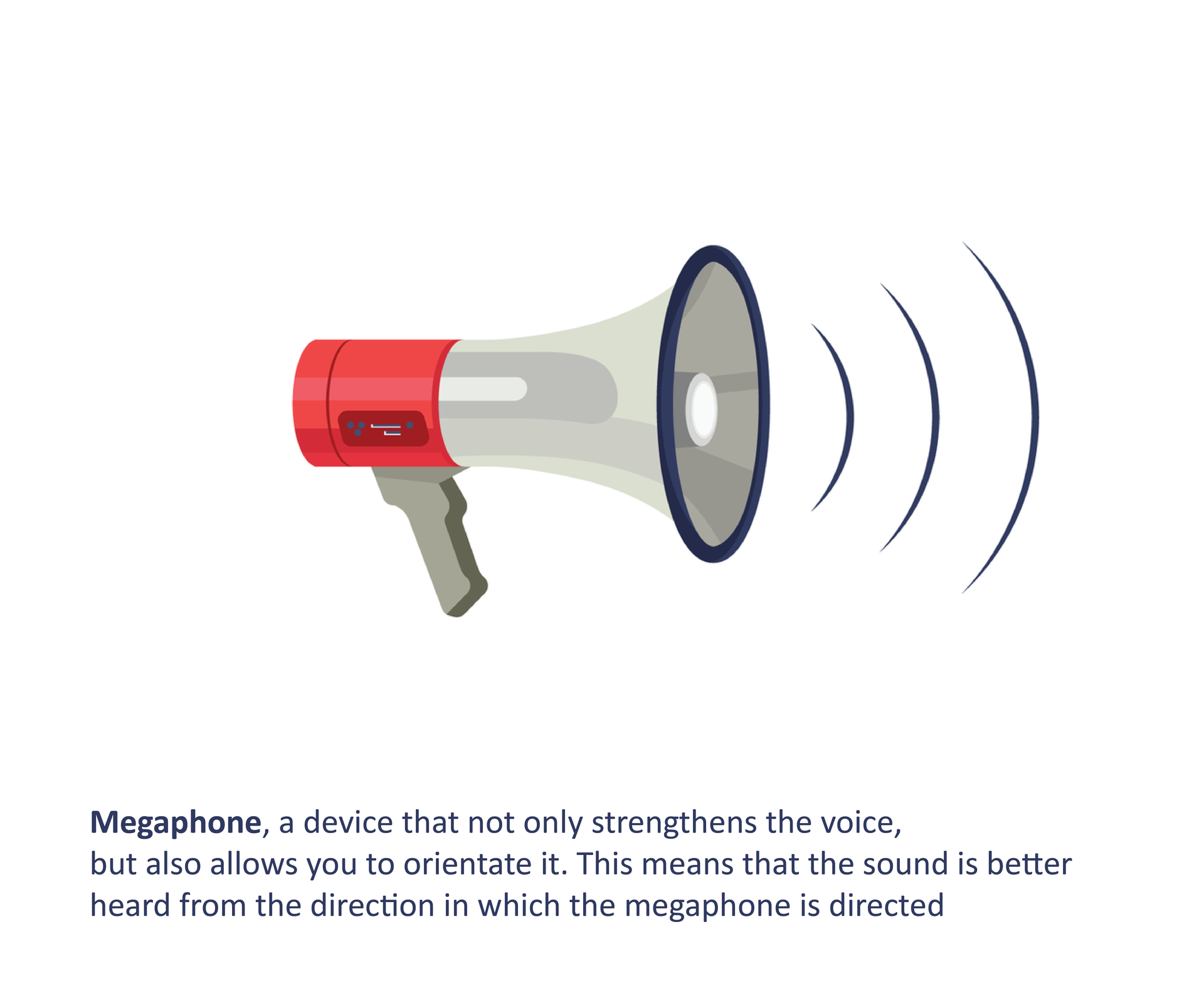
Ilustracja przedstawia megafon z wydobywającymi się z niego dźwiękami. Pod ilustracją jest podpis: Megaphone, a device that not only strengthens the voice, but also allows you to orientate it. This means that the sound is better heard from the direction in which the megaphone is directed
Sound propagation
Source: Anita Mowczan, licencja: CC BY 3.0.
Sounds travel through air and water, but also through rock, metal, glass and other materials. We will prove it by building a simple phone.
Sound dispersion in various materials
Observation 2
Examination whether sound can travel through more than just air.
You will need
a ruler,
a bowl with water,
around 10 metres of string,
2 plastic beverage cups,
a needle,
2 buttons,
the second part of the experiment will require assistance from a colleague.
Instruction
Take the ruler in your hand.
While holding one end of the ruler, strike the rim of bowl with the other end and quickly, while it’s still vibrating, submerse the ruler in water. What do you observe?
Poke two small holes exactly in the middle of the bottom of the cup with the needle and thread the string through them. Tie the buttons at the ends of the string so that they don’t fall out of the cups.
Ask someone in your class to take one cup, you take the other. Move away from each other so that the string is pulled taut. Place the cup to your ear – at that moment the other person with whom the observation is conducted should say something into their cup. Then switch roles.
Summary
Both water and string carry vibrations and, therefore, sounds.
Important!
Space is a vacuum, which means that there are no particles. This means that sound doesn’t travel in space. That’s why there is no sound in space.
Do sounds always travel with the same speed? The answer is no. The speed at which a sound wave travels depends on the medium through which it travels. For instance, sound travels significantly faster through water than air. This can be observed at a lake or at sea – an engine of a vessel can be heard much faster, if you lean over the water surface.
RwxcAi2qtBQJ9
Zdjęcie kobietę w okularach, ubraną w niebieską kurtkę nasłuchującą zwierząt z uchem przy ziemi. Osoba jest pochylona nad ziemią ponieważ przy samej ziemi dźwięki te słyszalne są najlepiej.
Listening for the sounds of approaching animals
Source: Tomorrow Sp. z o.o., licencja: CC BY 3.0.
Medium
Speed of sound travel ()
glass
6000
steel
5100–6000 (depends on composition)
ice
3300
water
1500
air at sea level
340
RZQMB1iZo5liF
Exercise 1
Match the terms with appropriate explanations. sound Możliwe odpowiedzi: 1. drgające ciała wytwarzające falę dźwiękową, 2. propagowanie wibracji cząstek w ośrodku, 3. rozchodzące się w przestrzeni drgania cząsteczek ośrodka, skutkiem których są chwilowe zagęszczenia i rozrzedzenia ośrodka source of sound Możliwe odpowiedzi: 1. drgające ciała wytwarzające falę dźwiękową, 2. propagowanie wibracji cząstek w ośrodku, 3. rozchodzące się w przestrzeni drgania cząsteczek ośrodka, skutkiem których są chwilowe zagęszczenia i rozrzedzenia ośrodka sound wave Możliwe odpowiedzi: 1. drgające ciała wytwarzające falę dźwiękową, 2. propagowanie wibracji cząstek w ośrodku, 3. rozchodzące się w przestrzeni drgania cząsteczek ośrodka, skutkiem których są chwilowe zagęszczenia i rozrzedzenia ośrodka
Match the terms with appropriate explanations. sound Możliwe odpowiedzi: 1. drgające ciała wytwarzające falę dźwiękową, 2. propagowanie wibracji cząstek w ośrodku, 3. rozchodzące się w przestrzeni drgania cząsteczek ośrodka, skutkiem których są chwilowe zagęszczenia i rozrzedzenia ośrodka source of sound Możliwe odpowiedzi: 1. drgające ciała wytwarzające falę dźwiękową, 2. propagowanie wibracji cząstek w ośrodku, 3. rozchodzące się w przestrzeni drgania cząsteczek ośrodka, skutkiem których są chwilowe zagęszczenia i rozrzedzenia ośrodka sound wave Możliwe odpowiedzi: 1. drgające ciała wytwarzające falę dźwiękową, 2. propagowanie wibracji cząstek w ośrodku, 3. rozchodzące się w przestrzeni drgania cząsteczek ośrodka, skutkiem których są chwilowe zagęszczenia i rozrzedzenia ośrodka
Match the terms with appropriate explanations.
drgające ciała wytwarzające falę dźwiękową, propagowanie wibracji cząstek w ośrodku, rozchodzące się w przestrzeni drgania cząsteczek ośrodka, skutkiem których są chwilowe zagęszczenia i rozrzedzenia ośrodka
sound
source of sound
sound wave
RjgwsARBE22as
Exercise 2
Jednokrotny wybór. Check the correct sentece. Możliwe odpowiedzi: 1. Sound is the dispersal of vibrations of medium particles., 2. Sound is a wave connected with each movement of particles in a medium., 3. Sound is produced when particles move from place to place.
Jednokrotny wybór. Check the correct sentece. Możliwe odpowiedzi: 1. Sound is the dispersal of vibrations of medium particles., 2. Sound is a wave connected with each movement of particles in a medium., 3. Sound is produced when particles move from place to place.
Check the correct sentece.
Sound is the dispersal of vibrations of medium particles.
Sound is a wave connected with each movement of particles in a medium.
Sound is produced when particles move from place to place.
RHc27maUBWWtl
Exercise 3
Specify whether the statement is true or false.. Sounds travel at different speeds depending on the medium through which they travel.. Możliwe odpowiedzi: True, False. Sounds travel slower in water than in air.. Możliwe odpowiedzi: True, False. We are able to hear sounds at any frequency.. Możliwe odpowiedzi: True, False. Sounds cannot travel through vacuumm.. Możliwe odpowiedzi: True, False
Specify whether the statement is true or false.. Sounds travel at different speeds depending on the medium through which they travel.. Możliwe odpowiedzi: True, False. Sounds travel slower in water than in air.. Możliwe odpowiedzi: True, False. We are able to hear sounds at any frequency.. Możliwe odpowiedzi: True, False. Sounds cannot travel through vacuumm.. Możliwe odpowiedzi: True, False
Specify whether the statement is true or false.
True
False
Sounds travel at different speeds depending on the medium through which they travel.
□
□
Sounds travel slower in water than in air.
□
□
We are able to hear sounds at any frequency.
□
□
Sounds cannot travel through vacuumm.
□
□
Summary
Sounds are created as a result of the vibration of various media.
A sound wave is the vibrations produced by the source of sound.