What do we need political parties for?
Political parties are social organizations whose main goal is to gain power and form a government to implement their political programmes.
Democracy is based on the principle of pluralism - creating political parties is legal, encouraged and desired. They have a number of important functions in a democratic political system.
The Polish Constitution forbidsforbids only the existence of parties that would be a threat to democracy itself.
You will be able to define a party system.
You will be able to name the most common types of party systems and explain their nature.
You will be able to discuss the advantages and disadvantages of each of the party systems.
You will be able to explain the difference between a proportional and majoritarian representation and discuss the consequences of each of the voting systems.
Political parties significantly influence the socio‑political reality of every democratic state, including Poland. They prepare their members to rule the state and society, strivestrive to gain power, shape the consciousness, attitudes and political behaviours of people. Political parties are constantly trying to gather the greatest number of supporters and mobilize them to be active. To this end, they form election committees and run election campaigns. Voters decide which of the political parties will dominate the political scene of the state, win the majority in the legislative bodies or form a government.
Watch the animation that presents the electoral systems in the world and in Poland.

Film dostępny na portalu epodreczniki.pl
Ordynacja wyborcza, system wyborczy – zbiór przepisów wchodzących w skład tzw. wyborów regulujących sposób przeprowadzenia wyborów, a w szczególności zasady wyłaniania ich zwycięzców i podziału mandatów. Głosy te następnie są zliczane i w stystemie reprezentacji proporcjonalnej lub głosowania większościowego.Ordynacja większościowa to system ordynacji wyborczej, w którym mandaty otrzymują kandydaci, bądź tylko jeden kandydat, który uzyskał określoną prawem większość głosów w danym okręgu wyborczym. Ordynacja proporcjonalna – szczególny sposób przeliczania preferencji wyborców na liczbę mandatów partii lub preferencji wyborców na liczbę głosów kandydata na urząd państwowy w procesie wyłaniania reprezentanta. W Polsce system proporcjonalny obowiązuje w wyborach do Sejmu, a większościowy w wyborach do Senatu.
A party system is the whole of relations between political parties and between parties and institutions of state power. It refers to the typical structure of parties within a political system. One of the possible ways to differentiatedifferentiate party systems is based on indicatingindicating the number of parties that are capable of actually participating in political life and exercising power.
Democratic systems of the modern world are dominated by two main systems. Study the scheme below and find out, what they are like.
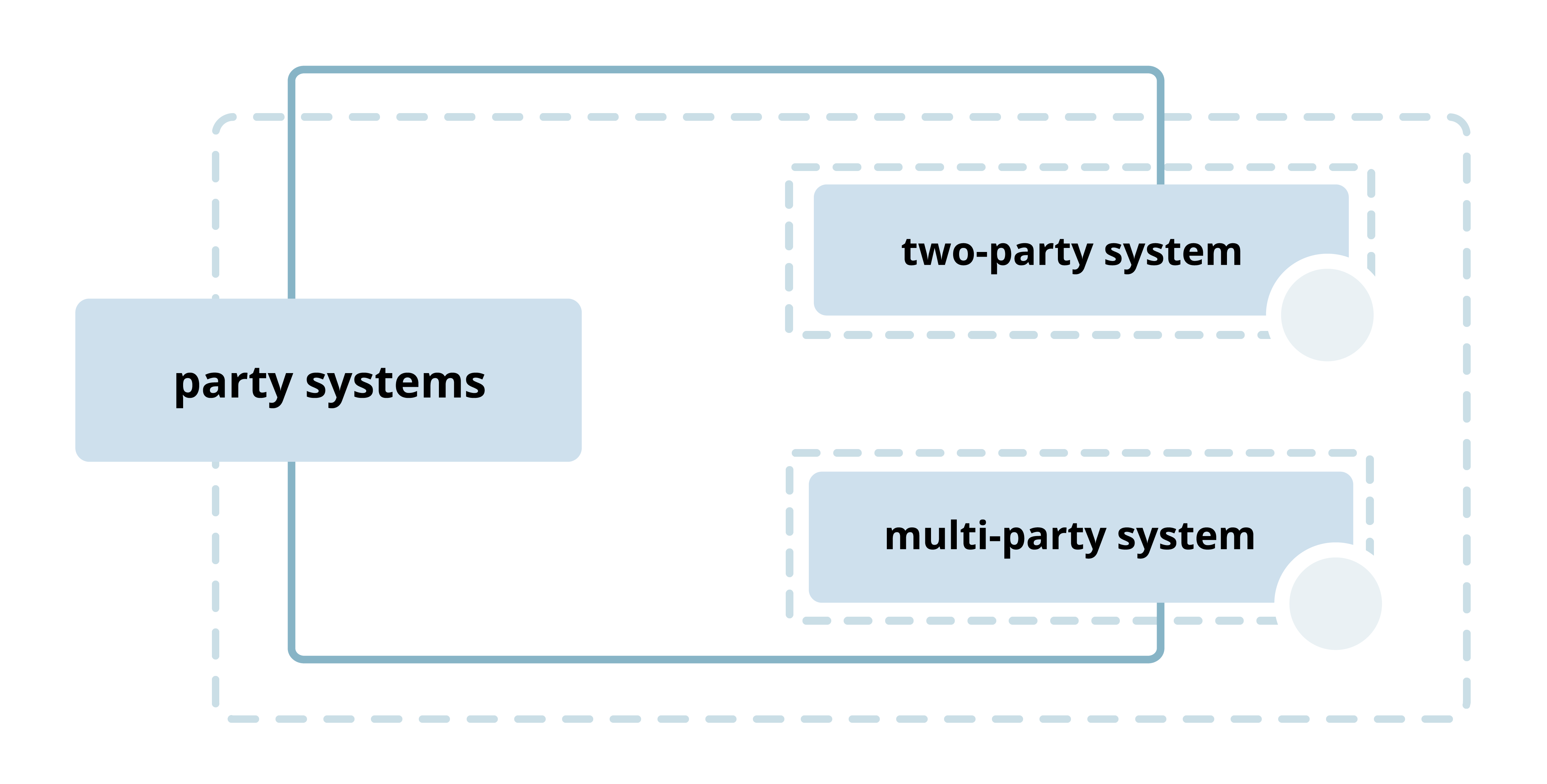
1. Two large parties dominate over other, smaller parties. These two large parties compete with each other to gain power in the state. The winning one forms an independent government. Such a system exists, among others, in the United States and the United Kingdom.
A system very similar to a two-party system is a two-block system. The main difference is that instead of two main parties there are two big coalitions trying to assume power. Moreover, the coalitions function a bit differently - there are greater ideological differences within the coalition than there are within a party.
2. There are many parties, none of which receive more than 50% of the seats in elected bodies, for example in the Sejm. This means that it is necessary to create a coalition government. Such a system exists, among others, in the Netherlands and Czechia.
A variety of a multi-party system is a dominant-party system, where one party, despite of not being the only one who has won mandates to a parliamentary body, has enough political support (enough votes in the parliamentary body) to single handedly form a government.
Analyze the two‑party and multi‑party systems. Think about the strengths and weaknesses, as well as the opportunities and threats they bring. Write your conclusions into the tables.
Which of the states has a two-party system?
- USA
- Poland
- China
- France
- Germany
In undemocratic states, a one‑party system is usually in placein place, where only one party can legally function, gathering all the power. There are no opposition parties and opponents of the only party are subject to repression.
Match the specific tasks to particular functions of the political party.
managing various spheres of state activity by making decisions and supervising their implementation, creation and dissemination of the party program, creation and dissemination of information, appointing the candidates to the executive branch, selection of candidates for elected state and local government institutions, shaping a relatively stable attitude towards various political phenomena and processes
| Shaping opinions and political attitudes | |
|---|---|
| Election | |
| Governance |
Listen to the abstract recording to review the material and new vocabulary. Then do the vocabulary exercise. Match the pairs: English and Polish words.
wskazać, obowiązujący, zróżnicować, starać się, zakazywać, zabraniać
| to forbid | |
| to strive | |
| to differentiate | |
| to indicate | |
| in place |
Keywords
party system, two‑party/multi‑party/one‑party system, voting system, majoritarian/proportional representation, coalition government
Glossary
zakazywać, zabraniać
starać się
zróżnicować
wskazać
obowiązujący