a) Provide the content of I, II and III Newton’s law. b) Give what is the measure of the inertia of the bodies. c) List the types of frictionfrictionfriction forces. d) Specify what the friction force depends on. e) Provide ways to change the friction force.
If no force or forces act on the body, the body remains at rest or moves in a uniform linear motion relative to the inertial reference frame.
Second Newton's law
If the body has a constant unbalanced forceunbalanced forceunbalanced force (or net force), the body moves in a uniformly accelerated motion with acceleration directly proportional to the applied force and inversely proportional to the mass of this body.
Third Newton's law
When the body A acts on the body B with a certain force , the body B acts on the body A with the force with the same magnitude but opposite direction. These forces cannot be balanced because they are applied to two different bodies.
The third Newton's law is often called action‑reaction law.
c) We distinguish two basic types of frictionfrictionfriction: static friction and dynamic friction.
d) The friction force depends on how large is the force which presses the two surfaces together and on the type of the two surfaces.
e) The friction force can be changed by varying the force which presses the surfaces together or by changing the coefficient of friction by changing the roughness of the surfaces (e.g. by smoothing) or by using a lubricant to reduce friction, grease or oil.
Check what the different letters in the formula mean:
RErqZd0VP9dX4
Ilustracja interaktywna przedstawia zapisy, od góry: Check what the different letters in the formula mean:, a równa się F z indeksem dolnym w przez m. Po prawej stronie legenda: F z indeksem dolnym w - 1, a - 2, m - 3. Nad literami F i a strzałka pozioma skierowana w prawo. Na ilustracji widoczne są numery, a na nich podpisy. 1. constant unbalanced force {audio}, 2. acceleration {audio}, 3. mass of the body {audio}.
Ilustracja interaktywna przedstawia zapisy, od góry: Check what the different letters in the formula mean:, a równa się F z indeksem dolnym w przez m. Po prawej stronie legenda: F z indeksem dolnym w - 1, a - 2, m - 3. Nad literami F i a strzałka pozioma skierowana w prawo. Na ilustracji widoczne są numery, a na nich podpisy. 1. constant unbalanced force {audio}, 2. acceleration {audio}, 3. mass of the body {audio}.
The second Newton's law
Source: GroMar, licencja: CC BY 3.0.
Exercise 2
The Earth attracts a body with a mass of 2 kg with a force of 20 N, and a body with a mass of 0,5 kg with a force of 5 N. Calculate the acceleration that these bodies get by falling (bypassing the air resistance).
Analysis
Given:
Unknown:
Solution:
Answer:
Acceleration with which the body falls to Earth is , it is gravitational acceleration.
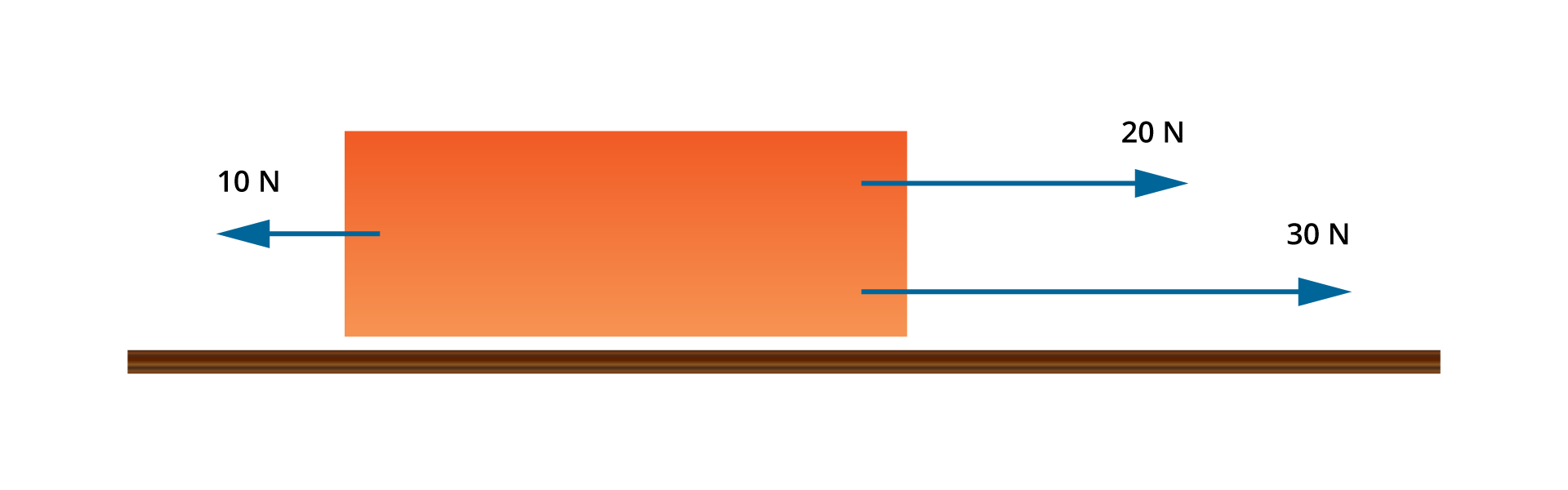
The forces shown in the figure act on a block with a mass of 10 kg moving on a horizontal surface. Calculate the acceleration of this block.
R1TeYEb0OTlP5
Na ilustracji znajduje się pozioma linia, nad nią narysowany prostokąt. Z lewego boku prostokąta narysowana najkrótsza strzałka pozioma skierowana w lewo opisana 10 N. Z prawego boku prostokąta narysowana strzałka pozioma skierowana w prawo opisana 20 N oraz poniżej najdłuższa strzałka pozioma skierowana w prawo opisana 30 N.
The platform on which there is a 200 kg box moves with an acceleration of 2,5 . What is the frictionfrictionfriction force if the box does not move on the platform? What fraction of the normal forcenormal forcenormal force is the friction force in this case?
Analysis
Given:
Unknown:
Solution:
Answer:
The magnitude of the frictionfrictionfriction force is 500 N. The friction force is of the normal force.
The body moves with a constant acceleration of 3 . This means that:
a) body speed increased by 1 in 3 seconds, b) body speed increased by 6 in 2 seconds, c) body speed increased by 3 in 3 seconds, d) body speed increased by 3 in 1 second.
If a body with a mass of acts on a body with a mass of , with a certain force it means that a body with a weight of acts on a body with a mass of with a force:
a) 4 times larger. b) 4 times smaller. c) The magnitude of the force is the same in both cases. d) The magnitude of the force is the same, but opposite direction. e) The magnitude of the force cannot be determined because there not enough information.
a) The direction of the frictionfrictionfriction force is always opposite to the direction of the velocity of the body. b) If you want to stop the car, use force. c) The friction that acts during movement is greater than the friction that must be overcome to set the body in motion. d) When we stand on the Earth, we press on the Earth and the Earth does not press on us. e) The car moves at a constant speed when the net force acting on it is constant and greater than zero. f) The force of 10 N gave an acceleration of 2 to a body with a mass of 0,5 kg.
a) True. b) True. c) False. d) False. e) False. f) False.
DynamicsdynamicsDynamics describes the movement of a physical body under the influence of forces.
The first Newton's law is that in the inertial reference frame a body can change its speed only an external force acts on it.
The second Newton's law determines that the acceleration a which the body with the mass m under the influence of the unbalanced forceunbalanced forceunbalanced force F is experiencing is equal to:
The third Newton's law is that bodies always act on each other with equal forces but on opposite directions. Each action is accompanied by reaction equal in magnitude, but with opposite direction.
All bodies during their movement experience the forces of resistance to movement.
FrictionfrictionFriction is the resistance to motionresistance to motionresistance to motion (force) associated with the interaction occurring on the contact surface of two bodies when a force acting on the body is trying to set the body in motion. To calculate the friction forces we can use the following formula:
where: - friction force, - normal forcenormal forcenormal force, - coefficient of friction.
Exercises
Rbh6grbfXPZft
Exercise 10
Wersja alternatywna ćwiczenia: Determine which sentences are true. Możliwe odpowiedzi: 1. The inertia of the empty wagon is greater than that of filled with coal., 2. The rocket can start when its thrust is greater than the weight of the rocket., 3. The resultant of forces acting on an immobile magnet on the refrigerator is 0 N., 4. Acceleration of a body can be calculated using the formula , 5.
Wersja alternatywna ćwiczenia: Determine which sentences are true. Możliwe odpowiedzi: 1. The inertia of the empty wagon is greater than that of filled with coal., 2. The rocket can start when its thrust is greater than the weight of the rocket., 3. The resultant of forces acting on an immobile magnet on the refrigerator is 0 N., 4. Acceleration of a body can be calculated using the formula , 5.
Determine which sentences are true.
The inertia of the empty wagon is greater than that of filled with coal.
The rocket can start when its thrust is greater than the weight of the rocket.
The resultant of forces acting on an immobile magnet on the refrigerator is 0 N.
Acceleration of a body can be calculated using the formula
Exercise 11
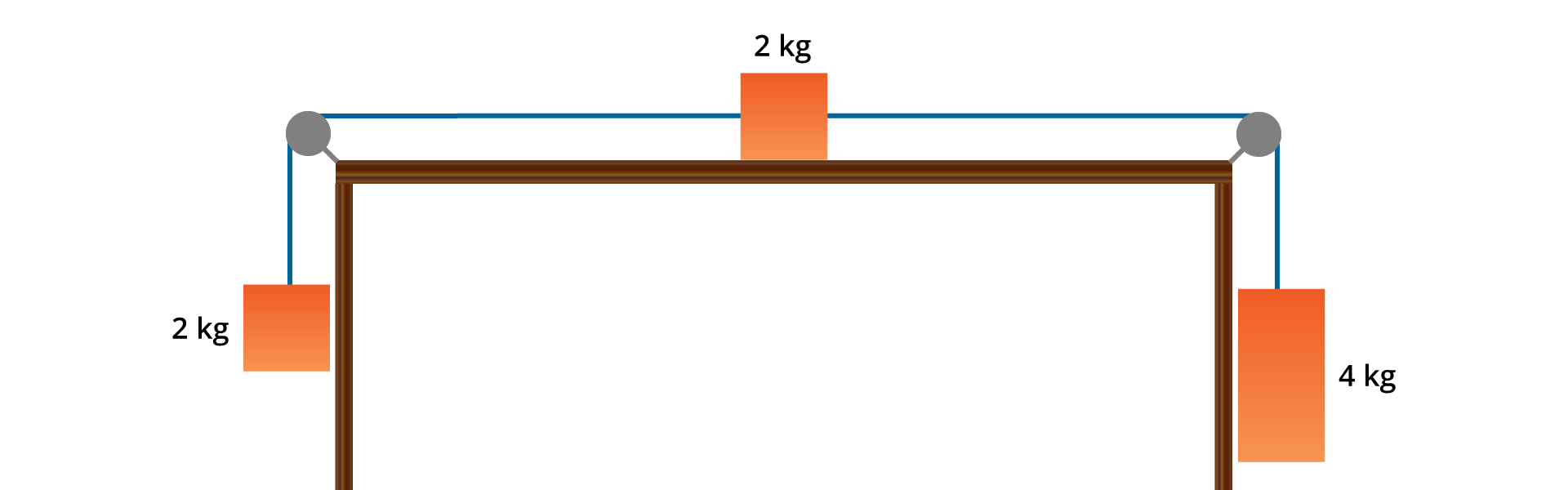
Calculate the acceleration of the set of blocks shown in the figure (assume g = 10 ).
R1GYWPNY2bNWg1
Ilustracja przedstawia stół, na którego środku znajduje się kwadrat opisany 2 kg z obu stron prostokąta narysowane są linie poziome do kółek umieszczonych w rogach stołu. Od kółek narysowane są linie pionowe w dół. Na ich końcach znajdują się po lewej stronie stołu kwadrat opisany 2 kg, po prawej stronie stołu prostokąt opisany 4 kg.
Source: GroMar, licencja: CC BY 3.0.
The net force F setting the blocks in motion is equal to the difference in weight of the hanging blocks:
The mass m on which the force F acts is the sum of three masses:
According to the second Newton’s law, the acceleration of the three masses is:
a =
a =
a = 2,5
Answer:
a = 2,5
Exercise 12
Explain in English why if the locomotive pulls the wagon with some force and the wagon pulls the locomotive with the same force, then the whole train moves forward and not backwards.
In this phenomenon, besides the locomotive and the wagon, there is also the Earth. In this system, the locomotive, by means of friction (kinetic) of wheels on rails, pushes them together with the Earth backwards, while the Earth pushes the locomotive forward. The weight of the locomotive, which is bigger than the weight of the wagon, is significant here, hence the friction force of the locomotive's wheels on the rails is greater than the friction force of the wagon wheels on the rails. Therefore, when starting off, the resultant of forces acting on the train is directed towards the motion of the locomotive. With uniform motion, all forces acting on the train are balanced, but the inertia of the train results in maintaining the acquired direction of movement.
RxvK1zeJLKK9j
Exercise 13
Wersja alternatywna ćwiczenia: Indicate which pairs of expressions or words are translated correctly. Możliwe odpowiedzi: 1. siła niezrównoważona - balanced force, 2. siła akcji - action force, 3. siła reakcji - reaction force, 4. siła nacisku - normal force, 5. siła zrównoważona - unbalanced force, 6. opory ruchu - resistance to motion
Wersja alternatywna ćwiczenia: Indicate which pairs of expressions or words are translated correctly. Możliwe odpowiedzi: 1. siła niezrównoważona - balanced force, 2. siła akcji - action force, 3. siła reakcji - reaction force, 4. siła nacisku - normal force, 5. siła zrównoważona - unbalanced force, 6. opory ruchu - resistance to motion
Indicate which pairs of expressions or words are translated correctly.
siła niezrównoważona - balanced force
siła akcji - action force
siła reakcji - reaction force
siła nacisku - normal force
siła zrównoważona - unbalanced force
opory ruchu - resistance to motion
zadanie
Source: GroMar, licencja: CC BY 3.0.
RjFPJ8RPXG1ij1
Interaktywna gra, polegająca na łączeniu wyrazów w pary w ciągu jednej minuty. Czas zaczyna upływać wraz z rozpoczęciem gry. Jeden ruch to odkrywanie najpierw jednej potem drugiej karty z wyrazem. Każdy wyraz jest odczytywany. Kolejny ruch to odkrywanie trzeciej i czwartej karty. W ten sposób odsłuchasz wszystkie wyrazy. Nawigacja z poziomu klawiatury za pomocą strzałek, odsłuchiwanie wyrazów enterem lub spacją. Znajdź wszystkie pary wyrazów.
Interaktywna gra, polegająca na łączeniu wyrazów w pary w ciągu jednej minuty. Czas zaczyna upływać wraz z rozpoczęciem gry. Jeden ruch to odkrywanie najpierw jednej potem drugiej karty z wyrazem. Każdy wyraz jest odczytywany. Kolejny ruch to odkrywanie trzeciej i czwartej karty. W ten sposób odsłuchasz wszystkie wyrazy. Nawigacja z poziomu klawiatury za pomocą strzałek, odsłuchiwanie wyrazów enterem lub spacją. Znajdź wszystkie pary wyrazów.
Match Polish terms with their English equivalents.
friction
tarcie
resistance to motion
balanced force
unbalanced force
dynamika
siła niezrównoważona
opory ruchu
dynamics
siła zrównoważona
Source: Zespół autorski Politechniki Łódzkiej, licencja: CC BY 3.0.