Floorings and tessellations
Learning objectives
You will get to know a method of recognizing particular types of polygons.
You will get to know a method of using the properties of polygons in realistic contexts.
Learning effect
You will learn how to recognize particular types of polygons.
You will learn to use the properties of polygons in realistic contexts.
Find the meaning of the ideas of flooringflooring and tessellations in available sources.
The tessellationtessellation is the tiling of a plane using adjoining polygons, with no overlaps and no gaps. The flooringflooring is the top covering of a floor, often decorative.
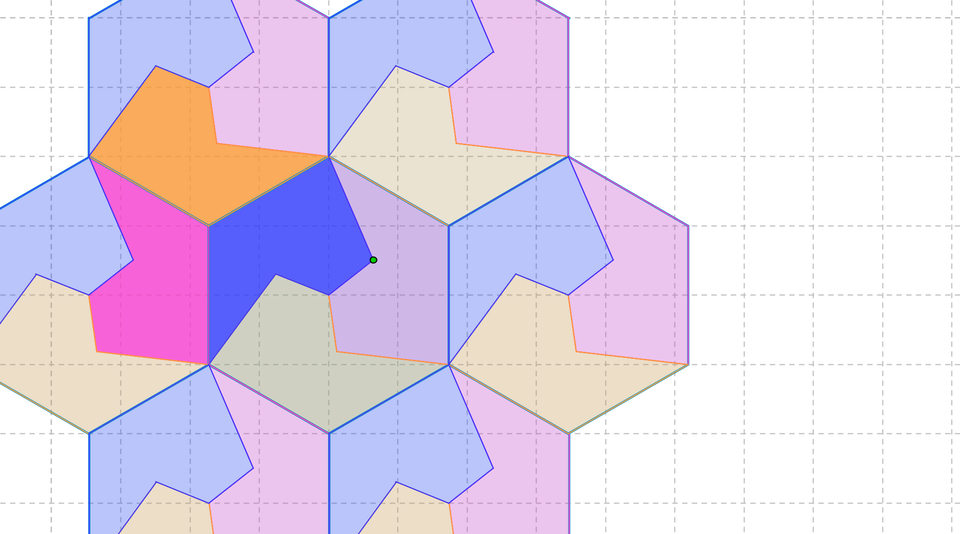
The aim of the class is getting to know the possibility of using polygons to make tessellations and decorative floorings. Patterns on floorings are often made of regular polygons, which means the polygons whose all sides and angles are equal. You will observe the process of making tessellations, as repetitive elements, using the applet.
Zasób interaktywny dostępny pod adresem https://zpe.gov.pl/a/DKeP0DX5i
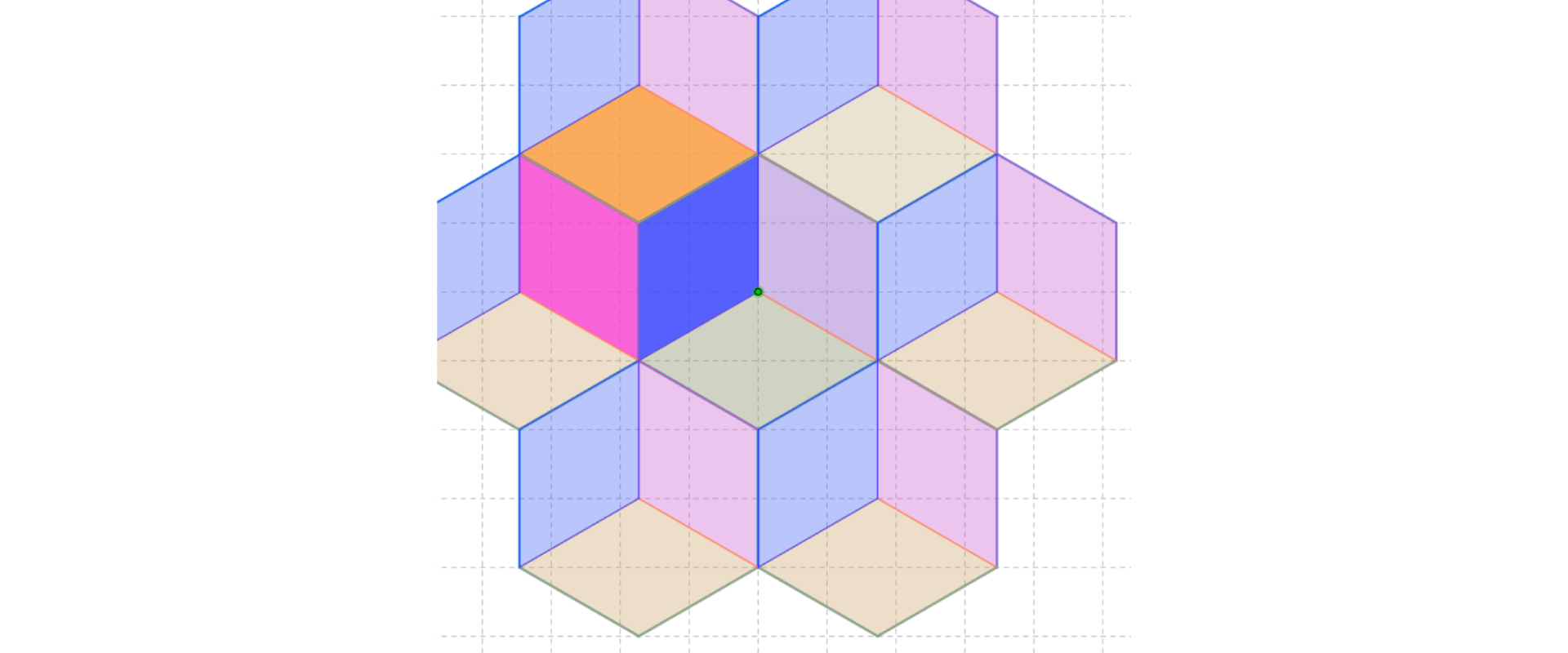
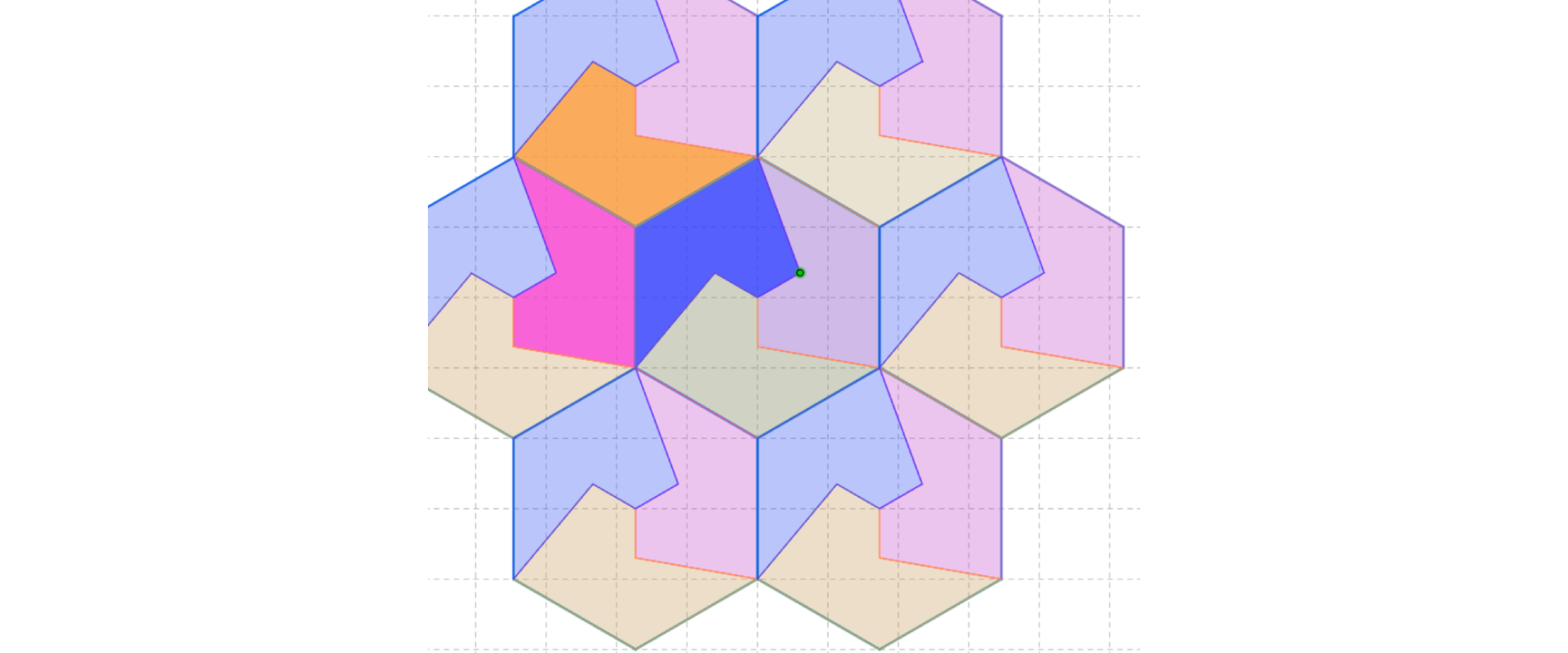
Observe how the shape of one polygonpolygon, a single element of the tessellationtessellation, changes when the position of its apex changes. Use the terminology referring to polygons (a convex polygonpolygon, a concave polygonpolygon, a heptagon, etc.). Give examples of popular tessellations, that they know (e.g. ceramic tiles or woodblocks). Draw the patterns on the board. Use the diagram TESSELLATIONS, where you can see a flooringflooring patternpattern commonly found in palaces to solve the tasks.
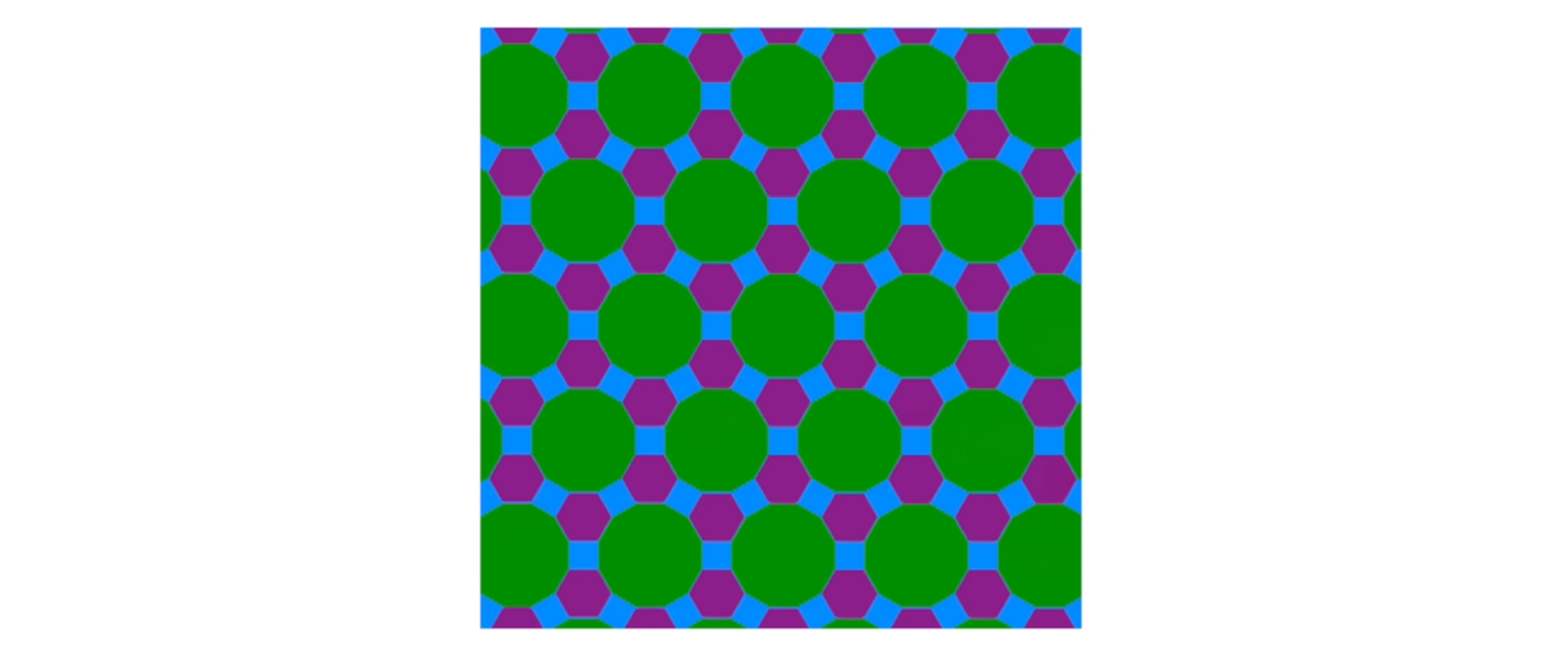
How many different types of polygons do you need to make a patternpattern similar to the one in the illustration? Give their names.
What do you think – can any type of polygonpolygon be used to make a tessellationtessellation? What does it depend on?
The point where the polygons used to make a tessellationtessellation “meet” is called the vertex of the tessellationtessellation. Find the measure of “touching” angles in one vertex of the tessellationtessellation. Find their sum. Have you noticed anything?
The conclusion
The sum of the angles with a mutual vertex in a tessellationtessellation measures 360 degrees.
Use the information to solve the tasks.
What is the maximum number of triangles “touching” at the vertex of the tessellationtessellation? And how many hexagons?
Complete the sentences with appropriate number.
b) 3 triangles and [tu uzupełnij] squares.
c) A square, a regular dodecagon and [tu uzupełnij] triangles can “meet” at one vertex of a tessellation.
b) 3 triangles and [tu uzupełnij] squares.
c) A square, a regular dodecagon and [tu uzupełnij] triangles can “meet” at one vertex of a tessellation.
What properties of polygons are used to design decorative floorings?
Design your own template to make tessellations. Cut the designed figure out of a cardboard and check the correctness of your patternpattern by making drawings.
Do the consolidation tasks. Formulate the conclusions that you need to remember.
The tessellationtessellation is the tiling of a plane using adjoining polygons, with no overlaps and no gaps. The flooringflooring is the top covering of a floor, often decorative.
The sum of the angles with a mutual vertex in a tessellationtessellation measures 360 degrees.
Exercises
Determine which sentence is true.
- A plane can be covered with squares.
- 5 vertices of squares “meet” at one vertex of a tessellation.
- A plane cannot be covered with equilateral triangles.
- The sum of the angles at one vertex in a tessellation equals a straight angle.
Design a tessellation made of only squares and equilateral triangles. Make a template cutting appropriate figures out of adhesive paper and stick them on a cardboard.
Justify in English that making a tessellation of only regular pentagons is impossible.
Indicate which pairs of expressions or words are translated correctly.
- posadzka - flooring
- parkietaż - tessellation
- wzór - pattern
- wielokąt - polygon
- kwadrat - pentagon
- sześciokąt - square
- pattern
- flooring
- wielokąt
- parkietaż
- tessellation
- polygon
- posadzka
- equilateral triangle
- trójkąt równoboczny
- wzór
Glossary
wzór
Nagranie dostępne na portalu epodreczniki.pl
wymowa w języku angielskim: pattern
trójkąt równoboczny
Nagranie dostępne na portalu epodreczniki.pl
wymowa w języku angielskim: equilateral triangle
posadzka - wierzchnia warstwa podłogi, często dekoracyjna
Nagranie dostępne na portalu epodreczniki.pl
wymowa w języku angielskim: flooring
sześciokąt
Nagranie dostępne na portalu epodreczniki.pl
wymowa w języku angielskim: hexagon
pięciokąt
Nagranie dostępne na portalu epodreczniki.pl
wymowa w języku angielskim: pentagon
wielokąt
Nagranie dostępne na portalu epodreczniki.pl
wymowa w języku angielskim: polygon
kwadrat
Nagranie dostępne na portalu epodreczniki.pl
wymowa w języku angielskim: square
parkietaż - pokrycie płaszczyzny wielokątami przylegającymi do siebie, ale nie zachodzącymi na siebie
Nagranie dostępne na portalu epodreczniki.pl
wymowa w języku angielskim: tessellation
Keywords
patternpattern
flooringflooring - the top covering of a floor, often decorative
polygonpolygon
tessellationtessellation - the tiling of a plane using adjoining polygons, with no overlaps and no gaps