Ilustracja interaktywna
In this section, you are going to learn more about how the problems mentioned in the reading section can be solved. Click on the pictures to listen to people talking about each SDOH and what measures can be taken to increase the well‑being and health of people.
W tej części dowiesz się, jak można rozwiązać problemy wymienione w części poświęconej czytaniu. Kliknij w ilustracje, aby posłuchać, jak ludzie rozmawiają o poszczególnych SDOH i jakie działania można podjąć, aby poprawić samopoczucie i stan zdrowia ludzi.

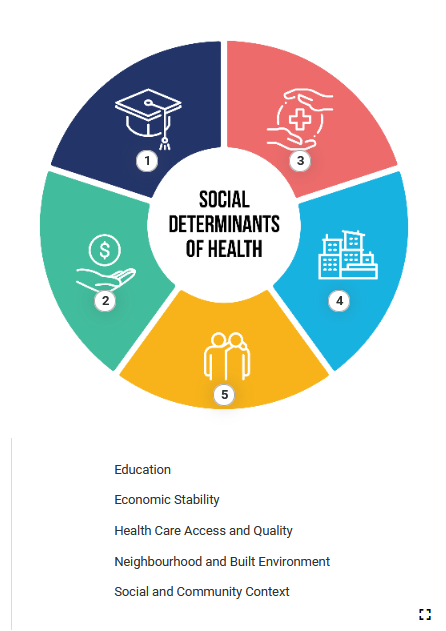
Zasób interaktywny dostępny pod adresem https://zpe.gov.pl/a/D13BpBhvg
Ilustracja przedstawia wykres kołowy składający się z pięciu pól w kolorze czerwonym, niebieskim, żółtym, zielonym i granatowym. Na każdym polu widoczny jest symbol. Pośrodku widoczne jest białe koło z napisem z czarnych liter w języku angielskim: SOCIAL DETERMINANTS OF HEALTH.
Do każdego pola przypisany jest numer od 1 do 5. Po naciśnięciu numerka można odsłuchać nagranie przypisane do punktu interaktywnego.
Transkrypcja do nagrań znajduje się poniżej.
Get familiar with the recordings and match the speaker (1–5) with the correct sentence.
2. Any type of intervention which will increase graduation rates and help young people in the world of work will 1. capacity, 2. take advantage of, 3. be beneficial for, 4. emphasis should be put, 5. be introduced, 6. can be tackled, 7. contribute to their mental and physical health.
3. People who suffer from diseases should be taught to manage their condition in order to increase their ability to work, and therefore, their 1. capacity, 2. take advantage of, 3. be beneficial for, 4. emphasis should be put, 5. be introduced, 6. can be tackled, 7. contribute to to keep a steady job.
4. The solution would be to increase the numbers, allowing more people to 1. capacity, 2. take advantage of, 3. be beneficial for, 4. emphasis should be put, 5. be introduced, 6. can be tackled, 7. contribute to medical services.
5. A special 1. capacity, 2. take advantage of, 3. be beneficial for, 4. emphasis should be put, 5. be introduced, 6. can be tackled, 7. contribute to on reaching the people who refuse to be treated or who are afraid to do so.
6. Preventive programmes should 1. capacity, 2. take advantage of, 3. be beneficial for, 4. emphasis should be put, 5. be introduced, 6. can be tackled, 7. contribute to to reduce the number of crimes committed by young people
7. Fostering a positive attitude and atmosphere at home, school, and at work can significantly 1. capacity, 2. take advantage of, 3. be beneficial for, 4. emphasis should be put, 5. be introduced, 6. can be tackled, 7. contribute to our personal and as a result, public well-being.
Answer the questions.
Which problem mentioned in the recording concerns your town/city the most? Why?
Which solutions mentioned in the recordings seem to be the most urgent to introduce in the area where you live? Why?