Ilustracja interaktywna
There are different activities required to gain knowledge, depending both on what you’re studying and also on your learning style. Visual learners have to read something on their own instead of just listening to it while kinaesthetic learners walk around while trying to remember things. You will now practise the vocabulary for the various activities used for acquiring knowledge.
W zależności od tego, czego się uczysz oraz od tego, w jaki sposób przyswajasz wiedzę, możesz podejmować różne aktywności. Wzrokowcy powinni coś przeczytać, a nie tylko posłuchać, a kinestetycy spacerują gdy próbują coś zapamiętać. Teraz przećwiczysz słownictwo potrzebne do opisywania rozmaitych aktywności pomagających w nauce.
Analyse the interactive illustration and then do the tasks below.
Zasób interaktywny dostępny pod adresem https://zpe.gov.pl/a/DassbEGMo
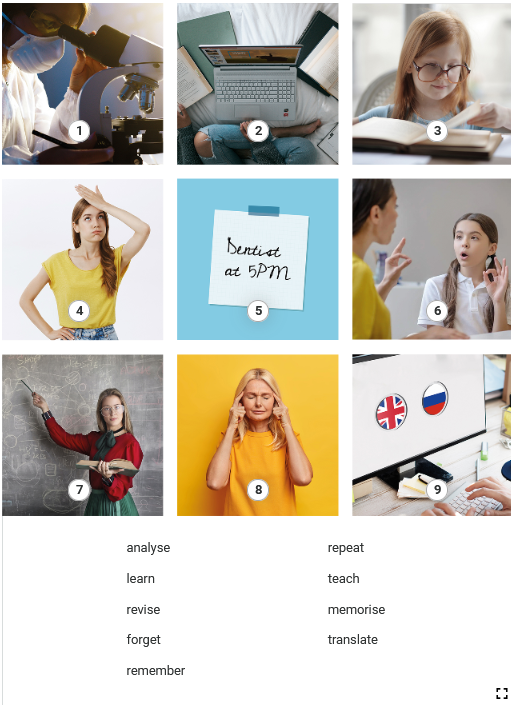
Grafika składa się z dziewięciu zdjęć ułożonych w kwadracie po trzy. Grafika posiada dziewięć punktów interaktywnych, po naciśnięciu których pojawiają się tekst oraz nagrania. Transkrypcja nagrań znajduje się poniżej.
Analyse.
To study or examine in detail, in order to discover more about it. For example: My homework is to analyse this short text about learning.
Zdjęcie nr 1 przedstawia naukowca w fartuchu pochylonego nad okularem mikroskopu.
Learn.
To get knowledge or skill in a new subject or activity by study, experience, or being taught. For example: I’ve been learning English for close to 10 years.
Zdjęcie nr 2 przedstawia osobę siedzącą po turecku na łóżku a przed nią stoi laptop. Po obu stronach laptopa widoczne są książki i zeszyty.
Revise.
To study again something you have already learned, in preparation for an exam. For example: We’re revising grammar for our test tomorrow.
Zdjęcie nr 3 przedstawia dziewczynkę w okularach czytającą książkę.
Forget.
To be unable to remember a fact, something that happened, or how to do something. For example: I’ve forgotten to bring my homework with me.
Zdjęcie nr 4 przedstawia nastolatkę z wydętymi policzkami i ręką opartą o czoło.
Remember.
To be able to bring a piece of information back into your mind, or to keep a piece of information in your memory. For example: I remember everything I’ve learned about this subject. Zdjęcie nr 5 przedstawia małą karteczkę przyklejoną do ściany, na której napisano: DENTIST AT 5PM.
Repeat.
To say, tell, or do something again. For example: Our teacher repeated the question two times.
Zdjęcie nr 6 przedstawia dziewczynkę siedzącą na przeciwko kobiety, który uczy ją wymowy głoski O.
Teach.
To instruct or train someone or give someone knowledge of something. For example: My mum teaches English in a secondary school.
Zdjęcie nr 7 przedstawia kobietę w młodym wieku stojącą z książką przed tablicą wskazując coś na niej ołówkiem.
Memorise.
To learn something so that you will remember it exactly. For example: I memorise new vocabulary by using Post‑it notes.
Zdjęcie nr 8 przedstawia kobietę, która ma przymknięte oczy i palcami wskazującymi dotyka swoich skroni.
Translate.
To change words into a different language. For example: I have to translate these sentences from English to Polish.
Zdjęcie nr 9 przedstawia ekran komputera, na którym wyświetlono dwie flagi w kółeczkach. Po lewej flaga brytyjska a po prawej francuska.
- Can you teachlearnrevise me how to play the guitar? You’re so talented!
- I can’t go shopping with you. I have to stay at home and repeatforgetrevise for the exam.
- Please forgetmemoriserepeat after me: “My brother loves cooking.”
- How could you analyseforgetlearn everything that we talked about? You need to buy some pills to improve your memory.
- He is a genius! It took him a very short time to memoriseanalyseteach all the new English words from the list.
- Scientists want to teachanalysememorise some samples from Mars.
- If you don’t have time to learnrepeatforget a new language, maybe you should stop playing computer games so much!
- She revisedanalysedrepeated all night for the maths test, but it was so difficult that she failed.
- I have to repeatteachremember about my dentist’s appointment tomorrow.
- How many times do I have to repeatrevisetranslate that you should put your dirty socks in the laundry basket, not on the floor!
Choose the correct translation.
Work with the recording and then, do the tasks below.
Based on the dialogue, drag and drop the phrases into the correct group. There are four phrases for each group.
Sophie: Could be better, I guess. I’m getting stressed out about this chemistry exam.
Beth: But you have been revising for the last three days!
Sophie: I know, but it feels like I can’t remember anything. Every time I think about the exam, my mind just goes blank and I forget everything.
Beth: It can’t be that bad. I’m sure that you will do really well. I didn’t revise as much as you, but I’m definitely more optimistic about it! People who have already written the exam said that it’s not that difficult.
Sophie: Maybe you’re right. I shouldn’t panic so much.
Beth: You have to learn how to take it easy. Just go for a walk and eat some chocolate. There’s nothing better for your brain! You have worked so hard that the exam will be a piece of cake.
Sophie: Thanks for cheering me up, you’re a star! I can’t thank you enough.
Beth: You can thank me by revising a bit with me. I think we both could use it!
Beth: Hi, Sophie. How are you?