Mapa pojęć
bg‑azure
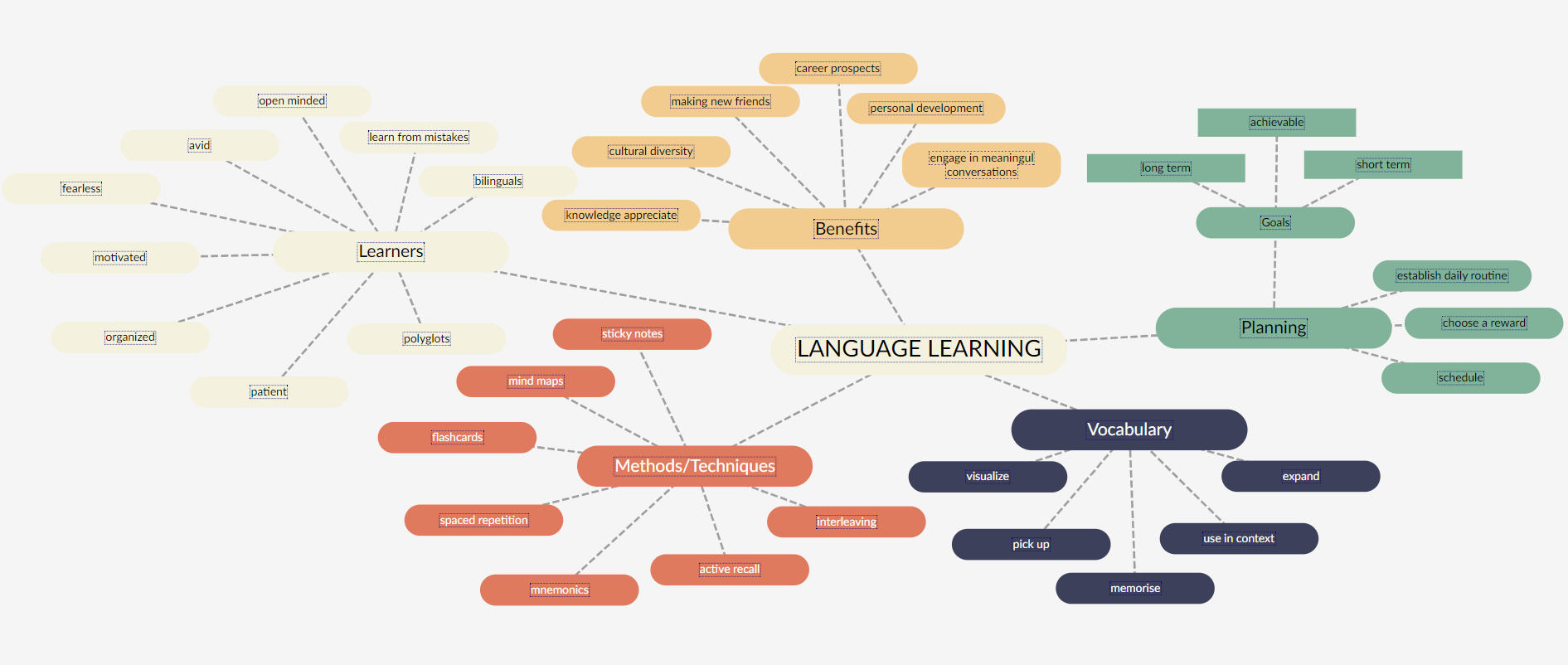
According to the writer Haruki Murakami, learning another language is like becoming another person. Have you ever thought about it in such a way? In this section, you are going to learn some useful words and phrases connected with language learning. All the words and phrases will be presented in the form of a mind map. Consider the map and discover how much you already know!
Haruki Murakami twierdzi, że uczenie się języka jest jak zamiana w zupełnie inną osobę. Czy kiedykolwiek myślałeś/myślałaś o tym w ten sposób? W tej sekcji poznasz kilka przydatnych wyrazów i wyrażeń związanych z nauką języka. Wszystkie będą umieszczone na mapie myśli. Zapoznaj się z nią i sprawdź, ile wyrazów już znasz!

Do you have friends from different cultural backgrounds?
Czy masz znajomych wywodzących się z różnych kultur?
Źródło: dostępny w internecie: www.unsplash.com [dostęp 29.10.2021], domena publiczna.
Exercise 1
Źródło: GroMar Sp. z o.o., licencja: CC BY-SA 3.0.
Exercise 2
Study the categories connected to language learning. Then drag and drop expressions into the correct category.
Źródło: GroMar Sp. z o.o., licencja: CC BY-SA 3.0.
Examine the mindmap about language learning. Complete the empty spaces with the words and phrases below:
long term
making new friends
motivated
flashcards
memorise
Źródło: GroMar Sp. z o.o., licencja: CC BY-SA 3.0.
Exercise 2
Źródło: GroMar Sp. z o.o., licencja: CC BY-SA 3.0.
Exercise 3
- learn from Tu uzupełnij
- Tu uzupełnij daily habits
- engage in Tu uzupełnij conversations
- choose a Tu uzupełnij
- Tu uzupełnij materials
- Tu uzupełnij cultural diversity
- Tu uzupełnij repetition
Źródło: GroMar Sp. z o.o., licencja: CC BY-SA 3.0.
Exercise 4
- If you want to (zwizualizować) Tu uzupełnij new words, create a mind map.
- By learning new languages you can expand your (wiedzę) Tu uzupełnij on a variety of topics.
- (Naucz się kilku wyrażeń) Tu uzupełnij in Spanish before going to Spain.
- His sister is (dwujęzyczna) Tu uzupełnij. She speaks Polish and French fluently.
- Learning foreign languages largely influences your (rozwój osobisty) Tu uzupełnij.
- If you learn a foreign language, you have to (zapamiętać) Tu uzupełnij a lot of new words and phrases.
- You shouldn’t be afraid to experiment with language learning and (uczenie się na błędach) Tu uzupełnij.
Źródło: GroMar Sp. z o.o., licencja: CC BY-SA 3.0.