Precipitation of sediment pt 2
that salts are a group of ionic chemical compounds, composed of cations of metals and anions of an acid radical;
that there are salts which dissolve in water and those, which are sparingly soluble or practically insoluble in water;
that based on the solubility table, it can be determined whether ions present in the solution will react with each other, a chemical compound that is sparingly soluble in water.
to predict whether mixing of substances that undergo dissociation will (or will not) create a sparingly soluble compound;
to explain what the precipitation reaction is;
to present chemical equations for precipitation using molecular, complete ionic and net ionic formulas.
Anticipation of the precipitation reaction course
When we mix solutions of substances which occur in the form of ions, it may happen that a cation of one substance will create a sparingly soluble compound with an anion of the other substance. We then observe precipitation.
To anticipate whether the precipitation will occur after mixing two ionic substances, we can use the solubility table. On its basis we can assess whether the ions present in the formed mixture will create a sparingly soluble compound.
Before you conduct experiment „Obtaining calcium phosphate”, formulate research question and hypothesis.
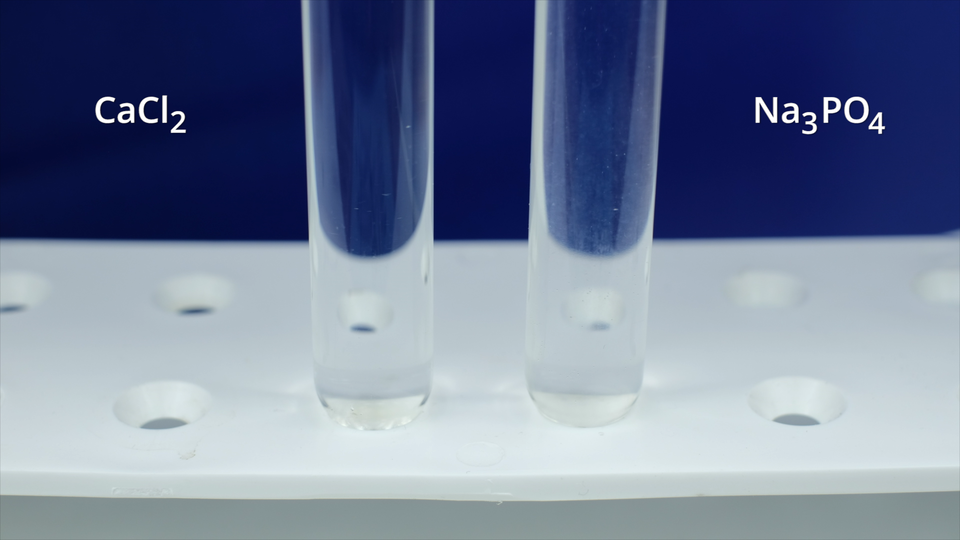
Film dostępny na portalu epodreczniki.pl
Film pokazuje eksperyment. Problem badawczy: Otrzymywanie trudno rozpuszczalnego w wodzie fosforanu pięć wapnia. Hipoteza: Otrzymasz go w wyniku reakcji strącania. Zmieszasz dwa roztwory, z których jeden będzie zawierać kationy wapnia, a drugi – aniony fosforanowe pieć. Będziesz potrzebować: probówki, statyw do probówek, pipety, bagietki, zlewki, woda, roztwór chlorku wapnia, roztwór fosforanu pięć potasu, roztwór azotanu pięć wapnia, roztwór fosforanu pięć sodu. Instrukcja: Do probówki wlej około dwa centymetry sześcienne roztworu soli jeden, a następnie około dwa centymetry sześcienne roztworu soli dwa.
How to make a calcium phosphate that is sparingly soluble in water?
It is formed as a result of the precipitation reaction. We will mix two solutions, one of which will contain calcium cations, and the other one – phosphorus anions.
test tubes, test tube stand, pipettes, glass rods, beakers,
water, calcium chloride solution, potassium phosphate solution, calcium nitrate solution, sodium phosphate
Pour approx. 2 cmIndeks górny 33 of the salt solution (I), and then approx. 2 cmIndeks górny 33 of the salt solution (II) to a test tube. Observe the changes, note the observations in the worksheet. Perform subsequent experiments in a similar manner.
Can precipitation of sparingly soluble compound be planned?
If we want to carry out a precipitation reaction, we have to mix together two solutions of soluble substances, the ions of which will form a sparingly soluble compound.
In order to obtain, for example, calcium phosphate that is sparingly soluble in water, we have to mix together two solutions, one of which should contain calcium cations, and another one – phosphate anions. Then it will be possible to precipitate the required salt from the solution.
Calcium phosphate can be formed as a result of mixing together the solutions of appropriate salts. Below there are examples of two possible reactions of obtaining calcium phosphate:
The reaction of potassium phosphate with calcium chloride
molecular equation: 2KIndeks dolny 33POIndeks dolny 44 + 3CaClIndeks dolny 22 → CaIndeks dolny 33(POIndeks dolny 44)Indeks dolny 22↓ + 6KCl
complete ionic equation: 6KIndeks górny ++ + 2POIndeks dolny 44Indeks górny 3-3- + 3CaIndeks górny 2+2+ + 6ClIndeks górny -- → CaIndeks dolny 33(POIndeks dolny 44)Indeks dolny 22 + 6KIndeks górny ++ + 6ClIndeks górny --
net Ionic equation: 2POIndeks dolny 44Indeks górny 3-3- + 3CaIndeks górny 2+2+ → CaIndeks dolny 33(POIndeks dolny 44)Indeks dolny 22
The reaction of sodium phosphate with calcium nitrate
molecular equation: 2NaIndeks dolny 33POIndeks dolny 44 + 3Ca(NOIndeks dolny 33)Indeks dolny 22 → CaIndeks dolny 33(POIndeks dolny 44)Indeks dolny 22↓ + 6NaNOIndeks dolny 33
complete ionic equation: 6NaIndeks górny ++ + 2POIndeks dolny 44Indeks górny 3-3- + 3CaIndeks górny 2+2+ + 6NOIndeks dolny 33Indeks górny -- → CaIndeks dolny 33(POIndeks dolny 44)Indeks dolny 22 + 6NaIndeks górny ++ + 6NOIndeks dolny 33Indeks górny --
net Ionic equation: 2POIndeks dolny 44Indeks górny 3-3- + 3CaIndeks górny 2+2+ → CaIndeks dolny 33(POIndeks dolny 44)Indeks dolny 22
Precipitation reactions occurring in water between salts as well as salts and hydroxides are the examples of an exchange reaction:
Indicate sentences that are true.
- The precipitation reaction consists in the fact that the products of reaction of two salts soluble in water are two different salts soluble in water.
- Lead(II) sulfate is a salt soluble in water.
- Lead(II) nitrate is a salt soluble in water.
- The essence of the precipitation reaction is the reaction between metal cations and anions of acid radicals, as a result of which sediment of this salt is formed.
- As a result of reaction of lead(II) chloride with barium nitrate sediment is formed.
Create a multiple-choice test based on today's lesson. Then exchange your questions with a friend or classmate.
Question: ...
- ...
- ...
- ...
- ...
Conclusion
Reactions occurring in an aqueous solution between ions from two different substances, which together form a sparingly soluble compound, are called precipitation reactions.
Precipitation reactions can be predicted on the basis of the solubility table by checking whether the ions that are found in the solution after mixing of two soluble substances will combine into a compound that is sparingly soluble in water.
Reaction between salts as well as between salts and hydroxides are examples of an exchange reaction.
Keywords
sediment, salt, precipitation reaction, precipitation, hydroxide, salts and hydroxides solubility table
Glossary
reakcja strąceniowa – reakcja chemiczna zachodząca w roztworze wodnym między jonami pochodzącymi od zmieszanych ze sobą substancji, prowadząca do powstania trudno rozpuszczalnego związku, który wytrąca się z roztworu w postaci osadu