Have you ever had the opportunity to attend a court trial? Each legal system has different standards and customs that can be observed during hearings. You will read a text about the distinctive features of the British and American judicial systems.
Czy kiedykolwiek miałeś/miałaś okazję uczestniczyć w rozprawie sądowej? W każdym systemie prawnym obowiązują inne normy i zwyczaje, które można zaobserwować podczas rozpraw. Przeczytaj tekst, aby poznać cechy charakterystyczne brytyjskiego i amerykańskiego systemu sądownictwa.
RLkgpcGNuAzjS
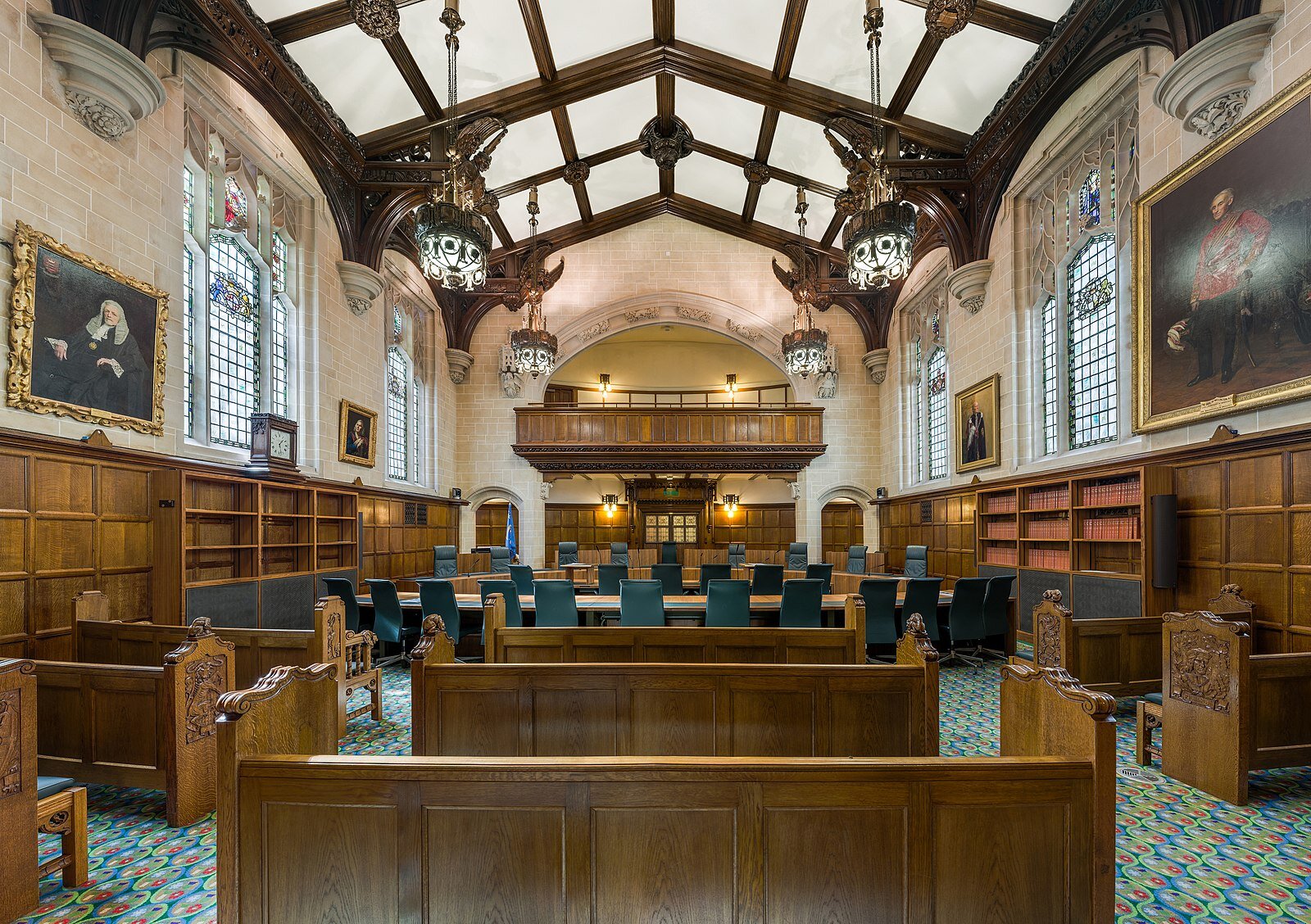
Zdjęcie przedstawia salę sądową w Wielkiej Brytanii oraz w Stanach Zjednoczonych. Jest to wysokie pomieszczenie z drewnianymi ławkami, podestem gdzie zasiada sędzia, miejscem dla obrony, oskarżonego oraz świadków.
Courts in the UK and the U.S.A.
Sądy w Wielkiej Brytanii oraz w Stanach Zjednoczonych
Źródło: dostępny w internecie: commons.wikimedia.org [dostęp 16.03.2022], domena publiczna.
Exercise1
Match words with their definitions.
Połącz poniższe wyrazy z ich definicjami.
R13c16ZqoEZm1
judge Możliwe odpowiedzi: 1. a person who may have important information for the court, 2. a lawyer who makes decisions that people must obey, 3. an act that is forbidden by law, 4. a decision on a punishment that is given by a judge, 5. a person who has broken the law defendant Możliwe odpowiedzi: 1. a person who may have important information for the court, 2. a lawyer who makes decisions that people must obey, 3. an act that is forbidden by law, 4. a decision on a punishment that is given by a judge, 5. a person who has broken the law witness Możliwe odpowiedzi: 1. a person who may have important information for the court, 2. a lawyer who makes decisions that people must obey, 3. an act that is forbidden by law, 4. a decision on a punishment that is given by a judge, 5. a person who has broken the law crime Możliwe odpowiedzi: 1. a person who may have important information for the court, 2. a lawyer who makes decisions that people must obey, 3. an act that is forbidden by law, 4. a decision on a punishment that is given by a judge, 5. a person who has broken the law sentence Możliwe odpowiedzi: 1. a person who may have important information for the court, 2. a lawyer who makes decisions that people must obey, 3. an act that is forbidden by law, 4. a decision on a punishment that is given by a judge, 5. a person who has broken the law
judge Możliwe odpowiedzi: 1. a person who may have important information for the court, 2. a lawyer who makes decisions that people must obey, 3. an act that is forbidden by law, 4. a decision on a punishment that is given by a judge, 5. a person who has broken the law defendant Możliwe odpowiedzi: 1. a person who may have important information for the court, 2. a lawyer who makes decisions that people must obey, 3. an act that is forbidden by law, 4. a decision on a punishment that is given by a judge, 5. a person who has broken the law witness Możliwe odpowiedzi: 1. a person who may have important information for the court, 2. a lawyer who makes decisions that people must obey, 3. an act that is forbidden by law, 4. a decision on a punishment that is given by a judge, 5. a person who has broken the law crime Możliwe odpowiedzi: 1. a person who may have important information for the court, 2. a lawyer who makes decisions that people must obey, 3. an act that is forbidden by law, 4. a decision on a punishment that is given by a judge, 5. a person who has broken the law sentence Możliwe odpowiedzi: 1. a person who may have important information for the court, 2. a lawyer who makes decisions that people must obey, 3. an act that is forbidden by law, 4. a decision on a punishment that is given by a judge, 5. a person who has broken the law
Źródło: GroMar Sp. z o.o., licencja: CC BY-SA 3.0.
Read the text about how courts work in the UK and the U.S.A. Then do the exercises.
Przeczytaj tekst na temat działania sądów w Wielkiej Brytanii oraz w Stanach Zjednoczonych. Następnie wykonaj poniższe ćwiczenia.
British and American JudicialjudicialJudicial Systems
MarcinLegeżyńskiBritish and American Judicial Systems
The UK and the U.S.A. are countries that share many common elements of culture, similar customs, and the same language. However, some things in the UK also differ from those ‘across the pond’. One of them is the legallegallegal system. The most important difference is that while the whole territory of the United Kingdom shares the same lawslaws [law]laws, the U.S. is divided into states. This means that some set up general laws are federalfederalfederal ones and apply in the whole country, and some are for each state. Consequently, if you are taken to courttaken to court [take to court]taken to court, you may receive a different punishmentpunishmentpunishment for certain crimes in Texas and New York, while you will face similar consequences of your actions in London and Glasgow.
The names of legal jobs also differ between these two countries. Any legal professional in the U.S. is called a lawyerlawyer [lawyers]lawyer. Lawyers that represent the state in criminal cases are prosecutorsprosecutors [prosecutor]prosecutors, and those whose job is to defenddefenddefend criminals are attorneysattorneys [attorney]attorneys. On the other hand, UK legal practitioners are divided into solicitorssolicitors [solicitor]solicitors and barristersbarristers [barrister]barristers. Solicitors provide legal advice to their clients and help them prepare legal documentation or suesuesue another person. When the case is taken to courtcourtcourt, barristers will represent their clients before the judge, examine evidenceevidenceevidence, witnesseswitnesses [witness]witnesses, defendantsdefendants [defendant]defendants and victims of a crime.
Courts are where trialstrials [trial]trials take place. Judgesjudges [judge]Judges listen to both sides in a case, consider the evidence, and declare the sentencesentence [sentences]sentence. In the UK, minor cases are considered in Magistrate CourtsMagistrate Courts [Magistrate Court]Magistrate Courts, which are called State CourtsState Courts [State Court]State Courts in the U.S. Serious criminal and civil cases find their end in Crown CourtsCrown Courts [Crown Court]Crown Courts in the United Kingdom, and District CourtsDistrict Courts [District Court]District Courts in the U.S.A. Both countries use common lawcommon lawcommon law in the way they judge cases. This means that judges’ decisions are often based on similar cases which happened in the past. These are called precedentsprecedents [precedent]precedents. Sometimes, court rulingsrulings [ruling]rulings are based on precedents dating back hundreds of years, which may seem very surprising to residents of other countries. Another distinctive feature of the UK and U.S. courts is that they often employ juriesjuries [jury]juries. Juries are groups of ordinary people who advise the judge or issue a verdictverdictverdict in some cases. They usually decide whether someone is guiltyguiltyguilty or not guilty of a crime, and the judge’s job is to declare the sentence and decide on a type of punishment. Jury members in the UK are randomlyrandomlyrandomly selected, while in the U.S. they are chosen by both the prosecutors and attorneys.
The interesting difference is also the use of cameras in courts. While it is very common that U.S. court proceedings are filmed and shown on TV, this is very rarely done in the UK. Most UK courts employ artists who draw pictures showing people in the court, but the first court case that was filmed in a UK court took place in 2013 and it was the first such event in 90 years! Another surprising element of UK courts are wigswigs [wig]wigs! Senior judges and barristers in the United Kingdom must wear them as a sign of the dignitydignitydignity of their positions. No wigs are worn by judges in the U.S.A., although in both countries judges and lawyers often wear special robesrobes [robe]robes. These make them look very serious and give more importance to court proceedingscourt proceedings [court proceeding]court proceedings.
1 Źródło: MarcinLegeżyński, licencja: CC BY-SA 3.0.
Exercise2
Read the text and choose the correct answer.
Przeczytaj tekst, a następnie wybierz prawidłowe odpowiedzi.
RxcwqOM7nR7q9
1. In the U.S.A., the laws are Możliwe odpowiedzi: 1. the same in the whole country., 2. different in every state., 3. federal for serious crimes.
Źródło: GroMar Sp. z o.o., licencja: CC BY-SA 3.0.
R1e2lOL85MQmu
2. Prosecutors are lawyers who Możliwe odpowiedzi: 1. defend criminals., 2. accuse defendants., 3. defend judges.
Źródło: GroMar Sp. z o.o., licencja: CC BY-SA 3.0.
R1ULqOKWiAtgf
3. Magistrates Courts are Możliwe odpowiedzi: 1. places in the U.S.A. where major offences are judged., 2. places in the UK where major offences are judged., 3. places in the UK where minor offences are judged.
Źródło: GroMar Sp. z o.o., licencja: CC BY-SA 3.0.
R12NU48sbo1fh
4. District Courts Możliwe odpowiedzi: 1. decide on serious cases in the U.S.A., 2. decide on minor cases in the UK., 3. decide on serious cases in the UK.
Źródło: GroMar Sp. z o.o., licencja: CC BY-SA 3.0.
Rtl5N0AAd0sTK
5. Juries Możliwe odpowiedzi: 1. tell the judge what the punishment should be., 2. decide who should be the judge., 3. decide if a defendant is innocent.
Źródło: GroMar Sp. z o.o., licencja: CC BY-SA 3.0.
Exercise3
Read the above text again and decide if the following sentences related to the work of courts are true or false.
Po przeczytaniu tekstu zdecyduj, czy podane zdania związane z pracą sądów są prawdziwe, czy fałszywe.
R11Kya7B1uoeu
Źródło: GroMar Sp. z o.o., licencja: CC BY-SA 3.0.
Exercise4
Read the above text again and drag the words connected with the court jobs to fill the gaps.
Ponownie przeczytaj tekst, po czym przeciągnij w odpowiednie luki wyrazy dotyczące zawodów prawniczych.
R11YgbelxrhL1
1. In the U.S., lawyers who defend defendants are called 1. guilty, 2. precedents, 3. attorneys, 4. Barristers, 5. robes.
2. 1. guilty, 2. precedents, 3. attorneys, 4. Barristers, 5. robes represent clients in UK courts.
3. Common law in both countries is based on 1. guilty, 2. precedents, 3. attorneys, 4. Barristers, 5. robes.
4. The jury’s task is to decide if someone is 1. guilty, 2. precedents, 3. attorneys, 4. Barristers, 5. robes.
5. Lawyers in the UK and the U.S. wear special 1. guilty, 2. precedents, 3. attorneys, 4. Barristers, 5. robes.
1. In the U.S., lawyers who defend defendants are called 1. guilty, 2. precedents, 3. attorneys, 4. Barristers, 5. robes.
2. 1. guilty, 2. precedents, 3. attorneys, 4. Barristers, 5. robes represent clients in UK courts.
3. Common law in both countries is based on 1. guilty, 2. precedents, 3. attorneys, 4. Barristers, 5. robes.
4. The jury’s task is to decide if someone is 1. guilty, 2. precedents, 3. attorneys, 4. Barristers, 5. robes.
5. Lawyers in the UK and the U.S. wear special 1. guilty, 2. precedents, 3. attorneys, 4. Barristers, 5. robes.
Źródło: GroMar Sp. z o.o., licencja: CC BY-SA 3.0.
Exercise5
Read the above text again. Then, translate the missing words to complete the gaps in the text about legal systems.
Ponownie przeczytaj tekst, a następnie przetłumacz wyrażenia w nawiasach i uzupełnij luki w poniższych zdaniach.
Rz4YRf7QyeUNw
1. Tu uzupełnij(prawne) systems in the UK and the U.S.A. are quite similar. In both countries, 2. Tu uzupełnij(sędziowie) are helped by 3. Tu uzupełnij(członków ławy przysięgłych) to declare a 4. Tu uzupełnij(wyrok) . However, 5. Tu uzupełnij(prawnicy) have different names there. In the UK, they are called solicitors and barristers. These names are not usually used in the U.S.
1. Tu uzupełnij(prawne) systems in the UK and the U.S.A. are quite similar. In both countries, 2. Tu uzupełnij(sędziowie) are helped by 3. Tu uzupełnij(członków ławy przysięgłych) to declare a 4. Tu uzupełnij(wyrok) . However, 5. Tu uzupełnij(prawnicy) have different names there. In the UK, they are called solicitors and barristers. These names are not usually used in the U.S.
Źródło: GroMar Sp. z o.o., licencja: CC BY-SA 3.0.
Exercise6
Drag and drop the expressions to the correct category.
Przeciągnij wyrażenia do odpowiedniej kategorii.
R1aoYxCMnRkky
People Możliwe odpowiedzi: 1. Solicitor, 2. Prosecutor, 3. Attorney, 4. Barrister, 5. Crown, 6. State, 7. District, 8. Magistrate Types of courts Możliwe odpowiedzi: 1. Solicitor, 2. Prosecutor, 3. Attorney, 4. Barrister, 5. Crown, 6. State, 7. District, 8. Magistrate
People Możliwe odpowiedzi: 1. Solicitor, 2. Prosecutor, 3. Attorney, 4. Barrister, 5. Crown, 6. State, 7. District, 8. Magistrate Types of courts Możliwe odpowiedzi: 1. Solicitor, 2. Prosecutor, 3. Attorney, 4. Barrister, 5. Crown, 6. State, 7. District, 8. Magistrate
Źródło: GroMar Sp. z o.o., licencja: CC BY-SA 3.0.