Przeczytaj
The picture below shows a young boy sitting in front of a telly, who is probably absorbing commercials. In this section, you are going to read a text about the impact that omnipresent advertising has on our lives. Are you aware of the selling techniques used on you? Should every marketing ploy be allowed? Have you ever thought about the ethical boundary of advertising?
Poniższe zdjęcie przedstawia chłopca siedzącego przed telewizorem i prawdopodobnie pochłoniętego oglądaniem reklam. W tej sekcji przeczytasz tekst o wpływie wszechobecnej reklamy na nasze życie. Czy zdajesz sobie sprawę ze stosowanych wobec ciebie technik sprzedaży? Czy każdy chwyt marketingowy powinien być dozwolony? Czy zastanawiałeś/zastanawiałaś się kiedyś nad etycznymi granicami reklamy?

Study the short text related to advertising and decide whether the sentences below are true or false.
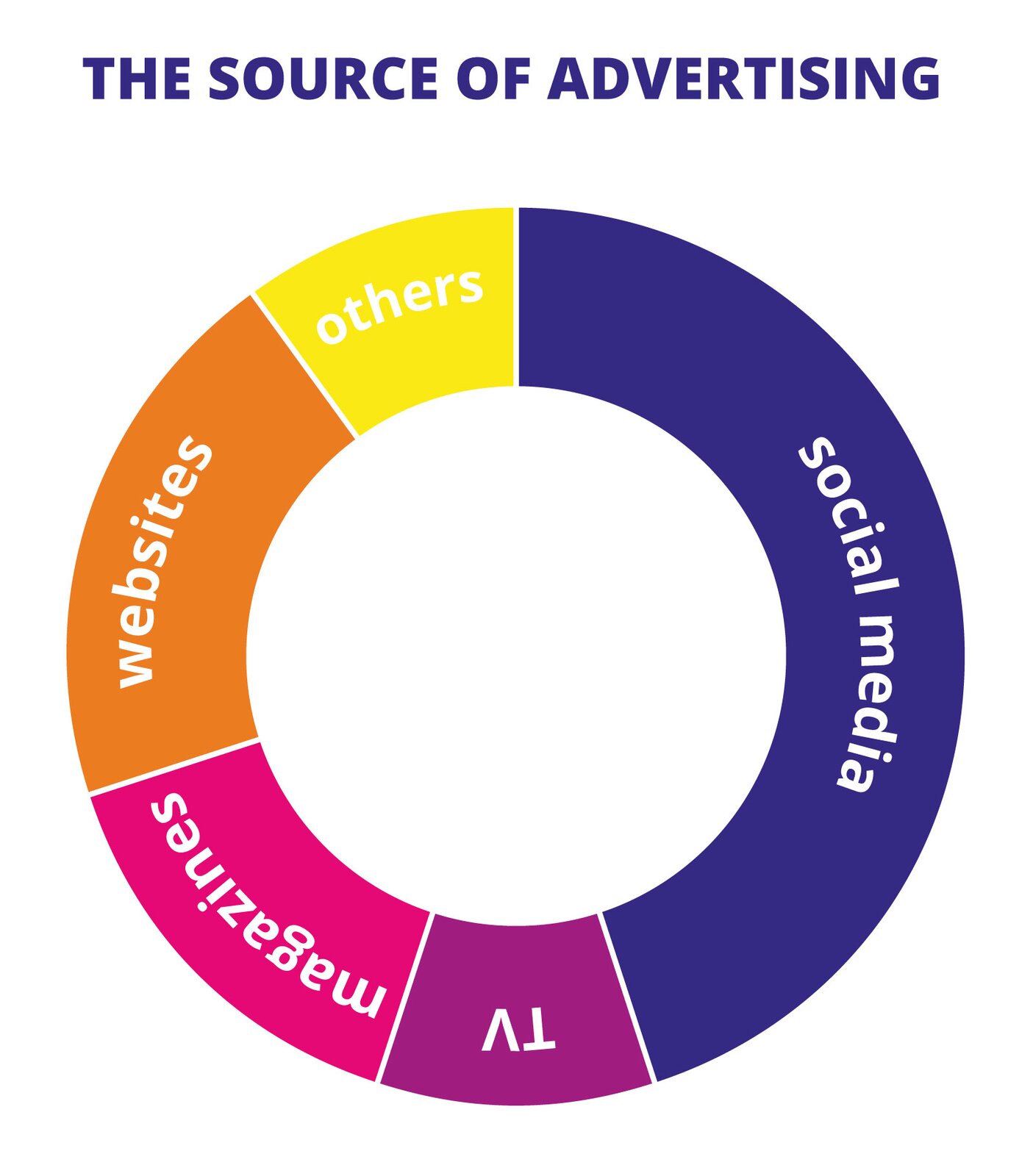
When it comes to the source of advertising, the most popular is social media, and then websites. The least popular source is TV.
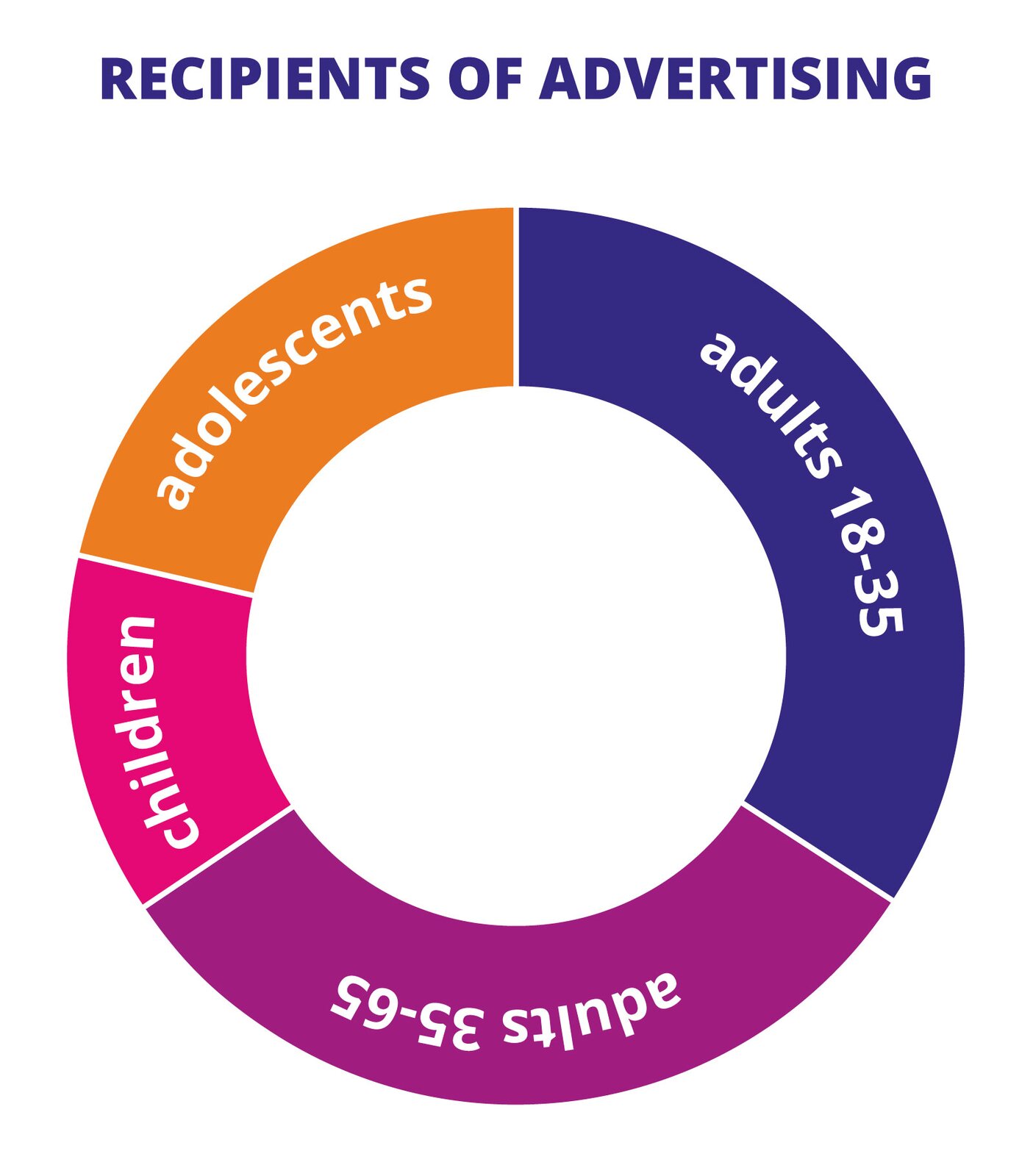
The study shows that the biggest group of recipients of advertising are adults. Especially people at the age of 18–35, then 35–65. The smallest group are children.
Look at the following charts related to advertising and decide whether the sentences below are true or false.
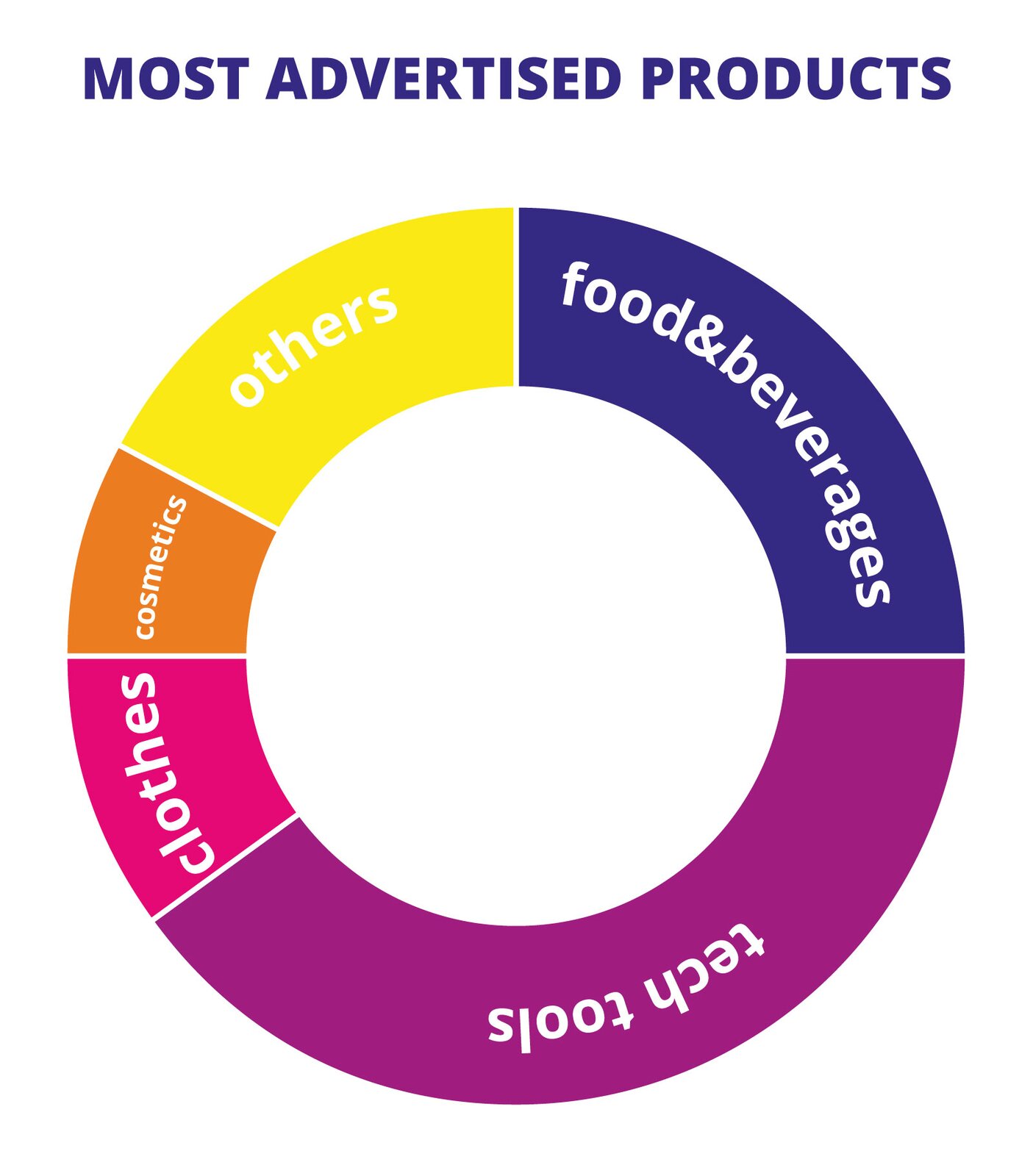
- According to the charts, technological devices and garments are the items which are the most popular amongst buyers.
TRUE FALSE
- The charts show that the clothes and beauty industries invest the least in advertising.
TRUE FALSE
- According to the charts, children and teenagers make up half of the advertising audience.
TRUE FALSE
- As shown by the charts, people up to 35 years old are the main target of adverts.
TRUE FALSE
- The charts demonstrate that most ads and commercials come from the internet.
TRUE FALSE
- As indicated by the charts, the tiniest percentage of the advertising source isn’t related to the internet, TV or printing industries.
TRUE FALSE
Read the text about advertising techniques and then do the exercises below.
Trapped in the Commercial WorldDid you happen to buy a piece of garment, a hi‑tech gadget or a beverage only because you had seen it advertised before? If not, congratulations! You are in a tiny minority of consumers who (1) ……………. .
It appears that everyday life is inseparable from omnipresentomnipresent billboards in the urban areaurban area, commercialscommercials on the radio and TV (2) ………… . Constant advertising of countless products has become so commonplace that we seem not to notice it at all. Moreover, it is much harder for businesses to grab the consumers’ attention. Not only are we accustomedaccustomed to marketing temptationtemptation but we are also saturatedsaturated with a variety of images, ideas and slogans. Nevertheless, we are all simultaneouslysimultaneously and paradoxically affected by a world littered with advertising.
CopywritersCopywriters and art directors have been outdoing themselves in marketing ploysmarketing ploys – creating catchy, rhythmic tunes, (3) …………, which usually attractattract a potential customer's attentionattention for no more than just a few seconds. Advertising departments are said to have been in a crisis for a while because anything they come up with appears to be already familiar and is treated as though it was a relicrelic. It is thought that surprising a regular customer either with an item or with any professional campaign is doomed to failure,doomed to failure, yet advertising experts work by the sweat of their browwork by the sweat of their brow to manipulate us painlessly and almost imperceptiblyimperceptibly.
However indifferentindifferent to advertising we may seem to ourselves, we are actually trapped in this commercial, (4) ............ . It is not enough to ignore companies’ attempts to sell us a “must‑have item;” we should be also aware of more indirect techniques such as product placementproduct placement. This is when manufacturers gain exposuregain exposure for their branded goodsbranded goods or services by paying for them to be featuredfeatured in films and television programmes. When an actor in a film is drinking a clearly labelledlabelled beverage or using a cell phone with its logo clearly visible, the viewer is internalising the need for a product without realising it.
If you still think you are immune to commercial manipulation techniques, you need to familiarise yourself with the term “subliminal advertisingsubliminal advertising.” Have you ever experienced a sudden, strong cravingcraving for a particular meal or drink right after turning off the TV? If yes, you may have become a victim of so‑called “subconscious marketingsubconscious marketing” whose goal is to make unaware recipientsrecipients walk away from the ad with a specific message in their mind – a desire that has arisen unconsciouslyunconsciously. Although there is no scientific proof that this actually works, it sounds scary enough to have been banned in many countries. The subliminal trading strategiestrading strategies are said to use such sophisticated tools as “backmasking” (voice recordings played backwards which are to give listeners messages that their brains try to decode), “sub‑audible messaging” (usually of much lower volume than the primary audio) or “sub‑visual messaging” (a hidden logo or a small image tucked away withintucked away within another image). The idea is that we don’t realise what we actually perceive or hear, (5)................ is quickly converted into a need. Isn’t it terrifying? No wonder subliminal advertising was banned in the UK right after the first attempts at using it in the 1950s.
Social media advertising also seems to be concealedconcealed and carefully considered by a staff of sociologists, psychologists and hi‑tech experts as it is always adjustedadjusted to an individual profile. It is perfectly configured advertisingconfigured advertising which carefully and precisely trackstracks (6) ................. . It has recently become obvious that searching for a product once means seeing a dozen ads related to this particular item each time you access your account, right?
Numerous marketing strategies such as shock advertising, also known as shockvertisingshockvertising, have been in use. It is nothing more than applying taboo subjects, bizarrebizarre and controversial sentences, disconcertingdisconcerting and even offensive images to draw the consumer’s attentiondraw the consumer’s attention and triggertrigger a strong reaction. It is often used for social advertisements whose purpose is to conveyconvey a crucial message, to raiseraise our political or ecological awarenessawareness and to fight racism or homophobia. They (7) ………… child labourchild labour, domestic violence and sexual abuseabuse. The purpose of these adverts, though, is not to make us buy any products but to raise awareness - a spark of hope in this consumerist world.
So, are you free from manipulation or rather enslaved by advanced commercial techniques? Is the need you feel a real one? Are the desires for ultra‑modern gadgets or brand‑new cosmetics really yours? Next time, before you buy anything, think twice about why you can't resist a particular consumer temptation.
Źródło: Ewelina Ramotowska, licencja: CC BY-SA 3.0.
- broach such unpleasant subjects as – 1. 6, 2. 4, 3. 7, 4. 2, 5. 3, 6. 5, 7. 1
- consumerist world wherever we step – 1. 6, 2. 4, 3. 7, 4. 2, 5. 3, 6. 5, 7. 1
- are resistant to a great bunch of selling techniques – 1. 6, 2. 4, 3. 7, 4. 2, 5. 3, 6. 5, 7. 1
- ultra modern visualisations or astonishing commercial plots – 1. 6, 2. 4, 3. 7, 4. 2, 5. 3, 6. 5, 7. 1
- as well as thousands of virals on the internet – 1. 6, 2. 4, 3. 7, 4. 2, 5. 3, 6. 5, 7. 1
- the interests, likes, dislikes and requirements of regular customers – 1. 6, 2. 4, 3. 7, 4. 2, 5. 3, 6. 5, 7. 1
- but our brain still stores the information which – 1. 6, 2. 4, 3. 7, 4. 2, 5. 3, 6. 5, 7. 1
a) are immune to commercials.
b) don’t care about the ads.
c) are influenced by the advertising.
d) are into advertisements.
2. Due to the fact that advertising is global
a) consumers aren’t used to it and yield to temptations.
b) consumers are aware of it but it still has an impact on them.
c) consumers are fed up with images and catchy slogans.
d) consumers are an easy target for advertising companies.
3. Why are advertising departments claimed to be in crisis?
a) Due to lack of customers.
b) Because it is more than hard to amaze the customer.
c) Due to the fact that commercials are the things of the past.
d) Because every single new ad is based on a repetitive pattern.
4. Some companies allocate some funds to film-makers
a) in order to advertise their brand product.
b) to sell them the brand item.
c) in order to gain exposure for the company policy.
d) in order to present a product placement technique.
5. Subliminal advertising uses
a) the fact that customers are familiar with advertising techniques.
b) scientifically proven ways to influence the mind.
c) subconscious tricks to trigger the need for a product.
d) our unawareness of our selling and buying needs.
6. When you are scrolling through social media,
a) the system follows your interests and demands.
b) the system adjusts your profile to the advertisements.
c) you may have trouble finding products chosen for you.
d) you are tracked by psychologists and sociologists.
7. Shockvertising is
a) untolerable for recipients.
b) always politically engaged.
c) often aimed at social issues.
d) inappropriate and harsh.
Answer the question and share your experience.
Have you ever been aware of any advertising techniques used on you? When was it? How did you feel?
Słownik
/ əˈbjuːs /
wykorzystywanie (unfair, cruel or violent treatment of somebody)
/ əˈkʌstəmd /
przyzwyczajony/przyzwyczajona (familiar with something and accepting it as normal or usual)
/ əˈdʒʌstɪd /
dopasowany/dopasowana (changed slightly to make it more suitable)
/ əˈtrækt əˈtenʃn̩ /
przyciągać uwagę (make someone notice something or someone)
/ bɪˈzɑː /
dziwaczne (very strange)
/ ˈbrændɪd ɡʊdz /
markowe towary [markowy towar] (products of a particular manufacturer or marketing company)
/ brəʊtʃ /
poruszać (np. temat) (to raise (a difficult subject) for discussion)
/ ˈbrɔːdkɑːst /
emitować (send out programmes on television or radio)
/ bʌntʃ /
garść, grupa (a number of things of the same type)
/ tʃaɪld ˈleɪbə /
praca wykonywana przez dzieci (work done by children)
/ kəˈmɜːʃl̩ /
reklama (najczęściej telewizyjna) (broadcast advertisements)
/ kənˈsiːld /
ukryty/ukryta (hidden)
/ kənˈfɪɡəd ˈædvətaɪzɪŋ /
skonfigurowana reklama (the commercial which is adjusted to individual profile)
/ kənˈveɪ /
przekazać (send)
/ ˈkɒpɪraɪtəz / / ˈkɒpɪraɪtə /
copywriterzy/copywriterki [copywriter/copywriterka] (osoby lub osoba tworząca reklamy) (a person who works as an advertisement creator)
/ ˈkreɪvɪŋ /
zachcianka, pragnienie (a strong desire for something)
/ ˌdɪskənˈsɜːtɪŋ /
niepokojące (making you feel worried)
/ duːmd tu ˈfeɪljə /
skazany/skazana na porażkę (inevitable end in a lack of success)
/ drɔː ðə kənˈsuːmərz əˈtenʃn̩ /
przyciągnąć uwagę klienta (make the consumer notice something or someone)
/ ˈfiːtʃəd /
wyróżniony/wyróżniona, umieszczony/umieszczona (np. w filmie, utworze muzycznym) (highlighted, placed, e.g. in a film, a piece of music)
/ ɡeɪn ɪkˈspəʊʒə /
uzyskiwać ekspozycję, częste eksponowanie (np. produktu) (of a product or advertisement: get public attention)
/ ɡræb əˈtenʃn̩ /
przyciągnąć uwagę (make someone interested)
/ ˌɪmpəˈseptəbli /
niezauważalnie, niepostrzeżenie (in a way that cannot be seen or felt)
/ ɪnˈdɪfrənt /
obojętny/obojętna (having or showing no interest)
/ ˈleɪbl̩d /
oznakowany/oznakowana (np. produkt) (to describe or put a logo on a product)
/ ˈmɑːkɪtɪŋ plɔɪz / / ˈmɑːkɪtɪŋ plɔɪ /
sztuczki marketingowe [sztuczka marketingowa]
/ ˌɒmnɪˈpreznt /
wszechobecny/wszechobecna (present everywhere)
/ ˈprɒdʌkt ˈpleɪsmənt /
lokowanie produktu (a practice in which manufacturers of goods gain exposure for their products by paying for them to be featured in films and television programmes)
/ reɪz əˈweənəs /
zwiększać świadomość (make somebody conscious of an important cause)
/ rɪˈsɪpɪənts / / rɪˈsɪpɪənt /
odbiorcy [odbiorca] (a person who receives something; the target or audience)
/ ˈrelɪk /
przeżytek (an object that has survived from the past)
/ rɪˈzɪstənt /
odporny/odporna (not affected by something)
/ ˈsætʃəreɪtɪd /
nasycony/nasycona (full of something)
/ ˈʃɒkˈvətaɪzɪŋ /
reklama szokująca (the ad whose aim is to amaze and surprise the recipient)
/ ˌsɪmlˈteɪnɪəsli /
jednocześnie, w tym samym czasie (at the same time)
/ ˌsʌbˈkɒnʃəs ˈmɑːkɪtɪŋ /
podświadomy, podprogowy marketing (selling and buying techniques which the customers are unaware of)
/ ˌsʌbˈlɪmɪnl̩ ˈædvətaɪzɪŋ /
reklama podprogowa (a kind of advertising used to influence consumers' responses without their being consciously aware of it)
/ tempˈteɪʃn̩ /
pokusa (a strong desire)
/ trækt /
namierzony/namierzona, śledzony/śledzona (being observed)
/ træks / / træk /
śledzi [śledzić]
/ ˈtreɪdɪŋ ˈstrætədʒɪz / / ˈtreɪdɪŋ ˈstrætədʒi /
strategie handlowe [strategia handlowa] (ways to sell items)
/ ˈtrɪɡə /
wywoływać (cause)
/ tʌkt əˈweɪ wɪðˈɪn /
ukryty/ukryta w (hidden in)
/ ʌnˈkɒnʃəsli /
nieświadomie (without awareness)
/ ˈɜːbən ˈeəriə /
przestrzeń miejska (city space)
/ ˈvaɪrəls // ˈvaɪrəl /
wirale [wiral] (pieces of information, a video, an image which are sent rapidly over the internet)
/ ˈwɜ:k ˈbaɪ ðə swet əv wʌnz braʊ /
pracować w pocie czoła (work really hard)
Źródło: GroMar Sp. z o.o.,licencja CC BY‑SA 3.0