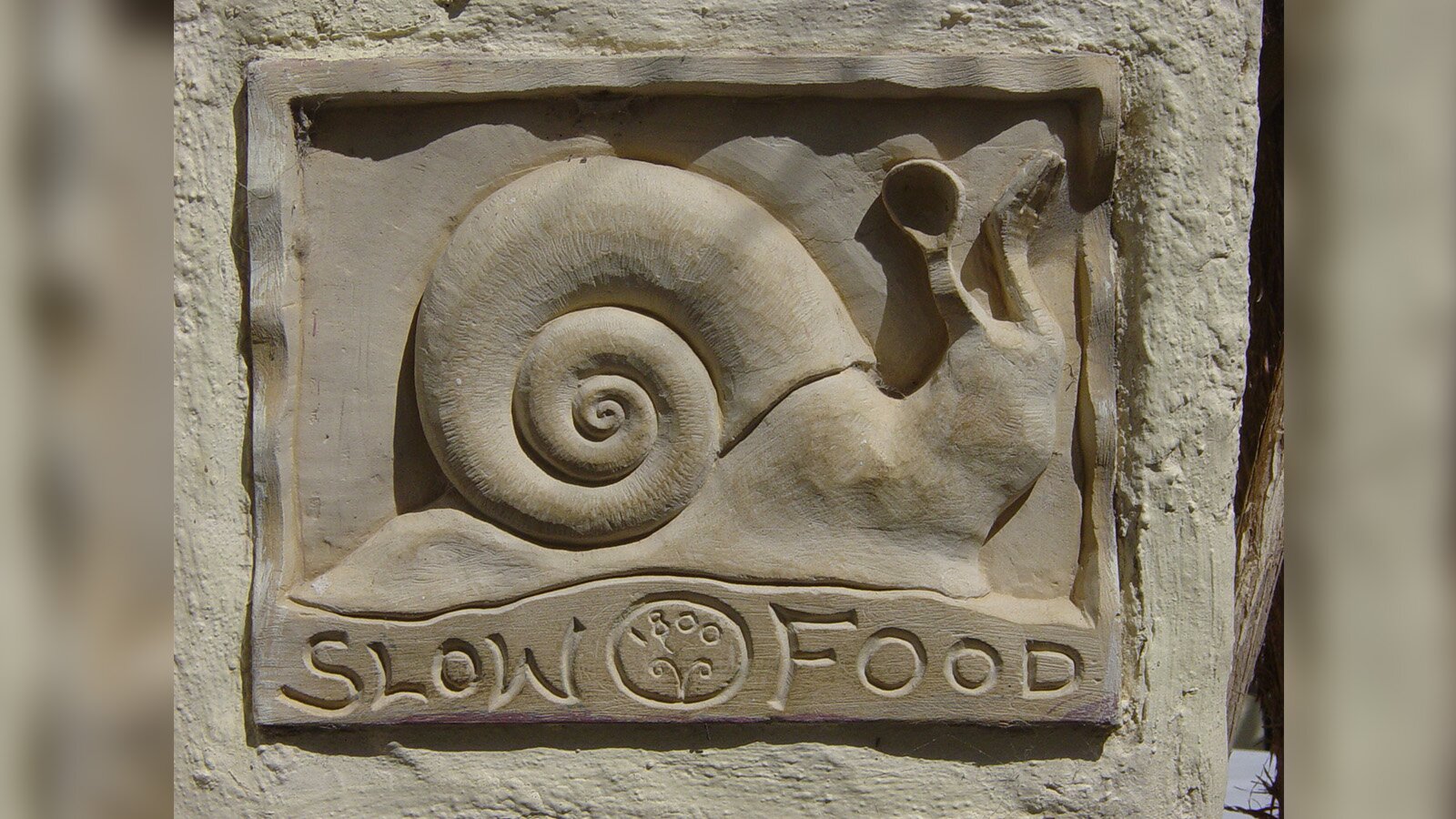
In this section, you are going to read about the Slow Food movement, its history, main ideas and activities. The picture, taken from a front of a local restaurant in Greece, shows the Slow Food logo – a happy snail taking its time when eating! What about you? Do you prefer to have a quick bite or slowly savour your meal?
W tej sekcji przeczytasz o organizacji Slow Food. Poznasz jej historię, główne założenia i aktywności. Poniższe zdjęcie zostało zrobione przed lokalną restauracją w Grecji. Przedstawia logo ruchu Slow Food – wesołego ślimaka, któremu długo zajmuje pałaszowanie jedzenia! A ty? Wolisz posiłek serwowany na poczekaniu czy nieśpieszne delektowanie się potrawą?
RNLMfVgyWGSvJ
Zdjęcie przedstawia płaskorzeźbę z drewna, na której przedstawiony jest ślimak. Pod nim widoczny jest napis w języku angielskim: SLOW FOOD.
Slow Food logo
Logo organizacji Slow Food
Źródło: dostępny w internecie: https://wikipedia.org/wiki/Slow_Food#/media/Plik:SlowFoodThera06676.JPG [dostęp 16.02.2022], domena publiczna.
Exercise1
Rgy1yGKwdaYQO
Odpowiedz na pytania lub uzupełnij tekst. 1. When you are in a _________, fast food seems like a good option, but it’s really not., 2. We are facing the _________ pandemic, people around the world are getting more and more overweight., 3. We source our food only from __________ suppliers, so that it’s always fresh as it’s transported over short distances only., 4. Our movement aims to counteract _________change and protect the environment., 5. Our shop has a zero-______ policy, which means we attempt to reuse or recycle everything others would normally throw out., 6. Those dishes are part of the cultural ___________ of the region, the recipes are passed from generation to generation.
Odpowiedz na pytania lub uzupełnij tekst. 1. When you are in a _________, fast food seems like a good option, but it’s really not., 2. We are facing the _________ pandemic, people around the world are getting more and more overweight., 3. We source our food only from __________ suppliers, so that it’s always fresh as it’s transported over short distances only., 4. Our movement aims to counteract _________change and protect the environment., 5. Our shop has a zero-______ policy, which means we attempt to reuse or recycle everything others would normally throw out., 6. Those dishes are part of the cultural ___________ of the region, the recipes are passed from generation to generation.
Źródło: GroMar Sp. z o.o., licencja: CC BY-SA 3.0.
Read the text and do the exercise(s) below.
Slow Food - a Revolution or Back to Basics?
Tomasz WiśniewskiSlow Food - a Revolution or Back to Basics?
What is Slow FoodSlow Food (organisation)Slow Food? In short, it is a movement that advocatesadvocates [advocate]advocates enjoying food and embracingembracingembracing its preparation and consumption. It is about a slow, calm and mindful approach to eating, and about giving it all the necessary attention. So, in other words, it is everything that fast food isn’t. The movement started in Italy as a protest against fast‑food chainsfast‑food chains [fast food chain]fast‑food chains setting up in the heart of historic Rome. Its philosophy is to slow down and appreciate the time we spend with food and consequently resist the encroachment of fast foodresist the encroachment of fast foodresist the encroachment of fast food restaurants. Its followers say „no” to the homogenisation and globalisation of food productionhomogenisation and globalisation of food productionhomogenisation and globalisation of food production and instead savoursavoursavour the precious moments when we engageengage engage with food, taste it and smell it, eat and drink, and at the same time spend quality timequality timequality time among the people we love.
Slow food is not only a way of life, it’s also an organisation that embraces traditional cuisine and locally sourced ingredients. One of its ideas is the ‘Ark of TasteArk of TasteArk of Taste’, a cataloguecataloguecatalogue of local culinary traditionslocal culinary traditions [local culinary tradition]local culinary traditions, regional foodsregional foods [regional food]regional foods and unique heritageheritageheritage of each region, along with its original dishes and specific spices. The Slow Food organisation also cares for the stories and knowledge tied to their preparation. This way, it promotes gastronomic individualitygastronomic individualitygastronomic individuality of regional foods and their flavoursomeflavoursomeflavoursome specifics (as opposed to uniform fast‑food chains and their blandblandbland flavours). However, most importantly, it draws attention to the risk of their extinctionextinctionextinction and the need for their protection.
Education
In addition to promoting local slow foodslow foodslow food, the organisation engages in a wide range of educational activities and projects, promoting the idea of a varied dietvaried dietvaried diet to counter the problems connected to the obesity pandemicobesity pandemicobesity pandemic and the amounts of fats and sugars in processed food. One of its main ideas is taste educationtaste educationtaste education, based on training the senses. It also teaches about eco‑gastronomyeco‑gastronomyeco‑gastronomy, in which eating is in tune with sustainabilitysustainabilitysustainability and low‑wastelow‑wastelow‑waste ideas. It thus reminds us that food and our planet are connected and our culinaryculinaryculinary choices impact the health of both the environment and society. Other slow food activities include teaching how to set up food gardensfood gardens [food garden]food gardens and utilise compost binscompost bins [compost bin]compost bins so that food waste goes back to the ecosystem, feeding vegetable patches and other plants. According to the slow food vision, their concept of food is defined by three interconnectedinterconnectedinterconnected principles: good, clean and fair. ‘Good’ stands for high‑quality and healthy food; ‘clean’ relates to food production that does not harm the environment; finally, ‘fair’ advocates accessible prices for consumers and fair conditions and pay for producers.
Structure
The slow food organisation operates in over 160 countries, and it is organisationally divided into so‑called conviviaconvivia [convivium]convivia. Currently, there are around 1,600 of them around the world. A single conviviumconvivia [convivium]convivium is a local group that organises slow food events and spreads the philosophy throughoutthroughoutthroughout the local community. If you want to know more, try to find the local convivium around where you live, and get in touch!
1 Źródło: Tomasz Wiśniewski, licencja: CC BY-SA 3.0.
R1IYjY9z9Bl9a
Exercise2
Read the text above and choose the correct answer. There is only one correct answer in each point. 1. Slow food does not promote
a) mindfulness towards food.
b) embracing quick preparation of food.
c) being attentive to food.
2. The slow food movement was founded
a) in Italy as a fast food chain.
b) as a countermovement to fast food restaurants.
c) to resist the growing network of local restaurants.
3. The Ark of Taste serves to
a) promote adding flavour and spices to dishes.
b) teach about food preservatives.
c) safeguard local culinary traditions that are threatened.
4. One of the educational projects of slow food is aimed at
a) preventing unhealthy eating.
b) teaching about plant extinction.
c) teaching culinary recipes.
5. Taste education is based on
a) stimulating smell and taste.
b) setting up waste disposal.
c) growing plants.
6. The concept of fair food is about
a) healthy eating.
b) protecting ecosystems.
c) spreading awareness about trade equality.
7. The role of a convivium is not to
a) organise local activities.
b) share the ideas of the slow food movement.
c) prepare food for the local community.
Read the text above and choose the correct answer. There is only one correct answer in each point. 1. Slow food does not promote
a) mindfulness towards food.
b) embracing quick preparation of food.
c) being attentive to food.
2. The slow food movement was founded
a) in Italy as a fast food chain.
b) as a countermovement to fast food restaurants.
c) to resist the growing network of local restaurants.
3. The Ark of Taste serves to
a) promote adding flavour and spices to dishes.
b) teach about food preservatives.
c) safeguard local culinary traditions that are threatened.
4. One of the educational projects of slow food is aimed at
a) preventing unhealthy eating.
b) teaching about plant extinction.
c) teaching culinary recipes.
5. Taste education is based on
a) stimulating smell and taste.
b) setting up waste disposal.
c) growing plants.
6. The concept of fair food is about
a) healthy eating.
b) protecting ecosystems.
c) spreading awareness about trade equality.
7. The role of a convivium is not to
a) organise local activities.
b) share the ideas of the slow food movement.
c) prepare food for the local community.
Źródło: GroMar Sp. z o.o., licencja: CC BY-SA 3.0.
R14W7UVAMAwRX
Exercise3
Read the text about the slow food movement above. Then, drag and drop the words to match them with their definitions. 1. promote and advertise – 1. encroachment, 2. compost bins, 3. homogenisation, 4. extinction, 5. advocate, 6. heritage, 7. obesity pandemic
2. uncontrollable spread – 1. encroachment, 2. compost bins, 3. homogenisation, 4. extinction, 5. advocate, 6. heritage, 7. obesity pandemic
3. traditions and passed knowledge – 1. encroachment, 2. compost bins, 3. homogenisation, 4. extinction, 5. advocate, 6. heritage, 7. obesity pandemic
4. dying out – 1. encroachment, 2. compost bins, 3. homogenisation, 4. extinction, 5. advocate, 6. heritage, 7. obesity pandemic
5. the global tendency to become fat – 1. encroachment, 2. compost bins, 3. homogenisation, 4. extinction, 5. advocate, 6. heritage, 7. obesity pandemic
6. containers for rotten vegetables – 1. encroachment, 2. compost bins, 3. homogenisation, 4. extinction, 5. advocate, 6. heritage, 7. obesity pandemic
7. a process of diverse things becoming similar – 1. encroachment, 2. compost bins, 3. homogenisation, 4. extinction, 5. advocate, 6. heritage, 7. obesity pandemic
Read the text about the slow food movement above. Then, drag and drop the words to match them with their definitions. 1. promote and advertise – 1. encroachment, 2. compost bins, 3. homogenisation, 4. extinction, 5. advocate, 6. heritage, 7. obesity pandemic
2. uncontrollable spread – 1. encroachment, 2. compost bins, 3. homogenisation, 4. extinction, 5. advocate, 6. heritage, 7. obesity pandemic
3. traditions and passed knowledge – 1. encroachment, 2. compost bins, 3. homogenisation, 4. extinction, 5. advocate, 6. heritage, 7. obesity pandemic
4. dying out – 1. encroachment, 2. compost bins, 3. homogenisation, 4. extinction, 5. advocate, 6. heritage, 7. obesity pandemic
5. the global tendency to become fat – 1. encroachment, 2. compost bins, 3. homogenisation, 4. extinction, 5. advocate, 6. heritage, 7. obesity pandemic
6. containers for rotten vegetables – 1. encroachment, 2. compost bins, 3. homogenisation, 4. extinction, 5. advocate, 6. heritage, 7. obesity pandemic
7. a process of diverse things becoming similar – 1. encroachment, 2. compost bins, 3. homogenisation, 4. extinction, 5. advocate, 6. heritage, 7. obesity pandemic
Źródło: GroMar Sp. z o.o., licencja: CC BY-SA 3.0.
Exercise4
Read the text above. Then, answer the following questions using three sentences. Use as many words from the reading passage as you can.
What do you understand by slow food?
RyrFudrha8GNW
(Uzupełnij).
Źródło: GroMar Sp. z o.o., licencja: CC BY-SA 3.0.
Show hintazurewhite
In my understanding… It’s a philosophy that… and…
Show answerazurewhite
In my understanding, slow food is about fighting for our health and for the value of our time. It’s a philosophy that advocates slowing down and educates on how to do it, showing the local community the practices that are beneficial to ourselves and to our planet.
What are the advantages of slow food over fast food?
R8tuim4YtfOYG
(Uzupełnij).
Źródło: GroMar Sp. z o.o., licencja: CC BY-SA 3.0.
Show hintazurewhite
One of the obvious advantages of slow food over fast food is… Another benefit is that it is… Thirdly, slow food embraces…
Show answerazurewhite
One of the obvious advantages of slow food over fast food is the multitude of flavours that come from home‑cooked, organic, locally sourced ingredients in comparison with the bland taste of processed food offered by chains. Another benefit is that it is healthy and contributes to our well‑being. Thirdly, slow food embraces local cuisine and local traditions and advocates a fair treatment of local food vendors in opposition to corporations that often exploit local producers.
What can you do to change your unhealthy food habits according to the slow food philosophy?
RwqJX8s82Ltax
(Uzupełnij).
Źródło: GroMar Sp. z o.o., licencja: CC BY-SA 3.0.
Show hintazurewhite
First of all… Secondly, I can try to… Thirdly,
Show answerazurewhite
First of all, I can stop, or at least cut down on eating fast food. Secondly, I can try to cook at home with foods bought at the local market that are more healthy and nutritious, and also support the local economy. Thirdly, I can try to slow down and approach food mindfully, and take time to appreciate it.
Would you join a convivium in your local community? Why/Why not?
R1AJHwGgNEAAw
(Uzupełnij).
Źródło: GroMar Sp. z o.o., licencja: CC BY-SA 3.0.
Show hintazurewhite
I would be happy to join a convivium… The movement sounds very interesting and… Moreover, I would love to attend… I am not familiar with… and I would love to…
Show answerazurewhite
I would be happy to join a convivium in my city. The movement sounds very interesting and supports the same causes that I do, namely, low‑waste, fair‑trade and planet‑friendly concepts. Moreover, I would love to attend some events that aim to celebrate the food from around my area. I am not familiar with my local food heritage and would love to find out about it.
an approach to consumption that aims to get a healthier and more sustainable food and, at the same time, to reduce the impact of food production on the environment
organizacja Slow Food (ruch społeczny skupiający osoby zainteresowane ochroną tradycyjnej kuchni i praktyk związanych z żywnością z różnych regionów świata)
an organisation that promotes local food and traditional cooking