Przeczytaj
Shops tempt us with a great variety of food products, all beautifully packed and ready to grab and consume. Food producers reassure us that all their products are high quality and safe. However, it’s not a secret that most of the food products are highly processed and so of low nutritional value. Can you make informed decisions about what you eat? Do you know what substances hide behind the most common E‑numbers on food labels? Can you differentiate between processed and ultra‑processed food?
Półki sklepowe kuszą nas ogromną ilością pięknie opakowanych produktów, a producenci żywności zapewniają o wysokiej jakości i bezpieczeństwie oferowanych przez siebie przekąsek. Nie jest jednak tajemnicą, że większość tej żywności jest wysokoprzetworzona, i dlatego cechuje się niską wartością odżywczą. Potrafisz podejmować świadome decyzje dotyczące tego, co jesz? Wiesz, jakie substancje kryją się za najczęściej spotykanymi numerami E na etykietach? Czy potrafisz odróżnić żywność przetworzoną od wysokoprzetworzonej?
Read the text and find out what are some food additives commonly used in food production.
Food Additives - Friends or Foes?
PreservativesPreservatives, emulsifiersemulsifiers and synthetic colourantscolourants are prevalentprevalent in food we consume these days. In recent decades, people’s awareness of what they put on their plates has increased enormously. We want to know more to be able to make informed decisionsinformed decisions about products we buy and consume. This trend is reflected in actions undertaken by relevant authorities. For example, the European Food Safety Authority (EFSA) has recently stated that the toxicity oftoxicity of food additivesadditives evaluated before 2009 must now be re‑evaluated in the light of current scientific knowledge. Do you read labels on food products? If you feel confused by the hard‑to‑pronounce names of chemical compoundschemical compounds and what’s behind them, let us walk you throughwalk you through the most common food additives.
The mysterious E‑numbers
E stands for Europe. The E‑numbers list was created by regulatorsregulators in the 1960s and it comprises codes for substances used as food additives. Some of them are natural, like vitamin C (E300) or agaragar (E406), others are synthetic, for example amaranth (E123) and sodium citratesodium citrate (E316). Their function is to enhance the taste, texture and appearanceenhance the taste, texture and appearance of food. E‑numbers are often vilifiedvilified and used synonymously with all harmful substances in food. You should remember that the list only includes chemical compounds that have been thoroughly tested and approved to be used in foods. Companies promoting their products as “free of E‑numbers” are simply using a marketing gimmickmarketing gimmick on you. However, regulations regarding which substances and especially how much of them can be used vary between countries and depend on how local authorities assess the potential toxicity of them. It’s worth knowing what different E‑numbers refer to, for instance numbers 200 to 299 are preservativespreservatives, which prevent microbes from growing in food and making consumers sick. Your most important rule should be to go for products with as short lists of ingredients as possible.
Number range
Additive type
100‑199
Food colours
200‑299
Preservatives
300‑399
AntioxidantsAntioxidants
400‑499
ThickenersThickeners, emulsifiers and stabilisersstabilisers
500‑599
Acidity regulatorsAcidity regulators and anti‑caking agentsanti‑caking agents
600‑699
Flavour enhancersFlavour enhancers
700‑799
SweetenersSweeteners, foaming agentsfoaming agents and gases
Sugar – your worst enemy?
Sugar takes the blame for a great number of medical issues of the contemporary world. ObesityObesity, tooth decaytooth decay or cardio‑vascular diseasescardio‑vascular diseases are all linked to the overconsumptionoverconsumption of the white crystals, which some decades ago used to be an occasional treat and now have become ubiquitousubiquitous in 80% of food products we eat on a daily basis. No wonder people started to look for sugar substitutessugar substitutes, not wanting to give up on the sweet taste. There are natural alternatives to sugar such as stevia leaves, honey or maple syrup. However, you should bear in mindbear in mind that many of them undergo refining processes before they end up on your table. On the other hand, there are artificial sweeteners such as aspartameaspartame (E951). Although people are rather cautious about everything labelled as artificial, much research confirms that artificial sweeteners are generally safe in limited quantities. Since sweeteners are usually 200 to 700 times sweeter than table sugar, you need much less to satisfy your sweet toothsweet tooth.
Processed or ultra‑processed?
Unless it’s an apple you have just picked from a tree, the food you’re eating is probably processed. Chopping, blending, baking, etc. are all classified as processing and although vegetables may lose some of their qualities when boiled, these processing methods do not usually have detrimental effectsdetrimental effects on consumers’ health. Ultra‑processing is quite a different story. Frozen meals, soft drinks, salty snacks and many other products all contain added ingredients and are made from substances extracted from food. They are full of fats and starches, saturated withsaturated with added sugars and artificial colours and flavours. If you don’t monitor your intake ofintake of such products, weight gain is the smallest problem you can expect. Numerous studies show clearly that an ultra‑processed diet makes people consume more carbohydrates and fat in comparison with people following an unprocessed diet.
Food industry in developed countries offers an almost limitless choice of products these days, all of them tempting us with a variety of flavours and smells. Research shows that we eat over two kilos of chemical food additives every year. It’s an unprecedentedunprecedented amount! There are two takeaway points from this story. Firstly, it’s entirely up to us how knowledgeable we are about what we eat. Secondly, the old adageadage “everything in moderationin moderation” seems to be still relevantseems to be still relevant.
Źródło: Anna Dutka, licencja: CC BY-SA 3.0.
a) more people are interested in what substances are added to food.
b) substances added to food nowadays are more toxic than in the past.
c) the state of knowledge about how toxic food additives are has changed.
d) more toxic substances are added to food nowadays.
2. E-numbers
a) are codes for names of substances of natural origin.
b) are wrongly considered to be detrimental to our health.
c) are codes for names of substances which can damage consumers’ health.
d) refer to different substances in different countries.
3. Why do some companies advertise their products as “E-free”?
a) To attract more customers.
b) To prove that their products are safe.
c) To warn customers against dangerous substances.
d) To help customers stick to their diets.
4. People want to replace table sugar with a substitute because
a) 80% of our diet should be sugar-free.
b) sugar alternatives are sweeter.
c) natural alternatives are tastier.
d) sugar leads to many health problems.
5. Ultra-processed food
a) is food that has been mechanically fragmented.
b) is food that does not lead to people putting on weight.
c) is food that contains many synthetic substances.
d) is food that has to be boiled before consumption.
Answer the questions. Write 2–3 sentences to each question.
How much attention do you pay to what you eat?
Do you try to stick to a balanced diet? Why? / Why not?
Do you read labels on the food products you buy? Do you understand what effect the different substances listed on the labels have on your health?
There are a lot of products containing E316, E250, E621, E450, E262, E331, E412. Imagine you’ve been served breakfast consisting of sausages, ketchup and toast bread. Write why you think it’s not the best choice of products to eat. Check the table in the text to help you. What would you rather eat for breakfast?
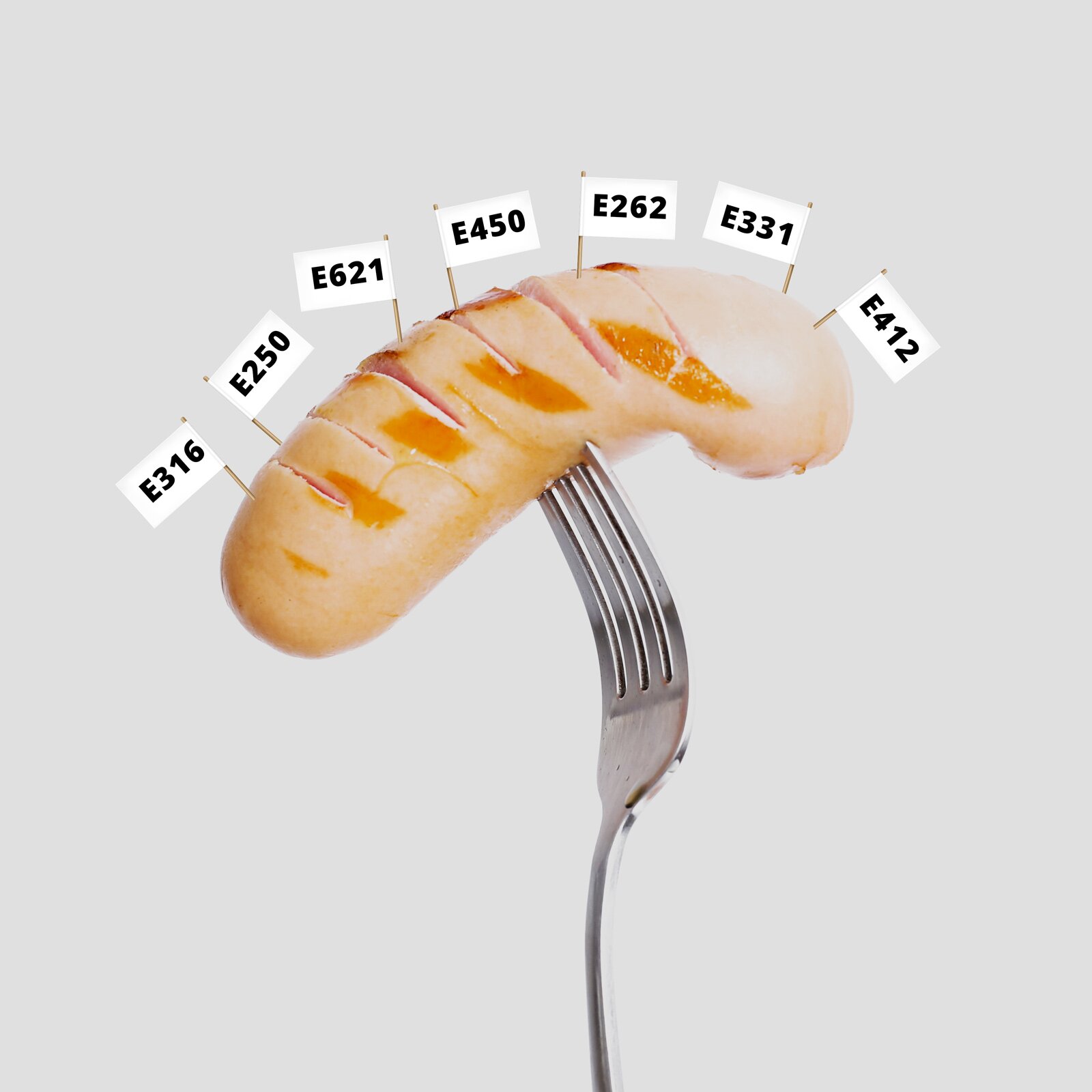
Look at the photo of a sausage above. Imagine you’ve been served breakfast consisting of sausages, ketchup and toast bread. Write why you think it’s not the best choice of products to eat. Can you figure out what categories of E‑numbers have been added to the sausage in the photo? Look at the table in the text to help you. What would you rather eat for breakfast?
Write 5‑6 sentences.
Słownik
/ əˈsɪdəti ˈreɡjʊleɪtəz / / əˈsɪdəti ˈreɡjʊleɪtə /
regulatory kwasowości (food additives used to change or maintain acidity or alkalinity)
/ ˈædɪdʒ /
powiedzenie (a saying)
/ ˈædətɪvz / / ˈædətɪv /
dodatki [dodatek] (any of a big group of substances which can be added for example to food)
/ ˈeɪɡə /
agar (a jelly‑like substance made of algae)
/ ˌænti ˈkeɪkɪŋ ˈeɪdʒənts / / ˌænti ˈkeɪkɪŋ ˈeɪdʒənt /
substancje przeciwzbrylające [substancja przeciwzbrylająca] (a substance added to finely powdered or crystalline food to prevent lumping)
/ ˌæntiˈɒksɪdənts / / ˌæntiˈɒksɪdənt /
przeciwutleniacze [przeciwutleniacz] (a substance which stops food products from decaying)
/ ˈæspərˌtem /
aspartam (an artificial non‑saccharide sweetener used as a sugar substitute in foods and beverages)
/ ˈbeər ɪn maɪnd /
uwzględnić coś, mieć coś w pamięci (consider)
/ ˈkɑːdiəʊ ˈvæskjʊlə dɪˈziːzɪz / / ˈkɑːdiəʊ ˈvæskjʊlə dɪˈziːz /
choroby układu krążenia [choroba układu krążenia] (a number of diseases affecting heart and blood vessels)
/ ˈkemɪkl̩ kəmˈpaʊndz / / ˈkemɪkl̩ kəmˈpaʊnd /
związki chemiczne [związek chemiczny] (natural or synthetic substances which consist of two or more chemical elements)
/ ˈkəʊtɪŋ ˈeɪdʒənt /
środek powlekający (a substance serving as a coating applied on the surfaces of food)
/ ˈkʌlərənts / / ˈkʌlərənt /
barwniki [barwnik] (a substance that is used to put colour in something)
/ ˌdetrɪˈmentl̩ ɪˈfekts / / ˌdetrɪˈmentl̩ ɪˈfekt /
szkodliwe skutki [szkodliwy skutek] (having a damaging effect on something or someone)
/ ˌɪˈməlsəˌfaɪəz / / ˌɪˈməlsəˌfaɪə /
emulgatory [emulgator] (a kind of additive which helps two or more liquids mix)
/ ɪnˈhɑːns ðə teɪst ˈtekstʃər ənd əˈpɪərəns /
polepszyć smak, konsystencję i wygląd (to improve the flavour, thickness and the look)
/ ˈfleɪvər ɪnˈhɑːnsəz / / ˈfleɪvər ɪnˈhɑːnsə /
wzmacniacze smaku [wzmacniacz smaku] (a substance used to boost the taste of a food or drink)
/ ˈfəʊmɪŋ ˈeɪdʒənts / / fəʊ /
środki spieniające [środek spieniający] (a substance added to food which makes the formation of foam easier)
/ fəʊz / / fəʊ /
wrogowie [wróg] (enemy)
/ ɡwɑː ɡʌm /
guma guar (a natural thickening agent derived from the guar bean)
/ ɪn ˌmɒdəˈreɪʃn̩ /
z umiarem (not too much, in reasonable amounts)
/ ɪnˈfɔːmd dɪˈsɪʒn̩z / / ɪnˈfɔːmd dɪˈsɪʒn̩ /
świadome decyzje [świadoma decyzja] (decision taken based on knowledge and understanding of relevant facts)
/ ˈɪnteɪk ɒv /
spożycie czegoś (the amount of food consumed at a given time)
/ ˈlɛsɪthetaɪn /
lecytyna
/ ˈmɑːkɪtɪŋ ˈɡɪmɪk /
chwyt marketingowy (a trick a company can use to persuade customers to buy its products)
/ əʊˈbiːsɪti /
otyłość (the state of being heavily overweight)
/ ˈəʊvəkənˌsəmpʃən /
nadmierna konsumpcja (consuming too much food, drink, or other substances)
/ prɪˈzɜːvətɪvz / / prɪˈzɜːvətɪv /
konserwanty [konserwant] (substances used to prolong food life)
/ ˈprevələnt /
powszechnie występujący/występująca, rozpowszechniony/rozpowszechniona (widespread)
/ ˈreɡjʊleɪtəz / / ˈreɡjʊleɪtə /
organy nadzoru [nadzór] (a person or organisation setting standards of practice, especially those established by law)
/ ˈsætʃəreɪtɪd wɪð /
nasycony/nasycona czymś (containing as much of a substance as it is possible)
/ ˈsiːmz tu bi ˈstɪl ˈreləvənt / / siːm tu bi ˈstɪl ˈreləvənt /
wydaje się wciąż aktualne [wydawać się wciąż aktualnym] (appear to make sense now as much as it did in the past)
/ ˈsəʊdɪəm ˈsɪtrɪt /
cytrynian sodu (organic chemical compound that is used as a flavouring and preservative food additive)
/ ˈsteɪbəlaɪzəz / / ˈsteɪbəlaɪzə /
stabilizatory [stabilizator] (a substance which helps to keep food products in a stable form)
/ ˈsteɪpᵊl miːl /
podstawowy posiłek
/ ˈstiːvɪə /
stewia (także stevia) (a natural substance used as a sugar substitute to sweeten drinks and other food products)
/ ʃʊgə ˈsʌbstɪtjuːts / / ʃʊgə ˈsʌbstɪtjuːt /
zastępniki cukru [zastępnik cukru] (a substance that we use instead of sugar)
/ ˈswiːtnəz / / ˈswiːtnə /
słodziki [słodzik] (a substance used as a sugar substitute to sweeten drinks and other food products)
/ ˈswi:t tuːtheta /
słabość do słodyczy (to like sweets very much)
/ ˈthetaɪkənəz / / ˈthetaɪkənə /
zagęstniki [zagęstnik] (a substance which improves firmness of food products, especially the liquid ones)
/ tuːtheta dɪˈkeɪ /
próchnica (a common health problem when your teeth develop tiny openings which can lead to serious infections)
/ tɒkˈsɪsɪti ɒv /
toksyczność czegoś (the quality of being very harmful or poisonous)
/ juːˈbɪkwɪtəs /
wszechobecny/wszechobecna (present everywhere)
/ ʌnˈpresɪdentɪd /
niespotykany/niespotykana, bezprecedensowy/bezprecedensowa (never encountered before)
/ ˈvɪlɪfaɪd / / ˈvɪlɪfaɪ /
oszkalowany/oszkalowana [szkalować] (with damaged reputation because of bad information spread about him/her or it)
/ wɔːk ˈsʌmbədi thetaruː ˈsʌmthetaɪŋ /
przeprowadzać kogoś przez coś (to carefully explain something to someone)